Furoshiki Gift Wrap: Eco-Friendly Ideas for 2026
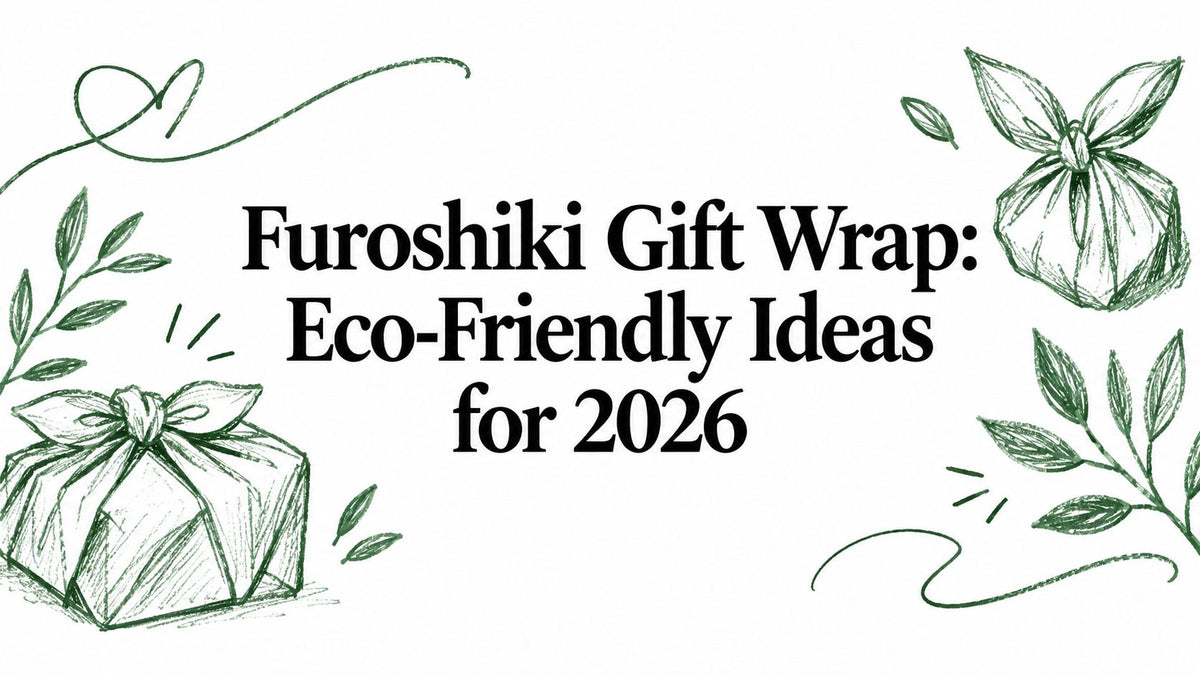
You've arrived at a birthday dinner with a matcha tin in one hand and a roll of torn wrapping paper in the other. The paper has creased at the corners, the tape is showing, and you already know the wrapping will be thrown away before dessert. Furoshiki gift wrap offers a calmer alternative: the wrapping becomes part of the present, then continues into the recipient's home.
Table of Contents
- What Furoshiki Is and Why It Works for Gifting
- The Origins of Furoshiki as Everyday Wrapping
- Two Core Furoshiki Knots You Will Use Again and Again
- Choosing the Right Fabric for Your Wraps
- When Furoshiki Beats Paper and When It Does Not
- Sizing Your Cloth to the Gift
- Reuse, Aftercare, and Gifting It Forward
What Furoshiki Is and Why It Works for Gifting
Furoshiki is a nearly square piece of cloth folded and knotted around an object. It doesn't need adhesive tape, a cardboard box, or a perfect paper fold. The cloth holds the gift through tension, overlapping corners, and a balanced knot.
That makes it a repeatable skill rather than a craft project you complete once. The same square might hold a tea tin this week, a bottle of sake next month, and folded clothing after that. It can also become a shopping bag, a storage cloth, or a way to carry objects around the home.
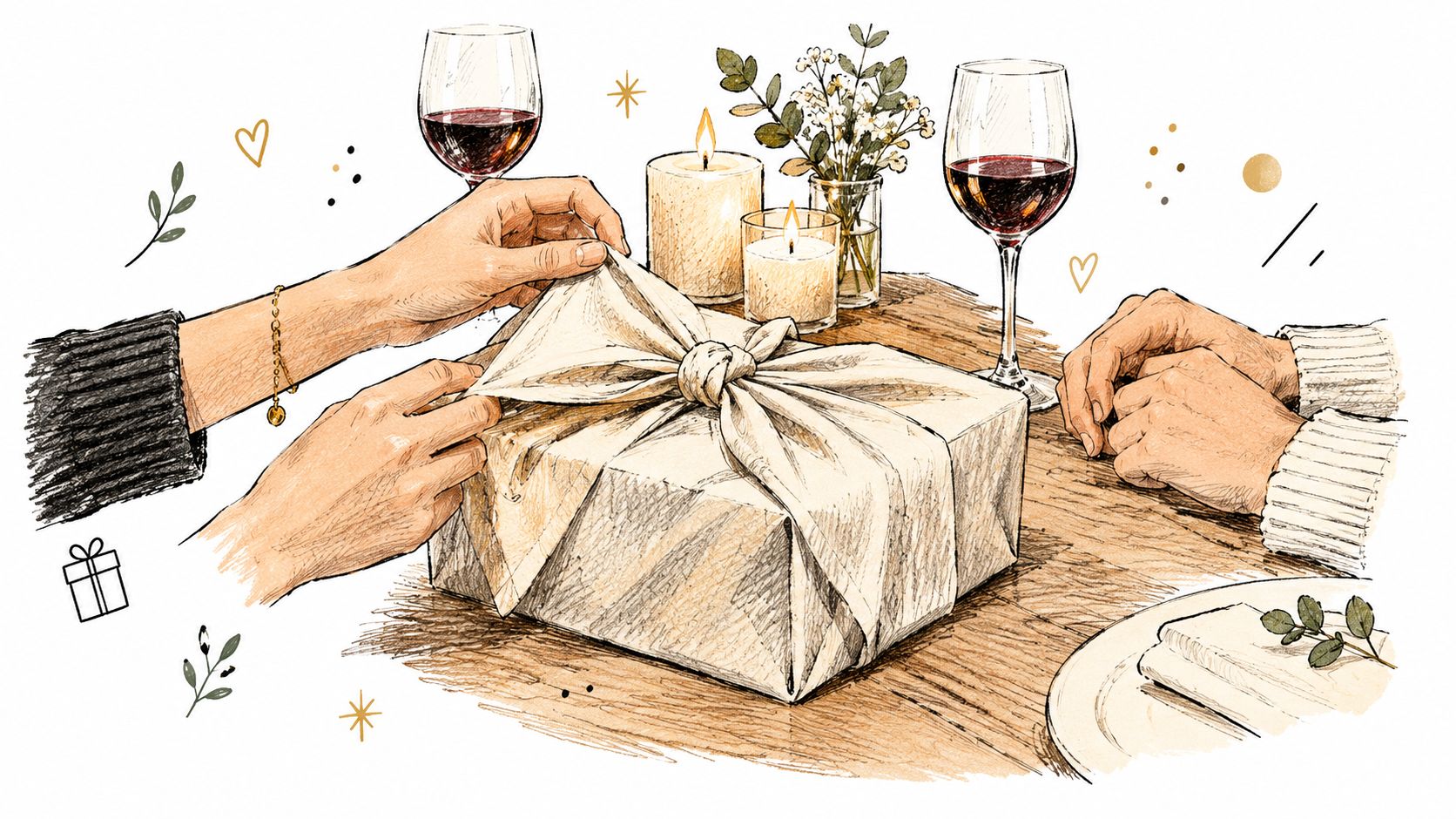
Wrapping that remains useful
The value is not only visual. ABC News describes furoshiki as a practice connected with the three Rs, reduce, reuse, and recycle, and notes that the recipient keeps a usable piece of fabric after opening the gift. That changes the moment of unwrapping. Instead of tearing through a disposable layer, the recipient loosens a knot and discovers a second useful item.
Australia's seasonal wrapping habits show why this matters. Australians used approximately 8,000 tonnes of wrapping paper annually, according to ABC News' report on furoshiki. Business Victoria has also stated that Australians used more than 150,000 kilometres of wrapping paper during each festive season, enough to circle the globe four times. Those figures provide context for the material stream, not proof that furoshiki has already prevented a measured amount of waste.
A home giver can use the method for birthdays and quiet holiday mornings. A business can use it for client gifts or team events. If you're preparing a ceremonial matcha tea set, the cloth can make the presentation feel considered while giving the recipient something they can use after the tea has been enjoyed.
Practical rule: Treat the cloth as part of the gift, not as packaging that disappears when the box opens.
The Origins of Furoshiki as Everyday Wrapping
A square of cloth makes more sense when you understand what it was designed to do. It wasn't created only for decorative presentation. Cloth could cover an object, gather around it, and become a carrying surface without requiring string, glue, or a rigid container.
The Japanese Government connects cloth wrapping for valuable objects with the Nara period, from 710 to 794, while wider public use developed during the Edo period, from 1603 to 1867. At public bathhouses, people bundled clothing and belongings in cloth so they wouldn't be confused with another bather's possessions. The same logic suited travel and everyday carrying.
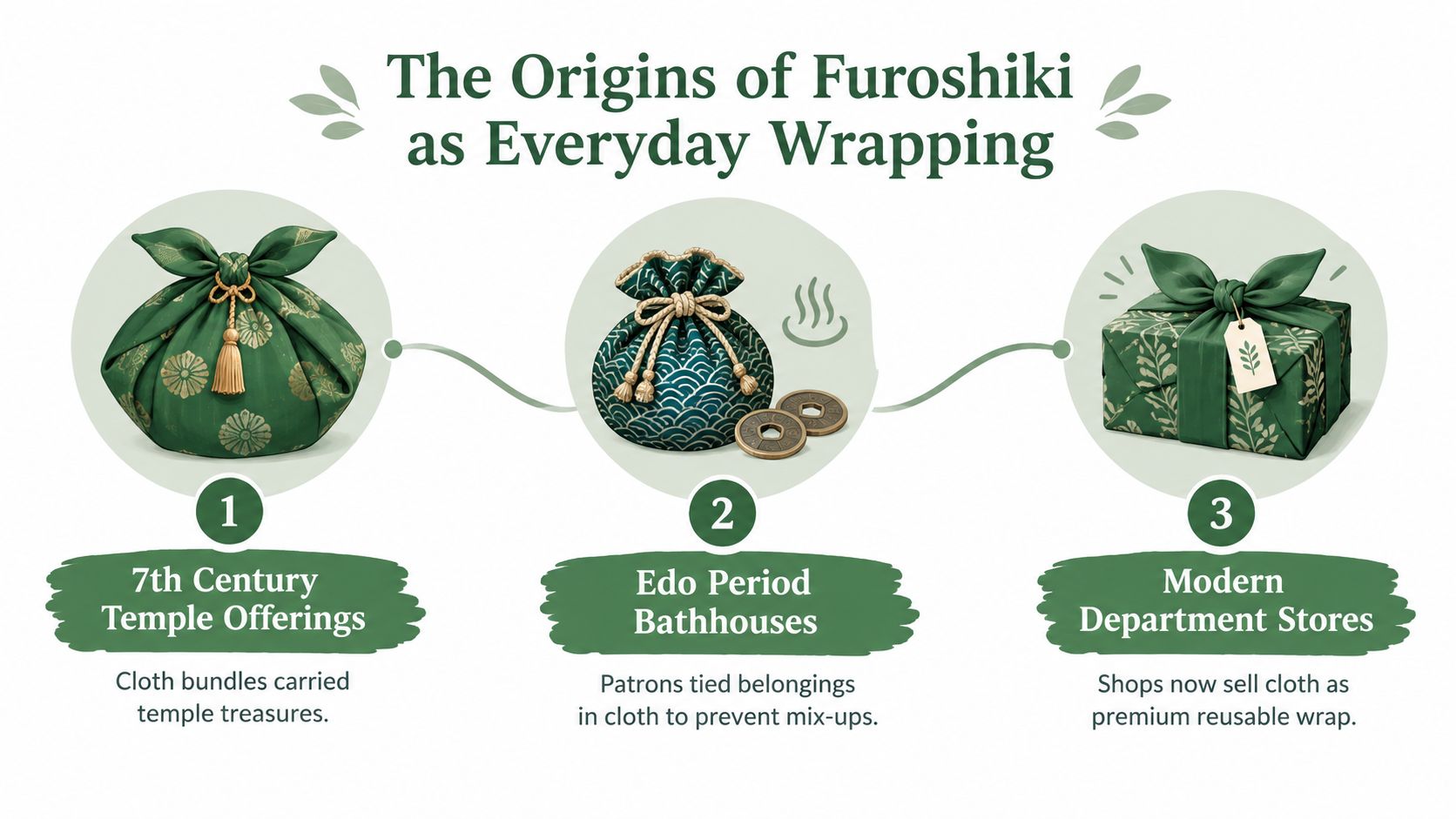
From practical bundle to considered gift
The square shape creates a flexible relationship between cloth and object. A small bundle can sit in the middle while the corners rise around it. A taller object can use the diagonal, giving the fabric more reach. A knot closes the arrangement, but the cloth remains ready to open and use again.
Australia has its own documented connection with these objects. The Australian War Memorial records a Japanese rayon furoshiki acquired during the Aitape-Wewak campaign in New Guinea on 26 June 1945 by Private Clifford George Le Claire of the 2/3 Australian Infantry Battalion. The cloth, found in a Japanese bunker, bears a central crimson Hinomaru design, the date 22 November 1939, the words “Osaka Army Hospital 3 Barracks Kanaoka”, and a dedication from comrades. Its history shows furoshiki serving practical purposes around food and equipment, not only decorative gifting.
A second Australian War Memorial record links a dark-blue commemorative furoshiki associated with Lieutenant Keiu Matsuo to a poem written by his mother after visiting Sydney in 1968. These records place the object in Australian wartime and intercultural memory, as documented by the Australian War Memorial collection record.
That history also helps explain why a cloth wrap suits a Japanese tea gift. Whether you're giving a small matcha set or Premium Sweet Matcha 200g, the wrap carries the object before becoming useful in its own right. You can find more context on seasonal customs in how Japanese people celebrate Christmas, but the central lesson is simple: furoshiki has always joined presentation with practical use.
Two Core Furoshiki Knots You Will Use Again and Again
Start with a clean, square cloth on a flat surface. Put the pattern side down if one side is more decorative, then smooth the fabric with your palms. Creases trapped beneath the gift will become bulky folds, and a slippery wrinkle can pull one corner shorter than the other.
For a boxed gift, use a cloth approximately 70 cm by 70 cm for an item around 20 cm across, as demonstrated by Japan Foundation Sydney. Place the gift centrally on the diagonal, so one corner points towards you and the opposite corner points away. Bring the near and far corners over the box, keeping the folds flat, then make a flat double knot.
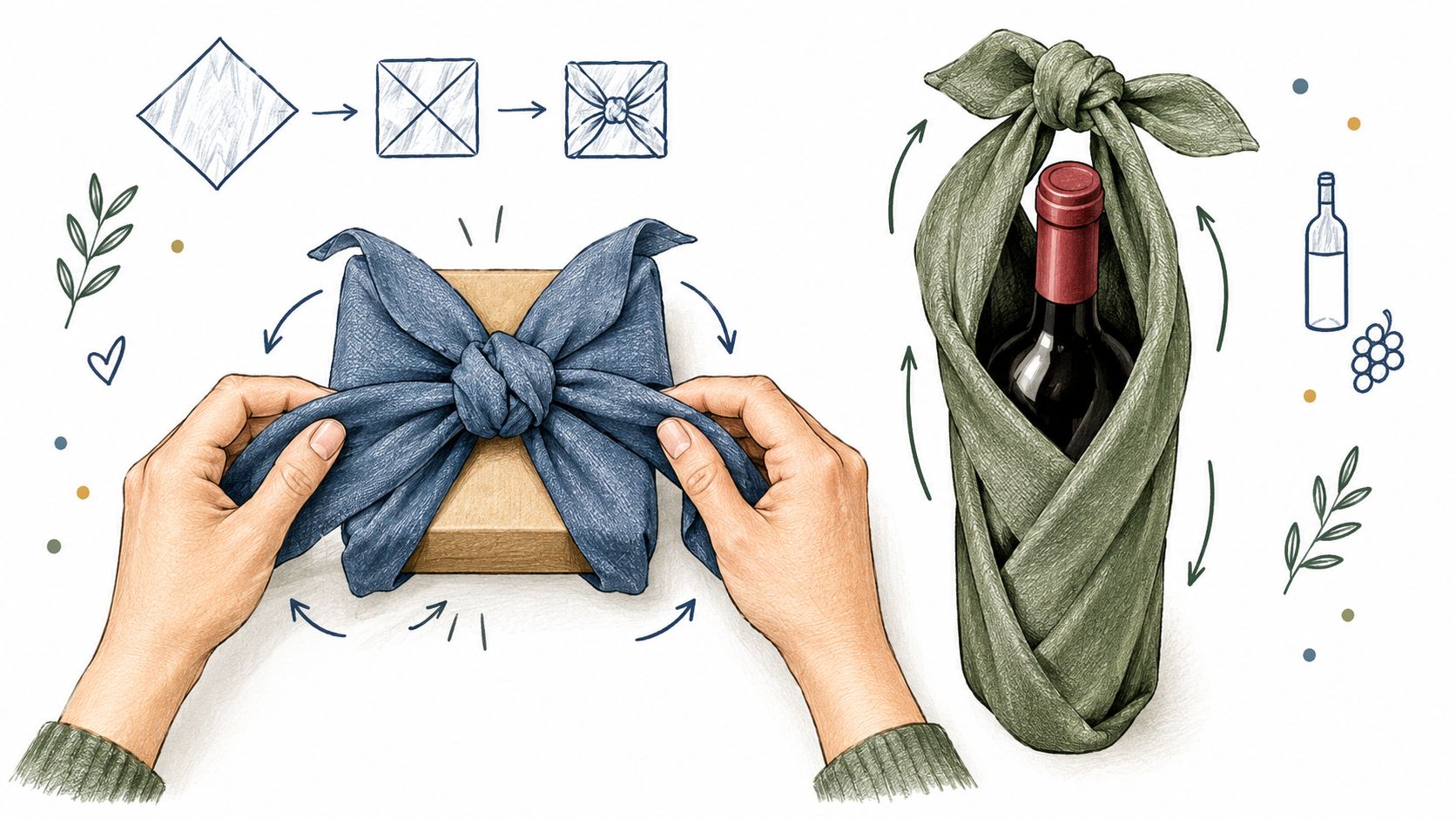
The balanced square wrap
The remaining corners should rise naturally from the sides of the box. Pull them upwards rather than towards one another across the lid. When the fabric feels evenly tensioned, tie a second balanced knot above the first.
You're looking for a firm hold, not a compressed package. If the knot sits off-centre, the gift may slide towards the shorter side. If the corners fall short, the cloth is too small for the object. If too much fabric gathers at the base, flatten the folds and retie before pulling harder.
The Australian hardware guide's furoshiki method recommends flattening the fabric, centring the item, folding opposite corners, then folding the remaining corners and finishing by tying and tucking the ends. That sequence keeps the wrap symmetrical and reduces rework.
For a bottle, place it diagonally across the cloth, with the base near one corner and the neck pointing towards the opposite corner. Fold the lower corner over the bottle, bring the side corners around it, and tie them above the bottle's centre of gravity. The second knot should sit securely without pressing on the cap or seal.
The movements are easier to understand when you can watch the fabric travel around both shapes.
Small adjustments prevent most failures
A knot that looks loose often needs better alignment, not more force. Hold the two ends at equal height, pull the fabric smooth, and tie with the same tension on both sides. For fragile tea tins, keep the knot clear of the lid so the pressure lands on the cloth rather than the seal.
Once your hands learn the feel of a square wrap and a bottle carry, decorative variations become easier. The foundation remains the same: a large enough diagonal, smooth fabric, even tension, and two knots that sit in balance.
Choosing the Right Fabric for Your Wraps
Your first cloth should help you learn. A fabric that grips lightly, folds without fighting you, and survives regular washing will be more useful than a delicate textile that looks beautiful but slips open.
Cotton is the most forgiving starting point. It holds a knot reliably, handles repeated folding, and suits boxed gifts, books, and tea accessories. Linen gives a softer, more textured appearance, though it may need ironing if you want crisp corners. Silk creates an elegant finish, but its smooth surface can slide under a heavy or tall gift.
Reclaimed fabric adds another layer of meaning. A clean old tablecloth, scarf, or garment can become a wrap rather than going straight to disposal. The City of Joondalup specifically suggests making Japanese fabric wrapping from old garments or fabric sourced through opportunity shops, which offers an accessible Australian way to source the cloth.
Fabric choices at a glance
| Fabric | Knot grip | Care | Best for |
|---|---|---|---|
| Cotton | Reliable and forgiving | Machine washable, depending on finish | First wraps, boxes, tea tins |
| Linen | Moderate, with natural texture | Often benefits from ironing | Flat gifts and refined presentation |
| Silk | Smooth and less secure under load | Gentle washing or specialist care | Light gifts and special occasions |
| Reclaimed tablecloth or clothing | Varies with weave and condition | Check fibre and wash before use | Meaningful, low-purchase gifting |
| Recycled synthetic fabric | Can be smooth or firm | Usually durable, follow the care label | Lightweight gifts and frequent reuse |
Avoid fabric that is too thin for the object or too slippery for your knot. A large cloth isn't automatically better if it creates heavy folds and leaves the package difficult to hold. Conversely, a beautiful small square will frustrate you if its corners can't overlap securely.
A good first choice is a washable cotton square with enough texture to hold a double knot.
Look in opportunity shops, use clean household textiles, ask local makers about offcuts, or choose pre-cut squares from Japanese textile retailers. For your first three wraps, prioritise grip, washability, and sufficient size. Save silk or highly decorative cloth for a gift whose shape and weight you already understand.
When Furoshiki Beats Paper and When It Does Not
Reusable cloth isn't automatically the greener choice. Its advantage depends on what happens after the knot is untied. If a newly purchased textile is used once, washed frequently, transported long distances, and then forgotten, the environmental story is less straightforward than the phrase “eco-friendly wrapping” suggests.
Sustainability Victoria reports that Australians discard about 1.9 million tonnes of packaging annually, enough to fill the Melbourne Cricket Ground nine times. That makes packaging reduction important, but it doesn't remove the need to consider the cloth itself. A durable textile, low-impact laundering, and repeated use give furoshiki a stronger case than a fragile fabric intended for a single presentation.
Australia's packaging system also complicates the paper-versus-cloth comparison. Australian Packaging Covenant Organisation data records average packaging consumption falling from 264 kg per person in 2022–23 to 251 kg in 2023–24, with 86% of packaging classified as reusable, recyclable, or compostable. The same source records 1.3 million tonnes of paper and paperboard going to landfill. These figures show why paper recovery matters, while also showing that recyclable packaging doesn't always stay out of landfill.
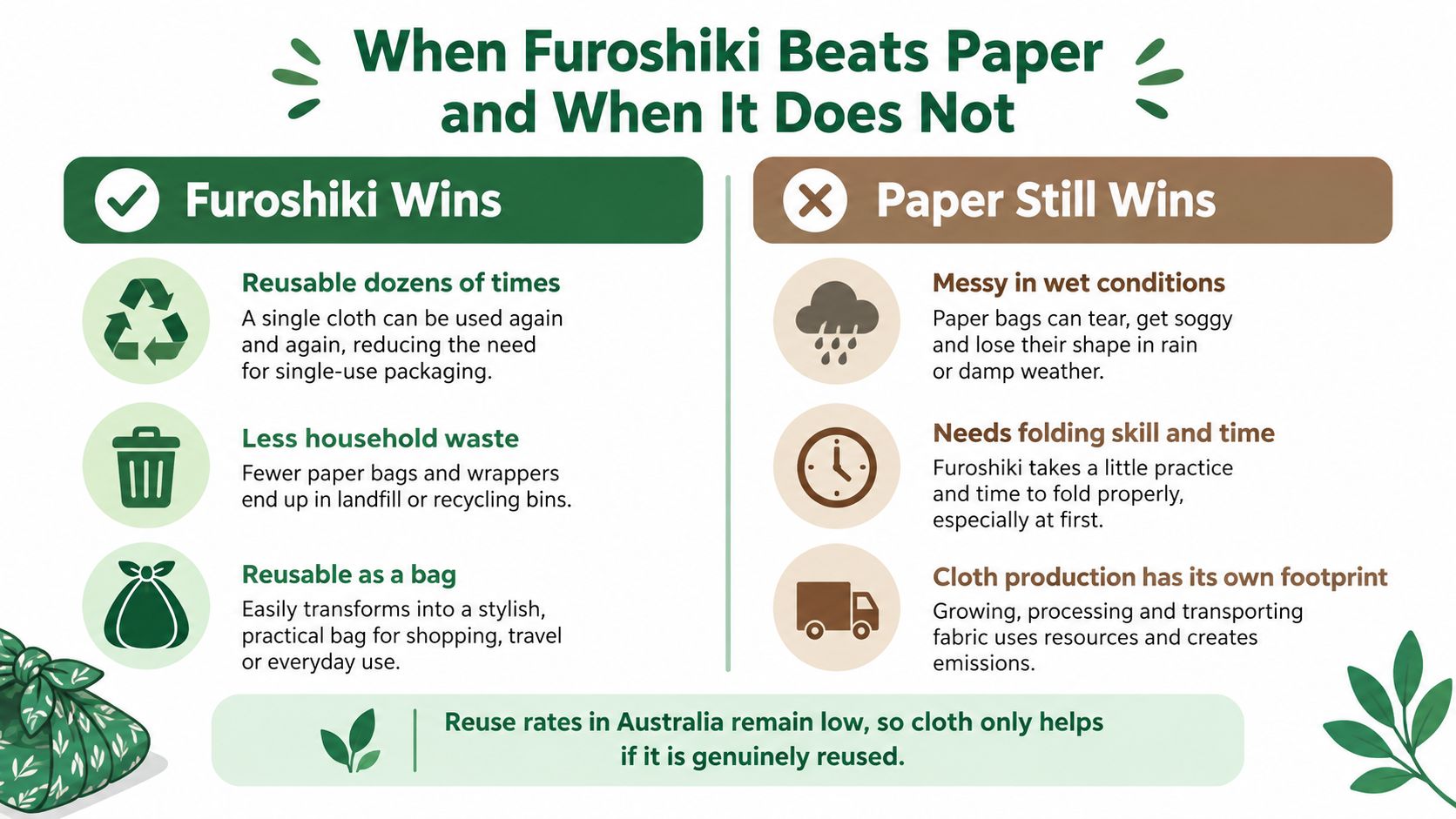
Make the decision recipient-first
Furoshiki is a strong choice when the recipient is likely to keep the cloth, the fabric is durable, and the wrap can serve another purpose. A second gift, a shopping trip, or household storage gives the material a life beyond the opening moment.
Recycled paper may be more sensible for a one-off gift to someone who doesn't want another textile. An existing tea towel can be better still, because it avoids purchasing a new wrap. Plain paper may also enter recycling more easily than laminated, dyed, glittered, metallic, or plastic-containing wrapping, which the City of Joondalup places in general waste.
The Australia Institute reports that 69% of Australians buy wrapping paper, while only 24% reuse it. It also reports that 50% place used wrapping paper in recycling bins and 15% put it in general rubbish. These figures make reuse worth designing for, but they don't justify claiming that every cloth wrap is impact-free.
Before choosing a cloth for a matcha gift, consider the recipient's habits. Someone who carries reusable bags and enjoys textiles may welcome it. Someone living with limited storage may prefer recycled paper or a tea towel they already own. A transparent choice is more useful than a reflexive one, so consider the options in Japanese tea sets alongside the wrapping material and the person receiving it.
Sizing Your Cloth to the Gift
The cloth needs enough diagonal length to travel across the object, rise over its height, and leave corners long enough to tie. Measure the gift as a three-dimensional object, not just across its lid. A tall bundle can defeat a cloth that seems wide enough when viewed from above.
| Cloth size | Suitable examples |
|---|---|
| 45 cm square | Jewellery, small accessories, compact items |
| 70 cm square | Most boxed gifts, matcha tins, starter sets |
| 90 cm or 100 cm square | Books, clothing, larger or awkward bundles |
For a boxed matcha gift, start with the largest package rather than the smallest item. A 70 cm square is a reliable reference for an item around 20 cm across, provided the object's height and diagonal allow the corners to overlap. Place the largest box in the centre, test the two opposite corners, and check that they can meet comfortably above the gift.
Test before adding the finishing touches
Prepare the complete bundle before tying the final version. If you're wrapping a TOO MATCHA gift with a card or accessory, test the largest package first, then add the smaller pieces only if they don't increase the height or disturb the balance. Keep the knot away from fragile tin lids and avoid compressing powdered-tea packaging.
Short corners create unstable knots and expose the gift. Excess fabric produces bulky folds that can make the bundle awkward to carry. If the cloth is almost large enough, changing the direction of the gift may help, but don't rely on a diagonal that leaves only a narrow overlap.
A useful test is to lift the finished bundle gently from the knot. The package should remain centred, and the fabric should stay smooth beneath it. If one side lifts first, release the knot, square the gift, and retie with equal tension.
Reuse, Aftercare, and Gifting It Forward
The question after opening is often more complicated than “Do you like it?” The recipient may wonder whether the cloth is theirs, borrowed, washable, or expected back. Answer that question before they have to ask.
Attach a small tag that says:
This cloth is yours to reuse. Wash gently, dry fully, and pass it on when you're ready.
If you want the cloth returned, write that clearly instead: “This wrap is borrowed. Please return it when convenient.” For a special textile, include a return envelope or a QR-based return option. A visible message removes the awkwardness and lets the recipient enjoy the gift without guessing at the social rules.
A simple aftercare routine
Wash the cloth according to its care label after food or drink contact. Treat a tea spill promptly with a gentle method suitable for the fabric, then dry it completely before folding. Don't tie a damp cloth around another gift, especially if the textile has a dense weave that holds moisture.
A small stitched prompt on one corner can keep the purpose visible: “Use me again.” You can also label the cloth for a second gift, shopping, clothing storage, or carrying objects. The Australian sustainability guidance around furoshiki emphasises reduce, reuse, and recycle, but reuse only works when the recipient knows the cloth is meant to continue.
The Australia Institute's Christmas research found that 52% of Australians did not want to receive a Christmas present, 27% said they would never use or wear their present, and 47% of gift givers didn't consider how the gift would ultimately be disposed of. Those findings make consent and aftercare part of responsible gifting, not an optional extra.
If the recipient doesn't want another textile, accept the answer gracefully. Offer to take the cloth back, suggest passing it to someone else, or explain that it can be returned with no offence. A reusable wrap succeeds when it remains useful, not when the giver insists on ownership or admiration.
TOO MATCHA. offers Japanese tea powders, matcha and hojicha options, accessories, starter sets, and gifting-friendly products for home preparation. Choose a tea gift, wrap it with a washable cloth that suits the recipient, and visit TOO MATCHA. to explore the range.