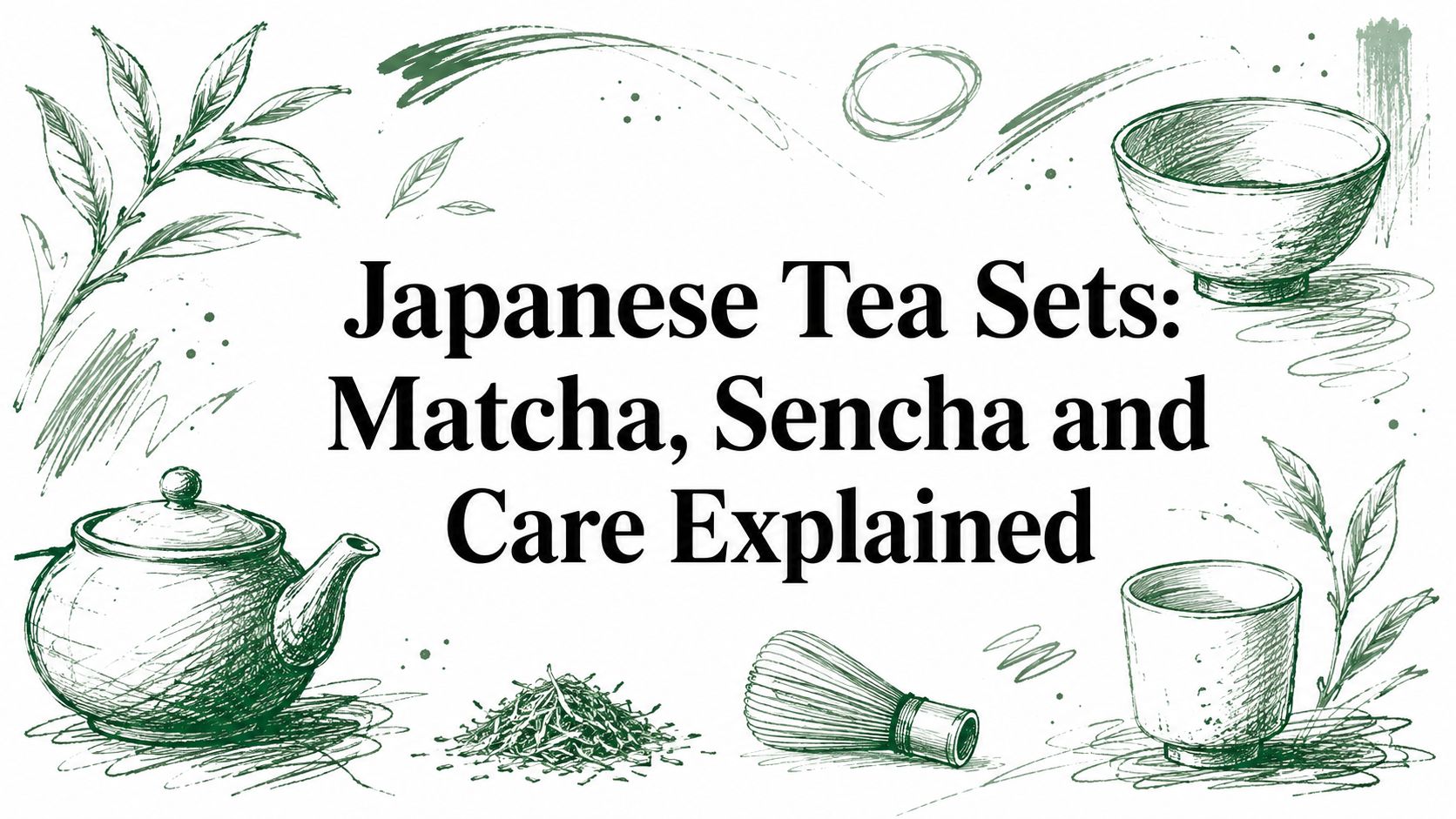
Japanese Tea Sets: Matcha, Sencha and Care Explained
You know the feeling. The matcha tin is on the bench, the kettle's ready, but the cup beside it is too narrow, the little pot dribbles when you pour, and the whole ritual feels more fiddly than calming. A Japanese tea set solves that problem when it's treated like a toolkit, not a souvenir, because the right pieces work with the tea instead of fighting it.
That matters in an Australian kitchen, where people often want a quiet evening brew, a faster matcha latte, or a proper loose-leaf cup without buying a dozen random bits. A tea set can be a workflow decision. If you choose the wrong one, the tea can taste flat, awkward, or hard to prepare. If you choose the right one, the setup feels natural, like using the correct brush for a job in a workshop.
Table of Contents
- Introducing Japanese Tea Sets for Home Brewers
- Core Parts and Regional Styles of Japanese Tea Sets
- Matcha Sets Compared With Sencha and Hojicha
- Materials and Quality Cues for Tea Ware
- Tea Style Size and Tool Pairings
- Choosing Japanese Tea Sets for Home and Gifts
- Caring for and Storing Your Tea Set
- Brewing Basics and TOO MATCHA Pairings
Introducing Japanese Tea Sets for Home Brewers
A lot of people start with one hopeful purchase. They buy a pretty pot, or a “complete” tea set, then realise they make only matcha at home, or only hojicha, or a mix of both. The result is familiar, a drawer full of cups that don't quite fit the job, and a tea routine that feels more like tidying than brewing.
The better way to think about Japanese tea sets is as a kit for a specific task. A matcha bowl, a whisk, and a scoop aren't the same thing as a sencha teapot and cups, because they're built for different tea behaviour. Matcha is whisked into suspension, while leaf teas are infused and poured. That difference changes everything.
Why the workflow matters
Tea sets became culturally significant in Japan through long ritual use, not as casual tableware. Tea was documented in Japan in the 9th century, with Eichū serving tea to Emperor Saga in 815, and imperial order in 816 supported tea cultivation in the Kinki region. By the late 12th century, Eisai introduced the powdered-tea method, which laid groundwork for the bowl-and-whisk format still linked with matcha today, while tea culture also moved from imported Chinese utensils toward local production by the 15th to 16th centuries. Japanese tea ceremony history
That history helps explain why the wrong setup feels off. A narrow mug can make whisking messy. A pot with the wrong pour can slow a quick second steep. A decorative bundle might look polished on a shelf, but still be clumsy in daily use.
Practical rule: choose the set by the tea you actually make most often, not by the style that looks nicest in photos.
Australian buyers often want calm, convenience, and a bit of ceremony without turning the kitchen into a shrine. That's where the right tea set earns its place. It supports the habit you already want to build, whether that's an after-work matcha, a roasted hojicha latte, or a small pot of loose-leaf tea shared at the table.
Core Parts and Regional Styles of Japanese Tea Sets

A Japanese tea set is usually more than one object. In the most useful sense, it's a group of tools that work together, much like a well-run workshop bench where each item has a job. One piece heats and holds the tea, another controls the pour, another measures powder, and another shapes the drinking experience.
The core pieces
The simplest way to organise the set is by function:
- Teapot, or kyusu. This is the main brewing vessel for loose-leaf tea.
- Teacups, often chawan or yunomi. These are the drinking vessels, shaped for different use cases.
- Tea caddy, or chaire. This stores loose leaves.
- Whisk, or chasen. This is used for matcha preparation.
- Tea scoop, or chashaku. This measures matcha powder.
That mix already shows why “tea set” can be misleading. A matcha bowl and whisk are not substitutes for a kyusu. A kyusu and cups are not enough for matcha. The set only makes sense when you match the tools to the tea.
Regional style adds character, but function comes first
Japanese tea ware also carries regional identity. Tokoname is known for red clay and high-fired kyusu, Kyoto for refined celadon glazes, Mashiko for a rustic, textured look, and Shigaraki for natural clay colours. Those styles change the feel of the set as much as the appearance. The surface finish, weight, and pour all matter when the piece is used every day.
Japanese tea utensils were also politically and socially significant. In the Sengoku era, elite tea utensils could become status objects of extraordinary value, with Luís Fróis recording a powdered-tea vessel worth 25,000 to 30,000 cruzados, and another utensil worth more than 40,000 cruzados presented to Oda Nobunaga. That helps explain why Japanese tea ware carried prestige well beyond ordinary dining objects. Sengoku tea utensils and status
The key point is simple. The form says a lot about the function, but it also says something about the tradition behind it. A good tea set reflects both.
Matcha Sets Compared With Sencha and Hojicha

Matcha is the easiest place to get confused because people often look for a “tea set” when they really need a matcha tool set. The mechanics are different from loose-leaf brewing. Matcha is an insoluble suspension, so the bowl shape and whisk density matter in a way that a teapot can't solve.
Matcha needs a bowl, whisk, and scoop
A matcha-focused setup centres on the chawan, chasen, and chashaku. Buying guidance commonly cites 80 to 120 prongs for the whisk, and the wide bowl shape helps with aeration and foam formation. That design supports rapid whisking and reduces splashback, which is exactly what you want when you're trying to form a smooth drink rather than infuse leaves. Matcha tea set buying guide
A generic pot can't do that job properly. It doesn't create the right motion, and it doesn't support the same mouthfeel. That's why a matcha setup feels more like a mixing station than a brewing station.
Sencha and hojicha want a different system
Loose-leaf teas such as sencha, gyokuro, and hojicha work better with a kyusu. Japanese tea guidance places kyusu volumes in the roughly 200 to 400 ml range for regular tea service, and specialist teaware distinguishes filters such as sasame, ceramesh, tomochakoshi, and donuki, each affecting leaf retention, flow resistance, and pour speed. Choosing the perfect Japanese tea set
That's why a set for sencha or hojicha should be judged by the pour, not by the bowl. Finer filters can improve clarity, but they can also slow drainage, which matters when you're doing short steeps or low-temperature brewing. A matcha whisk doesn't help there, and a teapot won't replace a chawan.
For a broader tea shopper, the practical question is not “Which set is prettiest?” It's “Which tools match the tea I make?” That is the difference between a decorative bundle and a functional tea toolkit.
One useful starting point is the Japanese green tea guide on TOO MATCHA's blog, especially if you're deciding whether your daily habit leans more towards whisked drinks or leaf tea.
The wrong vessel doesn't just look awkward, it changes how the tea behaves in your hands.
Materials and Quality Cues for Tea Ware
A good set starts with the material, because material affects weight, heat, cleaning, and durability. Ceramic, porcelain, and bamboo each send different signals, and none of them should be judged by appearance alone. A glossy finish can be practical, while a rustic surface can be beautiful but more demanding to maintain.
What the surface tells you
Unglazed ceramic often feels more tactile and traditional, but it needs more careful handling. Several independent guides note that unglazed pieces should be rinsed with warm water only, dried thoroughly, and stored carefully to reduce the risk of mold or scratches. Glazed ceramics are generally simpler for everyday home use, especially if the household wants less upkeep and easier cleaning.
Bamboo accessories bring a different issue. They're light and functional, but they need drying space and a bit of discipline after washing. If they stay damp, they're far less forgiving than ceramic or porcelain parts.
Low pricing can also be a clue, though not a perfect one. It may point to mass production rather than craft finishing, especially if the seams, glaze edges, or whisk detail look rough. That doesn't automatically make the set bad, but it does mean the buyer should inspect the workmanship instead of trusting the packaging.
Authenticity isn't the same as convenience
Many buyers get tripped up. A tea set can be culturally faithful and still be awkward in a busy kitchen. Australian households are also practical by default, and the ABS reports that 81% of Australian households own a dishwasher. ABS household dishwasher ownership
That makes maintenance a real buying factor. A delicate ceremonial set may be lovely, but a glazed or hybrid setup can be a better fit for everyday use if the household wants something that's easier to keep clean. The point isn't to reject authenticity. It's to choose the version of authenticity that fits the way you live.
If the set will be used often, look for clean edges, even glaze, and components that feel balanced in the hand. Those are small signals, but they matter more than marketing language.
Tea Style Size and Tool Pairings
The best way to understand sizing is to match it to tea style. Japanese tea sets are not built around one universal capacity, because the tea itself changes how much water you need and how the brew is served. That's why a tiny gyokuro pot, a mid-sized sencha pot, and a larger hojicha setup can all make sense in the same category.
Tea Style Capacity Pairings
| Tea Type | Teapot Size (cc) | Cup Size (cc) |
|---|---|---|
| Gyokuro | 120 | 40 |
| Sencha | 250 | 120 |
| Hojicha | 600 | 130 |
These pairings show the logic clearly. Gyokuro is usually served in a more compact setup, sencha sits in the middle, and hojicha can suit a larger service style. Guide for Japanese tea sets
What the numbers mean in practice
The table also reveals something important for matcha buyers. Matcha doesn't belong in the same sizing logic at all, because it's not a leaf infusion. It uses a bowl rather than a brewing pot, so its workflow is closer to whisking batter than steeping tea.
That's the useful mental model. A tea set is not “small, medium, or large” in the abstract. It's sized for a ritual. If you mostly pour for one person, a compact kyusu is usually easier to manage. If you regularly serve guests, the balance changes. If you only want whisked matcha, the pot sizing question drops away and the bowl shape becomes the main issue.
For buyers who want a quick filter, the simplest test is this, does the tea style need infusion, whisking, or both? Once you answer that, the right set starts to become obvious.
Choosing Japanese Tea Sets for Home and Gifts

Choosing a tea set gets much easier when you stop asking, “What looks authentic?” and start asking, “What job does it need to do?” That question matters for home use, for gifts, and for tea powder buyers who want the tools to match the product.
Match the set to the drinking habit
If the drinker only makes matcha, the set should centre on a chawan, chasen, and chashaku. If the household makes sencha and hojicha, a kyusu and cups make more sense. If the buyer wants both styles, a separate brewing pot plus matcha tools is usually more logical than one all-purpose bundle.
That is especially relevant for powders and starter kits. TOO MATCHA offers ceremonial grade matcha in 60g, 500g, and 1kg formats for whisked preparation and pure sipping, premium culinary grade matcha in the same sizes for baking, blending, smoothies, and lattes, premium sweet matcha in 200g, 500g, and 1kg for quick drinks, and hojicha roasted green tea powder in 60g, 500g, and 1kg for beverages and desserts. It also sells 4-piece starter sets, which makes sense when someone wants the basic tools already grouped together.
Use a simple selection checklist
- Identify the tea occasion. Pick a set for everyday use or a special ceremony.
- Consider the material. Ceramic, porcelain, and cast iron all behave differently.
- Assess the number of users. Make sure the set covers the number of cups you need.
- Match the tea type. Matcha needs a whisk, while sencha needs a small teapot.
- Choose the right matcha grade. Ceremonial grade suits gifting and sipping, while culinary grade suits cooking and blended drinks.
- Check the delivery format. Make sure the necessary accessories are included.
- Look for gift-ready packaging. A box matters when the set is meant for giving.
Practical rule: if the powder and the tools don't match the same preparation style, the set is mismatched before it even leaves the box.
That's why a gift set should be chosen with the recipient's routine in mind, not just the seller's styling. A busy home might value practicality first. A tea lover might want ceremony and texture. A dessert maker might need powder and tools that support repeatable results.
Caring for and Storing Your Tea Set
Care is where a lot of good intentions fall apart. People buy a lovely tea set, use it once or twice, then store it wet or wash it the wrong way. After that, the set starts to smell stale, lose finish, or collect stains that are hard to shift.
Clean each material the right way
Unglazed ceramics need the lightest touch. Warm water is the safer choice, and soap is usually best avoided if you want to protect the surface and prevent flavour carryover. Bamboo accessories need to be dried thoroughly after washing, because lingering moisture is what creates problems later.
Glazed pieces are generally easier. They still deserve care, but they're less demanding in day-to-day home use. That's one reason many Australian buyers end up preferring a glazed or hybrid setup. It handles a normal kitchen routine without turning every wash into a maintenance ritual.
A useful companion piece is the T-2 Matcha Whisk guide, especially if you want to understand how the whisk itself should be treated after use.
Storage matters as much as washing
The biggest mistake is sealing damp parts away. A kyusu or bowl should be dried fully before it goes back on the shelf, and bamboo should never be packed away while still soft with water. If the set has a lid, let air move through it before storage.
The idea that the most authentic is always most practical breaks down here. In a household that relies on the dishwasher or needs a faster clean-up routine, the right choice may be a more durable glazed piece rather than a delicate ceremonial one. That doesn't diminish the tea. It just respects the way the household functions.
Tea ware lasts longer when it's treated like equipment, not decor. Clean it, dry it, and store it with enough space to breathe.
Brewing Basics and TOO MATCHA Pairings
A good brew begins with the correct tool and the right motion. For matcha, sift the powder into the chawan, add water, then whisk with a chasen that has 80 to 120 prongs until the drink looks even and lightly foamy. For loose-leaf tea, add the leaves to the kyusu, steep at the appropriate volume, then pour cleanly into cups so the leaves stop infusing at the right moment. If you want a basic visual reference for whisking technique, the how to whisk matcha guide is a useful companion.
Pair the product with the right use
- Ceremonial grade matcha fits the quiet, pure-sipping setup with chawan, chasen, and chashaku.
- Premium culinary grade matcha works better for baking, blending, and milk-based drinks.
- Premium sweet matcha suits fast lattes and iced drinks when you want consistency.
- Hojicha powder belongs in roasted drinks and desserts, and it pairs well with a home setup that can handle daily use.
- Loose-leaf sencha or gyokuro needs a kyusu and cups, not a whisking bowl.
The main lesson is simple. A Japanese tea set is a preparation system, not a decoration category. Once you match the tea style to the tools, the whole process gets easier, cleaner, and more satisfying.
If you're choosing your first setup or replacing one that never quite worked, start with the tea you drink most. Then select the pieces that support that habit every day.
TOO MATCHA. offers Japanese tea powders, starter sets, and accessories that line up with real home use, from whisked matcha to roasted hojicha and loose-leaf tea routines. If you want a setup that makes sense for your kitchen and your tea style, visit TOO MATCHA. and choose the tools that fit the way you brew.