
Ceremonial Matcha Tea Set Buying and Usage Guide

You've opened a new matcha kit on the kitchen bench and found a bowl, a bamboo whisk, a slim scoop and perhaps a small sieve. The bowl makes sense. The whisk looks delicate. The scoop seems too small to be useful, and the extra accessories in larger kits leave you wondering whether you're missing something important.
You're not. A good ceremonial matcha tea set can be simple, provided each piece suits the way you'll drink matcha. The essentials help you measure powdered tea, remove clumps and create the fine foam that a spoon, mug and fork rarely manage. Optional pieces can add comfort, presentation or portability, but they shouldn't decide your purchase for you.
Australian tea culture already has a substantial collecting and practice context. Bygone Beautys Treasured Teapot Museum says it holds more than 5,500 teapots from around the world, spanning five centuries, with most gathered within Australia. Urasenke Sydney's tea practice materials also name specific utensils, including a kettle, tea container, water vessel, stand and flower vase. These examples place a home matcha bowl within a wider Australian appreciation of purposeful tea vessels, rather than treating it as a passing kitchen accessory.
The practical starting point: buy for the bowl you'll make most often, not for the longest accessories list.
This guide focuses on that decision. You'll learn what the four core tools do, how to separate useful quality from decoration, which setup fits pure sipping, lattes or gifting, and how to whisk without turning the process into a performance. You'll also find a care routine that keeps bamboo usable and ceramic comfortable in daily life.
Table of Contents
- Introduction to the Ceremonial Matcha Tea Set at Home
- What Is Inside a Ceremonial Set and What Each Tool Does
- How to Choose Quality Pieces Without Overbuying
- How to Use Your Ceremonial Matcha Tea Set for a Smooth Frothy Bowl
- Care Tips That Keep Your Tools Beautiful and Functional
- Choosing the Right Size and Gift Ready Options to Take Home
Introduction to the Ceremonial Matcha Tea Set at Home
A ceremonial set matters because matcha isn't steeped and strained like loose-leaf tea. You drink the powdered leaf, so the powder needs to disperse evenly through the water. The shape of the bowl gives your whisk room to move, the whisk creates foam, the scoop helps with repeatable portions, and the sifter breaks up compacted powder before water is added.
A regular cereal bowl can work in an emergency, but its depth, width and interior curve may make whisking awkward. A fork can break up some lumps, yet it won't create the same fine bubbles as flexible bamboo tines. A teaspoon measures approximately, but its volume changes with how densely you fill it. None of these substitutions makes matcha impossible, though a dedicated set removes small frustrations that otherwise appear every morning.
The four-piece home station
The most useful first setup normally centres on four pieces:
- Chawan: A broad matcha bowl that gives the whisk space and feels stable in your hands.
- Chasen: The bamboo whisk that suspends the powder and builds a light, even froth.
- Chashaku: The curved bamboo scoop used to transfer matcha into the bowl with control.
- Sifter: A fine mesh tool that separates compacted powder before whisking.
The chashaku and sifter are the pieces people question first. You can use a small kitchen measure and a fine sieve instead, but the dedicated versions make the preparation feel more deliberate and consistent. For someone learning pure matcha, that consistency helps you identify whether a problem comes from the powder, water temperature or whisking.
A dedicated set also gives you a clearer ritual without requiring a formal tea-room routine. Museums Victoria records a Japanese tea ceremony trivet and charcoal pot brought to Australia in 1985 by Masumi Hiraga Jackson. The records describe tea ceremony as the ritualised preparation, serving and drinking of matcha, and connect the practice with Buddhist priests and samurai before it spread throughout Japan. That history explains why a ceremonial set carries cultural meaning beyond its appearance.
Who benefits from buying one
A first-time home user benefits when they want pure matcha rather than only blended drinks. The bowl and whisk also help latte drinkers make a smooth paste before adding milk, while a compact set gives a gift recipient a complete starting point instead of a loose pouch of powder and unclear instructions.
Not every buyer needs a display tray, utensil stand or decorative container. If your weekday drink is a latte, prioritise a whisk that feels comfortable, a bowl with enough room for vigorous strokes and a sifter that prevents stubborn clumps. If your aim is quiet sipping, the bowl's lip, weight and tactile finish deserve more attention.
The Australian market reflects this uncertainty. Retail listings range from about A$39.99 for a three-piece set to A$149.95 for premium six-piece or traditional sets, as shown by Australian matcha set listings. That spread doesn't automatically tell you which set is right. It tells you to ask what each added piece will do in your routine.
What Is Inside a Ceremonial Set and What Each Tool Does
A set becomes easier to judge when you identify each object by its job. The names can feel unfamiliar at first, but the workflow is straightforward: prepare the bowl, sift the powder, dose the matcha, add water and whisk.
Chawan for movement and heat
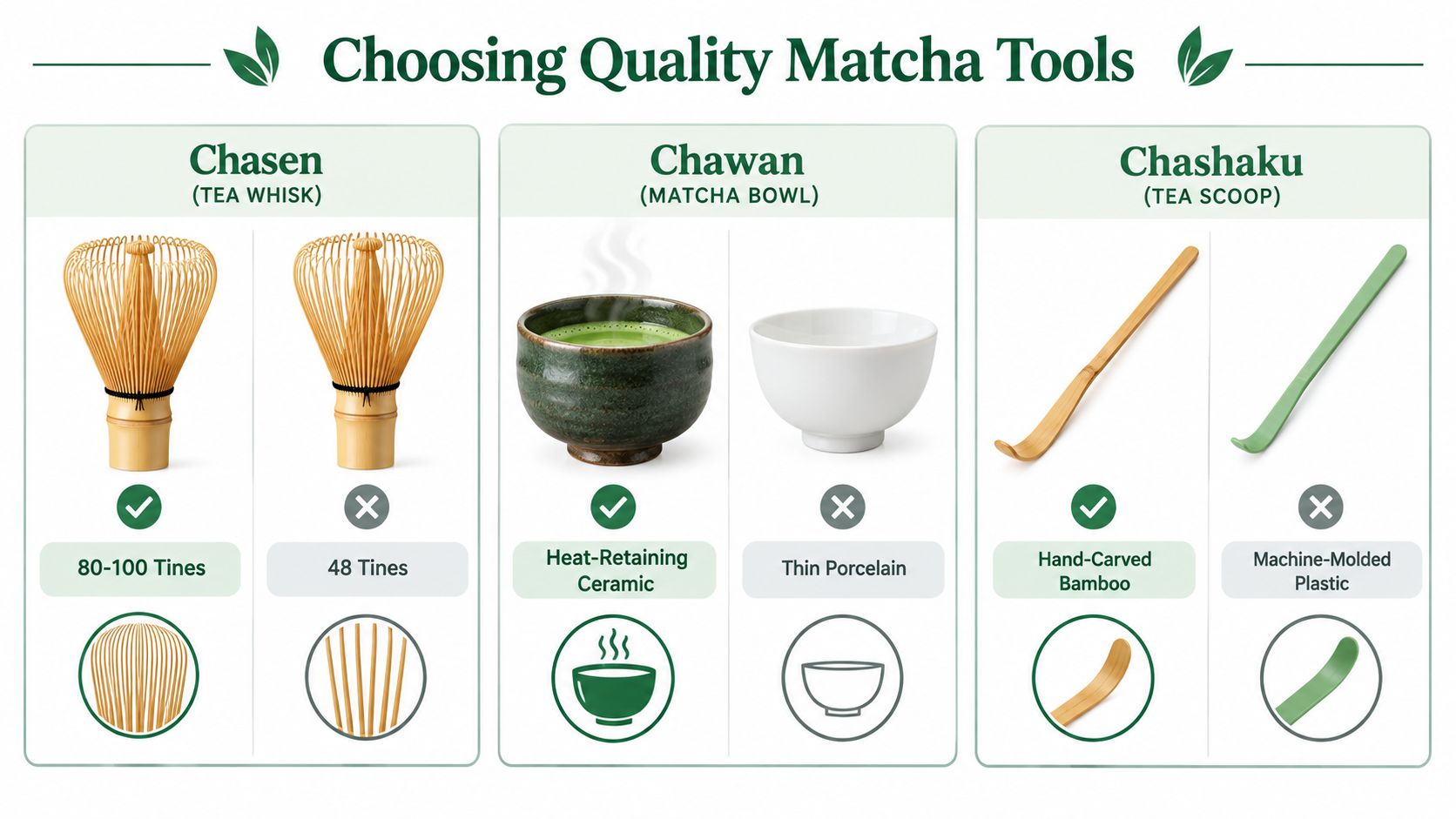
The chawan is the bowl. It's usually wider and deeper than a teacup, with an interior shape that lets the whisk travel across the bottom without catching on sharp corners. A ceramic glaze makes the surface easier to rinse, while a substantial body can hold warmth more comfortably than thin porcelain.
Look at the rim as well as the decoration. A gently shaped lip makes drinking easier and gives you a clear edge for presenting the bowl. The bowl should sit securely in your hands, with enough room to whisk without splashing.
Chasen for suspension and froth
The chasen is carved from bamboo into fine tines. Its job isn't to stir slowly in circles. It rapidly moves through the water and powder, helping suspend matcha and create small bubbles across the surface.
The tines should look flexible and evenly formed, with no obvious splinters or crushed sections. A whisk that feels loose, rough or misshapen may still work, but it can be harder to control and more vulnerable to damage if handled carelessly.
Chashaku for repeatable dosing
The chashaku is a narrow, curved bamboo scoop. It transfers powder neatly and helps you develop a repeatable visual measure without tipping a large spoon into the bowl. It isn't a precision laboratory instrument, so use it as a consistent habit rather than assuming every scoop contains an identical mass.
For a beginner, the value is control. You can adjust gradually, observe the flavour and keep your next bowl closer to the last one. The bamboo also keeps the tool light and comfortable in the hand.
Sifter for a smoother start
Matcha compacts during storage and handling. A fine sifter breaks the powder apart before water is introduced, reducing the chance of dry pockets that the whisk must later fight through.
Sift directly into the chawan, then tap or press gently with a small utensil. Don't force a large amount through a mesh in one aggressive push, as that can leave powder around the rim and make cleaning needlessly messy.
The pieces work as a sequence, not as separate decorations:
- Warm the chawan.
- Sift matcha into it.
- Add water.
- Whisk with the chasen.
- Drink from the bowl or pour into a serving cup.
A larger traditional setup may include a kettle, water vessel, stand or flower vase. Urasenke Sydney's Japanese tea set utensil guide helps show how formal practice uses named tools for distinct roles. At home, those additions are optional unless you're creating a fuller display or practising a particular tea-school style.
For a sweetened drink, Premium Sweet Matcha 200g is described as a pre-sweetened blend made with 30% authentic Japanese green tea leaves, with vegan, gluten-free, dairy-free and additive-free positioning. It can suit someone who wants a simple scoop-and-whisk routine, though a pure ceremonial bowl calls for an unsweetened matcha selected for direct sipping.
How to Choose Quality Pieces Without Overbuying
The best kit isn't the one with the most objects. It's the one where the bowl, whisk, scoop and sifter perform their roles comfortably, while the extras match a real use case.
Start with the chasen because it has the most direct effect on preparation. Fine, even bamboo tines should flex without feeling brittle. Some visual comparisons use 80 to 100 tines as a quality indicator against a coarser 48-tine alternative, as shown in the provided tool comparison. Treat tine count as one signal, not a guarantee. Bamboo quality, shape, finish and your cleaning habits all matter.
Compare the four core pieces
| Tool | Useful quality cue | What to avoid |
|---|---|---|
| Chawan | A stable ceramic body, usable width and comfortable rim | A very thin bowl that feels fragile or cramped |
| Chasen | Even bamboo tines with a clean finish and resilient shape | Splintered, crushed or uneven tines |
| Chashaku | Smooth, hand-carved bamboo with a gentle curve | Rough edges or a rigid plastic scoop |
| Sifter | Fine mesh that passes powder without excessive force | A coarse mesh that leaves visible compacted pieces |
A handmade chawan may have small variations in glaze or shape. Those variations aren't automatically faults. They can be part of the character of a fired ceramic piece, provided the bowl sits securely and the interior is practical.
Mass-produced tools can still suit a first station. A simple manufactured chashaku may be perfectly adequate if you're learning portion control, while a handmade scoop may matter more to a collector or gift buyer. Spend first on the parts you touch every time, especially the whisk and bowl, rather than paying for an ornamental stand you'll keep in a drawer.
Match the set to your use
For daily lattes, choose a solid bowl, dependable whisk and sifter. You won't need formal serving pieces, and a compact three-piece kit may be enough if you already own a fine sieve.
For pure ceremonial preparation, look for a bowl that feels good when held, a well-finished bamboo whisk and a scoop that supports measured repetition. The experience depends on touch and movement as much as on the final foam.
For gifting, a four-piece set is easier for a beginner because it explains the complete basic workflow. Add a whisk holder only if the recipient has a place to keep it, and avoid filling the box with tools that require a separate ceremony to understand.
Buying rule: a larger bundle is only better when you can name the job of every extra piece.
Australian food labelling also matters if matcha is included in a gift bundle or sold as a packaged food. Australian product labelling guidance says most retail food products need accurate country-of-origin information, along with details such as dates, ingredients, allergens, nutrition information and supplier details. The Australian country-of-origin labelling overview notes that the system began on 1 July 2016, with the transition ending on 1 July 2018.
Before buying a food-containing gift, check the label rather than relying on packaging impressions. The NSW Food Authority says packaged food for sale generally needs a label showing the supplier's Australian or New Zealand business address and lot or batch information, subject to limited exceptions, as outlined in its labelling law guidance.
How to Use Your Ceremonial Matcha Tea Set for a Smooth Frothy Bowl
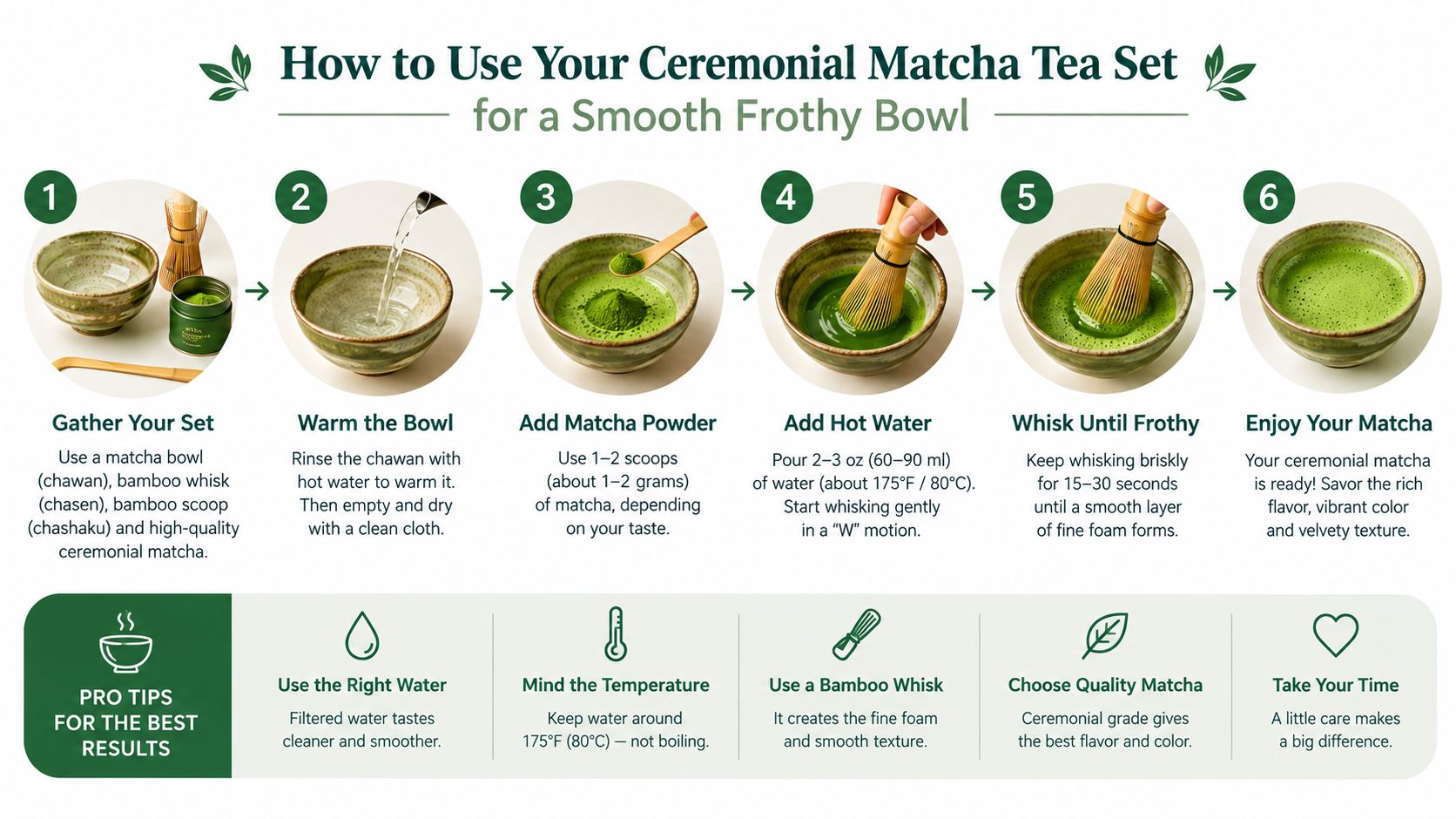
Set the chawan on a stable surface and warm it with a little hot water. Swirl that water around the interior, then empty and dry the bowl lightly. A warm bowl helps the drink feel more settled and keeps the preparation comfortable, especially when you're making a small serving.
Sift before adding water
For an Australian home workflow, sift approximately 1 to 2 g of matcha into the warmed bowl. Add about 60 to 70 ml of water at roughly 70 to 80°C, then whisk using fast M, W or zig-zag motions for 15 to 30 seconds, following Australian matcha preparation guidance.
The sifter matters because dry matcha can form compact little clusters. Once water hits those clusters, the outside becomes wet while the centre stays dry. Sifting distributes the powder before hydration, making the whisk's job much easier and supporting a more even froth.
Keep the water below boiling. Hotter water can draw out harsher flavours, while the lower benchmark above gives you a smoother starting point. If you don't have a thermometer, use water that has cooled after boiling rather than pouring it straight from a rolling boil.
Whisk with your wrist, not your arm
Place the chasen into the bowl and keep its tines near the surface once the powder has loosened. Move quickly from the wrist in a tight M or W pattern. The whisk should skim through the liquid rather than scrape heavily along the ceramic base.
During the first moments, the mixture may look dark and uneven. Keep going until the colour becomes consistent and a fine layer of bubbles begins to cover the surface. The aim is microfoam, not large soap-like bubbles, so avoid slow circular stirring.
After the initial fast strokes, finish with a gentler pass. Australian instructions specifically recommend this lighter finish to help pop larger bubbles and leave a more even surface. Lift the whisk carefully, allowing excess matcha to fall back into the bowl rather than dragging the tines across the rim.
Sensory check: a successful bowl looks bright and evenly mixed, smells fresh and vegetal, and feels smooth rather than gritty.
Adjust for your drink
For a quiet morning bowl, drink directly from the chawan once the foam settles. Hold the bowl with both hands, take a small first sip and notice whether the flavour is sweet, savoury, grassy or bitter. If it tastes harsh, review water temperature and powder freshness before blaming your technique.
For a latte, use the same sifting and whisking principles, but you can create a slightly concentrated base before adding milk. A wider bowl remains helpful because it gives the chasen room to work, even when the final drink goes into a separate cup. The matcha whisking guide offers another practical reference for building the motion.
When the surface looks smooth, add warmed or chilled milk according to your drink. Don't whisk the milk in the chawan with the bamboo tool, as the chasen is designed to disperse matcha in water, not to replace a milk frother.
Care Tips That Keep Your Tools Beautiful and Functional
A matcha set needs less maintenance than many people expect. The important habits are simple: rinse the chasen promptly, wash the bowl by hand and let bamboo dry completely before storage.
Clean the chasen first
After drinking, rinse the bamboo whisk in warm water. Use no soap on the tines, as residue can affect later bowls and the fine bamboo structure doesn't need aggressive detergent to remove matcha.
Run water through the tines from several angles, then inspect the centre and base for trapped powder. Don't twist the whisk sharply or press all the tines together. Those movements can distort the shape you rely on for efficient whisking.
A whisk holder can help the chasen dry in its intended form. If you don't have one, place it upright or rest it so air can reach the tines from every side. Never close a damp whisk inside a box or cupboard.

Wash ceramic and dry bamboo separately
Hand-wash the chawan with warm water and a soft sponge. Avoid sudden temperature changes, such as rinsing a very hot bowl under cold water, because ceramic can react poorly to thermal shock. Dry the outside and base before returning it to a shelf.
Rinse the chashaku and wipe it with a clean, dry cloth if powder remains. Don't soak it. Bamboo absorbs moisture, and repeated damp storage can encourage splitting, swelling or mould.
The sifter usually needs a gentle brush or rinse, depending on its construction. Shake out remaining water and leave it open to dry. If matcha has dried into the mesh, loosen it patiently rather than scraping hard with a sharp object.
Avoid the common shortcuts
- Dishwasher use: Keep bamboo tools out of the dishwasher, where heat, water pressure and detergent can change their shape.
- Long soaking: Don't leave the chasen or chashaku sitting in a sink. Rinse, drain and dry them promptly.
- Closed storage: Avoid putting wet bamboo into a tin, drawer or lidded container. Airflow is part of the care routine.
- Rough scrubbing: Don't attack ceramic glaze or fine mesh with abrasive pads. Gentle cleaning preserves the working surface.
- Neglected residue: Matcha left to dry becomes harder to remove. A quick rinse immediately after use is easier than a later rescue.
One-minute reset: rinse the whisk, wash the bowl, wipe the scoop and leave every bamboo piece exposed to air.
For a more detailed cleaning sequence, use this guide to cleaning a matcha whisk. The routine isn't fussy. It protects the tools that make the preparation pleasant.
Choosing the Right Size and Gift Ready Options to Take Home
Choose the set around the recipient's routine. A first-time home user usually needs the four core tools and clear preparation guidance, not a collection of formal accessories. A latte drinker may value a sturdy, easy-rinse bowl and a reliable whisk more than a decorative stand, while a pure tea drinker may care about the bowl's rim, weight and glaze.
A compact starter set works well when the buyer is testing whether whisked matcha belongs in the morning routine. It should include a chawan, chasen, chashaku and sifter, or clearly explain which kitchen substitute can cover a missing item. A fuller set suits someone who wants a dedicated shelf display, practises more intentionally or enjoys the visual rhythm of arranging tea tools.
For gifting, keep the experience approachable. Include:
- A workable bowl: Wide enough for whisking, stable on a bench and comfortable to hold.
- A bamboo whisk: Fresh, evenly formed and accompanied by simple drying advice.
- A scoop and sifter: These make the first preparation less clumpy and less improvised.
- A preparation card: State the matcha amount, water volume, temperature and whisking time in plain language.
- A suitable powder: Choose pure ceremonial matcha for direct sipping, or a sweetened option if the recipient prefers convenience.
Size matters in small ways. A bowl that's too narrow restricts the whisk, while one that's too deep can make it harder to see the foam developing. A whisk should sit comfortably in the bowl without forcing the tines against the base. If you're buying for travel, prioritise a protective container and a bowl that isn't so delicate you'll leave it at home.
Australian interest in Japanese green tea is also visible in import activity. Australia imported 195,319 kilograms of Japanese green tea between January and August 2025, a 131% year-on-year increase, and was reported as the eighth-largest export destination globally in the Australian matcha market report. That makes practical buying guidance more useful, because shoppers are choosing among more formats, grades and accessories.
For a first purchase, use this checklist: four functional tools, a bowl you'll enjoy holding, a whisk you can dry properly, a sifter you'll use and powder suited to your drink. Once those choices are right, the first bowl doesn't need to be perfect. Warm the chawan, sift carefully, use water in the recommended range and let the whisk teach your hands the motion.
TOO MATCHA. offers Japanese-sourced matcha and hojicha powders in ceremonial, culinary and sweetened formats, along with tools and four-piece starter sets for home preparation and gifting. Visit TOO MATCHA. to choose a powder and matcha tea set that fit the way you'll drink and share it.