
Matcha Whisk Alternative: 4 Tools That Actually Work

You've got the matcha out, the kettle's just clicked off, and your bowl is ready. Then you open the drawer and there's no whisk. Either it's vanished behind the cutlery tray, it's still drying from yesterday, or the tines have finally curled and snapped after months of loyal service. You don't need to abandon the cup, and you don't need to stir hopefully with a spoon either.
Table of Contents
- When You Need a Matcha Whisk Alternative
- What a Chasen Actually Does
- Four Alternatives Compared
- How to Prepare Matcha Without a Whisk
- Choosing the Right Tool for Your Drink
- Tips for the Best Froth and Texture
When You Need a Matcha Whisk Alternative
That missing whisk moment happens in a few familiar ways. You're at home and your chasen has split. You're travelling and packed the tin but not the tools. You're making matcha at work, at a friend's place, or in a small café where the one bamboo whisk is already in the sink and three lattes are waiting.
None of those situations calls for the same fix. A quiet hot cup at your desk is a different job from an iced oat latte in a rush, and both are different again from making drinks for six people on a Sunday morning. That's why a matcha whisk alternative shouldn't be picked by asking which tool is best in general. Ask what you're drinking, how many you're making, and how much washing up you're willing to do afterwards.
Why more people are improvising
Matcha has moved well beyond specialist tea drinkers in Australia. More beginners are buying a first tin, trying it in lattes and iced drinks, and only later realising the traditional tool needs care, drying space, and a reasonably gentle hand. Plenty of people also have not yet bought a chasen and want to know if what they already have will do.
The honest answer is yes, often it will. A chasen is a lovely tool, but it's not magic. It does a specific mechanical job, and several ordinary kitchen items can do enough of that job for everyday drinks.
Don't judge a substitute by whether it looks traditional. Judge it by whether your powder is fully suspended, with no gritty clumps at the bottom of the cup.
What changes between tools is texture, speed, and mess. Some give you fine foam and take a minute of attention. Others are almost instant but leave bigger bubbles that disappear under milk anyway. Once you accept that trade-off, choosing becomes easy. You're not looking for a perfect replica of bamboo. You're matching a tool to a drink, a serving size, and the amount of patience you've got at 7 a.m. before work.
What a Chasen Actually Does
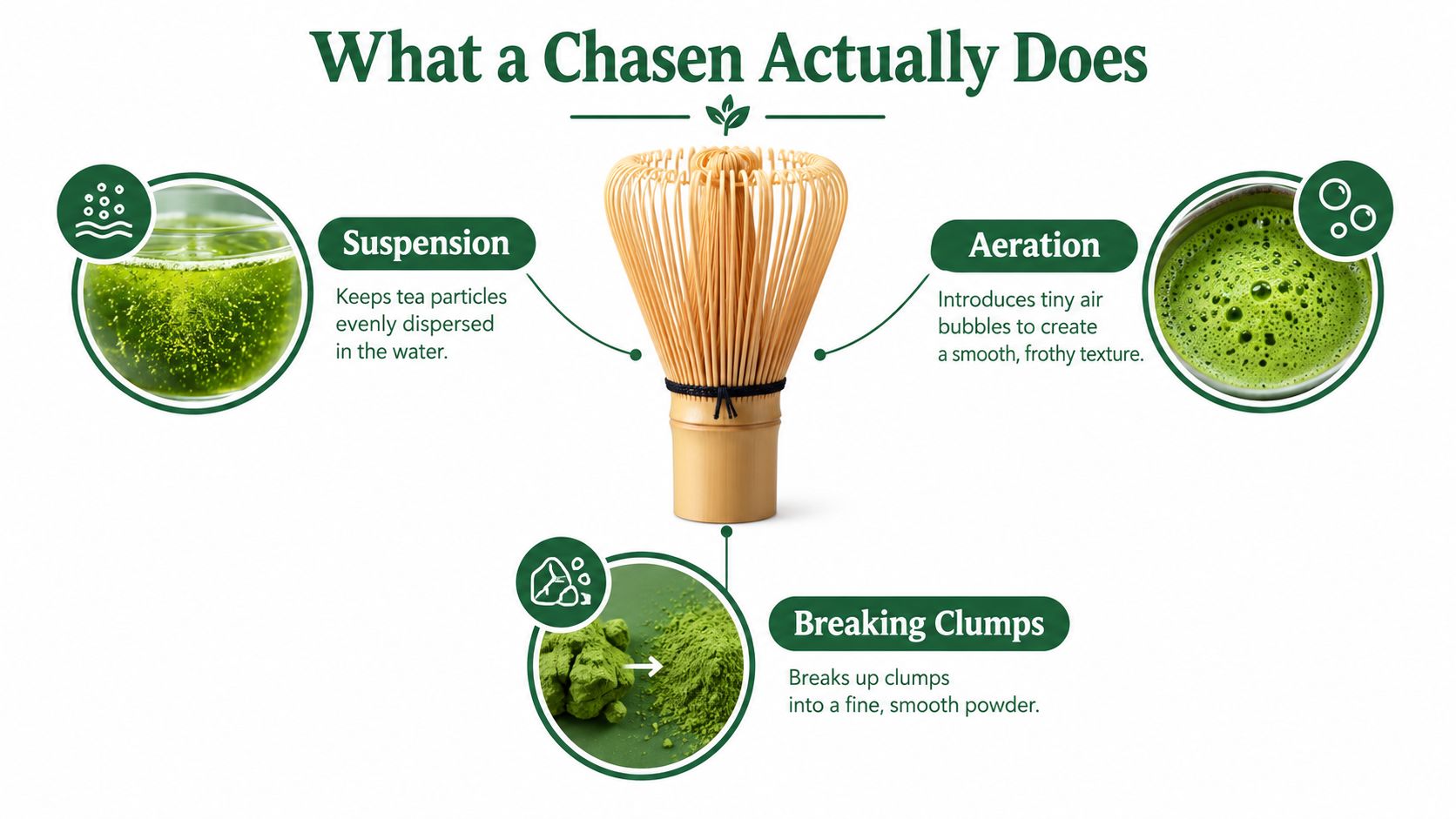
A chasen is carved from a single piece of bamboo and split into many fine tines. Those tines do three things at once when you whisk in a quick W or M motion. They suspend the powder through the water, they break up clumps, and they aerate the surface into a fine, even foam. One tool, three jobs, which is why a spoon feels so useless by comparison. A spoon pushes liquid around. Fine tines cut through it in many places at once.
That multi-point agitation is what you're trying to copy. If you want to see the motion the alternatives are standing in for, this guide to whisking matcha with a traditional chasen shows the wrist action and the foam you're aiming for.
The diagram below breaks the chasen's work into those three functions.
The practical downsides of bamboo
Bamboo has real limits as a daily tool. A chasen needs rinsing without soap, careful drying so it doesn't go mouldy, and storage where the tines won't get crushed. It's delicate, it's typically imported, and it wears out. Australia has long relied heavily on imported bamboo rather than local production, so a replacement usually means ordering and waiting, not grabbing one at the supermarket.
None of that makes the chasen a bad purchase. For a hot, ceremonial style cup where you're drinking matcha and water with nothing to hide behind, its finer microfoam and smoother texture are hard to match. The foam is part of the experience there.
For a latte, though, that finesse matters less. Milk, ice, and sweetener cover a lot of textural sins. If your daily drink is cold and milky, you may never miss the bamboo at all, and you certainly won't miss babysitting it while it dries.
Four Alternatives Compared
Four tools cover almost every situation. A handheld electric frother is the one most guides recommend, and it's easy to see why. It's cheap, small, fast, and already sitting in plenty of kitchen drawers. It'll disperse powder in seconds and it's brilliant for lattes. Used carelessly at full speed from the start, though, it throws matcha up the sides of the vessel and gives you coarse, soapy looking bubbles instead of fine foam. Technique matters more than power here, which is why it's worth understanding how an electric milk frother handles matcha before blaming the tool.
A screw-top jar or cocktail shaker works completely differently. There's no whisking at all, just violent shaking in a sealed vessel. For iced matcha it's arguably the best option on this list, because you shake, add ice and milk, and you're done, with one vessel to rinse. The foam is uneven and short lived, but in a cold drink nobody's inspecting it.
The quiet and the heavy duty options
A small kitchen whisk is the low cost, no batteries answer. It won't match a chasen's tines, but with a fast wrist it gets surprisingly close for a single hot cup. It's silent, which matters in a shared house at dawn, and it rinses in seconds. The cost is elbow grease and slightly less even foam.
An immersion blender sits at the other extreme. For one serving it's overkill and can over-aerate. For a big jug of iced matcha or a café batch, nothing else here comes close for speed and consistency.
Matcha Whisk Alternatives at a Glance
| Tool | Speed | Foam Quality | Cleanup | Best For |
|---|---|---|---|---|
| Electric frother | Very fast | Good if pulsed gently | Quick rinse | Lattes, single cups |
| Jar or shaker | Fast | Coarse, uneven | Very easy | Iced drinks, travel |
| Small kitchen whisk | Slow | Moderate, wrist dependent | Very easy | Hot single servings |
| Immersion blender | Very fast | Can over-aerate | More parts to wash | Large batches |
How to Prepare Matcha Without a Whisk
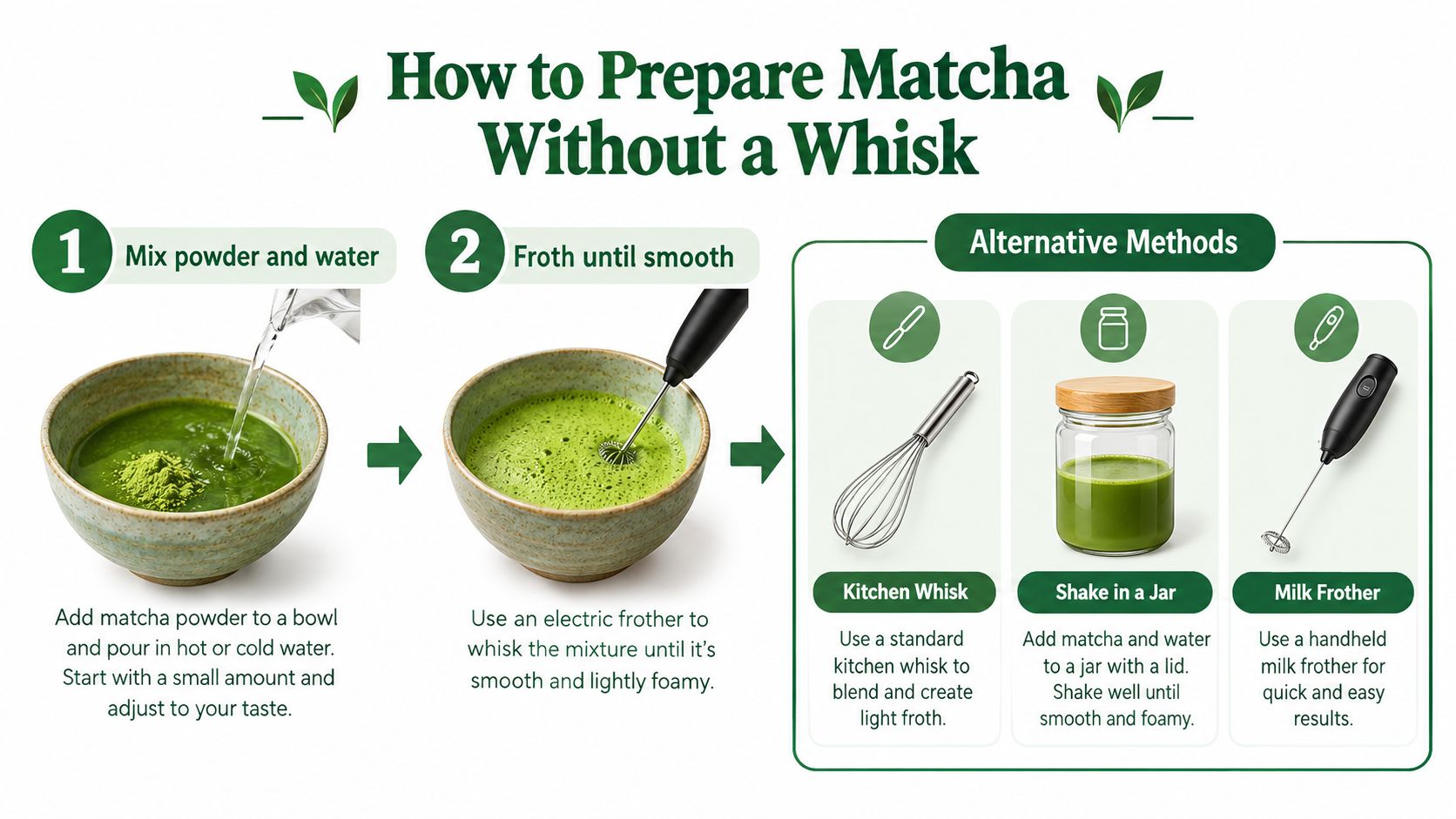
Every method below starts the same way. Sift 1 to 2 grams of matcha into a bowl or narrow jug, then add 50 to 80 millilitres of water at 70 to 80°C. Boiling water increases bitterness rather than improving anything, so let the kettle sit for a minute or two after it clicks off.
The flow below shows the core two-stage method, then the branches for each tool.
Electric frother and kitchen whisk
With a frother, work in two stages. First hold the head low in the liquid and pulse briefly to wet and disperse the powder. Then raise it just below the surface for 5 to 10 seconds to build foam. Starting at the surface on full power is the classic mistake. It aerates unevenly, leaves dry powder stuck to the wall, and gives you big bubbles.
With a kitchen whisk, keep the movement in your wrist, not your whole arm. A fast figure eight or zigzag through the liquid disperses better than big circular stirring, which just creates a whirlpool and pushes powder to the edges.
The short video below shows the surface stage and what finished foam should look like.
Jar, shaker, and immersion blender
For a jar or shaker, sift the powder in, add cool or lukewarm water, seal it properly, and shake hard for 10 to 20 seconds. Don't overfill, because you need headspace for the liquid to move. Add ice and milk only after the powder has dispersed.
For an immersion blender, use short pulses at low speed in a tall jug. Continuous blending over-aerates and can warm the drink.
For any latte, make this concentrated base first, then add milk. Powder dropped into a full glass of milk settles and clumps. A pre-sweetened option like Premium Sweet Matcha 200g, described as a 200g bag blended with 30% authentic Japanese green tea leaves into a naturally sweet, silky smooth powder, follows the same base first approach and removes the separate sweetening step.
Choosing the Right Tool for Your Drink
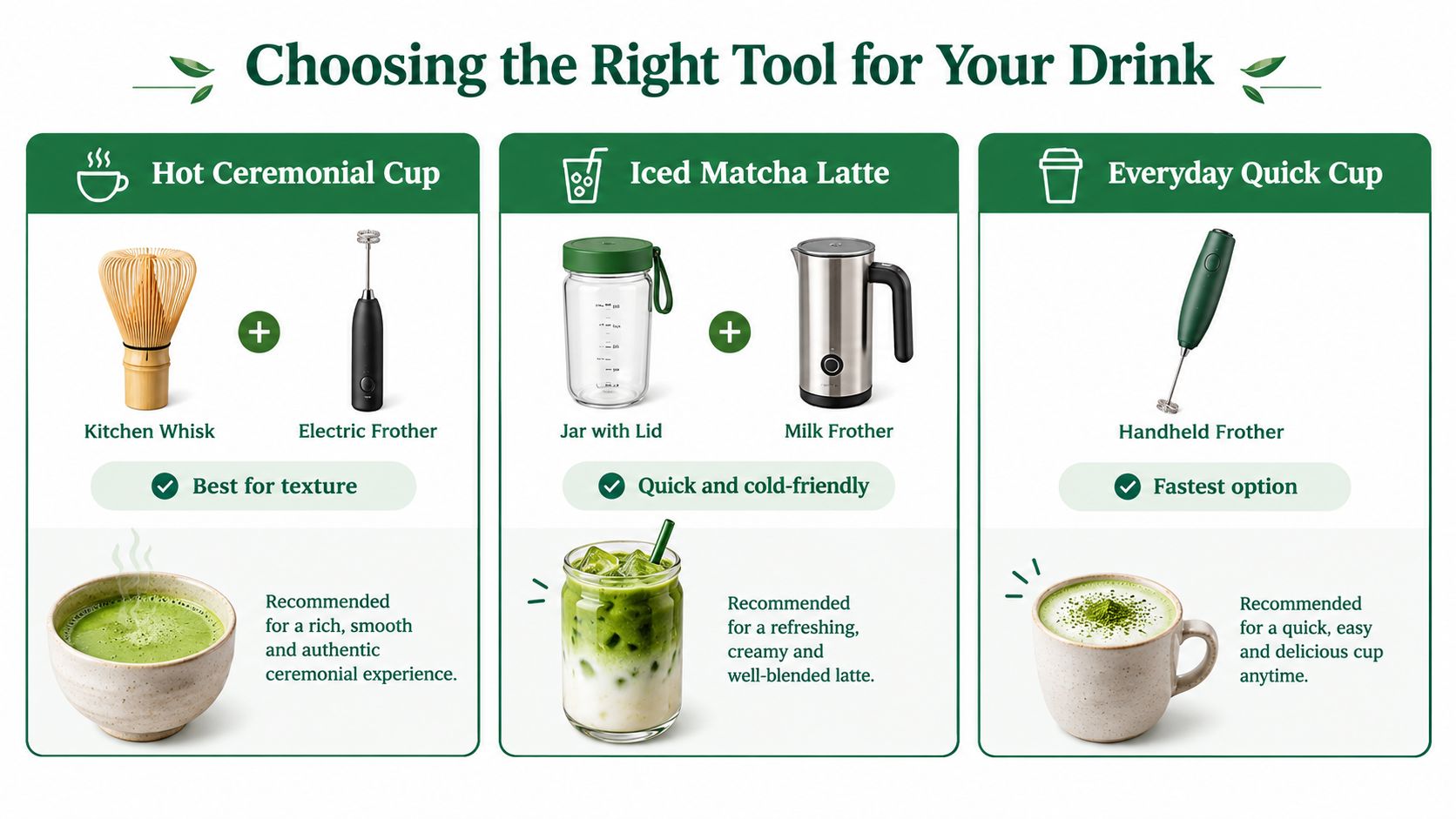
Start with the drink, not the drawer. For a hot ceremonial style cup, where it's just matcha and water and texture is the whole point, a small kitchen whisk worked with a quick wrist is the closest substitute. A frother used gently in two stages comes second. Accept slightly larger bubbles and drink it promptly, while the suspension holds.
For an iced matcha latte, reach for the jar or shaker without overthinking it. Cold liquid, ice, and milk make fine foam irrelevant, and shaking disperses powder fast with almost no cleanup. It's also the most portable option, which is why it wins for the office, the gym bag, and camping.
The comparison below matches each drink style to its most practical tool.
Café and batch realities
For café style oat milk lattes made one after another, the electric frother is hard to beat. It's fast, repeatable, and one rinse between drinks keeps service moving. That changes at volume. If you're a café, a mobile vendor, or making matcha for a crowd, a handheld frother becomes the bottleneck.
- Batch iced drinks: An immersion blender or large shaker bottle gives more consistent dispersion across a full jug.
- Single hot servings: A small whisk stays quiet, cheap to replace, and easy to rinse between orders.
- Service hygiene: Fewer parts means faster cleaning and less cross-contamination risk during a rush.
Practical rule: the best alternative isn't the one that makes the most foam. It's the one that fits your drink temperature, serving size, travel needs, cleanup tolerance, and the texture you actually care about.
A substitute that's perfectly fine for a sweetened milk drink may disappoint someone sipping matcha straight. Neither verdict makes the tool good or bad. It just means the context was wrong.
Tips for the Best Froth and Texture
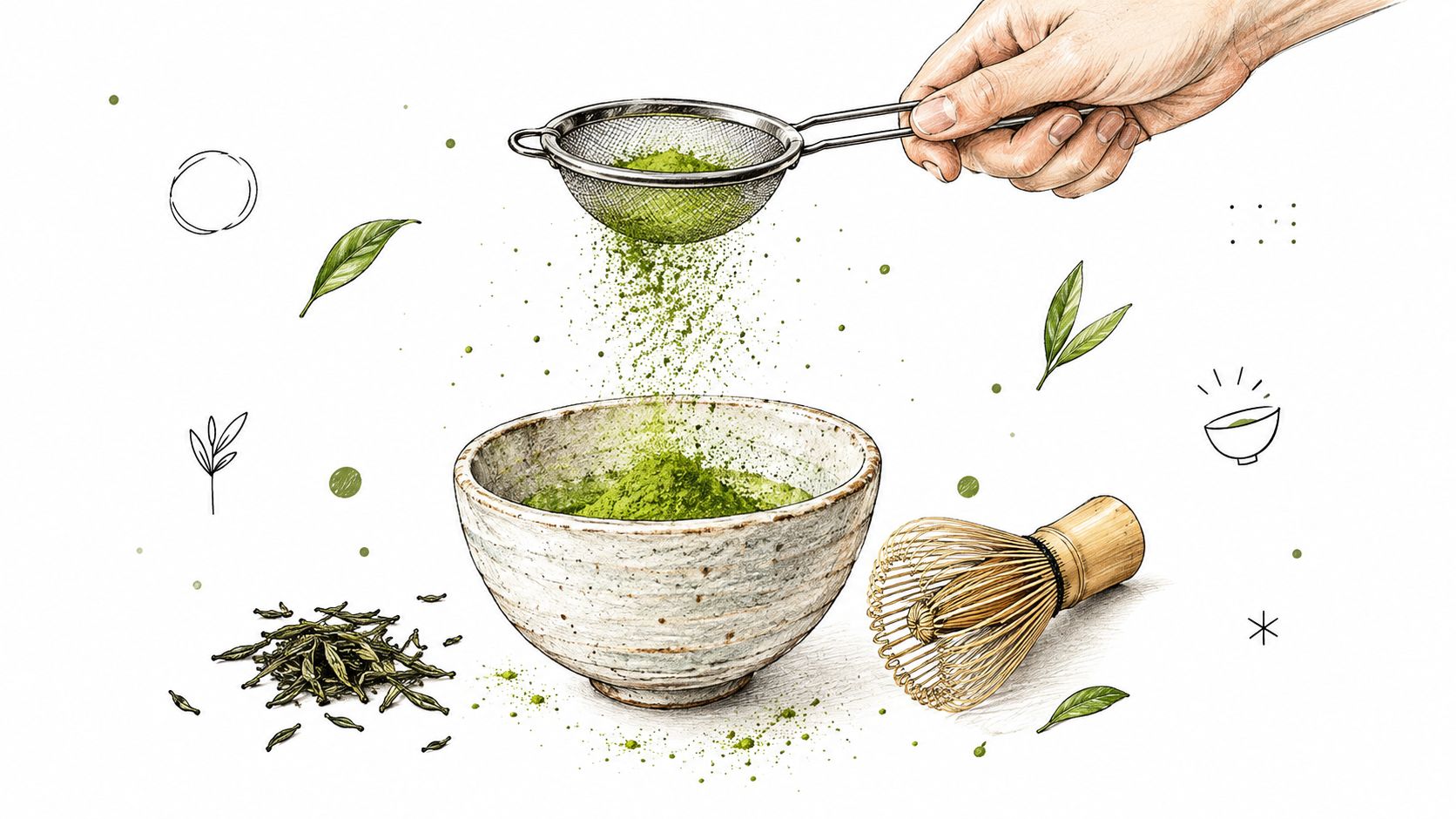
One step improves every method on this page more than any tool swap. Always sift. Dry matcha clumps are a powder dispersion problem, not a whisking problem, and no amount of vigorous shaking fully undoes a lump that went in dry. Thirty seconds with a small sieve prevents the gritty last mouthful entirely. If you don't own one yet, this overview of using a matcha tea sifter covers what to look for.
The photo below shows the sifting step done properly, before any water touches the powder.
After sifting, two habits do most of the remaining work. Keep your water at 70 to 80°C to protect the sweet, umami flavour, and mix in two stages, dispersing first and aerating second. Then check the result. A good cup shows complete suspension under a fine, even foam layer. Large bubbles mean you agitated the surface too hard or too early.
Weighing your powder and water, rather than guessing with teaspoons, makes the result repeatable, which matters most if you're serving other people. From there, experiment freely. The method that survives your busiest morning is the right one.
Whether you're whisking traditionally or shaking matcha in a jar, good powder does most of the work, and TOO MATCHA. stocks Japanese matcha and hojicha in ceremonial, culinary, and pre-sweetened formats for home cups, lattes, and café service. Browse the range, pick the grade that fits how you drink it, and put your new favourite alternative to work.