
Do Japanese Celebrate Christmas? a 2026 Cultural Explainer
You step off the Yamanote Line in Tokyo on 24 December expecting something like an Australian Christmas, perhaps family gatherings, public-holiday closures and a summer lunch. Instead, you find glowing streets, couples heading towards booked restaurants, department stores playing seasonal music and queues forming outside KFC shops. So, do Japanese celebrate Christmas? Yes, but Japan celebrates it in a distinctly local way.
The clearest answer separates Christmas into commercial participation, romantic observance and religious observance. For many people, it's a secular winter occasion built around lights, food, gifts and atmosphere. It isn't a national holiday, and it doesn't carry the same family-centred importance as New Year.
Table of Contents
- What Christmas Looks Like in Japan Today
- A Short History of Christmas in Japan
- Why Christmas Is Not a Public Holiday in Japan
- Christmas Eve as a Romantic Date Night
- Christmas Food Traditions from Cake to KFC
- Winter Illuminations Across the Country
- The Christmas Market and Consumer Spending
- What It Means for Travellers and Curious Observers
What Christmas Looks Like in Japan Today
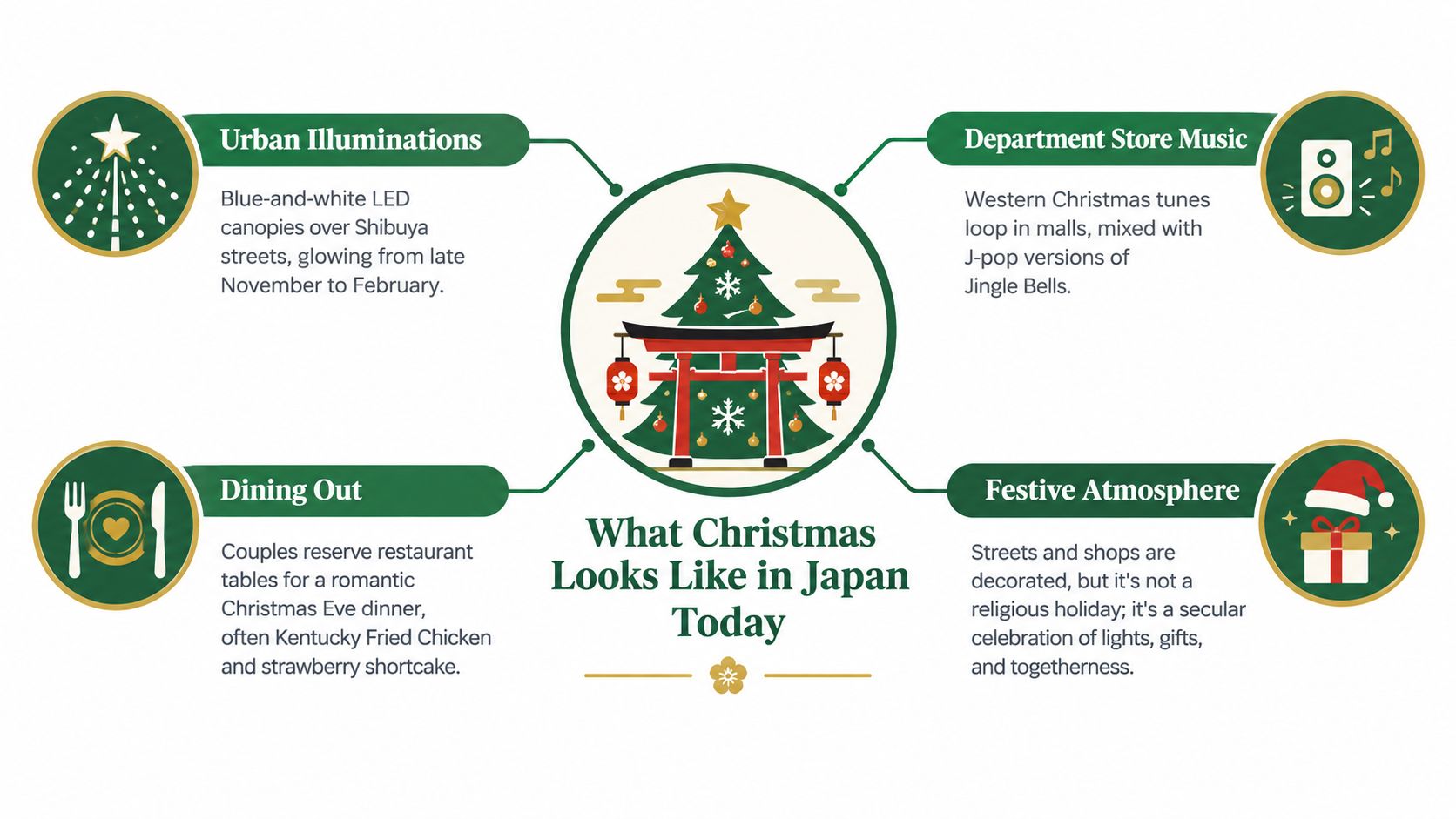
An Australian visitor arriving in Tokyo in late December can easily mistake the atmosphere for a religious festival. Shibuya may have blue-and-white LED canopies, department stores may play Christmas music, and restaurants may be filled with couples. Tokyo Station's countdown market, Roppongi's illumination tunnels, KFC queue ropes outside train stations and Hotel New Otani's strawberry shortcake counters all make the season highly visible.
The important point is that these signs don't all mean the same thing. Modern Japanese Christmas has three overlapping layers:
- Commercial spectacle: Shopping districts, hotels, restaurants and convenience stores sell Christmas-themed food, decorations and gifts.
- Romantic observance: Christmas Eve is strongly associated with couples, special dinners and illuminations.
- Religious observance: Christian communities still hold services in chapels and cathedrals, but religious participation represents a small minority in a country where the Christian population is under 1%. Historical context on Christmas in Japan
That combination makes Christmas in Japan feel festive without making it a national religious occasion. The country's commercial districts can look intensely Christmassy, while offices, schools and public services continue operating normally.
The practical definition: Japan has adopted Christmas as a seasonal tradition, not as a direct replacement for its own winter religious and family customs.
This differs sharply from the Australian summer model. In Australia, Christmas commonly centres on family meals, outdoor gatherings, beach trips and public-holiday routines. In Japan, winter darkness arrives early, city lighting becomes part of the attraction, and Christmas Eve often feels more important than Christmas Day.
Visitors may also notice how comfortably Christmas sits beside Japanese food culture. A festive evening might include fried chicken, strawberry cake and a walk through illuminated streets, while a separate cultural experience might involve learning about Japanese green tea. These aren't contradictions. They show how Japan often absorbs an imported custom, gives it local meanings and places it alongside established traditions.
A Short History of Christmas in Japan
The story begins in 1552, when Jesuit missionaries held a Nativity Mass in Yamaguchi. Historical accounts identify this as the first recorded Christmas celebration in Japan. The event introduced a Christian observance, but it didn't create a continuous national Christmas tradition.
Christianity later faced severe suppression under the Tokugawa shogunate. Following the ban on Christianity, Christmas practices disappeared from public life and Christian communities were forced underground for more than two centuries. This interruption matters because Japan didn't gradually develop Christmas as an uninterrupted religious holiday in the same way some European countries did.
The Meiji period changed the direction of the story. As Japan reopened to Western customs in the late nineteenth century, Christmas began to reappear in public and commercial settings. Oura Cathedral in Nagasaki, constructed in 1859, became a visible Christian landmark and was later designated a National Treasure. Its presence represents the return of open Christian practice, although the later popularity of Christmas would develop mainly through commerce and popular culture.
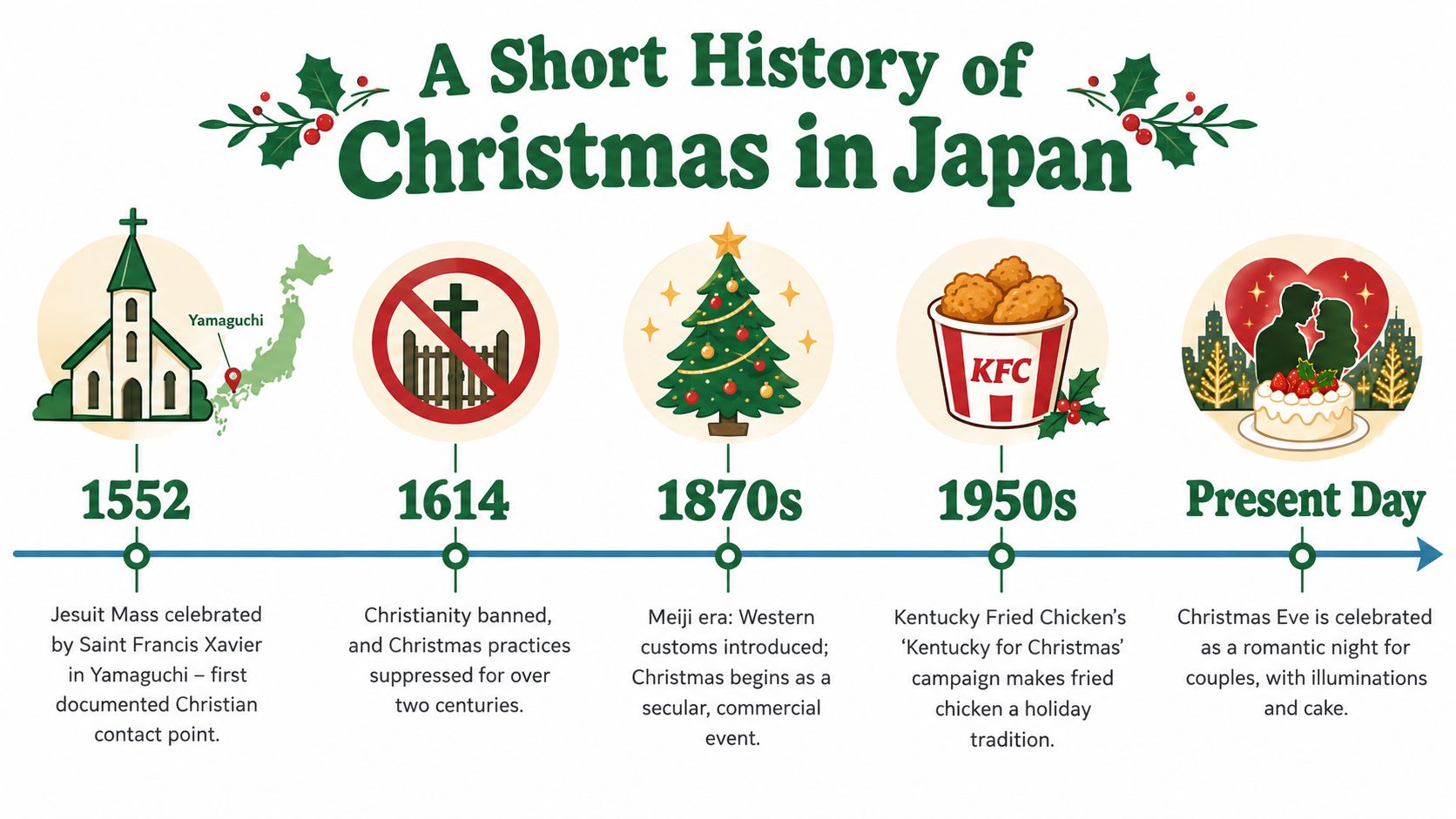
Department stores helped transform Santa, trees and Christmas decorations into consumer imagery. Advertising campaigns in the early twentieth century presented Christmas as an attractive modern occasion, and postwar American cultural influence strengthened that civilian, secular image.
That history helps explain why Japanese Christmas can look familiar while feeling different. The symbols are widely recognised, but the cultural centre of gravity shifted away from church and towards shops, restaurants, food brands and urban entertainment.
For readers curious about how Japanese traditions preserve ritual through preparation and attention, Japanese green tea ceremony offers a useful contrast. A product such as Ceremonial Grade Matcha 60g belongs to that tea tradition, with Shizuoka-sourced, shade-grown matcha intended for whisked preparation. Christmas, by contrast, became popular through a more commercial and social route.
Why Christmas Is Not a Public Holiday in Japan
Japan has 16 national holidays, and none falls in December. December 25 has never been included on the official national holiday calendar, so Christmas doesn't automatically create a day off work or school. Japan's public holiday arrangements therefore produce a very different visitor experience from Australia's Christmas period.
The legal distinction has everyday consequences. Retailers can trade, restaurants can serve customers, offices can open and trains can continue with ordinary weekday operations. Convenience stores also remain part of the normal urban rhythm rather than closing for a nationwide holiday.
Australia gives visitors a useful comparison. Christmas Day and Boxing Day are closely associated with public-holiday closures, altered trading hours and family gatherings. Japan doesn't create that same shutdown pattern for December 24 or December 25.
| Aspect | Japan | Australia |
|---|---|---|
| Christmas Day status | Not a national holiday | Public holiday |
| Christmas Eve | Normal working and school day | Often part of the holiday lead-up |
| Retail | Shops and restaurants generally continue trading | Many businesses close or use reduced hours |
| Transport | Operates as part of the regular weekday system | Holiday timetables and demand patterns may apply |
| Cultural focus | Commercial and romantic Christmas, then New Year | Family-centred Christmas and post-Christmas holidays |
For an Australian traveller, this means you won't necessarily find closed streets or empty shopping centres on December 25. You may instead encounter ordinary commuter traffic, open department stores and restaurants operating with seasonal menus.
Travel takeaway: Don't plan Japan's Christmas period as though the country will stop for a national closure. Check individual venue hours, but expect the wider city to keep moving.
The deeper reason is cultural as well as legal. New Year carries the stronger traditional family significance, with household preparations, visits and established customs concentrated around the turn of the year. Christmas therefore occupies a narrower space, festive and visible, but not institutionally dominant.
Christmas Eve as a Romantic Date Night
Christmas Eve in Japan can look like a date night unfolding across the city. On 24 December, couples often meet after work, visit an illumination display and share dinner, while 25 December is usually a quieter continuation rather than the main family gathering.
The evening often begins with advance planning. Partners reserve a restaurant, hotel buffet or venue with a city view, and popular tables may fill quickly. A plan might include the Tokyo Tower observation deck, a walk through Roppongi's lights or dinner near a major department store. For an Australian visitor, the closest comparison is a booked-out Valentine's evening, placed inside the bright retail setting of the Christmas season.
A simple sequence shows how the tradition works:
- After work: Couples meet in a decorated shopping or business district.
- Early evening: They visit an illumination display or observation point.
- Dinner: A restaurant, hotel buffet or home meal becomes the central occasion.
- Later: Partners exchange gifts, take photographs or continue walking through the lights.
Gifts are usually personal and couple-oriented. Jewellery, perfume and matching accessories suit the date-night mood. Families with children may instead hold a smaller celebration at home, with cake, chicken and presents from Santa.
The romantic image is strong, although it does not describe everyone's evening. Friends, families and people spending Christmas alone also take part in seasonal activities. Commercial Christmas, romantic Christmas and religious observance are separate behaviours, so a couple's dinner should not be mistaken for a religious ceremony.
Australia follows a different calendar rhythm. Christmas Eve is often preparation time, followed by the major family meal on Christmas Day and another public-holiday period around Boxing Day. In Japan, Christmas Eve matters because it offers a recognised opportunity for couples to spend an evening together.
New Year carries the deeper traditional role. Hatsumode visits and osechi are more closely connected with family and cultural observance than Christmas dinner. A simple matcha drink prepared with Premium Sweet Matcha 200g belongs to a Japanese-inspired home ritual, separate from these commercial Christmas customs.
Christmas Food Traditions from Cake to KFC
Japan's most recognisable Christmas meal combines fried chicken and strawberry shortcake. That pairing may surprise Australians, but it makes sense once the history is clear.
KFC Japan linked fried chicken with Christmas through a 1974 marketing campaign. The association became so strong that KFC Japan estimates 3 to 4 million families eat its chicken for Christmas each year, according to coverage of the tradition. KFC and Japan's Christmas custom
The result is easy to observe. Queue barriers appear outside shops, customers place advance orders, and families collect buckets or meal sets for a shared evening at home. The food isn't religious. Its meaning comes from repetition, advertising, convenience and the pleasure of having a familiar seasonal meal.
Christmas cake developed along a parallel path. The classic version is a light sponge covered with whipped cream and decorated with strawberries, Santa figures or other festive details. Patisseries, department-store counters and convenience stores make the cake visible and accessible, turning it into a standard part of the season.
Other foods can appear too. Pizza, roast-style dishes, party appetisers and champagne for adults fit the same social logic. These are easy to share, simple to order and suitable for a gathering that may be held at home rather than around a traditional religious feast.
| Food | Origin story | Typical setting | Modern scale |
|---|---|---|---|
| Fried chicken | Popularised through KFC Japan's 1974 campaign | Home parties, couples' meals and takeaway gatherings | KFC Japan estimates 3 to 4 million families eat it for Christmas |
| Strawberry shortcake | Shaped by Western-style baking and local patisserie culture | Home celebrations, restaurants and hotel counters | A widely recognised seasonal cake custom |
| Pizza and party foods | Adapted for easy sharing | Homes, gatherings and casual celebrations | Seasonal offerings from food chains and retailers |
| Champagne | Adult celebration drink | Restaurant dinners and private meals | A supplementary festive choice |
Christmas cake also creates an interesting connection with Japan's broader flavour culture. Matcha green tea cake shows how Japanese ingredients can enter familiar dessert formats without making the result conventionally Western.
Winter Illuminations Across the Country
Winter illuminations are one of the most striking ways Japan expresses the season. They often operate from late November through winter, so they're better understood as a December-to-February viewing culture than as a display reserved only for Christmas Day.
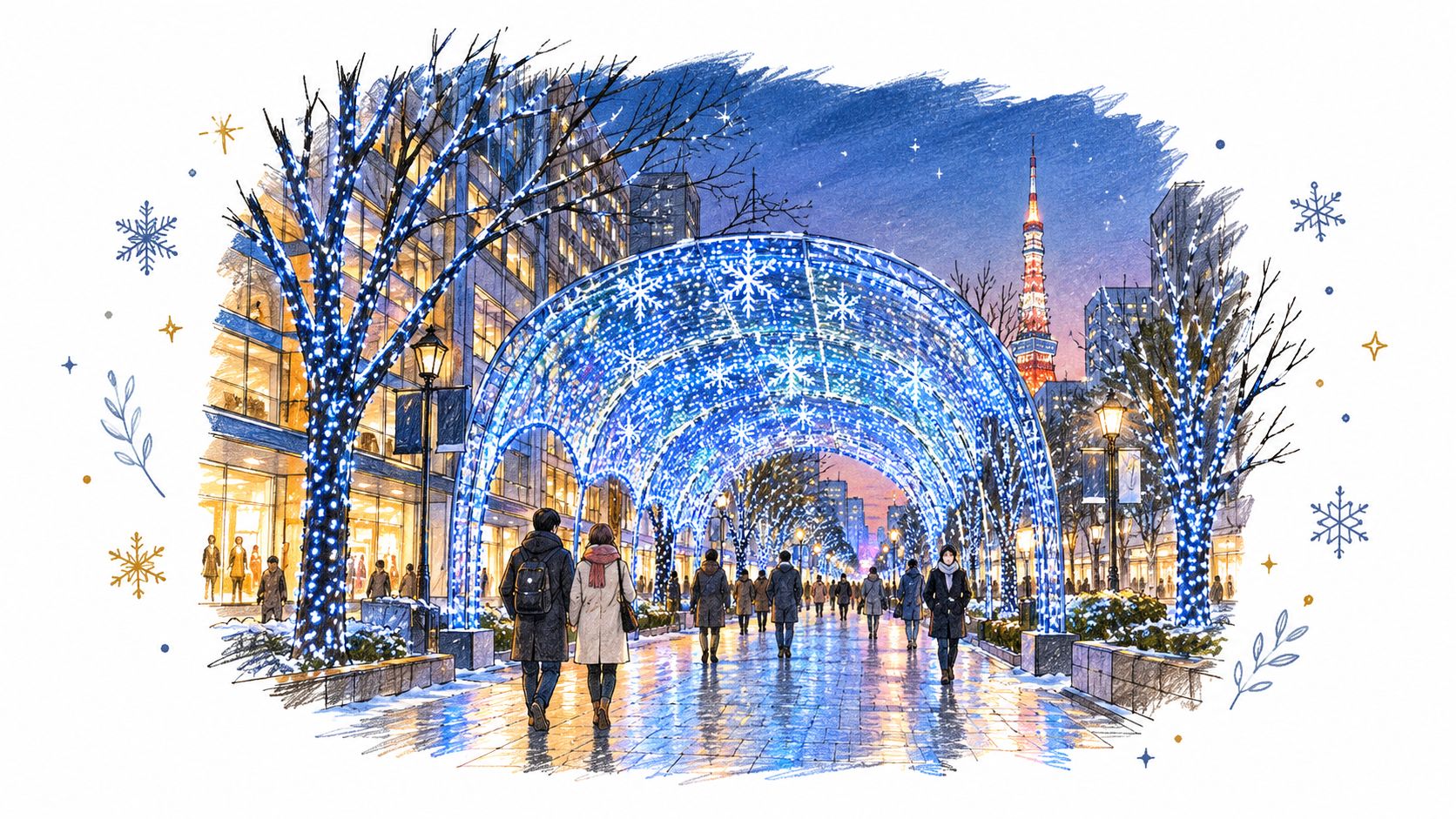
The experience usually begins after dark. Couples, families and photographers walk through streets, parks and commercial precincts designed around light tunnels, decorated trees and reflective installations. Shibuya Blue Cave is associated with blue LED corridors, while Marunouchi near Tokyo Station is known for a champagne-gold atmosphere. Kobe Luminarie adds a more commemorative character, and regional displays in Sendai, Sapporo and Ashikaga show that the custom extends well beyond Tokyo.
Some venues use several million LED bulbs, with the largest displays exceeding five million. Background on Japan's illumination culture The scale can involve sponsor partnerships, dedicated viewing routes and entry fees, especially where installations combine lighting with food stalls or entertainment.
What to look for: Treat an illumination as an evening attraction in its own right, not just decoration outside a shopping centre.
The commercial value comes from extending the season. A display can draw visitors after work, encourage restaurant bookings and keep department stores busy even though Christmas itself isn't a public holiday. Many displays continue beyond December 25, when Japanese businesses begin shifting attention towards New Year.
A visitor should check dates, access rules and ticketing before arriving. Some installations are free street walks, while others use controlled entrances or paid event spaces. Wear warm layers and comfortable shoes, because the most rewarding part is often walking slowly through several connected areas.
This video provides another visual reference for the atmosphere of Japan's winter light displays:
Illuminations explain why Christmas can feel prominent even when the religious dimension remains limited. Light, music and design create a shared public mood that welcomes participation without requiring a particular faith.
The Christmas Market and Consumer Spending
A queue outside KFC, a decorated department-store counter and a hotel Christmas dinner all belong to the same seasonal market. Christmas spending in Japan is visible, yet participation varies widely between households.
Recent reporting cited a 2026 survey in which 54.1% of Japanese respondents said they had no Christmas plans. Among respondents who did have plans, expected spending averaged 16,418 yen, down from more than 22,588 yen two years earlier. The same coverage estimated the broader Christmas market at about 727 billion yen in 2026, roughly two-thirds of its size two years before. Recent Japanese Christmas spending coverage
The figures help separate the market from personal observance. A business can promote Christmas widely even when many people make no special plans. For one person, participation might mean ordering a cake. For another, it could mean viewing lights, buying takeaway or walking through decorated streets.
Visitors usually encounter four spending areas:
- Food: Fried chicken, cake, pizza, restaurant meals and drinks.
- Gifts: Personal presents between partners, friends or family members.
- Experiences: Illumination venues, hotel events, markets and observation decks.
- Atmosphere: Decorations, seasonal merchandise and window displays.
| Category | Typical yen spend per unit | Notes for visitors |
|---|---|---|
| Romantic dinner | Varies by venue | Popular Christmas Eve tables may require advance booking |
| Christmas cake | Varies by size and retailer | Department stores, patisseries and convenience stores commonly offer seasonal versions |
| Fried chicken | Varies by meal set | KFC collection can involve pre-orders and queues |
| Gifts | Varies by item | Couple-oriented presents are a visible part of the season |
| Illuminations | Free or paid, depending on venue | Check the individual event before visiting |
Travel planning adds another layer. 1,058,300 Australian visitors were recorded in 2025, including 121,300 in December, according to official Japanese tourism figures. December is a peak month for Australian travel because school holidays overlap with festive trips.
A busy retail area may therefore contain two overlapping calendars. Japan's Christmas promotions, reservations and displays are active, while Australia's expectation of post-Christmas closures and Boxing Day shopping does not transfer neatly. Shops, restaurants and attractions may operate normally, but popular Christmas experiences can still fill quickly.
What It Means for Travellers and Curious Observers
For an Australian visitor, Japan's Christmas makes more sense as three overlapping behaviours rather than a copy of an Australian holiday. Commercial participation appears in department stores, KFC outlets, cake counters, markets and illuminated streets. Romantic participation centres on Christmas Eve dinners, gifts and evening walks. Religious participation remains visible in churches and chapels, but it does not define the season for most public spaces.
That distinction helps explain a familiar scene: a queue outside a train-station KFC may reflect a seasonal food custom, not religious observance. Likewise, an illumination display can be a date destination, a family outing or a popular winter attraction.
Australian travellers should book Christmas Eve dinners early, particularly at sought-after restaurants and hotels in major cities. Visit illuminations before December 25 if you want their strongest festive mood, although many displays continue afterwards. Check each venue's dates and entry arrangements rather than assuming every event follows the same schedule.
Christmas Day generally does not bring Australia's broad closure pattern. Shops, offices, banks, trains and convenience stores commonly operate, so visitors can usually travel and shop as normal. Popular Christmas meals and experiences may still fill quickly, especially as international visitors and local couples share the same limited tables.
New Year needs separate planning. Hatsumode, osechi and family gatherings belong to a period with deeper traditional importance, so Christmas activities should not be treated as a preview of Japan's main year-end customs.
Christmas plans also vary from person to person. Some people arrange a date, meal or outing, while others treat December 25 as an ordinary day. The reported survey and market context supports that broader point: Christmas is highly visible, but visibility does not mean universal observance.
A respectful approach: Ask what someone does over the winter season instead of assuming Christmas carries the same meaning as it does in Australia.
Enjoy the lights, food and music without judging Japan's Christmas as an incomplete Australian version. Japanese businesses, couples, families and communities have adapted familiar symbols into a local seasonal tradition.
TOO MATCHA. offers Japanese matcha and hojicha powders for whisked drinks, lattes, iced beverages and baking, including ceremonial, culinary and sweetened formats. Explore TOO MATCHA. for Japanese tea powders and recipe ideas for a seasonal table.