Best Tea Canisters Australia: Materials & Storage Guide

The most popular advice about tea canisters in Australia is also the least useful: “Choose any airtight jar.” That may be adequate for a sturdy black tea or a jar of whole spices, but it misses the point with matcha and hojicha powder. These finely milled Japanese teas are exposed to air, moisture, light and kitchen odours across a much larger surface area than intact leaves, so a clear decorative jar can preserve the appearance of your pantry while steadily compromising the tea inside.
Australia adds practical pressure. Kitchens can be warm, bright and humid, while tea often sits near kettles, ovens, coffee machines and spice racks. The right container therefore needs more than an attractive silhouette. It needs an opaque body, a dependable seal, food-contact suitability and a handling routine that prevents condensation and unnecessary oxygen exposure.
| Canister choice | Light protection | Moisture and oxygen control | Practical verdict |
|---|---|---|---|
| Stainless steel | Excellent when fully opaque | Strong with a quality gasket or silicone seal | Best all-round choice for matcha and hojicha |
| Tin | Usually good | Varies widely between traditional and modern designs | Useful if the lid seals firmly and the interior is food-safe |
| Glass with seal | Poor unless kept inside a dark cupboard | Can be good, but the seal is decisive | Better for short-term visibility than maximum protection |
| Ceramic | Depends on glaze and opacity | Lid and glaze quality vary | Attractive, but inspect it carefully before using it for powder |
For shoppers comparing tea canisters Australia options, the central question isn't whether a vessel looks organised. It's whether it can protect a light-sensitive powder in the place where you prepare tea.
Table of Contents
- Why Generic Pantry Jars Fail Delicate Tea Powders
- The Technical Benchmarks for Tea Storage in Australia
- Comparing Canister Materials for Matcha and Hojicha
- Best Practices for Storing Tea in Australian Kitchens
- Sustainability and the Modern Australian Tea Market
- Sourcing Premium Tea and Storage Solutions Locally
- Building Your Ideal Tea Storage Routine
Why Generic Pantry Jars Fail Delicate Tea Powders
Airtightness matters, but it isn't the whole storage system. Matcha and hojicha powder are finely ground, which gives air and moisture more contact with the product than they would have with larger, intact leaves. Every opening introduces fresh oxygen, and every damp spoon or humid kitchen moment creates an opportunity for clumping, muted aroma and a flatter finish.
Matcha shows the damage most visibly. Its vivid green colour can lose intensity when light and oxygen reach the powder, while the fresh, savoury character that makes good matcha enjoyable becomes less pronounced. Hojicha behaves differently in the cup, with roasted, nutty and smoky notes, but its powder still needs protection from humidity, heat and foreign aromas.
The practical test: If you can see the tea through the container, the container is allowing light to reach it. A tight lid doesn't cancel that weakness.
Why clear glass looks better than it performs
Clear glass is popular because it makes the pantry look clean and lets you monitor stock. The problem is that a sunny benchtop, a bright window or strong kitchen lighting exposes the powder every day. Australian retailers commonly advise storing tea in an airtight container in a cool, dry and dark place, away from aromas such as coffee and spices, as described by Tea Journeys' storage guidance.
A glass jar hidden in a dark cupboard can work better than glass left in the light, but it still depends on the lid, gasket and how often you open it. Many pantry jars use a simple clip or screw closure designed for dry-goods organisation rather than the close, repeatable seal needed for a delicate powder.
The same issue applies to unlined ceramic. An opaque ceramic body blocks light, but a porous or poorly glazed interior may retain odours, and a loose decorative lid can leave the powder exposed to humid air. Ceramic isn't automatically unsuitable. It requires more scrutiny than its weight and traditional appearance suggest.
Match the container to the tea
A strong everyday tea may tolerate a less specialised vessel, especially if it's consumed quickly. Matcha for whisking, hojicha for lattes and powders used in baking deserve more careful storage because their fine texture makes contamination and moisture immediately noticeable.
The advice in this airtight tea container guide is useful as a starting point, but “airtight” should be treated as a performance requirement, not a decorative product label. Look for opacity, a food-safe interior, a lid that closes consistently and a size that doesn't leave a large pocket of air around a small quantity of powder.
The Technical Benchmarks for Tea Storage in Australia
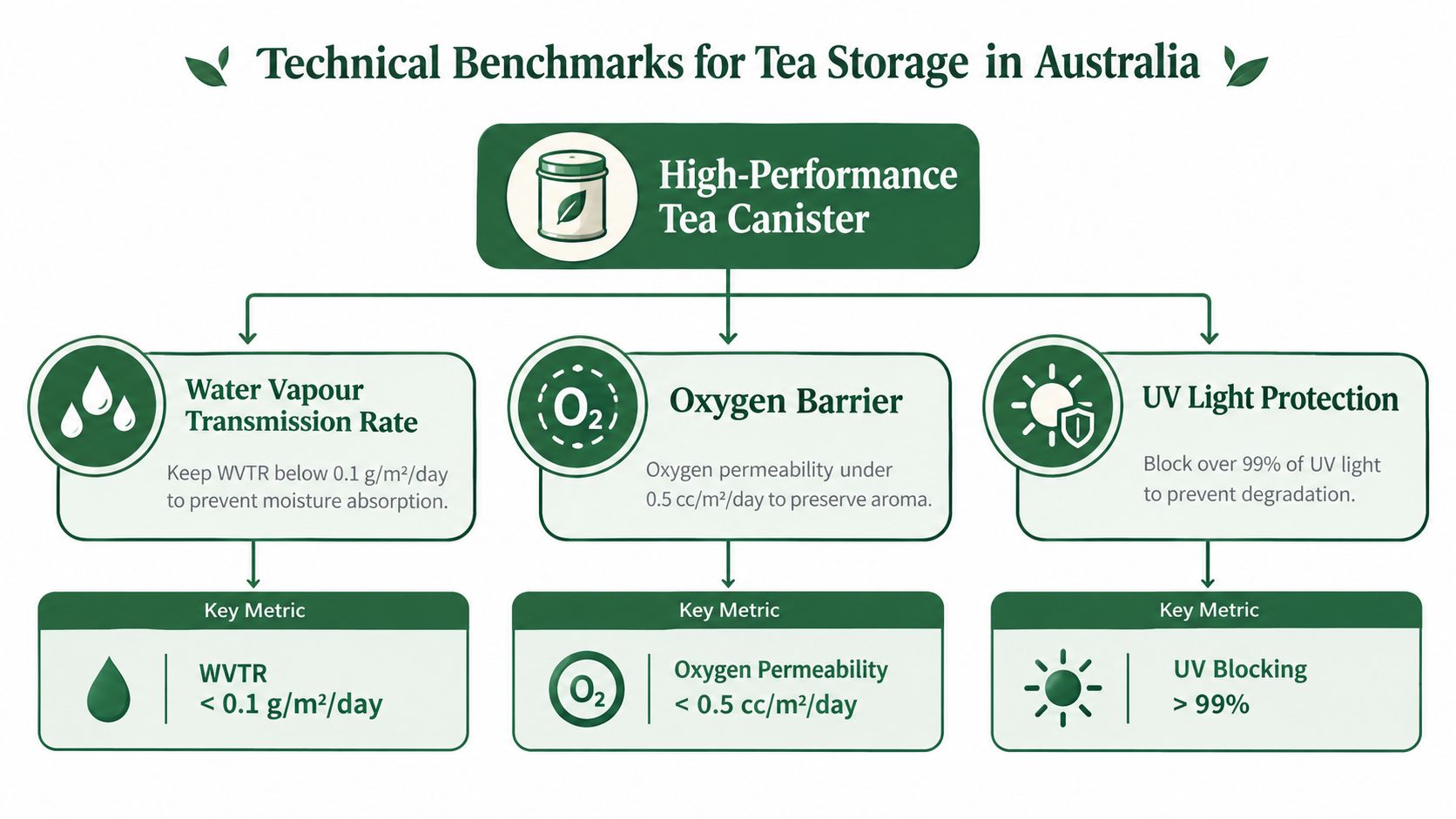
A canister for matcha or hojicha is a small food-contact package, not merely a pantry accessory. Its performance depends on how well the body, lining, lid and seal limit moisture, oxygen, light and odour transfer each time the container is opened in a warm, bright kitchen.
Food Standards Australia New Zealand treats packaging as part of the regulated food-contact system. The canister, lining, seal and plastic components should therefore be suitable for food contact. Water vapour transmission rate, or WVTR, is the most actionable moisture benchmark for tea packaging. A lower WVTR indicates stronger resistance to humid air. Australian packaging guidance identifies high-barrier structures such as PET/AL/PE as premium formats because the aluminium layer helps block moisture, oxygen and light. Metallised PET can cost less, though its barrier is lower than foil-based structures. The food-contact framework appears in Food Standards Australia New Zealand's food packaging guidance.
What to inspect on a canister
Inspect the seal before judging the finish or weight. A silicone gasket should sit evenly around the lid, with no gaps, warping or sections that lift during closure. If the lid depends on friction alone, move the closed canister and check whether it stays secure. A heavy lid does not prove an airtight seal.
A one-way valve can suit some dry-goods formats. It allows internal gases to escape while limiting the entry of oxygen and water vapour. An Australian listing for a 304 stainless steel canister describes this valve for tea, coffee, grains and dried fruit. That makes it a useful functional benchmark, not proof that every valve suits matcha.
A practical Japanese tea canister should also match the quantity you use. Too much empty space leaves more air around a small amount of powder, while an oversized container encourages unnecessary exposure during repeated opening.
Stainless steel canisters sold in Australia commonly combine a steel body with a BPA-free plastic or silicone-sealed lid. One local product specifies a 500 g capacity, showing a practical size used for tea and other dry goods. Capacity alone says nothing about moisture or oxygen control. The Australian stainless-steel canister benchmark shows why body material, lid material and sealing mechanism must be assessed together.
Don't mistake impressive specifications for a complete solution
Commercial barrier figures help when manufacturers publish them, but household canister listings often omit WVTR and oxygen permeability data. Apply the specification hierarchy practically:
- Choose a fully opaque body.
- Confirm a food-safe interior without manufacturing odour.
- Prefer a continuous silicone or rubber gasket to a loose decorative lid.
- Select a size suited to the quantity you use regularly.
- Keep the original high-barrier pouch if the canister offers no equivalent protection.
A canister protects tea only while closed. Repeated opening, a warm shelf and a damp scoop can defeat an otherwise sound design.
Comparing Canister Materials for Matcha and Hojicha
Material choice changes more than appearance. It affects light exposure, durability, cleaning, odour retention and how confidently the lid seals after dozens of openings. For Japanese tea powders, the body should block light first, then the closure should control air and moisture.
| Material | Light Protection | Seal Integrity | Best For |
|---|---|---|---|
| Tin | Usually strong when the body is opaque | Traditional slip lids may be variable; modern gasketed versions perform better | Shorter rotations, classic tea storage and decorative caddies with food-safe interiors |
| Stainless steel | Strong, consistent opacity | Excellent when paired with a properly fitted silicone or rubber gasket | Matcha, hojicha powder and regular kitchen use |
| Glass with seals | Weak in direct light; improved only in a dark cupboard or with an opaque sleeve | Can be strong with a quality gasket | Users who need to see stock and store it in a genuinely dark location |
| Ceramic | Often strong, depending on glaze and opacity | Highly dependent on lid design and fit | Low-frequency use where appearance and weight are acceptable |
Tin offers tradition, but construction decides performance
Tin caddies have a long association with tea because they're light, opaque and easy to decorate. Traditional designs can be excellent for a dry, frequently used tea, but a slip-fit lid isn't automatically airtight. Inspect the rim for a close fit, check for an odourless food-safe lining and avoid assuming that a vintage-looking caddy has modern barrier performance.
Tin can also dent, and a dent around the rim may affect closure. For hojicha powder used often in lattes, that matters more than the visual appeal of the container.
Stainless steel is the dependable default
Stainless steel gives matcha and hojicha the strongest combination of opacity, durability and easy cleaning. It doesn't absorb kitchen aromas in the way a porous or damaged surface can, and it handles daily use without the fragility of glass or ceramic.
The weak point is almost always the lid. A steel body with a badly fitted plastic lid still makes a poor canister. Look for BPA-free plastic or silicone components, an even gasket and a closure that doesn't need excessive force or repeated adjustment. Stainless steel also conducts heat, so don't place it beside an oven, cooktop or sunlit window.
Glass is convenient, but light remains the compromise
Glass makes stock levels visible and is easy to clean, but it allows light to reach the powder unless the jar is deliberately stored in darkness. A gasket can control air exchange, but it can't block light. This makes sealed glass more suitable for a small working quantity in a shaded cupboard than for a full supply left on display.
Ceramic blocks light more effectively, yet its performance depends on the glaze and lid. A glazed interior is preferable to an unsealed surface, particularly when the canister will hold aromatic hojicha powder. For a deeper comparison of handling and container choice, see this guide to storing matcha powder.
Best Practices for Storing Tea in Australian Kitchens
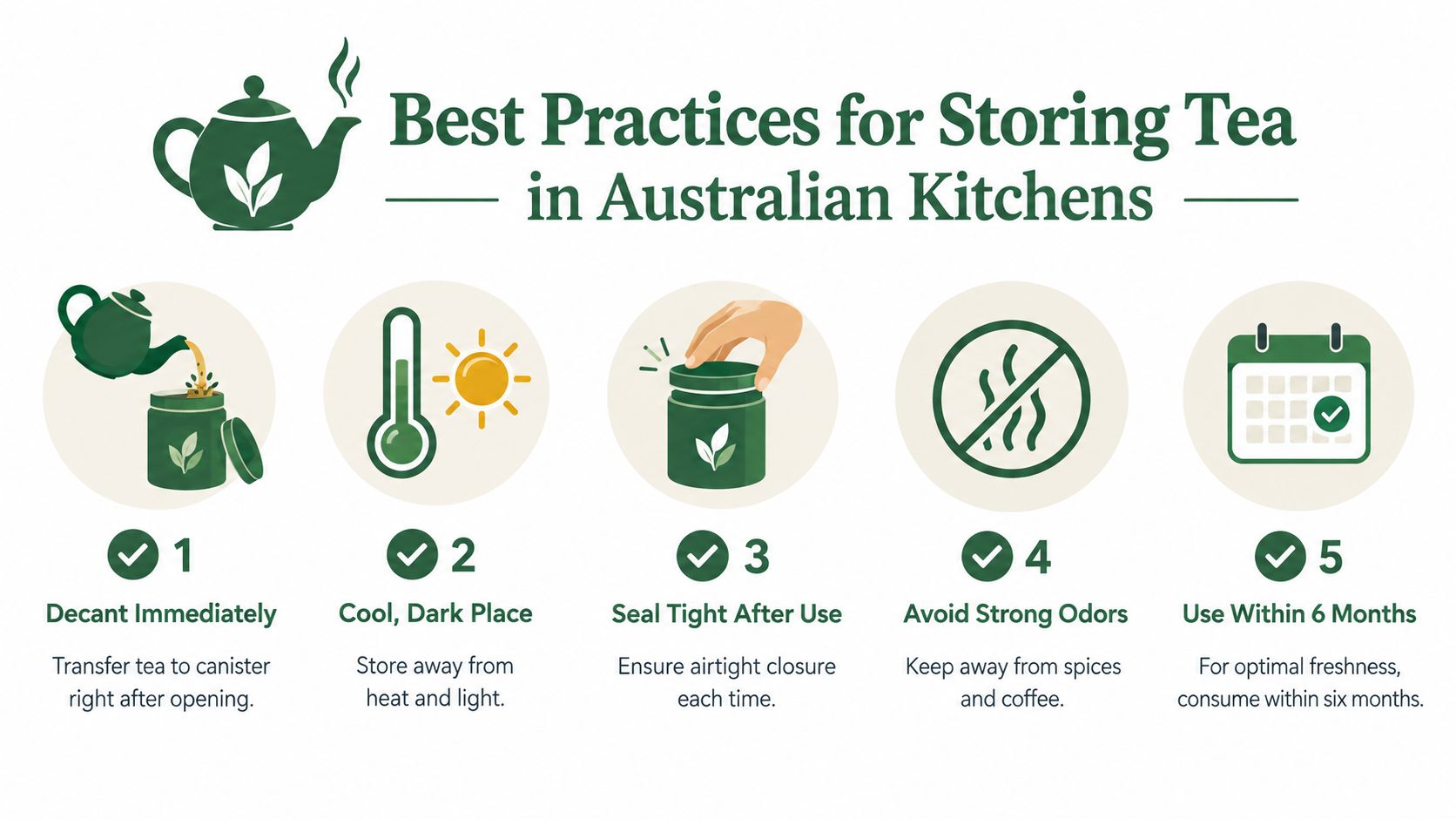
The strongest canister can't rescue poor handling. The aim is to reduce the amount of time the powder spends exposed to warm air, moisture and kitchen smells.
Decant for daily use, not for display
Keep the main supply in its original high-barrier pouch when that packaging is well sealed and opaque. Transfer only a practical working quantity into a smaller, opaque canister, then refill it as needed. This limits the number of times the entire supply is opened and avoids leaving a large unused air space around a small amount of powder.
Before decanting, make sure the canister is completely clean and dry. Never scoop fresh powder into a vessel that still contains residue from coffee, spices or an older batch of tea. A dry stainless-steel scoop is preferable to a wet or recently washed utensil.
Choose the cupboard carefully
Place the canister in a cool, dark cupboard away from the kettle, oven, dishwasher steam, cooktop and direct sunlight. Keep matcha and hojicha away from coffee, curry spices, vanilla and strongly scented pantry goods. Powders can pick up surrounding aromas, and the lid is not a substitute for sensible placement.
A small working tin near the preparation area is convenient, but convenience should not mean a shelf above the toaster or beside a window. If the only suitable storage space is away from the bench, that trade-off is worthwhile.
Treat refrigeration as a handling problem
Refrigeration can reduce exposure to warm kitchen conditions, but removing a cold container into warm, humid air creates a condensation risk. If you refrigerate matcha, keep it sealed while it returns to room temperature, and don't open it until the container and its contents have warmed sufficiently. Opening a cold canister immediately can draw moist air inside and cause clumping.
The Ceremonial Grade Matcha 60g format is suited to a smaller rotation for drinkers who want to work through a limited quantity rather than repeatedly open a large supply. Its stated product description identifies matcha sourced from Shizuoka, Japan, shade-grown, stone-ground and offered in a 60 g format. Those product details don't replace good storage, but a smaller pack can make disciplined rotation easier.
Sustainability and the Modern Australian Tea Market
A tea canister sits inside a much larger packaging conversation. Australia placed 6.74 million tonnes of packaging on the market in 2020–21, while 3.79 million tonnes of post-consumer packaging were recovered in the same year, according to the Australian Packaging Consumption and Recovery Data executive summary. The same source records that 44% of packaging placed on the market in 2020–21 was disposed of to landfill.
The later national picture shows both scale and pressure. Packaging placed on the market reached 6.84 million tonnes in 2023–24, and 86% of packaging was assessed as having good recyclability, as reported in the same packaging data source. A reusable canister won't solve packaging waste by itself, but its value improves when you use it repeatedly, choose a durable material and avoid buying disposable decorative containers that quickly become redundant.
Reuse works when the container earns its place
Australia's packaging policy has set a national target for 100% of packaging to be reusable, recyclable or compostable by 2025, a target discussed in FoodNavigator's reporting on sustainable tea packaging. For tea sellers, that makes material selection part of product positioning as well as a practical design issue.
The historical context is especially relevant. Tea canisters and caddies have been part of Australian household storage since the 1800s, with imported canisters recorded in the nineteenth century and the Wilson brothers manufacturing tin biscuit canisters in North Melbourne from 1889. Their range later included tea canisters that remained in Australian production and marketing until at least the 1960s, as documented by Australian Plastics History.
Tea was expensive enough to need secure storage, and colonial caddies could be lined with tin or lead and sometimes fitted with locks. Many Australian kitchens used canisters in sets of 4 to 6, covering tea, coffee, flour, sugar and cereal. That history frames the modern canister correctly. It's a practical preservation tool, not merely a pantry accessory.
Bulk buying needs a two-container system
Australia imported tea valued at US$111.4 million and totalling 11.23 million kilograms in 2023, according to World Integrated Trade Solution import data. A separate market overview reports that imports reached about 13,000 tonnes worth US$128 million in 2024, with the United Arab Emirates, India and Sri Lanka supplying 63% of total import volume. Black tea in immediate packings under 3 kg accounted for 71% of import volume and 74% of import value, according to IndexBox's Australian tea market overview.
For households and cafés, the sensible response is not automatically buying the biggest canister. Keep bulk stock sealed in suitable packaging, then maintain a smaller daily-use container. That approach reduces exposure, supports stock rotation and lets one durable canister serve different teas over time.
Sourcing Premium Tea and Storage Solutions Locally
Generic homeware retailers can provide attractive jars, but they rarely explain whether a lid is suitable for matcha powder, whether the interior is food-safe or how the vessel should be handled in a humid kitchen. Dedicated Japanese tea suppliers start with the product's sensitivity, which makes their packaging and storage advice more useful.
Look for suppliers that clearly identify the tea format, origin information and intended use. A ceremonial powder for whisking has different handling demands from culinary matcha used in baking, while hojicha powder may be opened frequently for lattes and desserts. The supplier should also use packaging that blocks light and limits air exposure, ideally with a resealable closure or a format that can remain protected until you're ready to decant.
What local sourcing can and can't solve
Buying from an Australian supplier can simplify delivery, customer support and replacement advice, but local dispatch doesn't automatically guarantee freshness. Ask how the tea is packed, whether the pouch is opaque and resealable, and whether the supplier distinguishes small household formats from café or wholesale supply.
A dedicated supplier may also carry practical accessories, including scoops, whisks, starter sets and storage vessels that match the product format. That reduces the risk of pairing a delicate powder with a visually appealing but poorly sealed jar.
Evaluate the recommendation, not just the product page
A responsible supplier should tell you to store tea away from light, heat, moisture and strong aromas. They should explain whether refrigeration is appropriate for the product and how to avoid condensation. They shouldn't imply that a canister alone preserves quality indefinitely.
For Australian buyers, the most useful combination is protected original packaging plus a smaller opaque working canister. That setup works for a home drinker, a baker who opens powder repeatedly and a café that needs controlled replenishment from a larger stock pack. It also makes it easier to identify stale or contaminated stock before it affects every serving.
Building Your Ideal Tea Storage Routine
A daily matcha drinker needs a small opaque canister beside a clean preparation area, with the main pouch stored away from heat and light. Open the working container only for scooping, close it immediately and keep the scoop dry. If the powder is used slowly, choose a smaller vessel rather than filling a large one with a thin layer of tea surrounded by air.
A casual hojicha baker can use the same principle differently. Keep the bulk pouch sealed, decant a modest working amount before a baking session and wash and dry the canister fully before changing products. Hojicha's roasted aroma is enjoyable in a cup, but it can transfer to other ingredients if the vessel isn't cleaned properly.
A small café or foodservice operation needs stock control as well as freshness protection. Use a labelled bulk container, maintain a smaller service canister and replenish it on a consistent schedule. Matcha for whisked drinks, culinary matcha for recipes and hojicha powder should have separate containers, scoops and labels to prevent mix-ups.
The most expensive canister is wasted if it sits beside a sunny window with a damp spoon inside. Choose opacity, a reliable gasket and a manageable size, then pair those features with protected bulk packaging and disciplined rotation.
TOO MATCHA. offers Japanese-sourced matcha and hojicha powders in formats for home preparation, recipes, cafés and wholesale supply, alongside preparation tools and recipe guidance. Visit TOO MATCHA. to explore tea powders and storage-friendly pack sizes for a fresher Australian kitchen routine.