Matcha Latte Benefits: What the Science Actually Says

At 7am, a matcha latte can look like a softer alternative to the flat white beside it. The colour is brighter, the flavour is more savoury, and the drink has become familiar on Australian café menus. But the useful question isn't whether matcha looks healthier. It's how much matcha is in your cup, how much caffeine that delivers, and whether the preparation suits your body and routine.
The most practical matcha latte benefits centre on focused alertness, a different caffeine experience, and the catechins delivered by the whole powdered leaf. Those benefits aren't automatic, and they don't make matcha a cure-all. Dose, milk, sweetener, timing, medication use, and your own caffeine sensitivity all matter.
Table of Contents
- Why Your Morning Cup Deserves a Second Look
- What Matcha Actually Is Before It Reaches Your Cup
- The Calm Focus Mechanism Behind the Hype
- Matcha Latte Versus Coffee and Green Tea
- Serving Suggestions That Keep the Benefits Intact
- Who Should Treat Matcha Lattes With Care
- Building a Matcha Habit That Actually Works
Why Your Morning Cup Deserves a Second Look
At a Melbourne café just after 7am, you might be answering messages with one hand while ordering a flat white with the other. The first mouthful helps you feel operational. Then the morning accelerates, the phone keeps buzzing, and by mid-morning you're looking for another lift rather than enjoying the coffee.
That pattern doesn't mean coffee is wrong for you. It does show that your morning drink is part of a larger routine, one that affects when you feel alert, when you feel flat, and whether a late caffeine top-up interferes with sleep. A matcha latte offers a different starting point because it combines caffeine with L-theanine, an amino acid naturally found in tea. Australian reporting describes matcha as containing both compounds and notes that some researchers associate their combination with calm alertness without the same crash some people experience with coffee. ABC News coverage of matcha's caffeine and L-theanine profile
The distinction is sensory as much as chemical. Coffee often arrives as a quick, forceful burst. Matcha can feel more measured, although it still contains enough caffeine to affect sleep, anxiety, heart rate, and concentration in sensitive people. A café latte may also contain more powder than a cautious home preparation, so the green colour doesn't tell you the dose.
Practical rule: Treat matcha as a caffeinated drink with a smoother reputation, not as caffeine-free wellness water.
Australian demand makes this question more relevant. Japan green tea imports into Australia reached 195,319 kilograms between January and August 2025, a 131% year-on-year increase, and Australia was reported as the eighth-largest export destination for Japanese green tea globally. The same reporting valued Australia's matcha market at more than $54 million in 2024. Australian matcha market and import reporting
So the useful comparison isn't “matcha good, coffee bad”. It's a closer look at the cup in front of you. The sections ahead focus on real serving amounts, the caffeine and theanine pairing, preparation choices, and the situations where a matcha latte deserves caution.
What Matcha Actually Is Before It Reaches Your Cup
Matcha and ordinary green tea begin with the same tea plant, Camellia sinensis. The important difference is what happens before and after harvest.
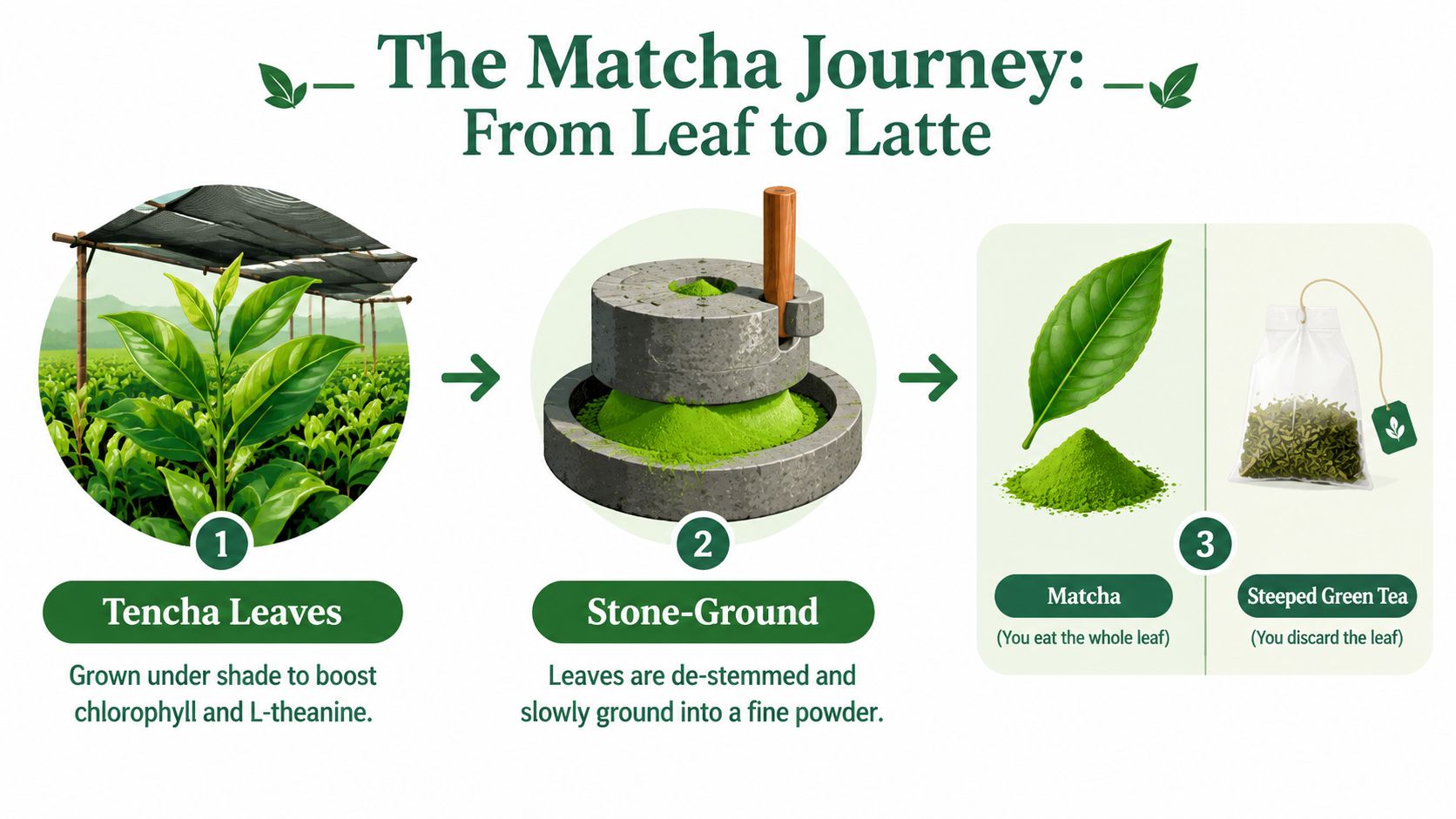
Tea growers shade the plants before picking, producing tencha leaves with a vivid colour and a flavour that can be sweet, savoury, and rich with umami. The leaves are then processed, stripped of stems and veins, and ground into a fine powder. Stone milling matters because the powder must be fine enough to suspend evenly in water, creating the familiar velvety texture rather than a gritty drink.
Whole leaf versus steeped leaf
Think of steeped green tea as borrowing the leaf. You place the leaves in water, extract some soluble compounds, then discard them. Matcha is different. You whisk the leaf itself into the water and drink the resulting suspension.
That whole-leaf habit explains why matcha can deliver more caffeine, L-theanine, and catechins per gram than an ordinary green tea infusion. Australian testing found average levels of 6.46 mg/g of theanine and 16.28 mg/g of caffeine in green tea infusions from a dataset of 36 commercial brands, compared with 21.3 mg/g of theanine and 33.3 mg/g of caffeine in a tested matcha product. In that dataset, matcha contained roughly 3.3 times more theanine and about 2.0 times more caffeine per gram than the average green tea infusion. Australian matcha potency lab results
Choosing a grade for a latte
Grade is mainly a flavour and use decision. A brighter, smoother matcha suits whisking with water or a lightly flavoured latte. A stronger, more assertive powder works well when milk, sweetener, vanilla, or other ingredients share the cup.
If you want to taste matcha without committing to a large amount, Ceremonial Grade Matcha 60g is described as sourced from Shizuoka, Japan, shade-grown, stone-ground, and intended to produce a smooth, umami-rich cup. It's vegan, gluten free, dairy free, and additive free. For technique ideas, see this practical guide to using matcha powder.
The Calm Focus Mechanism Behind the Hype
The phrase “calm focus” makes more sense once you separate the two main players. Caffeine increases alertness, while L-theanine may soften the sharper edges of stimulation. Matcha brings both in the same powdered leaf, so the experience can differ from taking caffeine alone.
A human trial summarised in a peer-reviewed review used 2.07 g of matcha per day, delivering 72.5 mg of caffeine and 50.3 mg of theanine. After two weeks, participants showed measurable improvements in attention-related and mood-related outcomes. That doesn't prove every latte will create the same result, but it gives the idea a useful dose context. Peer-reviewed review of matcha and cognitive outcomes
A separate randomised, double-blind, placebo-controlled crossover study tested 27 healthy adults using 100 mg of L-theanine plus 50 mg of caffeine. The combined condition improved speed of perception, alertness, and attention compared with caffeine alone and placebo, with lower ratings for some side effects, including headaches. The tested combination isn't identical to every café latte, but it supports a plausible explanation for why tea can feel less jagged than caffeine by itself. Australian evidence on L-theanine and caffeine
What the ratio means in practice
The 2.07 g matcha serving works out to a little under one part theanine to one and a half parts caffeine by weight. In everyday terms, that's enough caffeine for noticeable alertness, paired with enough theanine to make the stimulation feel less abrupt for some drinkers.
The brain mechanisms are more complicated than a simple “calm chemical”. Research discussions connect L-theanine with relaxed wakefulness and changes in brain activity, while caffeine influences alertness and attention. It's safer to describe the outcome modestly: matcha may support focused alertness, but it won't replace sleep, reduce every form of anxiety, or guarantee a crash-free afternoon.
Matcha and green tea in context
The whole-leaf advantage is real, but exact amounts vary by product and preparation. The verified Australian comparisons below show the composition difference clearly without pretending that every cup has the same laboratory profile.
| Compound | Matcha latte, 2g powder | Steeped green tea, 250ml |
|---|---|---|
| Caffeine | 72.5 mg in the cited 2.07g serving | 16.28 mg/g in the cited green tea infusion dataset |
| L-theanine | 50.3 mg in the cited 2.07g serving | 6.46 mg/g in the cited green tea infusion dataset |
| Catechins | 171.0 mg in the cited 2.07g serving | Not specified in the verified comparison |
The matcha serving also delivered 171.0 mg of catechins, a broad family of tea polyphenols. That makes antioxidant content one of the genuine matcha latte benefits, although “antioxidant” doesn't automatically mean a guaranteed disease-prevention effect. Milk, sweetener, and the amount of powder change the final drink, so a latte shouldn't be treated as a laboratory serving by default.
For a focused explanation of the amino acid itself, read about matcha and L-theanine benefits.
Matcha Latte Versus Coffee and Green Tea
The caffeine in an Australian café matcha latte can sit closer to coffee than many drinkers expect. Australian reporting citing Bond University pharmacology expertise places a typical 250 ml matcha serve at about 60–75 mg of caffeine. Independent Australian guidance gives a wider range of 38–176 mg per serve, depending on whether the recipe uses half to one teaspoon of powder. Australian guidance on caffeine in matcha lattes Australian reporting on matcha and coffee caffeine
Powder quantity explains much of that gap. A lightly mixed home latte may land near the lower end, while a café using a generous scoop can approach or exceed the caffeine in a standard coffee. Australian coverage commonly places a standard matcha serve at roughly 70 mg of caffeine, compared with 80–100 mg in coffee.
| Drink, typical serve | Caffeine | EGCG antioxidants | Energy curve | Average café price |
|---|---|---|---|---|
| Matcha latte, 250ml | 60–75 mg | Not specified in verified data | Often described as smoother, but dose and sensitivity matter | Australian menu prices range from $6.30 to $18.95, according to Australian matcha trend reporting |
| Coffee, standard serve | 80–100 mg | Not specified in verified data | Often feels faster and more forceful | Not specified in verified data |
| Steeped green tea | Lower than typical matcha in Australian reporting | Not specified in verified data | Generally lighter | Not specified in verified data |
The comparison makes one practical point clear: a matcha latte is not automatically a low-caffeine drink. Its appeal may lie in the shape of the experience, rather than in minimal stimulation. Caffeine arrives alongside L-theanine, and a latte is often sipped more slowly than a short coffee, although individual sensitivity still matters.
Price adds another part of the Australian café decision. Recent trend reporting placed matcha menu prices between $6.30 and $18.95, while social share rose 53% year-on-year. At home, the cost depends on powder grade, scoop size, milk, and sweetener. Your own recipe and receipt give a more useful comparison than a general average.
Choose coffee for its flavour and familiar, faster effect. Choose steeped green tea for a lighter drink. Choose matcha when you want the whole-leaf composition and a latte ritual, then adjust the powder so the caffeine suits your day.
Serving Suggestions That Keep the Benefits Intact
Preparation changes both taste and dose. Start with the powder amount, not the cup size. A large glass can still contain a small dose, while a modest café cup may contain enough powder to deliver caffeine closer to coffee.
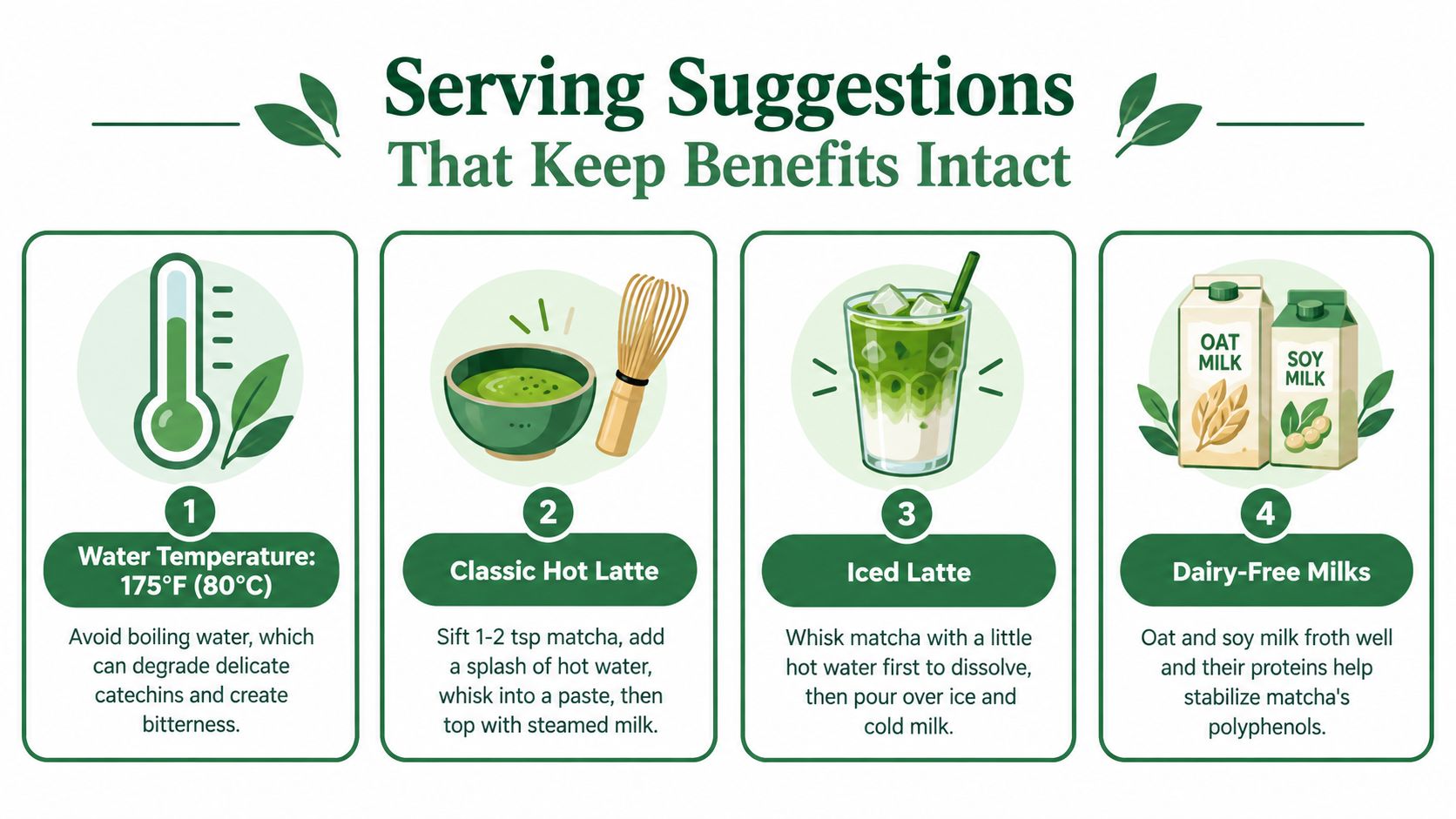
For a hot latte, use warm water rather than boiling water. A temperature around 80°C is shown in the preparation guidance below. Very hot water can make matcha taste harsh and bitter, which often leads people to add more sweetener. Sifting helps prevent clumps, while a bamboo whisk creates a smoother suspension. A jar with a secure lid or a shaker bottle works when speed matters.
Hot, iced, and dairy-free choices
Iced matcha needs the same first move as a hot latte: mix the powder with a small amount of warm water before adding ice and cold milk. That short dissolve-and-whisk stage prevents dry pockets of powder floating through the glass.
Oat and soy milks suit lattes because they froth easily and bring enough body to balance matcha's savoury taste. Dairy-free milk isn't automatically nutritionally superior, but it can be a useful flavour and dietary choice. If you use dairy, expect the milk to soften bitterness, while the drink's polyphenol absorption may be affected by the pairing.
Use ceremonial or premium matcha when you intend to taste the tea itself. Use a more intense culinary powder when milk, fruit, cocoa, or baking ingredients will dominate. Grade won't rescue an oversized dose or a heavily sweetened recipe.
Scaling the powder to your goal
The cited human serving used 2.07 g, with 72.5 mg caffeine and 50.3 mg theanine. That makes roughly 2 g a useful reference point for a substantial latte, not a universal prescription. Independent Australian guidance shows that half to one teaspoon can produce a much wider caffeine range, 38–176 mg, depending on the product and serving.
A sensible starting point: Begin with a lighter powder amount at home, assess your response, and only increase it if the flavour and caffeine both suit you.
Sweetener changes the drink's energy profile mainly by adding sugar, not by improving matcha's functional effect. Honey, maple syrup, or a sweetened blend can make bitterness easier to manage, but sweetness can also make it harder to notice how strong the caffeine feels. For a ready-to-mix option, Premium Sweet Matcha 200g is described as a pre-sweetened blend containing 30% authentic Japanese green tea leaves, with no added sweetener required during preparation. It's vegan, gluten free, dairy free, and additive free.
Who Should Treat Matcha Lattes With Care
Matcha is a real caffeinated food, and the whole-leaf format creates considerations that benefit-led descriptions often skip. People with iron deficiency or low iron should avoid taking matcha alongside iron-containing medicines or supplements unless their clinician or pharmacist advises otherwise, because tea compounds may affect absorption.
Medication use also deserves an individual check. Australian reporting highlights that matcha contains compounds that may affect medication absorption. If you take blood thinners, MAOIs, medicines affecting heart rhythm, or any regular prescription, ask a pharmacist about your specific combination rather than relying on a general internet rule.
Pregnant or breastfeeding readers should count matcha as part of their total caffeine intake and discuss a suitable limit with their healthcare professional. People with anxiety, arrhythmia, reflux, or strong late-day caffeine sensitivity may also need a smaller serving or an earlier caffeine window.
Dose stacking is easy
The wider Australian range of 38–176 mg per matcha latte means two drinks can represent very different caffeine totals. Adding coffee, an energy drink, or pre-workout can push the total higher without making the caffeine obvious, especially when each drink is consumed in a different setting.
A practical self-audit looks for symptoms rather than chasing a universal number:
- Jittery afternoons: Reduce the powder or remove the second serving.
- Poor sleep onset: Move the final matcha earlier or skip it.
- Racing heartbeat or tremor: Stop increasing the dose and seek medical advice if symptoms persist.
- Headaches or irritability: Review the combined caffeine from matcha, coffee, tea, energy drinks, and pre-workout.
For a focused explanation of what changes the caffeine amount in a latte, see caffeine in matcha latte. The aim isn't to make matcha seem dangerous. It's to match the drink to the person drinking it.
Building a Matcha Habit That Actually Works
The strongest matcha latte benefits are easier to notice when the habit is predictable. A random café drink with an unknown scoop size tells you less than a repeatable home preparation that you can adjust.
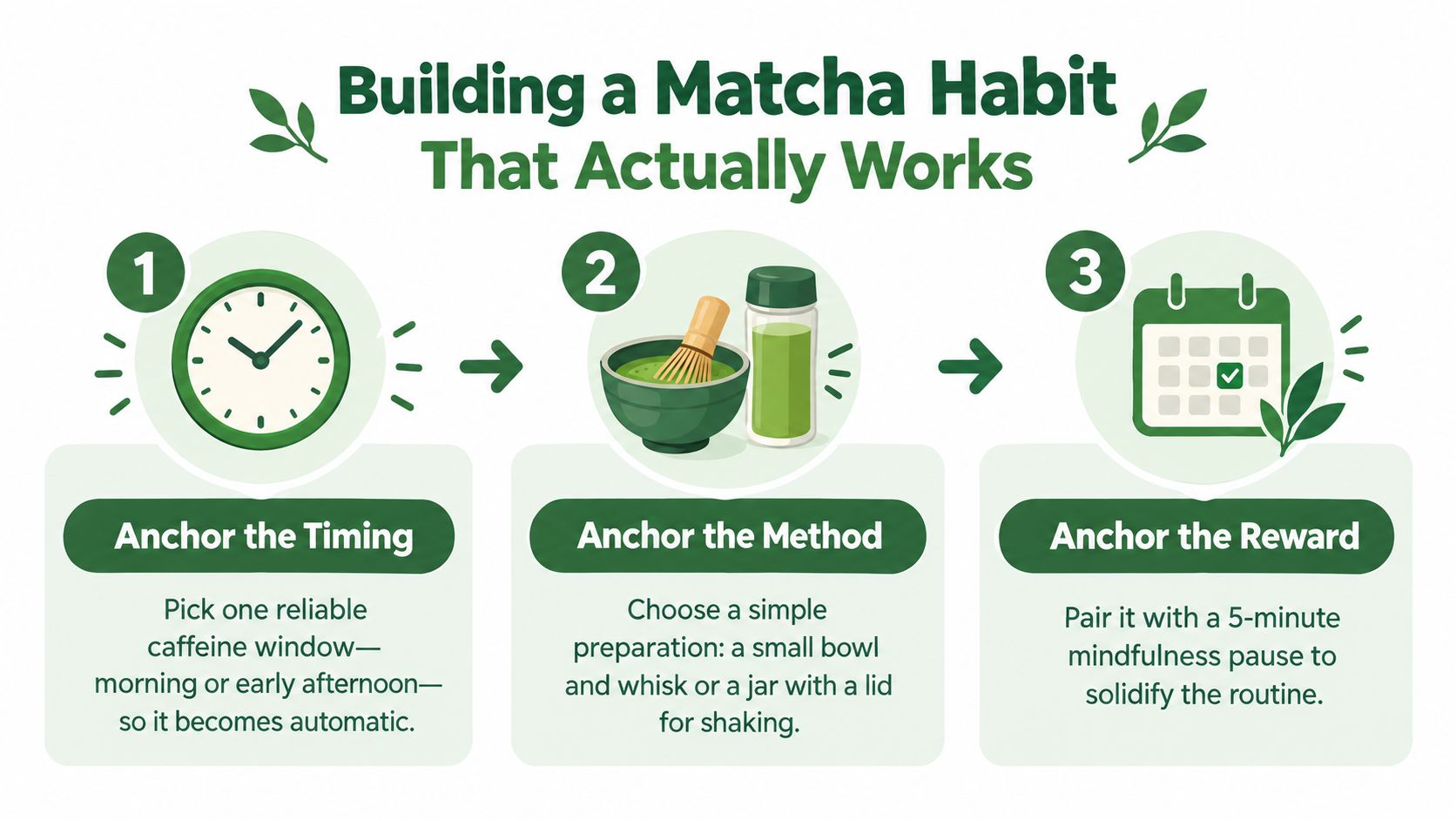
Start with one caffeine window. Morning works for many people, while an early afternoon serving may suit those who work later. Finishing before 2pm is a reasonable routine choice for people who want to protect evening sleep, although your own sensitivity matters more than the clock.
Next, choose a format you can repeat without friction. A hot oat latte may fit a kitchen morning. An iced coconut or soy version may work after lunch. A whisk is pleasant if you enjoy the ritual, while a jar with a lid is practical when you're leaving for work.
Pair the cup with a useful task
A caffeine habit becomes easier to evaluate when it has a clear purpose. Pair your latte with a deep-work block, study session, walking meeting, or a short pause before opening your inbox. The drink then becomes a cue for focused behaviour rather than another item consumed while scrolling.
Use the verified 2.07 g serving as a reference point, not a target everyone must reach. One serving can suit someone who wants a substantial morning drink. A more sensitive person may prefer a lighter serving, while splitting a smaller total amount across the day may feel gentler, provided the caffeine still fits their tolerance and doesn't disturb sleep.
Track three things for two weeks: energy, afternoon alertness, and sleep onset. If you feel steady and sleep normally, your amount may be working. If you feel wired, flat, or restless at night, reduce the powder or move the drink earlier.
Consistency matters more than chasing a stronger green colour or a bigger scoop. Start with one intentional matcha latte this week, prepare it the same way each time, and let your own response guide the next adjustment.
TOO MATCHA. offers Japanese matcha and hojicha powders in formats for traditional whisking, lattes, iced drinks, cooking, and quick sweetened preparation. Visit TOO MATCHA. to compare grades and choose a powder that matches the way you want to build your next Australian café-style cup at home.