
Strawberry Cold Foam Recipe: Make It Silky Every Time

You've stood in the kitchen with a punnet of strawberries, an iced drink sweating on the bench, and a frother in your hand, wondering why yesterday's pink cap was glossy and today's sank in a minute. Eyeballing the fruit and cream is usually the reason. A spoonful extra purée, milk that isn't quite cold, or ten seconds too long with the frother changes everything. This strawberry cold foam recipe fixes that by weighing each ingredient and using a simple pour test. You'll know what worked, you'll be able to repeat it, and you'll change one thing at a time when it doesn't.
Table of Contents
- Ingredients and Ratios for One Drink
- How to Make Strawberry Cold Foam Step by Step
- Fixing Foam That Collapses, Streaks or Goes Gritty
- Storing Cold Foam and Keeping It Food Safe
- Dairy-Free and Lower-Sugar Base Swaps
- Pairing Cold Foam with Matcha and Hojicha
- Run a Single Drink Test Before You Scale
Ingredients and Ratios for One Drink
Strawberry cold foam is a lightly sweetened, aerated topping poured over a cold drink, and the amounts below make enough for one 350 to 450 ml cup. Set out a digital gram scale, a fine-mesh sieve, a small jug and a handheld milk frother before you weigh anything. A colander won't do here because it lets seeds through.
Ratios for One Strawberry Cold Foam
| Ingredient | Amount per drink | Role in the foam |
|---|---|---|
| Strawberry purée, strained | 30-40 g | Colour, fruit flavour and sweetness |
| Sugar or syrup | Start with 5 g, to taste | Balances tart berries |
| Milk or barista oat milk, chilled | 60-80 g | Builds the foam base and volume |
| Cream, chilled | 20-30 g | Adds richness and holds the foam longer |
Each part has a separate job. The purée carries colour and strawberry flavour, the milk gives the foam its aerated volume, and the cream adds richness and helps the cap hold. If you push the purée up for a deeper pink, you usually lose stability. If you push the cream up for stability, the fruit tastes muted.
Start with about 5 g sugar, then taste the purée before you add more. Australian berries vary a lot through the season, so a fixed amount won't suit every batch. Early fruit can be sharp, peak-season fruit often needs almost nothing, and frozen berries sit somewhere in between.
Use fresh berries when they're in season and smell fragrant at the top of the punnet. Frozen or puréed fruit is the consistent fallback when supply drops or fresh berries look pale and watery. Thaw frozen fruit fully and drain loose juice, otherwise you'll add weight that looks like purée but behaves like water.
The mixture should taste a little sharper before frothing than you'd want in the finished drink, because the milk and cream soften the fruit.
Do a quick check before you switch the frother on. The base should be thick enough to coat a spoon and not run straight off it. It should look pale pink rather than bright red, which usually means the fruit is balanced rather than dominant. Berries, milk and cream should already be 5°C or colder, straight from the fridge, because a warm start makes every later step harder.
How to Make Strawberry Cold Foam Step by Step
Work in two stages. Make a smooth purée first, then stir it into a very cold base and froth briefly. The FSANZ temperature control guidance identifies milk and cream as foods that need temperature control and should be held at 5°C or colder, which is also the practical target for a foam that holds.
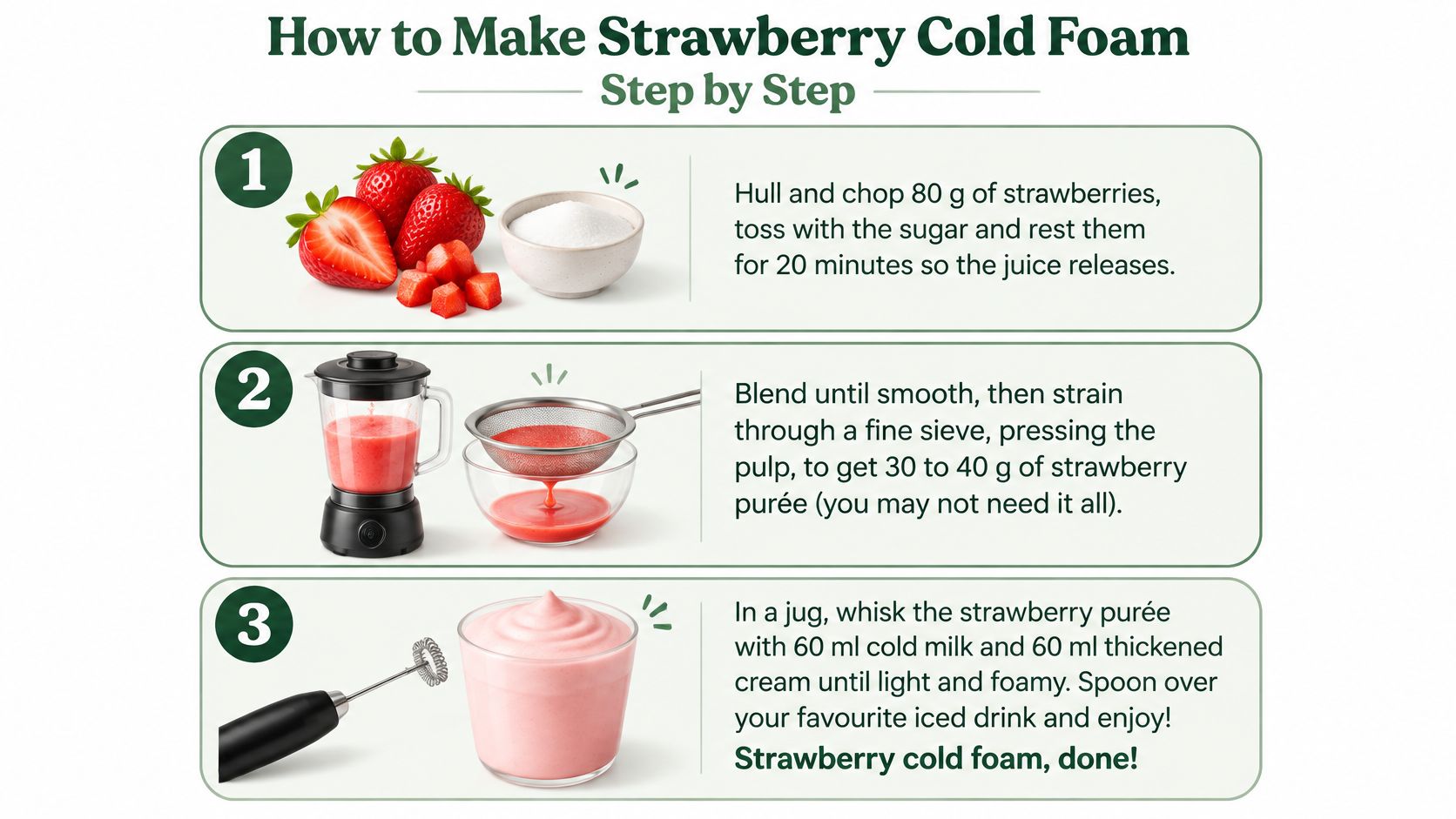
Make and Strain the Purée
- Hull and chop 80 g strawberries, toss them with the sugar and rest them for 20 minutes. The sugar draws out juice, so the berries blend smoothly without extra water.
- Blend until smooth, then strain through a fine sieve, pressing the pulp with the back of a spoon. You want 30 to 40 g strained purée per drink. Don't skip straining, because seeds and insoluble fibre interfere with fine bubble formation.
- Chill the purée until it's very cold. Warm purée will warm the milk on contact and give you a loose foam that collapses fast.
Build and Froth the Base
- Stir the purée into the chilled milk and cream in a small jug. Mix it through the base rather than layering it on top, so the colour spreads evenly and you don't get pink streaks.
- Froth in short bursts with a handheld frother held just under the surface, where it can draw in a little air without splashing. Choosing the right tool matters here, and this guide to an electric milk frother for home drinks covers what to look for. Stop once the volume visibly rises but the mixture still pours.
- Pour slowly over the back of a spoon onto your iced drink. The spoon breaks the fall, so the foam sits as a cap rather than plunging into the drink below.
Over-frothing is the most tempting mistake. It feels productive, but it creates large bubbles that look impressive for seconds and then vanish. Fine, glossy foam with bubbles you can barely see lasts far longer than a tall, airy mound.
- Record the finished foam mass and pour time, plus how long the cap holds. That's how you standardise a good batch instead of hoping to remember it. A healthy result is a glossy cap that stays continuous for at least 5 minutes, pours without separation, and shows no weeping at the edges. If it fails that test, you've got numbers to adjust, not a vague memory.
Fixing Foam That Collapses, Streaks or Goes Gritty
Start with temperature, because it is the cause most home cooks rule out first just because the bottle came from the fridge. Chill the jug itself as well: a room-temperature jug pulls heat out of a small volume of dairy faster than many people expect.
Cold Foam Problems, Causes and Fixes
| Symptom | Likely cause | Fix |
|---|---|---|
| Foam collapses within a minute | Base not cold enough or purée not strained | Chill milk and cream again and strain twice |
| Large, bubbly foam | Over-frothing or frother held too deep | Froth in short bursts just under the surface |
| Foam too thin to hold a cap | Too little cream or too much fruit | Add 5 g more cream, not more purée |
| Pink streaks or separation | Purée poured on top, or too watery | Mix purée into the cold base first and drain excess juice |
| Gritty texture | Seeds or fibre passed through | Strain through a fine sieve, not a colander |
Collapse within a minute usually means something in the jug was warmer than you thought. Purée blended at room temperature is the usual offender, especially if it sat on the bench while you made the drink underneath. Chill everything again and strain twice before you touch the ratios.
Large, bubbly foam comes from technique: the frother is sitting too deep in the jug or running too long in one go. Held near the surface, it draws in air in small amounts and builds a fine, glossy structure. Plunged to the bottom, it whips the whole volume into big pockets that look impressive for seconds and then drain away. Short bursts, check the volume, then short bursts again.
Thin foam tempts people to add more strawberry for body. That backfires, because extra fruit adds water and acidity. Add 5 g more cream instead and keep the purée where it is. You gain stability without dulling the drink, and the fruit flavour stays clean rather than stewed.
Practical rule: Change one variable per batch. If you chill harder, strain twice and add cream all at once, you'll get a better foam and no idea why.
Streaks and separation happen when purée meets foam at the end rather than the start, or when thawed berries released juice you didn't drain. Mix the purée into the cold base first and pour off any standing liquid before it goes in. Grit means seeds got through, so use the fine sieve every time and rinse it between batches so old fibre doesn't carry over.
Some fixes belong to the same session: temperature and frothing changes need nothing but the same ingredients and another two minutes. Grit and watery purée need a fresh purée, and a base that has been sitting out needs replacing rather than rescuing. Sorting a batch into one of those two groups before you start adjusting saves you from tuning ratios that were never the problem.
Storing Cold Foam and Keeping It Food Safe
Finished foam doesn't store. It loses structure within hours, weeps into the drink, and re-frothing a flat batch gives you large, tired bubbles rather than a fresh cap. Make the foam to order and prepare the components ahead instead.
What You Can Prepare Ahead
Keep strained strawberry purée in a sealed container in the fridge and use it within two to three days. Press a lid on firmly and give it a quick smell before each use. Sour or fizzy notes mean it's done, however good it still looks.
Freeze spare purée in an ice cube tray so you can thaw only what you need. Move cubes to the fridge overnight, then strain again if they've separated into juice and pulp. Skipping that second strain puts the watery part straight back into your foam.
Keep milk and cream at 5°C or colder until the moment you froth them. Don't return an unused dairy mixture to the bottle after it has sat out on the bench, because you'd be putting a warmed, handled mixture back into a clean supply. Pour what you need into the jug and put the bottles straight back in the fridge.
The cold chain matters at home for the same reason it matters in a café. Dairy mixtures are a food safety risk at room temperature, and a jug forgotten beside the kettle warms faster than you'd expect. Treat bench time as part of the recipe, not a pause in it.
A simple routine works well. Prepare purée once a week, chill the bottles before you start, and discard any purée that smells sour or looks cloudy. You'll spend two minutes frothing and almost no time troubleshooting.
Dairy-Free and Lower-Sugar Base Swaps
Dairy-free foam works well, but only if you name the substitute instead of calling everything plant-based. According to the FSANZ food allergies guidance, milk, soy, peanuts, tree nuts, eggs, sesame, fish, crustaceans, molluscs, lupin and wheat are among the major allergens, and they must be declared whenever present as ingredients, including in very small amounts.
Dairy-Free Bases Compared
| Base | Foam behaviour | Allergen to declare | Best for |
|---|---|---|---|
| Dairy milk and cream | Thickest and most stable | Milk | Classic café style |
| Barista oat milk | Light, slightly sweet, foams easily | Gluten if the oats are not certified gluten free | Closest dairy-free match |
| Soy milk | Stable with a mild bean note | Soy | Creamy café-style foam |
| Almond milk | Thinner, needs extra cream or a spoon of oat milk | Tree nuts | A lighter drink if a thinner cap is acceptable |
| Coconut-based cream | Rich and dense | Not on the FSANZ major allergen list, still check the label | Dessert-style drink |
Barista oat milk often surprises because it's the closest match to dairy in both foam and flavour. It's lightly sweet on its own, so you can often reduce the sugar in the purée. If you're building the drink underneath at the same time, this vegan matcha latte recipe uses the same logic for the base layer.
Soy milk gives a stable, creamy foam and holds a cap respectably, with a mild bean note that strawberry mostly covers. Almond milk is the honest disappointment of the group. It's thin, so add extra cream or a spoon of oat milk if you want the cap to sit rather than drift.
Coconut-based cream goes the other way and produces a rich, dense foam that reads as dessert. That's lovely over a plain iced tea and too much over an already sweet latte. Pick it deliberately, not as a default.
For a lower-sugar version, separate the two sources in your head. Strawberries supply naturally occurring sugars, while syrup and sweetened condensed milk add added sugar on top. Start with less sweetener, taste the purée, and add only what the berries need.
Cream also adds saturated fat, so a reduced-fat dairy base or an oat-based base is the lighter option. Check the labels of syrups and flavoured milks before you serve anyone else, because a substitute can introduce soy or tree nuts even when the original version only contained milk.
Pairing Cold Foam with Matcha and Hojicha
Strawberry foam can overwhelm a delicate tea if both layers are sweet. Keep the drink underneath lightly sweetened, leave a little headspace, then pour the foam over the back of a spoon to keep the layers distinct.
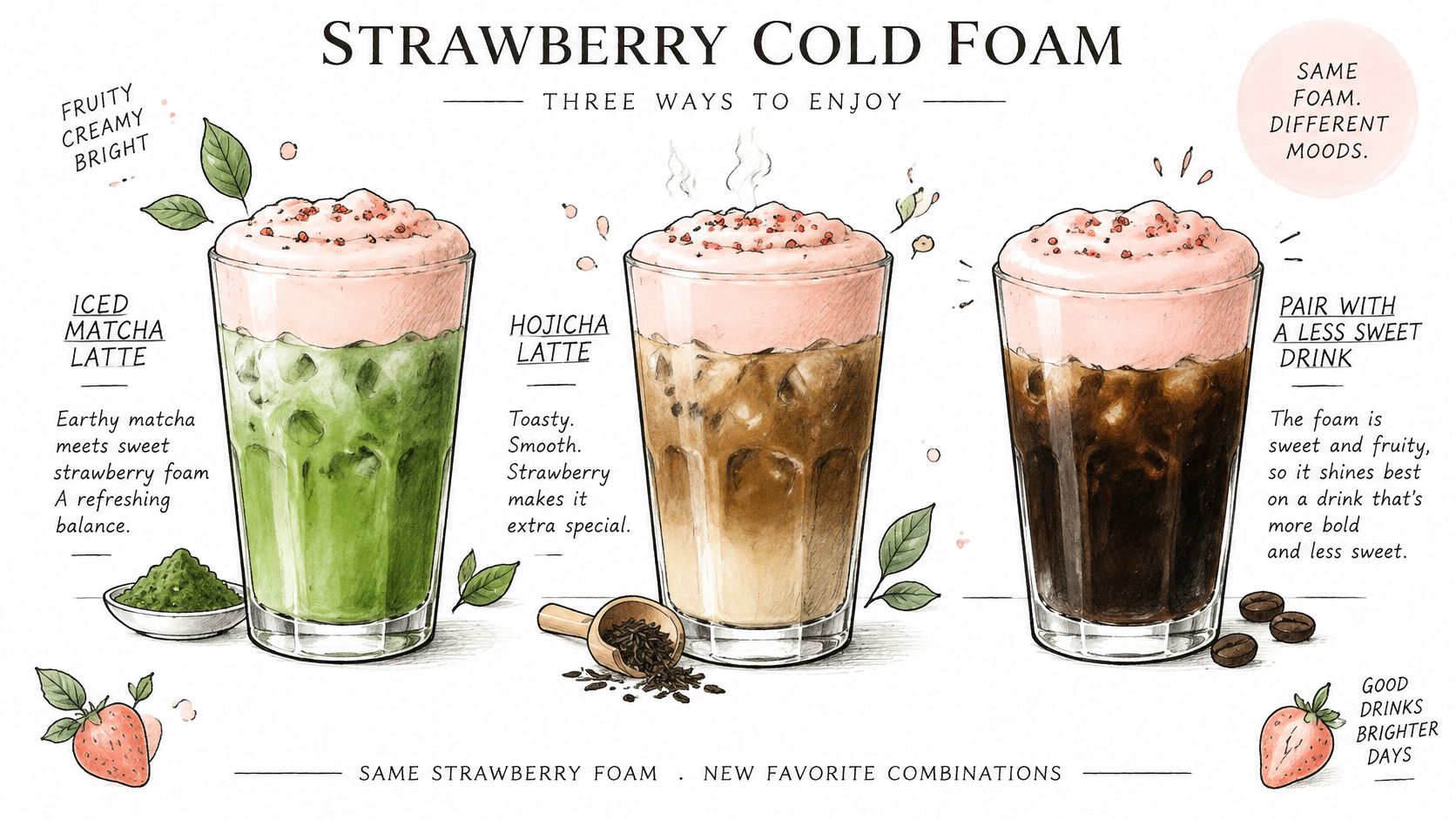
Three Pairings That Work
- Iced matcha latte: Its grassy flavour balances bright strawberry. Keep the base lightly sweetened so the tea still comes through.
- Iced hojicha latte: Roasted, toasty notes contrast with the berry. For another hojicha pairing, see this hojicha coconut cloud recipe.
- Sweetened matcha drink: Reduce the sugar in the foam to account for sweetness in the base.
Matcha style also affects the balance. Culinary matcha has a bold, earthy flavour suited to a more assertive drink, while ceremonial matcha is intended for traditional whisked tea. Premium Sweet Matcha is sweet, smooth and mild, with no bitterness. If you use Premium Sweet Matcha 200g, start with less sugar in the strawberry purée and taste before adding more. The 1kg size is blended with 30% authentic Japanese green tea leaves.
Watch how the layers come together in this short video before building your drink.
Judge sweetness across both layers. Foam that tastes balanced on a spoon can make a sweetened latte cloying. Leave the base slightly less sweet, then let the strawberry cap provide the fruit and sweetness in each sip.
Run a Single Drink Test Before You Scale
Start with one drink, because a single batch isolates which change mattered. A jug of failed foam hides the cause. One weighed batch tells you whether the purée was too wet, the milk too warm or the cream too lean.
Use the weigh, chill and short-burst froth method from the step-by-step above, with these test weights: 35 g strained strawberry purée, 70 g chilled milk and 25 g chilled cream. For a dairy-free test, use 90 g barista oat milk and skip the cream. Add 5 g sugar only if the purée tastes sharp on its own. Chill everything to 5°C or colder, including the jug if your kitchen runs warm.
Pour the foam over the back of a spoon onto iced hojicha or a lightly sweetened iced matcha, leaving headspace so the cap sits above the liquid. Hojicha 500g dissolves into hot or iced lattes and blends into baked goods and desserts. Premium Sweet Matcha is sweet, smooth and mild with no bitterness, so either makes a stable test base. The matcha is freshly shipped from Japan, which helps the flavour stay clear under a fruit topping.
Judge the drink at the 5-minute mark using the pass test from the step-by-step method. Then write down purée weight, milk weight, cream weight, froth seconds and cap minutes. That one line turns a lucky drink into a repeatable ratio.
If it fails, change only one variable on the next drink, in this order: temperature first, then 5 g more cream, then a second strain. Make a second matching batch before you double any weights. Two matching singles prove the method far better than one big batch does.
Once your test drink passes, repeat it on a base of Japanese matcha or hojicha, from ceremonial and culinary matcha to pre-sweetened blends for quick iced lattes. You'll find the powders, accessories and recipe ideas to repeat the drink at TOO MATCHA.