Sencha Tea Powder Explained: Uses, Flavour, and Sourcing
You've opened a pouch of green tea powder, warmed some water and reached for the whisk. The drink looks promising, but your first sip is grassier and brisker than the creamy matcha latte you remember from the café. Before changing your technique, check what's in the pouch.
Table of Contents
- The Powdered Tea Confusion at Your Bench
- What Sencha Tea Powder Actually Is
- Powdered Sencha, Matcha, and Loose Leaf Compared
- How Sencha Tea Powder Performs in Drinks and Recipes
- Sourcing and Buying Decisions for Australian Shoppers
- Caffeine, Serving Sizes, and Australian Labelling Notes
- Choosing Between Powdered Sencha, Matcha, and Loose Leaf
- Common Questions About Sencha Tea Powder
The Powdered Tea Confusion at Your Bench
Green tea powder isn't a precise product identity. It describes a form, not necessarily how the leaves were grown or processed. A pouch labelled sencha tea powder and another labelled matcha can both contain powdered Japanese green tea, yet they aren't interchangeable descriptions.
That matters when you're trying to recreate a drink. If you expect soft umami and get a drying finish instead, you might blame your whisk, water or milk. Those details can influence the result, but they can't turn one leaf-processing method into another.
Start with the product name
Look past the green colour and find the actual tea description. Does the seller identify ground sencha, matcha, or a sweetened blend? Each gives you a different starting point for preparation.
- Ground sencha should be understood as powdered sencha leaf, with its own flavour and preparation needs.
- Matcha refers to a different cultivation and processing pathway, not an especially fine green powder.
- Sweetened blends need an ingredient check before you add sugar or substitute them into a recipe.
A familiar kitchen example makes the distinction useful. You might enjoy a brisk sencha powder stirred into sweetened milk while preferring matcha whisked with water alone. Neither outcome means you've bought the wrong tea; you've discovered that different powders suit different jobs.
Bench-side rule: Identify the leaf product before trying to copy the café drink.
The useful question isn't whether powdered sencha is better or worse than matcha. It's whether the powder you've bought matches the cup you want to make, the recipe you're cooking and the caffeine information you need. Sencha tea powder deserves to be chosen on its own terms, rather than treated as an imitation.
What Sencha Tea Powder Actually Is
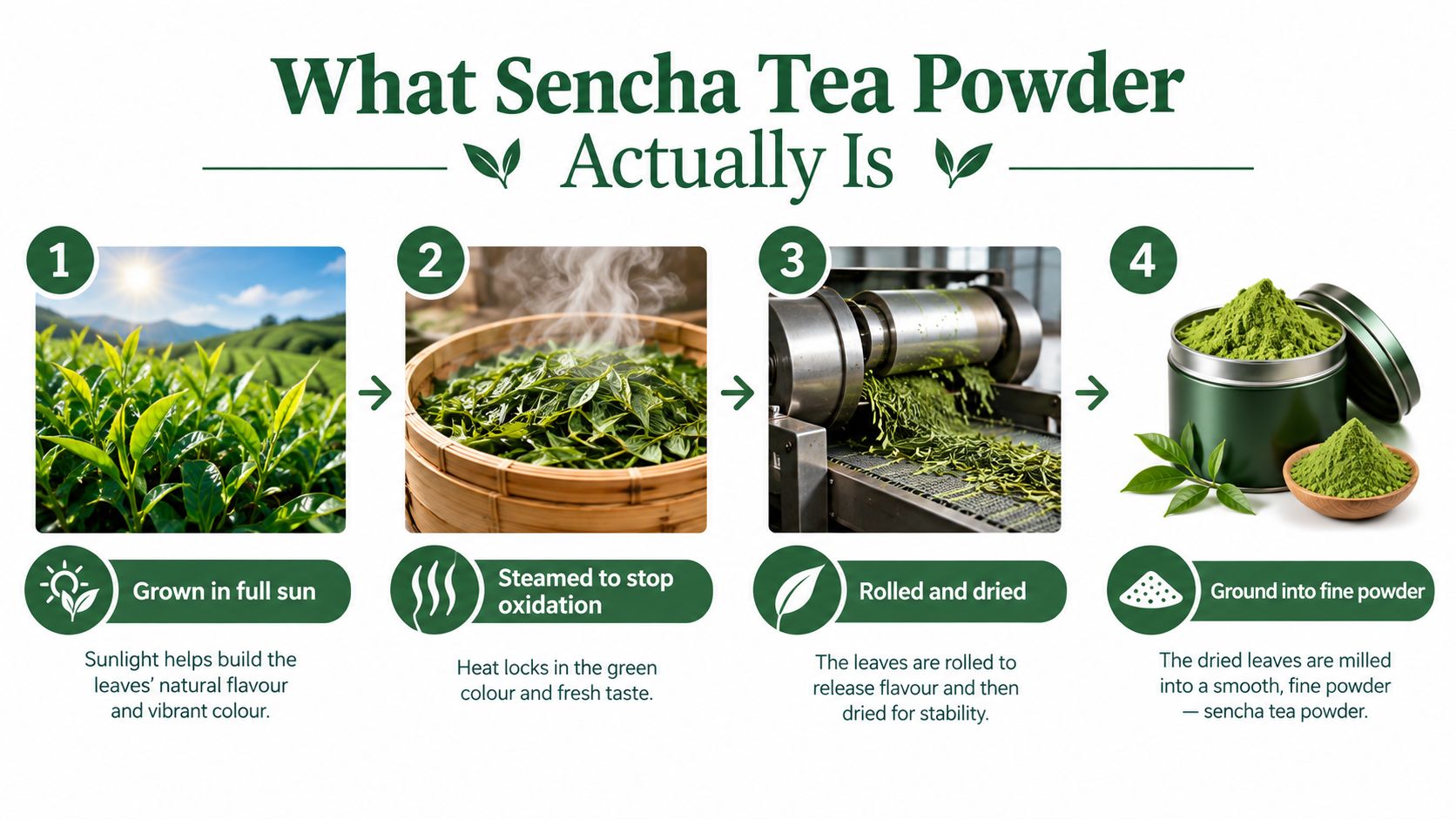
Sencha tea powder is dried sencha leaf milled into powder. Its identity begins before grinding: the leaves have already undergone sencha processing. Milling changes the format, but it doesn't erase the way the tea was made.
Conventional sencha is associated with sun-grown cultivation and a steamed, rolled and dried processing sequence. Matcha follows a different route, using shaded leaves that are steamed and dried without the conventional rolling stage. The distinction between standard rolled tea processing and matcha processing is described in this peer-reviewed paper on Japanese tea production.
Follow the leaf before the mill
Steaming inactivates enzymes involved in oxidation. Rolling then shapes the sencha leaf before drying, producing the familiar narrow leaf form used for traditional steeping. To make powdered sencha, the producer mills that dried material.
Matcha's precursor is tencha-style leaf material, produced through shading and processing without that rolling stage. Grinding both products doesn't make their starting materials identical, any more than grinding different roasted coffees makes them taste the same.
The production paper also reports that shading increases amino-acid and caffeine contents while decreasing catechin content. These differences help explain why powdered Japanese teas can vary in umami, bitterness and caffeine, although they don't establish the exact composition of a particular pouch.
Translate processing into flavour expectations
Think of powdered sencha as a candidate for a grassy, crisp and astringent cup. If you're accustomed to a ceremonial matcha with pronounced savoury depth, sencha may feel more direct and less creamy. Treat those words as tasting prompts, not promises that every product will behave alike.
Colour needs similar care. Don't assume sencha must be brighter than gyokuro, or that every matcha will look more vivid than every sencha powder. Origin, leaf selection, processing and the product's condition all matter when assessing what's in front of you.
- For the label: Look for the tea's identity, not just the word “powder”.
- For the palate: Notice grassiness, drying sensation and savoury depth separately.
- For expectations: Judge the actual product rather than treating a grade name as a guaranteed flavour.
The simplest explanation to give a friend is this: powdered sencha starts as sencha; matcha starts through a different production pathway.
Powdered Sencha, Matcha, and Loose Leaf Compared
Choose between these formats by considering what you'll prepare most often. A traditional infusion, a whisked bowl and a milk-based drink ask different things of the tea. Cost also needs a product-level comparison rather than an assumed ranking.
Powdered sencha vs matcha vs loose-leaf sencha
| Attribute | Powdered sencha | Matcha | Loose-leaf sencha |
|---|---|---|---|
| Flavour profile | Look for grassy briskness and astringency | Look for vegetal flavour and umami depth | Assess the balance achieved through steeping |
| Colour in the cup | Depends on the powder and preparation | Depends on the product; vivid green may be a selection goal | An infusion rather than an opaque powdered drink |
| Caffeine per typical serve | Needs supplier data and measured powder | Needs supplier data and measured powder | Depends on the tea and extraction |
| Preparation effort | Disperse and whisk or blend | Sift if needed, then whisk or blend | Steep, then separate the leaves |
| Recipe versatility | Consider for lattes, baking and savoury experiments | Consider for pure sipping, lattes and desserts | Best suited to steeping or tea-infused liquids |
| Typical price per cup | Calculate from pack price and your measured use | Calculate from pack price and your measured use | Calculate from leaf use and preparation |
| Best use case | When you enjoy its flavour in the finished recipe | When matcha flavour, colour or ritual matters | When you enjoy controlling an infusion |
The caffeine row deliberately avoids a simple low-to-high ranking. A product name doesn't tell you the dose in your cup. Likewise, powdered sencha isn't automatically cheaper than matcha: compare actual pack prices, usable quantities and the amount you enjoy per preparation.
Match the format to the experience
For milk drinks and baking, I'd choose the powder whose flavour remains pleasant in the finished food. Paying for a delicate pure-sipping profile makes little sense if a strongly flavoured recipe conceals what you enjoy about it. Loose leaf offers a different pleasure: adjusting extraction rather than incorporating powder.
For a specific matcha reference, Ceremonial Grade Matcha 60g is described as shade-grown tea from Shizuoka, Japan, stone-ground for whisked preparation, with a smooth flavour and rich umami. Those details identify its intended drinking experience without making it a universal substitute for sencha.
The right comparison is between finished cups you enjoy, not between names you think you ought to prefer.
Keep the differences between sencha and matcha in mind when shopping. Choose sencha powder for its character, matcha for the matcha experience, and loose leaf when steeping is part of the appeal.
How Sencha Tea Powder Performs in Drinks and Recipes
Start with a small test preparation rather than a full batch of baking. Taste the powder with water, then try it in the drink or food you want to make. That separates your opinion of the tea from your opinion of the recipe.
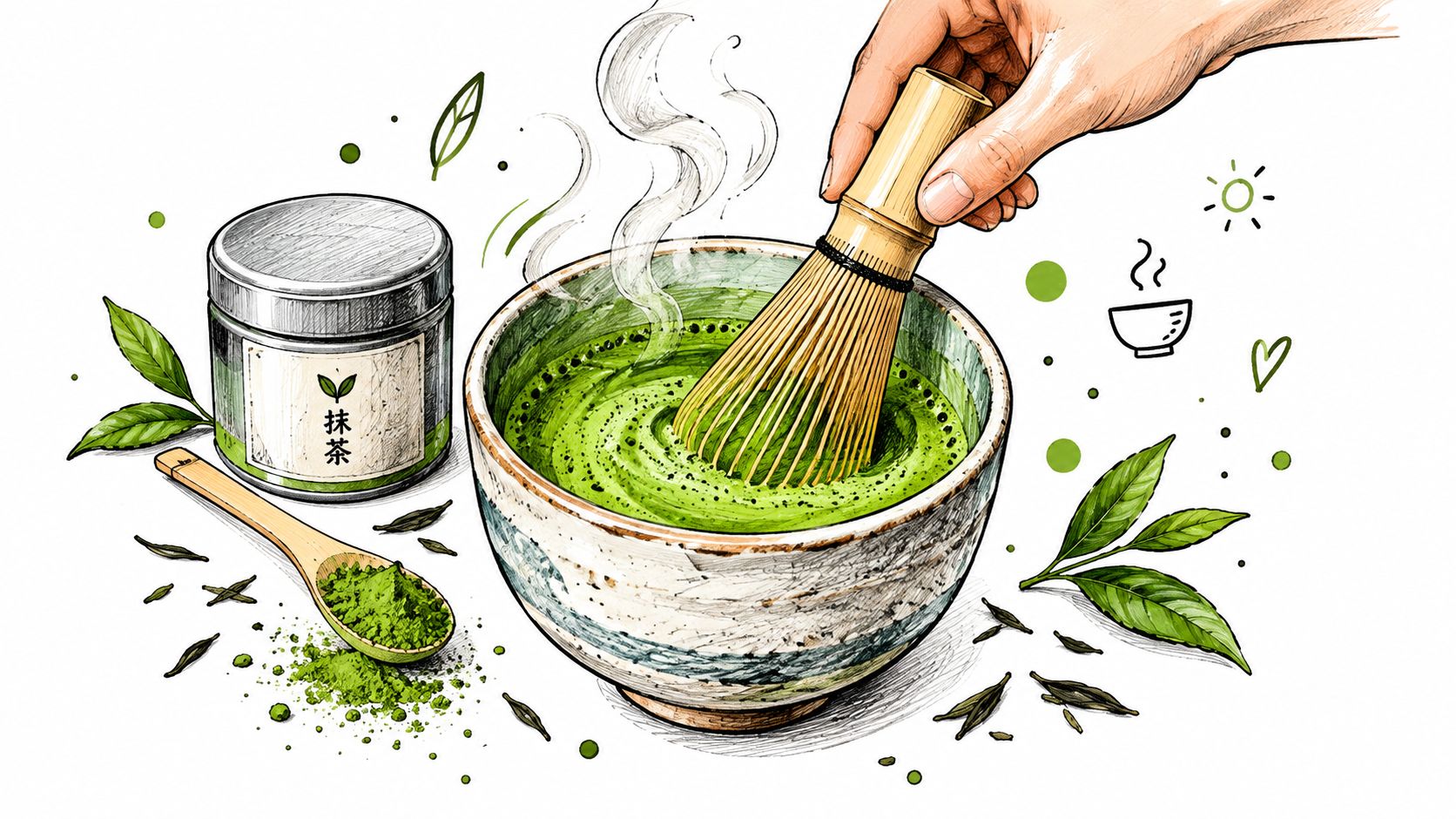
The whisking image below depicts matcha. It illustrates a useful preparation approach for powdered tea, but the appearance of a whisked bowl doesn't identify the tea inside it.
Water, ice and milk
For a hot drink, follow the supplier's preparation guidance and disperse the powder thoroughly. If you find the cup too assertive, adjust the powder quantity before reaching for sweetener. Don't expect sencha to reproduce a particular matcha's creamy mouthfeel.
For iced tea, mix the powder before adding ice so you can judge its flavour without chasing dry clumps around the glass. A sparkling version is another experiment: prepare a smooth tea mixture separately, then gently combine it with sparkling water. Taste for balance rather than assuming that more tea makes a more refreshing drink.
Milk changes the comparison. Try the same powder with your usual dairy or plant-based milk and assess whether you can still recognise the tea. A brisk powder may suit a sweet latte, but sencha doesn't categorically outperform ceremonial matcha in milk; your ingredients and preferences decide that.
Baking and blending
Cookies, pancakes, energy balls and savoury coatings are useful places to experiment with sencha powder. Blend it evenly into the appropriate dry or wet ingredients, and test a modest batch before committing a whole recipe. For smoothies, check the tea flavour against the fruit and other ingredients rather than adding powder solely for colour.
- For a light water-based cup: Begin at the lighter end of the supplier's serving guidance.
- For a latte: Adjust tea strength against the milk, keeping the powder amount recorded.
- For baking: Record the powder used for the batch and divide it across the portions.
If a recipe depends on matcha's particular green colour or umami, sencha may not deliver the result you want. Nor should you assume a cost saving without comparing the products.
Sweetened tea powder is a separate substitution question. Check the ingredient list first, then adjust the recipe's sugar accordingly; an unsweetened powder and a prepared sweet blend aren't equivalent ingredients.
Sourcing and Buying Decisions for Australian Shoppers
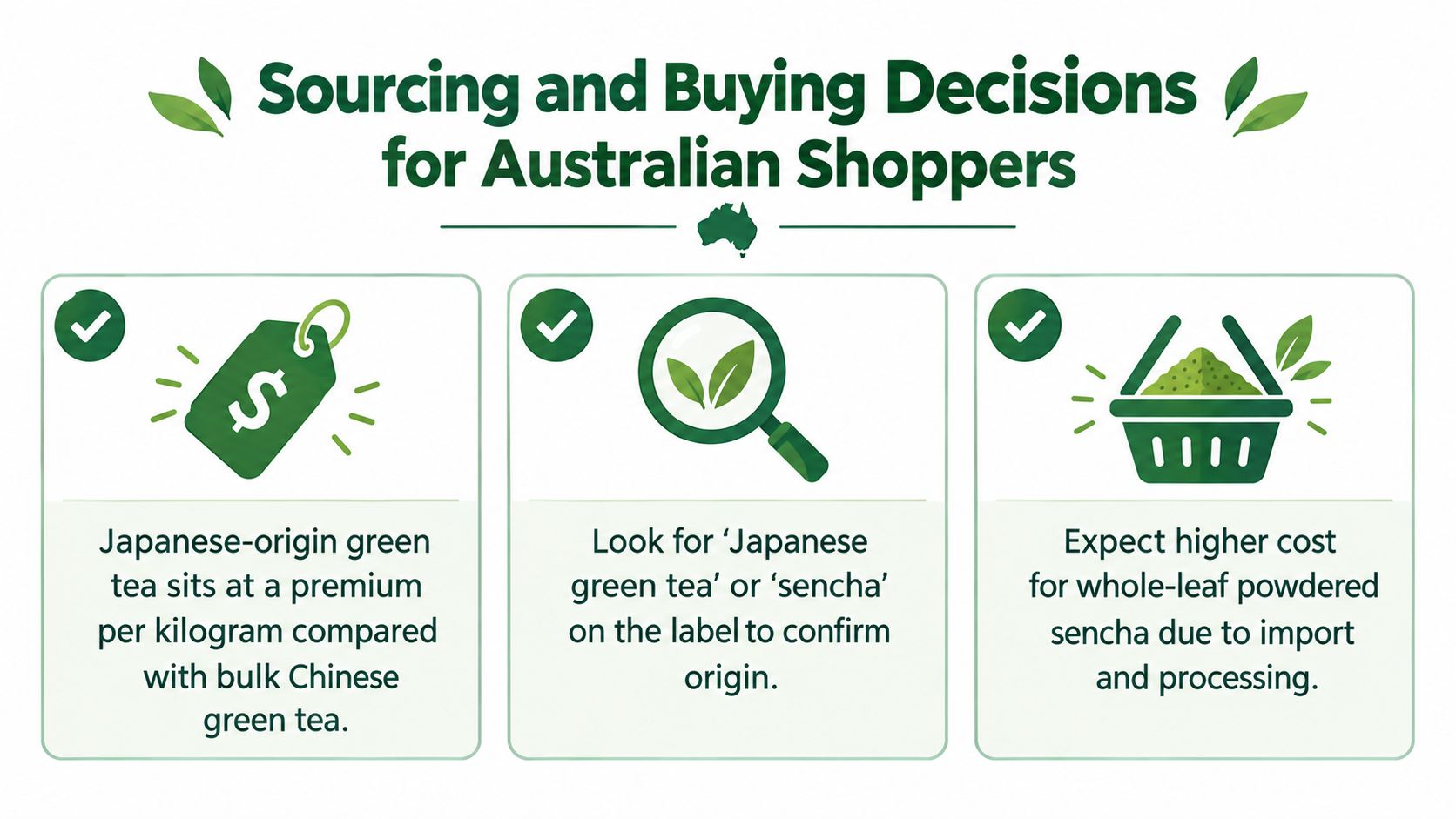
Australian buyers are comparing imported products, not just flavour descriptions. In the broad “green tea, nes” category, Australia imported 398,202 kilograms worth approximately US$4.37 million in 2024; Japan supplied 54,541 kilograms worth about US$1.70 million, while China supplied the largest volume at 112,738 kilograms, according to World Bank WITS green-tea import data.
That establishes Japan as the leading supplier by value within this category, while China led by volume. It supports a broad Japanese-origin premium, not a precise retail price for sencha powder. The category doesn't distinguish every tea style, quality level or powder format.
Read origin claims carefully
“Sencha” identifies a tea style, not proof of country of origin. Despite the shorthand in the visual, look for an explicit origin statement rather than treating the name alone as confirmation. If a seller says “Japanese green tea”, check whether the product details clarify the source of the leaves and the powder.
The wider consumer-pack channel is substantial too. Australia imported 2,135,520 kilograms of green tea in containers of 3 kilograms or less in 2024, with a declared value of approximately US$20.62 million, according to WITS packaged green-tea import figures. Those figures include other green teas and formats, so they don't measure sencha powder demand alone.
A buyer checklist worth keeping
Use a product page to answer practical questions before ordering.
- Confirm identity and origin: Is it ground sencha, matcha or a blend, and where are the tea leaves sourced?
- Ask about dates: Look for harvest, milling or packing information, and ask the seller when it isn't clear.
- Inspect packaging: Prefer a resealable, opaque pack and clear storage guidance.
- Check intended use: Look for specific preparation advice rather than an unexplained grade label.
- Review ingredients and caffeine information: Establish whether anything is added and whether supplier caffeine data are available.
Reviews can help you anticipate flavour, but they can't verify cultivation or replace a clear ingredient statement. A higher price also doesn't prove superior suitability for your latte.
For a more confident purchase, use these checks alongside the guide to buying Japanese green tea in Australia. Retailer transparency tells you more about the pouch you'll receive than a broad customs classification.
Caffeine, Serving Sizes, and Australian Labelling Notes
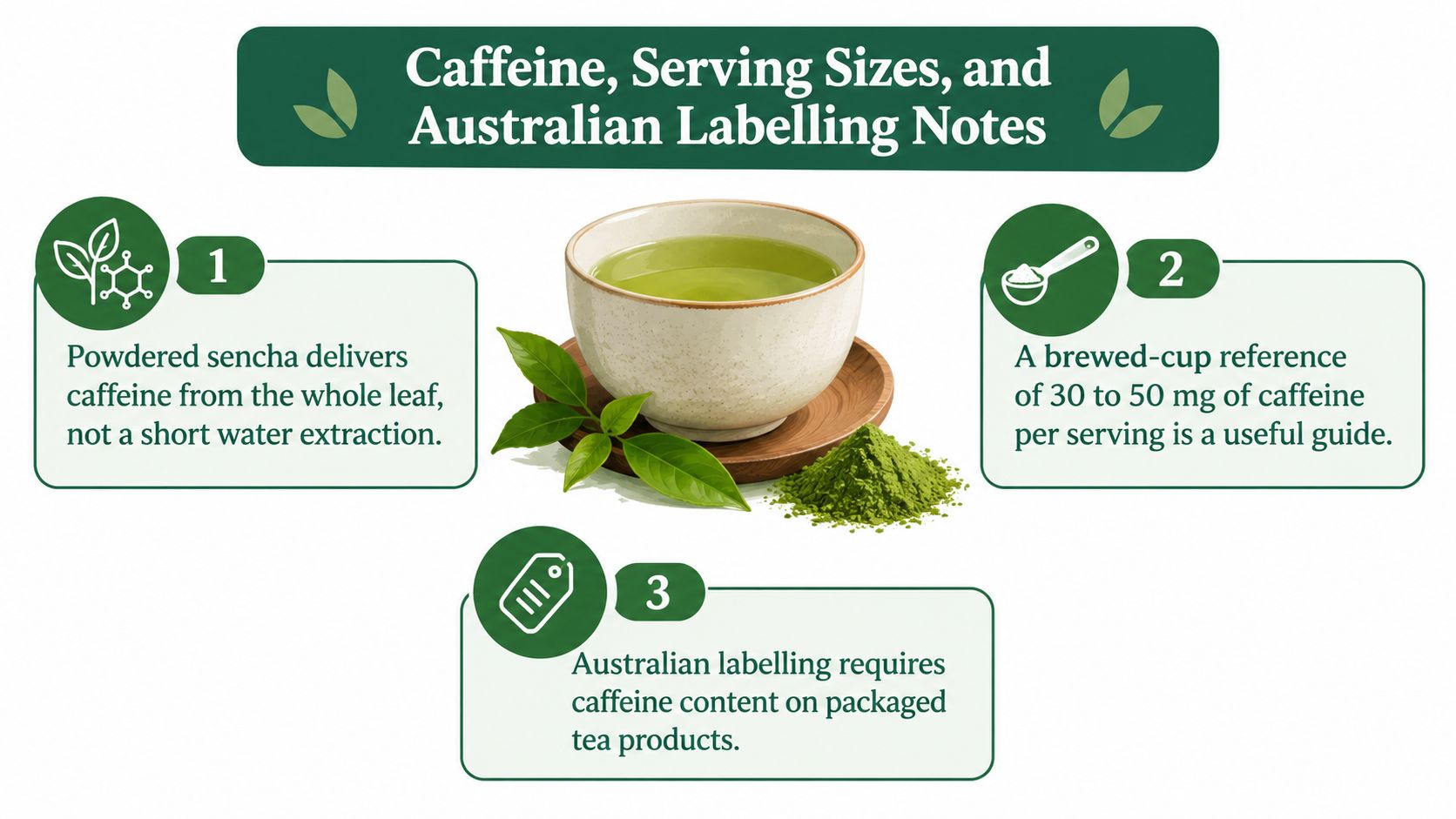
Powdered sencha needs a measured serving approach. The Australian Institute of Sport lists green tea at approximately 30–50 mg of caffeine per 250 mL cup, but that brewed-tea reference doesn't establish the caffeine in a measured portion of sencha powder, as explained by its caffeine food and drink guidance.
With powder, you consume the ground leaf rather than removing it after a short infusion. Supplier or batch information is therefore more useful than borrowing a generic brewed-cup estimate.
Calculate from the powder you use
Weigh your powder on kitchen scales, then apply the supplier's caffeine figure:
Caffeine per serve = grams of powder used × supplier caffeine in milligrams per gram.
Multiply that result by your daily servings, then account for coffee, energy drinks and other caffeine sources. If the supplier can't provide a reliable figure, don't invent one from teaspoon size, colour or perceived strength.
Australian caffeine policy calls for consideration of total dietary exposure and vulnerable groups, including children, adolescents, pregnant and breastfeeding people, and caffeine-sensitive consumers, in its policy guideline on caffeine in foods. Seek individual advice where appropriate, particularly if caffeine affects your anxiety or sleep.
Separate natural caffeine from added caffeine
The visual's labelling statement needs qualification. Naturally caffeinated tea powder doesn't automatically require the same caffeine quantity declarations as a formulated caffeinated beverage. FSANZ distinguishes naturally present caffeine from added caffeine, which requires ingredient declaration and a caffeine-containing label, in its Australian caffeine labelling guidance.
FSANZ also prohibits public retail sale of pure or highly concentrated caffeine products containing 5% or more caffeine in solid or semi-solid foods, while distinguishing naturally caffeinated tea from those products in its concentrated-caffeine safety guidance.
Compliance isn't a personal serving recommendation. Use the guide to caffeine in Japanese green tea alongside product-specific information, and treat sencha powder as a naturally caffeinated food, not a risk-free stimulant.
Choosing Between Powdered Sencha, Matcha, and Loose Leaf
Choose the format around your main use, then verify the product. If you mostly make sweet lattes or bake, sencha powder is worth considering when you enjoy its brisk flavour and the actual price works for your routine. Don't buy it solely because you assume it's budget matcha.
For whisked tea where savoury depth and ritual are your priorities, choose a matcha described for pure sipping. For a quieter preparation built around controlling the infusion, choose loose-leaf sencha.
Make the choice practical
- Everyday kitchen use: Test a clearly identified sencha powder in your usual milk drink or baking recipe.
- A dedicated whisked bowl: Select matcha with origin and flavour information that suits your preferences.
- Traditional steeping: Choose loose leaf when you want to work with extraction rather than powder dispersion.
These aren't mutually exclusive habits. Keeping more than one format on your bench is reasonable if each has a clear purpose; it doesn't mean you've failed to choose.
This week, identify the drink you make most often and compare products for that job. Buy a manageable pack with transparent origin, ingredients and preparation guidance, then record how much you use. You'll learn more from a deliberate tasting than from chasing a category name.
Common Questions About Sencha Tea Powder
Can sencha powder replace matcha in a recipe?
It can be a useful experiment, but equal quantities won't guarantee equal flavour or colour. Test a small batch, especially if the recipe relies on matcha's umami or appearance.
How should I store an opened pouch?
Follow the supplier's storage instructions and reseal it promptly. Keep it protected from light, air, moisture and strong kitchen odours.
Does sencha work with sweeteners?
Yes, you can experiment with sweetened sencha drinks or desserts. Check whether your powder is already blended with sweetener before adjusting the recipe.
Is it suitable for children or late-day drinking?
Don't treat it as caffeine-free because it's tea. Consider the cautions above, seek advice for children, and avoid late servings if caffeine disrupts your sleep.
TOO MATCHA. offers Japanese matcha and hojicha powders, preparation accessories and recipe content for home drinks and cooking. Visit TOO MATCHA. to compare ceremonial, culinary and sweetened matcha options against the flavour and preparation style you've identified for your next cup.