Matcha Powder Perth: Fresh, Quality-Tested Buying Guide
You're standing at a shelf with three matcha pouches, each promising something different. One says ceremonial, another says premium, and the cheapest has a tempting latte photograph. None has an obvious production date. Where does the good stock come from, and how much can you tell before paying?
Buying matcha powder in Perth starts with the seller, but it shouldn't end with a grade name. The useful questions concern the powder inside, the information on the pack, and how the seller has handled it since arrival.
Table of Contents
- Where to Buy Matcha Powder in Perth
- Matcha Grades and Which One Fits Your Cup
- Test Matcha Quality and Labels Before You Pay
- Keeping Matcha Fresh From Shop to Cup
- Caffeine Limits to Weigh Before You Buy
- Choose Your Perth Matcha Source This Week
Where to Buy Matcha Powder in Perth
A shop's postcode tells you less than its stockroom. Perth has a long-established Japanese community concentrated around the metro area, so dedicated Japanese grocers do exist beyond the big centres, and they carry matcha lines a supermarket won't. A specialist shopfront is evidence of range, not freshness. Judge any outlet by what it can show you about the current batch: production date, storage conditions and how quickly the stock moves.
Compare the buying channels
| Channel | Best for | What to check | Trade-off |
|---|---|---|---|
| Japanese and Asian grocers | Japanese-labelled tins and pouches | Pouch date, country of origin, whether stock sits in sunlight | Turnover varies; a dusty pouch may have sat for months |
| Health food and tea specialists | Ceremonial and single-origin options | Harvest or production date, and staff who can describe the flavour | Usually higher price per gram |
| Supermarkets | Convenient culinary-style powder | Ingredient list for added sugar or flavouring | Little grade detail; stock can sit longer between deliveries |
| Cafés and matcha bars | Tasting before buying | Whether they sell retail bags and which grade they actually pour | The café blend may differ from the bagged version, so ask |
| Farmers and weekend markets | Small-batch tasting and direct conversation | Vendor origin, grower connection and sealed packaging | Claims are hard to verify without supporting documentation or laboratory data |
| Online specialists shipping to Australia | Wider range and stock shipped from Japan | Shipping origin, resealable packaging and batch information | Postage costs, delivery wait and no way to smell the batch first |
At a market stall, establish whether you're speaking to a grower, importer or reseller. Someone selling Japanese tea powder in Perth isn't necessarily involved in growing it. A straightforward explanation of the supply chain tells you more than a vague claim about sourcing directly.
Online buying has a different limitation: you can examine information, but you can't smell the batch before ordering. Treat detailed product descriptions as a starting point, then check whether the seller can identify the specific stock being dispatched.
Match the channel to your routine
If you're unsure whether you even like matcha without syrup, start at a café that also sells retail bags. Taste the drink, then establish whether the bag contains the same powder. Otherwise, you're buying something different from what you sampled.
Daily latte drinkers can reasonably begin with a grocer or supermarket culinary powder, provided it passes the label and freshness checks. There's little value in paying for subtle sipping qualities you don't notice in your usual drink.
For ceremonial whisking, a tea specialist is the more useful starting point. Ask for the harvest or production date and an explanation of the flavour, rather than accepting the word ceremonial as the entire answer.
Buying rule: A useful retailer can explain what's in the pouch, where it came from and how the current stock has been handled.
Matcha Grades and Which One Fits Your Cup
Match the grade to how you'll drink it. Buying an expensive sipping powder for heavily sweetened baking wastes money, while choosing a forceful culinary powder for plain whisked tea can leave you disappointed.
Grade names give you a rough shopping framework. Each seller applies them differently, so compare the intended flavour and preparation method before comparing front-of-pack wording.
| Grade or style | Typical flavour | Best use | Buying note |
|---|---|---|---|
| Ceremonial | Sweet, smooth, umami-led | Whisked tea and sipping | Usually the highest price per gram; the name carries no regulated definition |
| Premium culinary | Bolder, earthy, medium intensity | Lattes, smoothies, baking | Can offer good value for daily drinks |
| Culinary | Strong, bitter-edged | Baking, cooking, blending | Usually the lowest-priced style; holds up against milk and sugar |
| Pre-sweetened blend | Mild, sweet, consistent | Quick iced lattes | Contains sugar; check the ingredient list |
| Hojicha, roasted green tea | Roasted, nutty, warm | Lattes, desserts, roasted tea | A different product, so colour expectations change |
What the descriptions should mean in your cup
Ceremonial matcha is generally presented as a youngest-leaf style for whisking and sipping, with sweetness, smoothness and umami taking priority. The word alone leaves leaf selection unconfirmed, and it never guarantees you'll enjoy the result.
For a concrete example, Ceremonial Grade Matcha 60g is listed with a sweet, smooth, umami-led profile. That gives you an intended sensory character to assess. The same supplier describes its matcha as freshly shipped from Japan and milled to an ultra-fine, clump-free powder, details you can weigh against any ceremonial pouch you're holding.
Premium culinary occupies the practical middle ground. Its bolder, earthier character suits someone who wants the tea to remain noticeable in a latte without making the drink entirely about bitterness.
Ordinary culinary powder prioritises a stronger contribution to cooking and blending. Intensity whisked with plain water is expected. Judge it in the recipe you plan to make.
Convenience and roasted alternatives
Pre-sweetened blends reduce preparation steps and make quick iced lattes easier to repeat. The trade-off is control: tea strength and sweetness arrive locked together, so adjusting one means accepting the other.
Hojicha suits milk drinks and desserts when roasted, nutty flavours appeal more than matcha's vegetal character. Treat it as its own product. A pale roasted powder can't be benchmarked against the vivid green or fresh grassy aroma you'd use to screen matcha at the shelf.
The ceremonial label carries no regulated nutritional or safety standard. Use the grade to shortlist a product, then let its condition, traceability and performance in your cup decide whether it earns its price.
Test Matcha Quality and Labels Before You Pay
You can screen out plenty of questionable stock at the shelf, but you can't fully judge sealed powder through an opaque pouch. Ask whether the shop has a current-batch sample or an opened demonstration tin. Never break a retail seal or handle saleable powder without permission.
The distinction matters: a shelf check helps assess freshness and transparency, while quality testing requires relevant documentation. Neither attractive colour nor a pleasant sample proves microbiological compliance or establishes caffeine content.
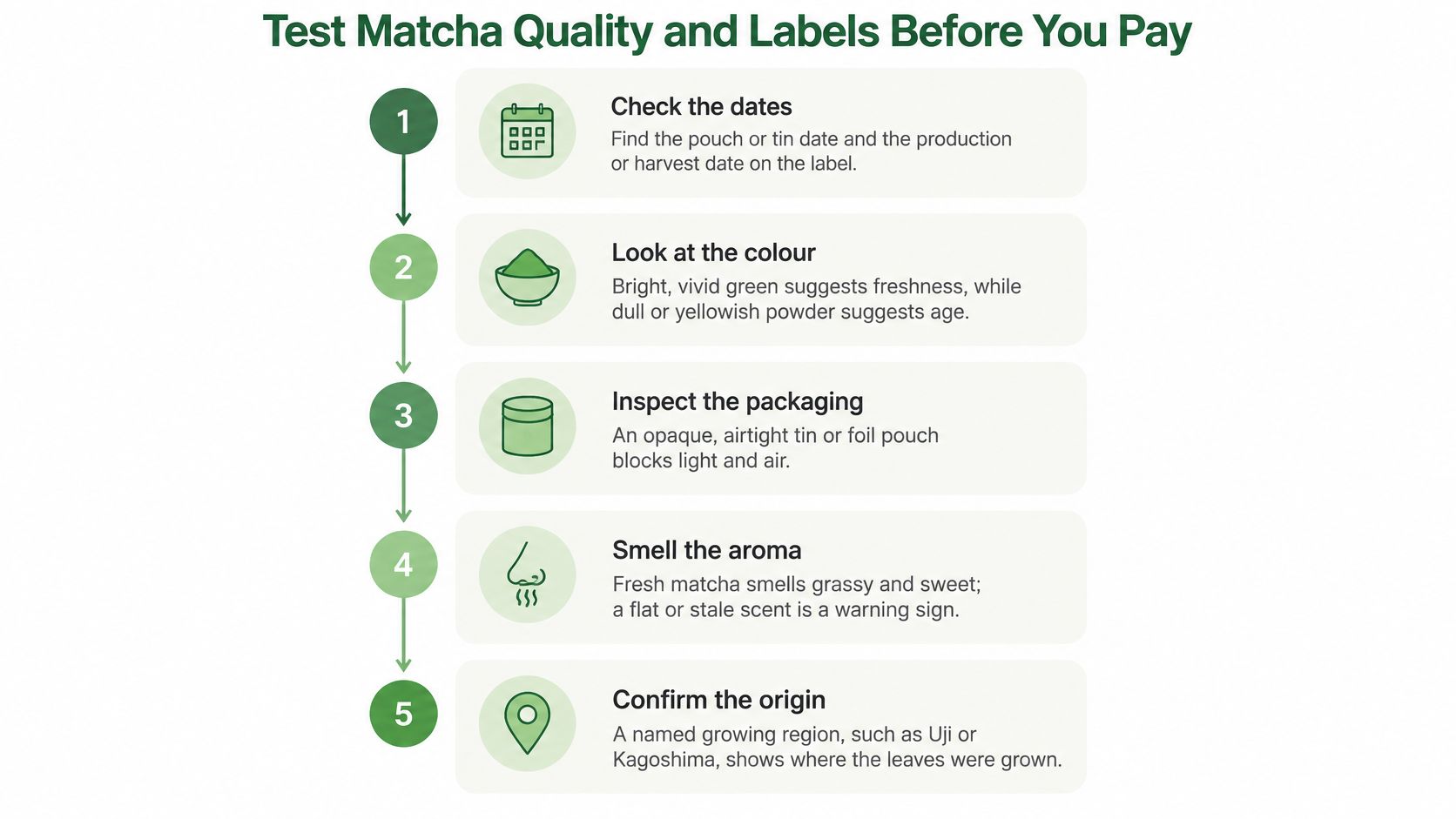
Use the visual checklist as a quick reminder, then follow the fuller checks below.
Run the in-store checks
- Find the dates. Locate the pouch or tin date, then distinguish packing, production, harvest and best-before information. A best-before date doesn't tell you when the leaves were harvested. If there's no date on the pack and the seller can't provide dated batch information, leave it.
- Inspect the colour where a sample is available. Look for vivid green rather than a noticeably dull, yellowish or brown appearance. Colour is a useful freshness signal, not a complete grading system. A photograph printed on the pouch tells you nothing about the current contents.
- Smell a current-batch sample. Ask staff to open their sample container and look for a fresh, grassy, vegetal aroma. Flat, cardboard-like or stale notes are reasons to reject the batch. A sample from unrelated stock won't resolve doubts about the bag you're holding.
- Check texture with permission. If the shop offers a separate sample, a small pinch should feel fine and silky rather than obviously coarse. Clumps can indicate moisture, although clumping alone doesn't diagnose the cause. Hard or damp-looking lumps deserve more caution than powder that loosens readily.
- Examine the packaging and shelf position. Prefer an opaque, properly sealed pack with a dependable resealable closure. Damaged seals, powder around the closure or display stock sitting in direct sunlight are warning signs. Don't assume an expensive tin compensates for poor handling.
- Read the origin and ingredients. Look for country of origin, identifiable batch information and wording that clearly describes powdered green tea. Sweetened blends should declare their additional ingredients. A named growing region adds traceability, but it still needs to agree with the rest of the product information.
- Ask about caffeine disclosure. Check whether the seller provides caffeine per gram or per recommended serve, and whether that figure comes from product testing or a general estimate. Missing caffeine information isn't proof of poor sensory quality, but it limits how confidently you can manage intake.
A clear failure, such as stale aroma, damaged packaging or untraceable stock, is enough reason to choose another pouch. An unavailable sample is different: you may still buy, but you're relying more heavily on batch information and the seller's handling practices.
Separate evidence from persuasive wording
FSANZ's caffeine review explains that formulated caffeinated beverages require caffeine quantity and advisory information, while traditional tea and coffee generally aren't subject to the same warning approach. That leaves shoppers needing to ask questions that the front label may not answer.
Likewise, focus, antioxidants and clean energy aren't substitutes for substantiated product benefits. Australian food-health claims need an appropriate evidentiary basis; a reassuring phrase isn't that evidence.
A plain label with traceable batch details and measured caffeine can tell you more than a glossy pouch covered in premium language.
For purchases without a shelf sample, use the same evidence standard when you buy matcha powder online. Distinguish what the seller documents from what the description merely suggests.
Keeping Matcha Fresh From Shop to Cup
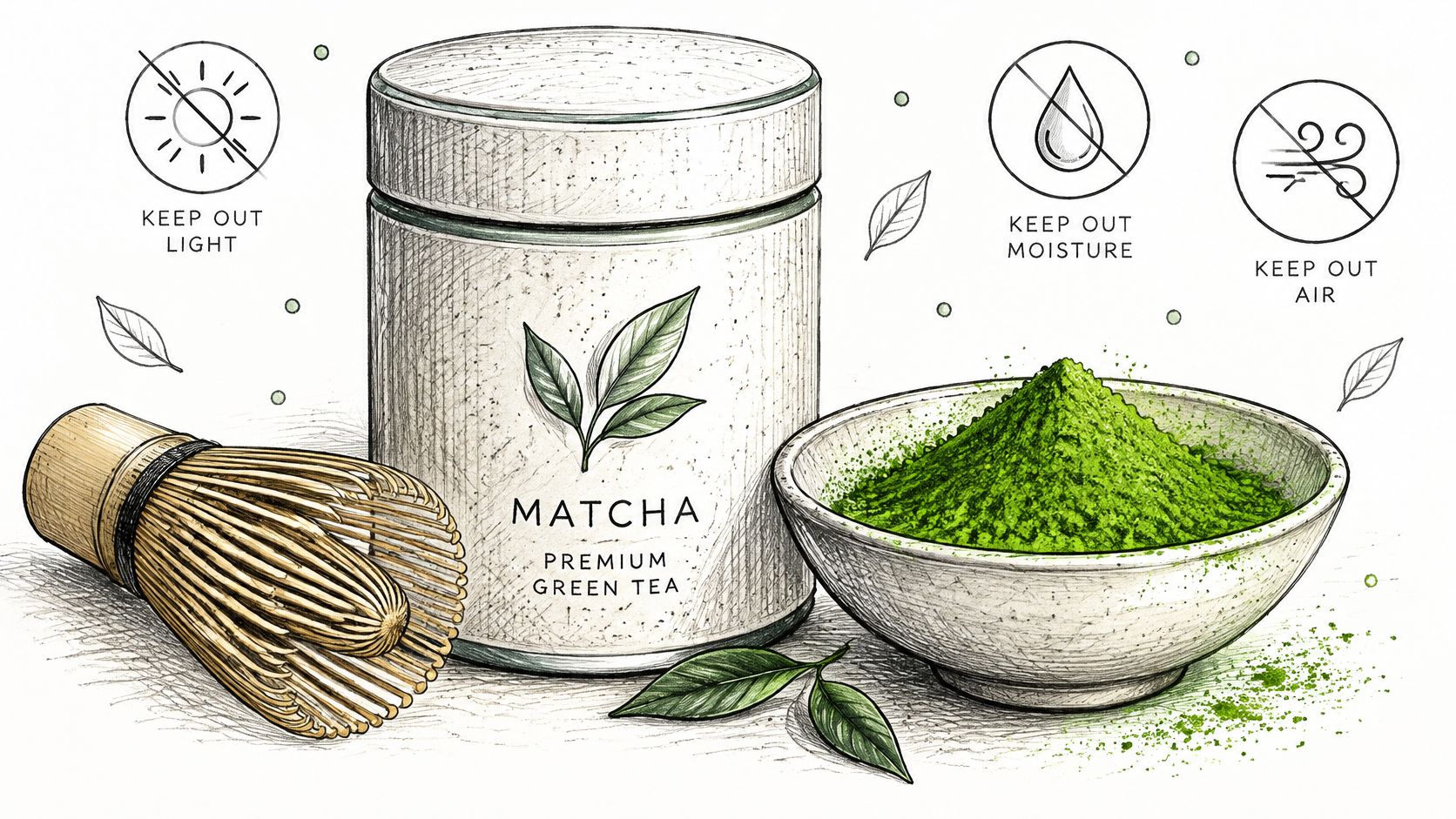
Freshness depends on what happens after milling, not just where the tea began. Matcha's fine particle size exposes a large surface area to oxygen, moisture and light, which can progressively dull its colour and fresh vegetal aroma while introducing stale notes.
That's why stock handling after arrival matters. A freshly imported pouch can still disappoint if it spends its time beside a sunny window or is repeatedly opened without a sound storage routine.
Keep the container and preparation tools together, but choose the storage location for the powder's needs.
Build a repeatable storage routine
Keep the powder in its opaque, resealable pouch, gently press out excess air and close it promptly after measuring. Store it somewhere cool and dry, away from the stove, kettle steam and window. A convenient preparation station isn't necessarily a suitable storage spot.
Refrigeration needs care. Let the closed pouch reach room temperature before opening so moisture doesn't condense on cold powder. Moving a pouch straight from the fridge into a humid preparation area and opening it immediately defeats the purpose of careful storage.
- Choose a realistic pack size. A smaller pouch you finish within a few weeks can be a better purchase than a cheaper bulk bag you repeatedly open for months.
- Keep utensils dry. Don't return a damp scoop to the powder.
- Close before whisking. Leaving the pouch open throughout preparation adds exposure without helping the drink.
Our guide to how to store matcha powder develops the home routine further.
Use the preparation video alongside a routine that keeps the open pouch away from water.
Check the delivery chain
For online orders, establish the production or harvest date, shipping origin and whether the powder travels in airtight packaging. Fresh shipment language is useful only alongside sensible sealing and storage.
At TOO MATCHA., our matcha is freshly shipped from Japan. Bulk matcha and hojicha powders are packaged in air-tight, resealable pouches, although careful handling at home still matters after opening.
If powder smells flat on arrival, treat it as a delivery-quality issue to resolve with the seller, not something to hide with extra syrup.
For consistent preparation, measure the powder and combine it with a small amount of water before adding the remaining liquid. Milk and sweeteners can mask stale flavour or inconsistent dosing, so they shouldn't be your first freshness test.
Caffeine Limits to Weigh Before You Buy
Matcha is swallowed as powdered whole leaf, so your measured dose decides the caffeine load. Extra milk, ice or water changes the volume of the drink; the stimulant arrived with the powder.
I have seen plenty of buyers assume a mild-tasting latte means a mild caffeine hit. Grade names describe intended use and flavour, and a smooth cup can still carry a heavy dose. The serving information on the pouch or the café's stated scoop size is the figure worth trusting.
Australian caffeine benchmarks
The reference levels below come from the FSANZ caffeine dietary assessment, and each row names the same source.
| Group | Reference level | Source |
|---|---|---|
| Healthy adults and athletes | 400 mg per day, recommended maximum chronic intake | FSANZ |
| Pregnant women | 200 mg per day, recommended maximum | FSANZ |
| Children | 3.0 mg per kg body weight per day, level linked to adverse effects on affective states | FSANZ |
| Adolescents | 5.7 mg per kg body weight per day, level linked to adverse effects on affective states | FSANZ |
These figures are population reference levels, not personal limits. Anyone with a heart condition, a medication interaction or a strong caffeine response needs individual clinical advice.
Total the whole day
Matcha rarely arrives alone in a diet. Before making several lattes a daily habit, count coffee, chocolate, energy drinks and any other caffeinated products alongside the powder.
Where a seller provides caffeine per gram, multiply that figure by your measured dose and add the day's other sources. Cup size is a poor proxy, since cafés use different amounts of powder per drink.
A latte comparison only helps when its serving assumptions are stated. Our page on caffeine in a matcha latte sets out those assumptions so you can apply them to your own routine.
Evening drinking deserves its own check against your sensitivity and sleep. Claims about calm or steady energy say nothing about the milligram figure, and L-theanine in the leaf does not remove caffeine's stimulant effect.
Choose Your Perth Matcha Source This Week
Choose your first purchase around the drink you want to repeat. If you're still learning your preferences, visit a café or local specialist and ask whether a small sample is available before committing to a retail pack.
For daily lattes, begin with culinary or premium culinary powder in a quantity you'll use while it still tastes fresh. For plain whisked tea, start with a small ceremonial pack rather than making a bulk commitment based on the label alone.
Make the final decision practical
- Run the shelf test. Resolve any concerns about condition, dates and packaging before paying.
- Check the useful label details. Prioritise traceable origin, clear ingredients and available caffeine information.
- Decide where it will live. Have a dry, protected storage location ready rather than leaving the pouch beside your kettle.
For an online price comparison, our pre-sweetened 200 g pack is $54.99 AUD, while the 60 g ceremonial pack is $74.99 AUD. Compare price per gram, but recognise that these are different formulations for different uses, not interchangeable measures of quality.
The better purchase is the one that suits your preparation method and remains enjoyable through the pack. A larger order only represents useful value if you'll use it well; a small trial can prevent a cupboard full of powder you don't like.
TOO MATCHA. offers Japanese matcha and hojicha powders for whisked tea, lattes, baking and larger-scale preparation. Visit TOO MATCHA. to compare the styles and pack sizes, then choose a manageable first order using the freshness, label and caffeine checks above.