Wholesale Tea Australia: How to Source Smarter
You've been buying small retail pouches to keep a matcha latte on the menu, and it's starting to pinch. Margins are thin, stock runs out mid-week, and every new bag tastes slightly different. Moving to wholesale tea in Australia should fix price and continuity, but only if you treat it as an operating decision. Grade, dose, compliance and reorder timing matter more than a supplier list.
Table of Contents
- Mapping Your Wholesale Tea Needs Before You Source
- How to Vet Tea Suppliers Before You Commit
- Minimum Orders, Pricing and Grade Trade-offs
- Compliance, Labelling and Caffeine Checks
- Freight, Storage and Reordering Without Running Out
- Opening a Trade Account and Placing Your First Order
Mapping Your Wholesale Tea Needs Before You Source
A wholesale tea order goes wrong before the first invoice lands. The carton arrives, the dose does not match your menu maths, and the replacement matcha drinks nothing like the sample that sold the idea. Treat sourcing as an operating decision: import exposure, serve cost, storage life and reorder timing all set the price.
Australia's tea supply is import-dependent, with the high-volume end concentrated in a small group of origins. Japanese matcha and hojicha sit in a premium, specialist segment, where each kilogram carries far more value than conventional tea. That gap changes the buying job. Conventional tea is usually a continuity problem; Japanese tea is a continuity problem plus a differentiation promise.
What Supplier Concentration Means for You
When supply is concentrated, disruption in one origin travels fast. A delayed vessel, a short crop or a freight bottleneck can tighten availability across several wholesalers at once, leaving buyers who rely on one source scrambling for a substitute that does not match flavour or colour.
The risk is uneven. Large-volume conventional blends have more interchangeable lots and more routes to replacement. Matcha and hojicha are differentiated by region, harvest, grade and processing, so a late swap shows up immediately in a whisked bowl or latte.
Decide the Job Before You Negotiate
Set the buying brief before you ask for pricing:
- Volume and price stability: proven demand, steady weekly use, pack sizes you can clear before freshness fades.
- Differentiation: origin, grade and flavour strong enough to justify menu space beside coffee and conventional tea.
- Both, in sequence: prove repeat orders first, then commit to larger lots.
Menu-volume maths should cap the first order. Estimate serves per kilogram at your real dose, weekly sales at a cautious case, and the date the stock will be finished. A small opening order in bulk formats for foodservice and retail buyers keeps the test honest; a premium powder sitting in a storeroom ties up cash while aroma and colour decline.
Practical rule: If you cannot name the drinker, the serve size, the weekly rate and the compliance documents you need, you are not ready to negotiate volume.
How to Vet Tea Suppliers Before You Commit
Don't start with price. Start with the lot in front of you, because two powders labelled with the same grade name can perform very differently in milk, in baking or whisked on their own.
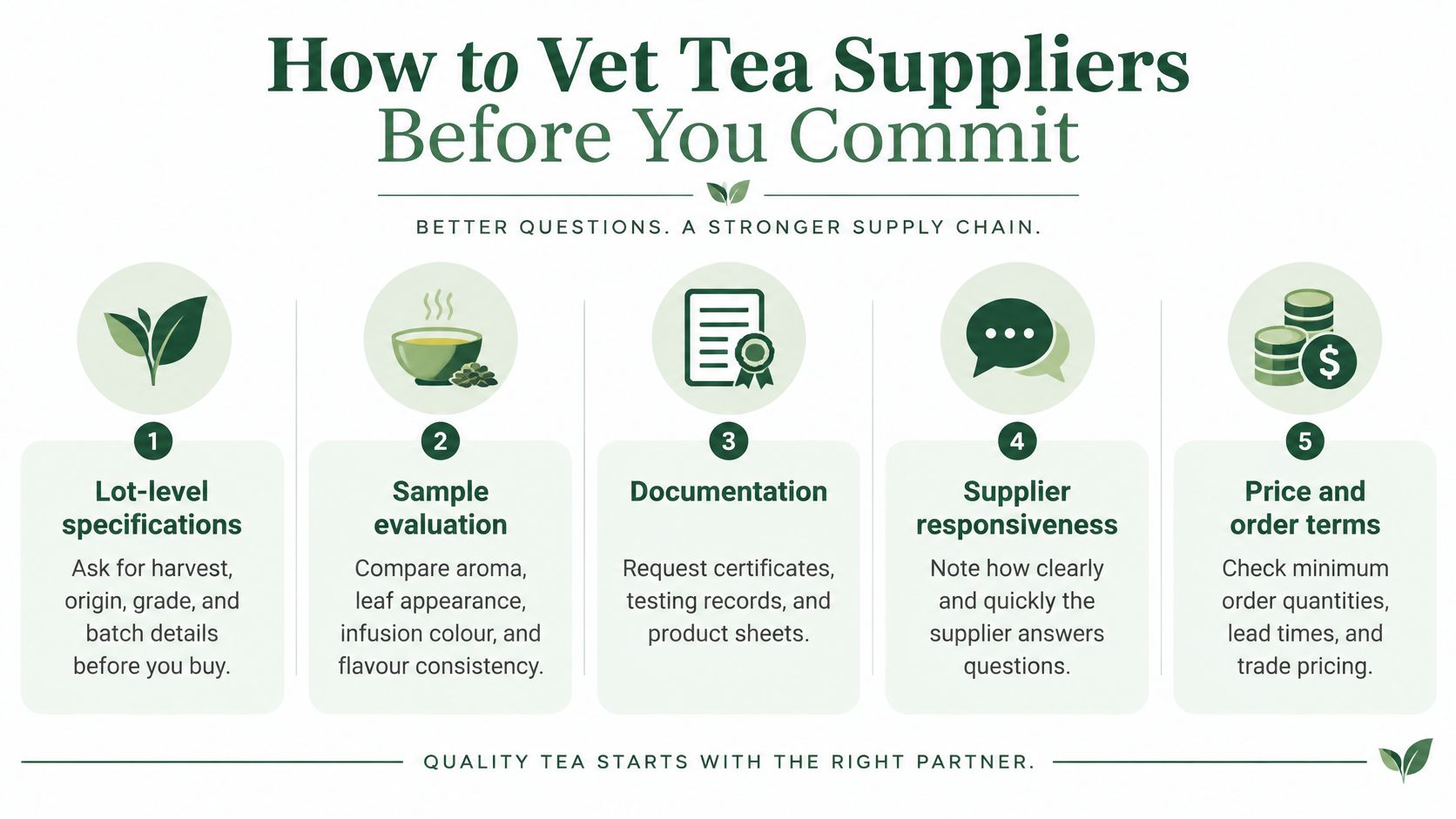
Ask for lot-level specifications first. You want grade, production or harvest timing, origin region and processing method for the specific batch you'd receive, not a general product description. A supplier who can answer at lot level is closer to the source and better placed to tell you what will change between shipments.
Sample Before You Commit to Volume
A sample should come before any volume order. Prepare it exactly as you'd serve it, at your intended dose and with your milk, water and sweetener. Check colour in the dry powder and in the finished drink, texture on the tongue, and aroma as soon as hot water hits it.
Judge it against the grade you asked for. A powder sold for pure sipping should whisk smoothly and taste balanced without milk masking it. A culinary powder should hold its flavour and colour through heat and other ingredients. If you have to increase the dose to get flavour, your cost per serve has already moved.
Test freshness claims with dates, not adjectives. Ask when the shipment left origin, when it arrived, how it's stored, and how long the current lot has been held. Vague answers about freshness usually mean the seller doesn't know, or the stock has been sitting.
Direct Importer or Reseller
A supplier that imports directly can usually explain shipment timing, next arrival and what happens if a lot sells out. A reseller holding older stock may offer convenience, but you'll have less visibility over age and continuity. Neither model is automatically wrong. You just need to know which one you're relying on for a menu item.
Three questions reveal the difference quickly. Who is the importer of record? When did this lot leave Japan? If I reorder in eight weeks, will I get the same lot or a new one, and how will you tell me if the profile shifts?
Checklist to Paste Into a Supplier Email
- Specifications: Please send grade, origin region, harvest or production timing and processing method for the current lot.
- Certificates and testing: Please provide the certificate of analysis and any testing records available for this batch.
- Traceability: How do you trace this product from supplier lot to the pack I'd receive?
- Importer responsibility: Who acts as importer of record, and what documents do you supply with the goods?
- Order terms: What are the minimum order terms, lead time and trade pricing structure?
- Sample: Can I buy a sample from the same lot as a first order?
Note how clearly and quickly the supplier answers. Slow, partial replies at enquiry stage rarely improve when a shipment is late.
Minimum Orders, Pricing and Grade Trade-offs
A 1 kg bag at a sharp per-gram price can cost you more than a 500 g bag at a higher one. Minimum order quantities only make sense against cost per gram in use, not pack price alone. A larger pack lowers unit cost, but it also extends the time powder sits open in your kitchen. If flavour fades before the pack is finished, the cheaper gram wasn't cheaper.
Grade and pack size aren't interchangeable decisions. A 60 g culinary pack is a low-risk way to test a recipe. A 1 kg ceremonial tin is a commitment to regular whisked service at a dose and price your customers will sustain. Buying the big pack first because the per-gram figure looks better is how good tea ends up wasted.
Matching Your Formats to Service Occasions
| Product | Available sizes | Best suited to |
|---|---|---|
| Ceremonial Grade Matcha 60g | 60 g, 500 g, 1 kg | Whisked preparation and pure sipping |
| Premium Culinary Grade Matcha 60g | 60 g, 500 g, 1 kg | Baking, blending, smoothies and lattes |
| Premium sweet matcha | 200 g, 500 g, 1 kg | Consistent, quick lattes and iced drinks |
| Hojicha powder | 60 g, 500 g, 1 kg | Roasted beverages and desserts |
The range is set out with bulk supply and a wholesale enquiry route, which makes it a useful reference for any wholesale-ready list. Each grade has a stated job, and pack sizes let you scale the same product rather than switching powders as volume grows.
Within that structure, the 60 g ceremonial pack works as a trial size for the ceremonial experience without a large bag commitment, and it's listed as vegan, dairy free and gluten free. A small format like that earns its keep in staff tastings and recipe calibration before you discuss 500 g or 1 kg supply.
Grade language is where quotes go quiet. Suppliers don't all use grade names the same way, so read a dedicated breakdown such as this guide to matcha green tea grades before you compare quotes side by side.
Test the Menu Slot, Not Just the Powder
Run a small menu trial before committing to bulk volume. Track drinks sold per day, preparation time, wastage and repeat orders for one or two recipes. Social-media interest can create trial without guaranteeing repeat purchase, and a drink that's slow to make during peak service costs you more than the powder does.
A grade earns its place when customers reorder it at a dose your team can repeat under pressure.
Ceremonial service, iced matcha, a sweetened latte and hojicha are separate occasions. They suit different customers, dayparts and price points, and they don't all need the same powder. Price them separately too, because a latte that hides the powder tolerates a different grade than a bowl served straight.
Compliance, Labelling and Caffeine Checks
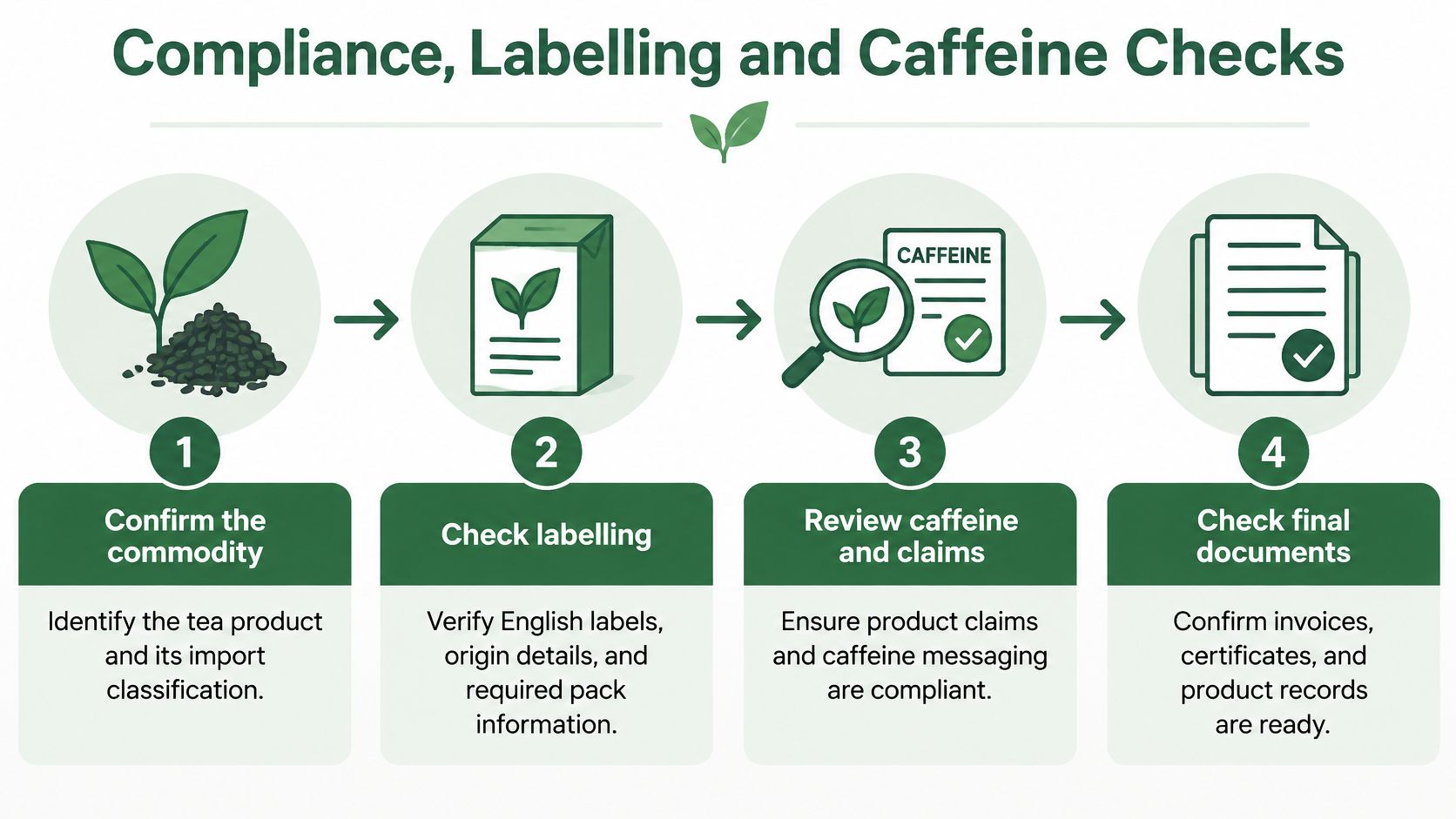
Compliance isn't paperwork you add after choosing a product. Formulation decides which rules apply, so check classification before you commit to a shipment or print a menu claim.
Start with the Department of Agriculture, Fisheries and Forestry's Biosecurity Import Conditions System, known as BICON. Confirm the commodity, preparation method and country of export for the exact product. Tea import conditions were updated effective 5 May 2025, so check current conditions rather than relying on a supplier's general statement or an old email.
Pure Tea Versus Blended Products
Pure tea made from Camellia sinensis, including green tea and matcha, is treated as minimal biosecurity risk and generally doesn't require an import permit or mandatory arrival inspection. That's the simpler pathway, and it applies because of what the product is.
Added botanicals can change the category. A blended product may fall into the higher-risk herbal tea category, where permits, questionnaires or additional conditions can apply, particularly if ingredients include restricted seeds or other high-risk plant material. Treat a pure Japanese green tea powder and a blended latte mix as different products for import and labelling purposes.
That distinction is where buyers slip up. They assume all tea powders are equivalent because they look similar in a pack. They're not, once formulation changes.
Who Carries Responsibility
Australian importers remain responsible for compliance even when a freight agent or supplier manages border documentation. Imported foods can also be inspected under the Imported Food Control Act 1992. If you're the importer, outsourcing the form doesn't outsource the obligation. If you're buying from a local wholesaler, ask who imported the goods and what traceability records come with them.
Verify the formulation and intended sale format against the Australia New Zealand Food Standards Code. Retain supplier specifications, lot traceability and product records, and check packaging and claims before release for foodservice or retail sale. Keep invoices and certificates with the batch they relate to, not in a separate inbox thread you'll lose.
Caffeine Labelling in Practice
Naturally occurring caffeine in tea is treated differently from caffeine deliberately added to food. Matcha and hojicha naturally contain caffeine, so they aren't subject to the added-caffeine ingredient rule merely because they provide caffeine. If a formulation adds caffeine separately, it must be identified as caffeine in the ingredient statement.
Pure and highly concentrated caffeine powders are a separate category and are banned from retail sale. Ordinary tea products sit outside that ban. Don't describe tea powder as an equivalent substitute for a concentrated stimulant ingredient. Also assess packaged formulated caffeinated beverages separately from café-made tea drinks, because warning requirements that apply to formulated products don't generally apply in the same way to naturally occurring caffeine in ordinary tea.
Freight, Storage and Reordering Without Running Out
Consider a café that costed its matcha latte on a neat recipe card and ordered a 500 g pack expecting it to last a month. It didn't. Staff dosed by spoon, remade drinks during training, and handed samples to regulars, none of which sat in the forecast. The pack ran out mid-weekend.
Measure consumption before you set a reorder point. Work from real transaction and usage data at your outlet, because online popularity tells you nothing about your own drink mix.
Build Your Usage Figure in Five Steps
- Collect transactions: Pull four weeks of outlet-level beverage transactions so you can see your actual drink mix.
- Calculate tea share: Work out the share of tea drinks and your average grams of powder per serve.
- Pilot the recipe: Trial one or two recipes, such as a 2 to 3 g matcha latte or hojicha latte, with staff weighing every dose.
- Compare forecast with actual: Weigh the pack weekly and compare forecast consumption with real usage.
- Set the reorder point: Calculate it from supplier lead time plus safety stock before stock runs low.
Tea usually contributes a modest share of café takings, so model conservatively. In a 2021 Australian Café Pulse survey, most cafés that recorded tea sales reported them as a small share of takings, while a portion offered no tea service at all and others sold tea only as a takeaway option. Coffee still drives most volume. Treat tea as a defined niche and expand it only after repeat orders show up in your weekly usage figures.
The 500 g Pack Maths
At 20 serves per day and 2 g per serve, a café goes through roughly 280 g over a 7-day week. A 500 g pack therefore covers about 12.5 operating days before waste.
Add a measured allowance for failed drinks, purging or spills, and promotional sampling. If your team remakes two drinks a day, that's real powder and it shortens the life of the pack. Nominal yield on the bag rarely survives a working week.
Reorder trigger: Daily grams multiplied by lead-time days, plus safety stock for your busiest stretch. When on-hand stock hits that figure, order that day.
Storage and Late Shipments
Store powder sealed, cool, dry and away from strong odours and light. Decant only what service needs, reseal the main pack promptly, and rotate stock so the oldest lot is used first. Write the opening date on the pack. Without it, nobody knows how long flavour has been declining.
Decide on your late-shipment plan before you need it. Will you 86 the drink, offer hojicha as an alternative, or hold a smaller backup pack? Choose now, because the call is harder at 7 am on a Saturday when the courier hasn't arrived. The recurring pitfalls are unmeasured dosing, menu cannibalisation where a new drink replaces a profitable one, and over-ordering premium grades before demand is proven.
Opening a Trade Account and Placing Your First Order
Your first wholesale order should be small enough to test and structured enough to teach you something. One large bag of one grade tells you only whether that bag sold. Two or three formats let you compare occasions, doses and repeat orders side by side.
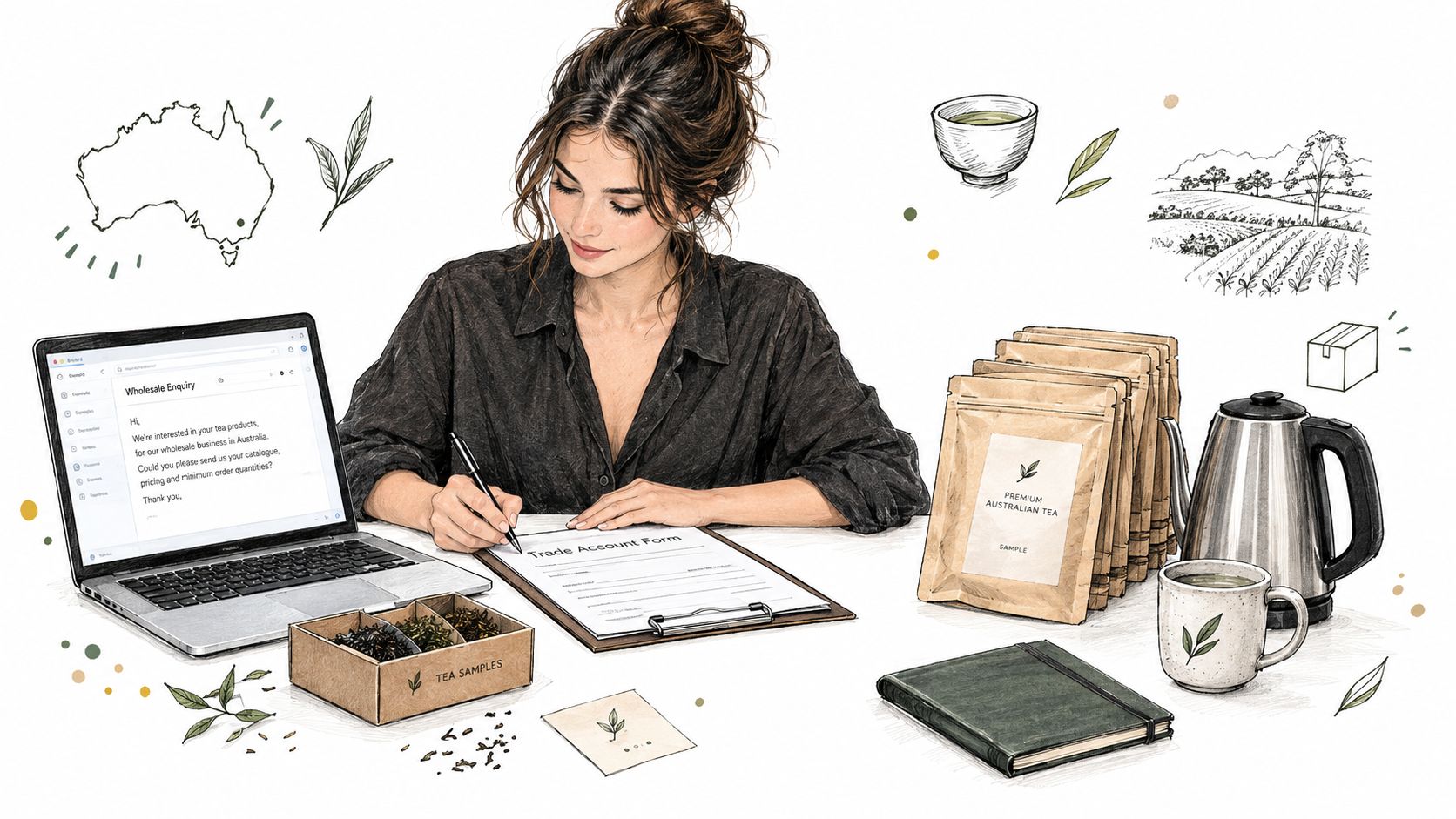
Prepare your information before you enquire. Suppliers can give you useful terms faster when you arrive with a clear picture of use and volume.
What to Have Ready
- Business details: Trading name, contact person, delivery address and whether you're buying for one site or several.
- Intended use: Retail shelf, café service, restaurant menu, bakery production or event supply, because format and labelling needs differ.
- Expected monthly usage: Base this on your weighed pilot and reorder maths, not on hope.
- Products of interest: Grade, pack size and whether you need a sample from the current lot first.
- Compliance documents: Specifications, certificates of analysis and traceability records you need for your own files.
Be specific about the service occasion. A bakery testing matcha in baked goods has different waste and colour requirements from a café whisking to order. A retailer needs shelf-ready packs and clear consumer information. Those details help a supplier recommend the right grade instead of the most expensive one.
Structure a First Order That Proves Demand
Start across two or three formats. For example, a small ceremonial pack for whisked service and staff benchmarking, a culinary or sweet format for lattes, and a small hojicha pack for customers who prefer a roasted, lower-intensity option. Keep pack sizes tied to how quickly you'll use them while flavour is at its best.
Move up to 500 g or 1 kg packs only for the products that earned repeat orders in the trial. Keep the smaller size in your range if it suits retail customers or backup stock. Scaling the winner is cheaper than discounting the loser.
TOO MATCHA. handles wholesale and bulk enquiries for cafés, restaurants and retailers through its website. You can start that conversation via the wholesale enquiries page for trade buyers, where terms can be discussed for your intended use and volume, without assuming a price from a retail listing.
Do one useful thing this week. Weigh your current dose for every tea drink for seven days, record serves sold and waste, then send that usage figure with your enquiry. You'll get a sharper recommendation, a more realistic first order, and a reorder point you can defend.
If you're ready to move from retail pouches to a tested wholesale setup, explore Japanese matcha and hojicha in formats built for cafés, restaurants and retailers at TOO MATCHA. Bring your dose, weekly serves and intended use, and start with a small order that proves demand before you scale.