How to Buy Matcha Powder Online Without Getting Burned
The most popular advice about buying matcha online is also the least useful: just buy ceremonial grade. That shortcut ignores the things that decide whether your powder tastes fresh or flat, vivid or tired, properly suited to your drink or wasted under milk and sugar. A small, expensive pouch that sits open in a warm kitchen can be a worse purchase than a larger, well-packed powder you finish quickly.
Australian buyers have extra logistics to manage. Heat, humidity, delivery delays and overseas biosecurity requirements can all affect the result before your whisk touches the bowl. Australia's green tea import category in immediate retail packings was worth US$12.8 million and 1,010,870 kg in 2023, with Japan supplying US$2.33 million and 96,630 kg, according to Australia matcha market import data. That's a mature, competitive supply market, not a reason to choose the most prestigious label without checking the details.
The better question is simple: how fast will you finish the matcha, and how will you use it? The guidance below treats your purchase as a logistics decision first and a taste decision second. You'll learn how to choose a grade, match pack size to turnover, read a product page, select the right format for lattes or wholesale, manage shipping and returns, and run a final checkout checklist.
Table of Contents
- Why Most Online Matcha Buying Guides Miss the Point
- Choosing Between Ceremonial, Culinary and Sweet Grade
- Matching Pack Size to How Fast You Drink It
- Reading a Product Page for Quality Signals That Matter
- Matching Format to Use Case From Lattes to Wholesale
- Shipping, Payments and Returns When Buying Matcha Online
- Your Quick Matcha Buying Checklist Before You Check Out
Why Most Online Matcha Buying Guides Miss the Point
Grade is only one part of the purchase
Ceremonial, culinary and sweet grades help describe a product, but they do not determine whether it suits your buying pattern. A premium powder can taste tired after months of poor storage. A practical everyday grade can produce the better cup when you open it often and use it for the right purpose.
Your drink matters just as much. Straight matcha exposes sweetness, umami and texture. Oat milk, smoothies and baked desserts need enough flavour to remain noticeable after mixing. Paying for delicate flavour before covering it with milk is poor value. Choosing a powerful kitchen grade for occasional straight drinking can leave the cup harsh or disappointing.
Pack size and turnover deserve equal attention. Matcha is finely milled tea, so more surface is exposed to air than in intact leaves. After opening, light, heat, oxygen and moisture gradually affect its colour, aroma and flavour. In Australia, warm delivery conditions and humid pantry storage can shorten the period when the powder tastes vivid. Buy the amount you can finish while the pouch still tastes fresh.
Retailer's rule: The best matcha is the grade you'll finish while it still tastes alive.
Australian buying conditions change the calculation
A domestic retailer may provide more predictable delivery and clearer returns than an overseas seller. Imported matcha still needs accurate labelling and suitable packaging. Australia's tea trade includes suppliers from Japan, Poland, Sri Lanka, India and other Asian origins, making origin, grade and pack format useful comparison points. Vague product pages deserve scepticism, especially when they omit storage guidance or basic product details.
Japan remains especially relevant to premium green tea supply. A recent Australia-Japan tea-and-mate import series recorded imports from Japan at AUD 1,635.588 thousand in December 2024, an all-time high in that series, with AUD 1,053.544 thousand in February 2025, close to January's AUD 1,090.249 thousand. The Australia-Japan tea import series indicates sustained trade strength rather than a short-lived spike.
Japanese origin signals quality potential, but the final decision should rest on packaging, harvest information and seller transparency. Check the origin, milling description, pack format and store policies together. Then choose a pouch or tin your household, kitchen or café can turn over before freshness becomes the main problem.
Choosing Between Ceremonial, Culinary and Sweet Grade
Use the grade as a job description
Ceremonial grade is designed for drinking with water, usually whisked into a relatively simple cup where sweetness, umami, colour and texture are exposed. Choose it for a weekend bowl, a quiet morning ritual or any preparation where milk and sugar aren't doing the flavour work. A first-time buyer who wants to understand what straight matcha tastes like should start here, but with a modest pack.
Ceremonial Grade Matcha 60g is sourced from Shizuoka, Japan, shade-grown, stone-ground and described as a smooth, naturally sweet powder with rich umami depth and vibrant green colour. Its 60g format suits someone who wants to try straight ceremonial matcha without committing to a larger bag. The product is also described as vegan, gluten free, dairy free and additive free.
Culinary grade is built for recipes and stronger mixed drinks. It generally has enough flavour and colour to remain noticeable beside oat milk, dairy milk, sugar, fruit, yoghurt, chocolate or flour. Use it for a weekday latte, smoothie, ice cream, pancakes and baking. If you mostly add matcha to something else, this is usually the sensible choice.
Sweet grade is a blended or pre-sweetened option for convenience. It suits quick lattes, iced drinks and desserts when you want consistent sweetness without measuring a separate sweetener. It isn't the right choice for someone comparing subtle umami in a bowl of straight tea, but it can be practical for a household that values speed and repeatable flavour.
| Grade | Flavour profile | Best for | Watch out for |
|---|---|---|---|
| Ceremonial | Smooth, sweet, umami-led | Straight whisked tea and simple preparations | Paying for delicacy you'll cover with milk |
| Culinary | Bolder and more resilient in recipes | Lattes, smoothies and baking | Using it for a delicate straight-tea ritual |
| Sweet | Smooth, ready-to-mix sweetness | Fast lattes, iced drinks and desserts | Less control over sweetness and recipe balance |
Choose the powder you'll actually use
A common mistake is treating ceremonial as a status symbol. If your morning routine is an oat latte, culinary grade can make more sense. If you're buying for a tea ceremony-style preparation, culinary powder may taste too forceful or lack the texture you want.
The reverse mistake costs just as much. A once-a-week straight drinker may become frustrated with a culinary powder's bitterness or heavier profile. Don't choose by the word that sounds most premium. Choose by the preparation you'll repeat.
One-line rule: Rebuy the grade that matches your most frequent preparation, then move up or down only when your use changes.
For a more detailed comparison of drinking and cooking applications, use this ceremonial grade matcha versus culinary guide, but keep the final decision tied to your actual routine.
Matching Pack Size to How Fast You Drink It
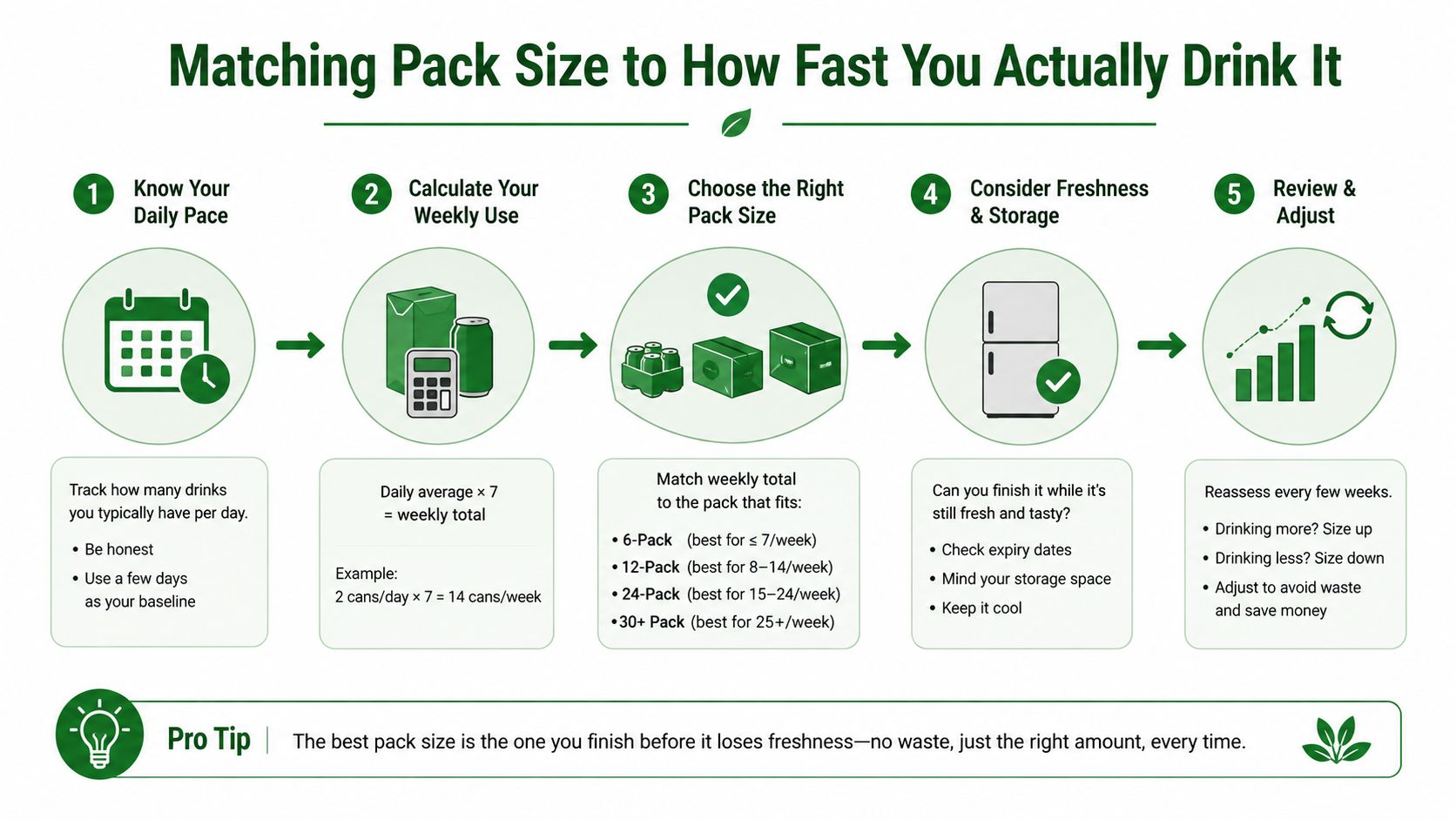
Pack size should reflect your actual turnover rate, not a perceived bulk discount. A larger bag lowers the cost per gram only when you finish it quickly enough to retain the colour, aroma and flavour that justified the purchase.
Start with your drinking rhythm
A small sample tin suits occasional drinking. A 60g pouch is a sensible starter size or suits anyone rotating flavours. Choose a 100g bag for a regular home routine. 250g can work for a household preparing matcha frequently. The 500g to 1kg range belongs with serious home use, baking, catering or food service. It is a poor choice for an uncertain first order.
Use your calendar, not an imagined routine:
- Occasional drinker: Choose a small pack and protect it from air and light.
- Daily morning drinker: A modest or medium pouch is easier to finish while the powder is fresh.
- Two-a-day household: A larger home format can work if you seal it carefully and use it consistently.
- Café or wholesale buyer: Bulk stock makes sense when service volume supports rapid turnover.
Skip the 1kg wholesale pouch if its main appeal is the price per gram. Buy that format when your operation can finish it within roughly eight to ten weeks, as the supplied market guidance recommends. Once opened, freshness sets the value of every serve.
Work out cost per cup before comparing bags
Divide the pack price by its total grams, then multiply the result by the amount used per cup. A $24 30g tin costs $0.80 per gram, while a $90 500g bag costs $0.18 per gram. The larger bag is cheaper per gram, yet the saving disappears when stale powder remains unused.
Those prices demonstrate the method only. Your serving amount, recipe and retailer price will change the result. Latte drinkers should also assess flavour strength, since a weaker powder may require more powder per drink.
Storage can change the answer
Keep opened matcha in a sealed, opaque container, away from sunlight, steam and the warmest part of the kitchen. Refrigeration may help in a hot Australian home, though condensation creates a real risk. Let a sealed container reach room temperature before opening it. Avoid moving a cold pouch repeatedly between the fridge and a humid bench.
Follow this matcha storage guide to set up a practical routine. The buying test is simple: can you finish this pack before its colour, aroma and flavour noticeably fade?
Reading a Product Page for Quality Signals That Matter
A product page should help you judge the powder quickly. Ignore labels such as “premium” or “superior” when the listing leaves out the details behind those claims. For matcha in Australia, pack size and turnover speed matter alongside product specifications, because freshness declines faster in a warm, humid kitchen.
Look for evidence, not decoration
Start with origin. A listing that names a Japanese growing region gives you more useful information than “Japanese style”. Uji, Nishio, Kagoshima and Shizuoka establish provenance. Origin alone is not sufficient to judge flavour quality, so check the rest of the page before choosing.
Look for shading details and a clear harvest date or harvest window. “Spring harvest” provides some context, while a specific harvest or packing date gives a stronger freshness signal. The page should also explain how the powder was milled. Stone-ground or traditional milling language carries more weight than an unsupported claim that the powder is fine.
Colour descriptions offer another clue. Vivid jade or bright green wording is more reassuring than yellow-green or dull descriptions, though colour remains only one signal. Lighting and image editing can change how the powder appears, so do not make the decision from a photograph alone.
Use the page to test seller transparency
A seller that lists caffeine or L-theanine per gram is describing the product with useful precision. Treat those figures as product information, not promises about health or performance. Caffeine matters to Australian shoppers, and ABC News' matcha and coffee comparison reports a typical serving at about 60 to 75 mg of caffeine.
Reviews become useful when they describe the experience beyond the first cup. Search for comments on bitterness, aroma, colour during the second month, clumping, whisking and foam. “Delicious” gives little to assess. Repeated reports of stale flavour or bitterness deserve much more attention.
Check the packaging before you buy. A resealable pouch, sealed tin, nitrogen-flushed format or individually separated sachets can reduce exposure after opening. The page should clearly show pack weight, ingredients and country of origin. Choose a format your household or café can finish promptly, since a lower price per gram does not compensate for powder that loses colour, aroma and flavour before use.
Matching Format to Use Case From Lattes to Wholesale
The wrong format can increase your real cost per serve. A home drinker, baker, café and gift buyer may all want matcha, but they shouldn't buy the same package.
| Buyer type | Best format | Pack size | Key extras |
|---|---|---|---|
| Home drinker | Resealable tin or pouch | 30g to 80g | Whisk, scoop or starter set |
| Baker | Resealable kitchen pouch | 250g to 500g | Clear origin and ingredient details |
| Café | Food-service pack | 1kg | Batch consistency and nitrogen flushing |
| Gift buyer | Curated multipack | Small assorted formats | Tin, whisk and chasen holder |
Home drinkers need manageable freshness
If you prepare one matcha most days, choose a pack you can finish within roughly six to eight weeks, as the supplied buying guidance recommends. A 30g to 80g tin is easier to rotate than a large food-service pouch. If you don't own a whisk, a starter set can be more useful than spending the same decision-making energy on a higher grade you'll use incorrectly.
For milk-based drinks, the best matcha powder for lattes guide can help you compare preparation styles. Choose a powder with enough flavour to hold its place beside milk, rather than selecting a delicate drinking grade purely because the label sounds refined.
Bakers and cafés should buy for consistency
Bakers need enough powder for repeated recipes without opening several small tins. A resealable 250g or 500g pouch is generally easier to manage than a collection of tiny containers. Prioritise a clear origin, reliable colour and flavour that can survive other ingredients.
Cafés and tea shops have different requirements. A 1kg wholesale pack can suit a busy menu, but only when staff use it quickly and the supplier can support consistent batches. Ask about nitrogen flushing, batch identification and a certificate of analysis if your purchasing process requires one. Don't treat “wholesale” as a quality grade. It's a format and supply relationship.
Sweetened blends suit convenience-led buyers
Premium Sweet Matcha 200g contains 30% authentic Japanese green tea leaves and is described as a naturally sweet, smooth pre-sweetened blend. Its 200g format is positioned for people building a routine who want a convenient latte or iced drink without adding separate sweetener.
That format is not a substitute for straight ceremonial matcha. It's a different solution for a different job. Gift buyers should also consider multipacks or accessory bundles that make preparation easier, especially when the recipient doesn't already own a whisk or chasen holder.
Shipping, Payments and Returns When Buying Matcha Online
Online matcha purchases fail for boring reasons more often than exotic ones. A seller may describe the tea well but provide weak packaging, unclear freight charges, vague origin information or no practical returns process.
Check biosecurity before ordering from overseas
Tea made purely from Camellia sinensis is treated by the Australian Department of Agriculture, Fisheries and Forestry as a minimal biosecurity risk, so it doesn't require an import permit or mandatory inspection on arrival under the relevant BICON tea conditions. That treatment doesn't automatically apply to every product sold as “matcha”.
Blended, flavoured or herbal powders may fall under different conditions. DAFF's plant products for human consumption guidance explains that herbal tea products can require different checks, documentation or permits. Herb-based tea consignments must be thoroughly dried, and mailed goods generally face a 1 kg maximum per blend in the relevant circumstances.
Before placing an international order, check the exact ingredients in BICON. Make sure the product is commercially prepared, dry, unopened and packed cleanly, with no seeds, soil, live insects or other contaminants. “Matcha” on the front of a pouch isn't enough to establish the import pathway.
Confirm origin, freight and checkout terms
Tea and coffee are non-priority foods under Australia's Country of Origin Food Labelling Information Standard. Retail products still need a text statement identifying where they were grown, produced, made or packed, but they don't use the full priority-food kangaroo graphic. The ACCC country of origin labelling guidance explains the distinction.
Prefer tracked shipping and packaging that protects the powder from light and moisture. Ask whether the seller records batch numbers, especially if you're buying for a café or ordering a large format. At checkout, look for a clear total in Australian dollars, including GST where applicable, and shipping costs that don't appear only after payment.
Know your position if the parcel arrives damaged
Australian Consumer Law gives online buyers protections when goods are damaged, misdescribed or unsuitable for a disclosed purpose. Goods must be of acceptable quality, fit for a disclosed purpose and match their description. If the parcel arrives damaged, you may have a right to a repair, replacement or refund depending on whether the problem is major or minor, as explained by Consumer Affairs Victoria's damaged goods guidance.
Read the retailer's written policy before opening the pouch. Payment options such as PayPal, Afterpay or credit card can provide familiar transaction pathways, but they don't replace your consumer guarantees. Keep the order confirmation, delivery record and photos if the package arrives compromised.
Your Quick Matcha Buying Checklist Before You Check Out
You don't need a complicated scoring system. You need a short pause before payment, especially when a product page is trying to push you towards the biggest bag or the grandest grade.
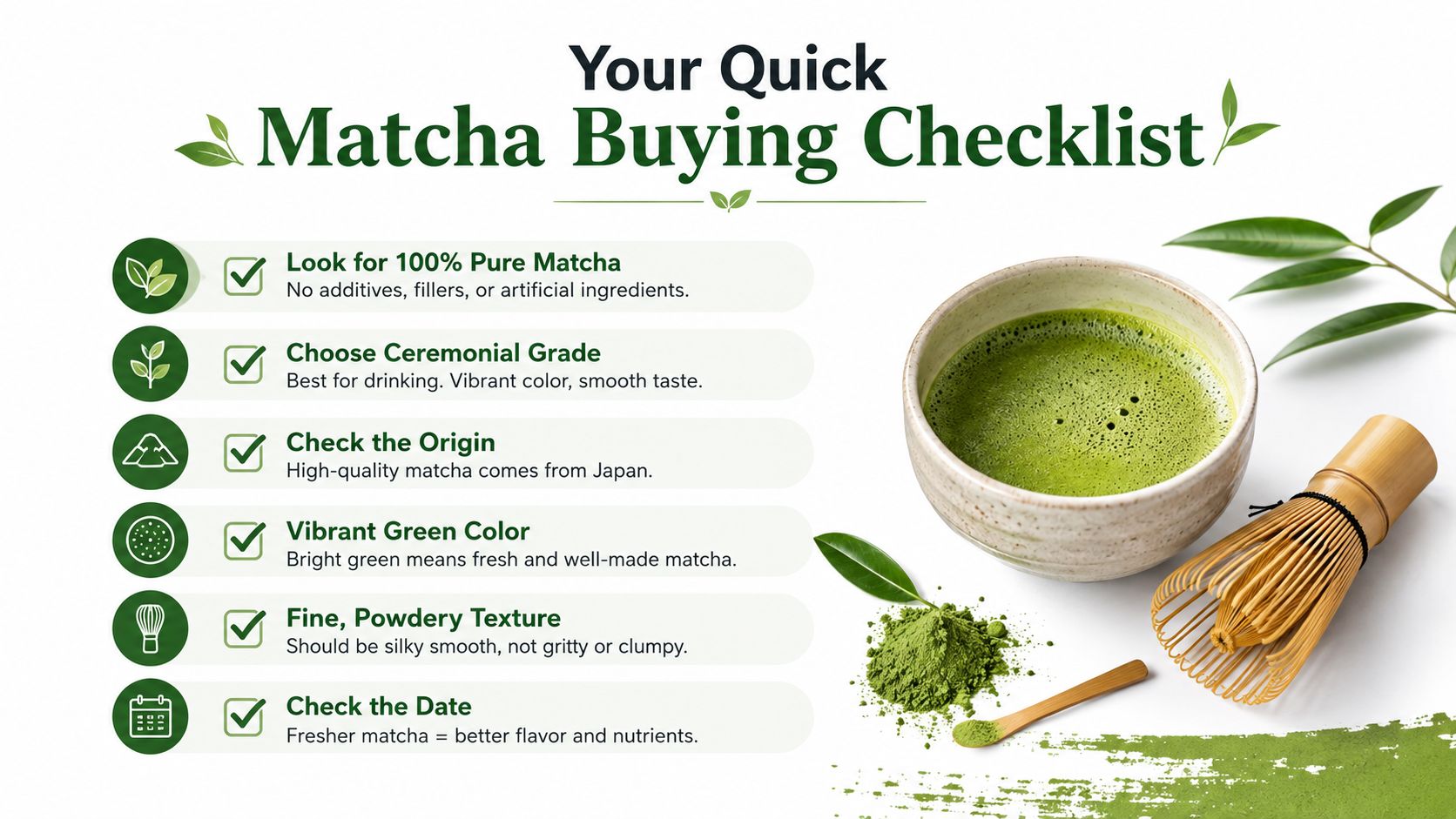
Run these checks in order
- Match the grade to the drink. Choose ceremonial for straight whisked tea, culinary for recipes and milk-based drinks, and sweet grade for convenient pre-sweetened preparations.
- Calculate your real serving cost. Divide the price by the pack weight, then account for how much you use per cup. A larger bag is not better value if you leave it open for too long.
- Check freshness information. Look for a harvest or packing date and favour stock that sits within the past four to six months when that information is available. The date alone isn't enough, so also inspect packaging and storage advice.
- Read reviews for useful complaints. Search for repeated mentions of bitterness, stale aroma, poor foam or colour fading after the first month. First-sip praise is pleasant but limited evidence.
- Confirm Australian delivery and returns. Check the shipping charge, estimated delivery method, origin statement, ingredients and written returns policy before you pay.
- Decide whether accessories belong in the same order. A whisk and scoop can improve preparation more than a marginal grade upgrade. Bundle tools only if you'll use them, not because the product page makes the set look complete.
The Australian category has room for both occasional home drinkers and serious food-service buyers. Independent market coverage estimates that Australia's matcha market generated more than $54 million in 2024, while Japanese green tea exports to Australia reached 195,319 kg from January to August 2025, up 131% year on year, according to Australia matcha market coverage. Those figures show why pack size and freshness deserve more attention as more buyers move from occasional café drinks to home routines.
Place a small first order from one or two retailers you trust. Only move to 250g, 500g or 1kg formats after the flavour suits you and your household or business can turn the powder over quickly.
The supplied video offers another visual preparation reference before you commit to a routine.
TOO MATCHA. offers Japanese-sourced ceremonial, culinary and sweet matcha in home, larger and wholesale formats, alongside starter tools and recipe guidance. Visit TOO MATCHA. to choose a pack that matches how quickly you'll drink it, then start with a manageable size before scaling up.