Matcha Panna Cotta Recipe That Sets Smooth Every Time
You've got the cream ready, the matcha tin open and guests coming tomorrow. What you don't want is a dessert with green specks on top, sediment underneath or a set so firm it eats like jelly.
Smooth matcha panna cotta depends less on buying the most expensive tea and more on dispersing the powder properly, dissolving the gelatine completely and controlling the cooling. Treat those as separate jobs and the dessert becomes much easier to get right.
Table of Contents
- Ingredients and Quantities for Four Serves
- How to Make Matcha Panna Cotta Step by Step
- Blending Matcha Smoothly and Choosing a Grade
- Fixing Texture, Colour and Set Problems
- Storing and Serving Matcha Panna Cotta Safely
- Vegan and Dairy-Free Matcha Panna Cotta Variations
- Choosing Your Batch Size and Caffeine Level
Ingredients and Quantities for Four Serves
Plan for four serves in four 120 mL moulds or ramekins, with a little spare mixture. The recipe below has a 450 mL dairy base, but the matcha slurry and gelatine-blooming water both add liquid, so the finished mixture will exceed the moulds' combined 480 mL capacity.
Ingredients for four 120 mL panna cottas
| Ingredient | Quantity | Role in the dessert |
|---|---|---|
| Double cream | 350 mL | Body, richness and a soft set |
| Full-cream milk | 100 mL | Lightens the base without thinning it |
| Caster sugar | 50 g | Sweetness; balances matcha bitterness |
| Powdered gelatine | 7 g, about 2¼ tsp; check sachet weight | Sets the dessert |
| Cold water for blooming | 45 mL, 3 tbsp | Hydrates the gelatine |
| Culinary matcha | 5–7 g for a balanced batch, up to 12 g for bold | Colour and flavour |
| Warm water for matcha slurry | 30 mL | Disperses the powder before mixing |
| Vanilla bean paste | 1 tsp, optional | Rounds out the matcha |
Use scales for the matcha and gelatine. Spoon measurements are convenient, but powder density and sachet sizes aren't consistent enough to make them your main production measure.
The 350 mL cream and 100 mL milk make 450 mL of dairy. Adding the slurry brings that to 480 mL before the blooming water, dissolved sugar and other ingredients are counted. Don't force everything into the moulds; pour the remainder into a small tasting glass.
Matcha is the flavour variable. Good Reading Magazine's recipe uses 7 g for four small panna cottas, while Purematcha Australia's recipe uses 12 g for four servings. Those are different formulations, not interchangeable guarantees of strength.
Batch rule: Count every liquid addition, including blooming water, when recording your formula.
For eight serves, double the ingredients exactly. Keep the gelatine proportional rather than adding another sachet because it's convenient.
How to Make Matcha Panna Cotta Step by Step
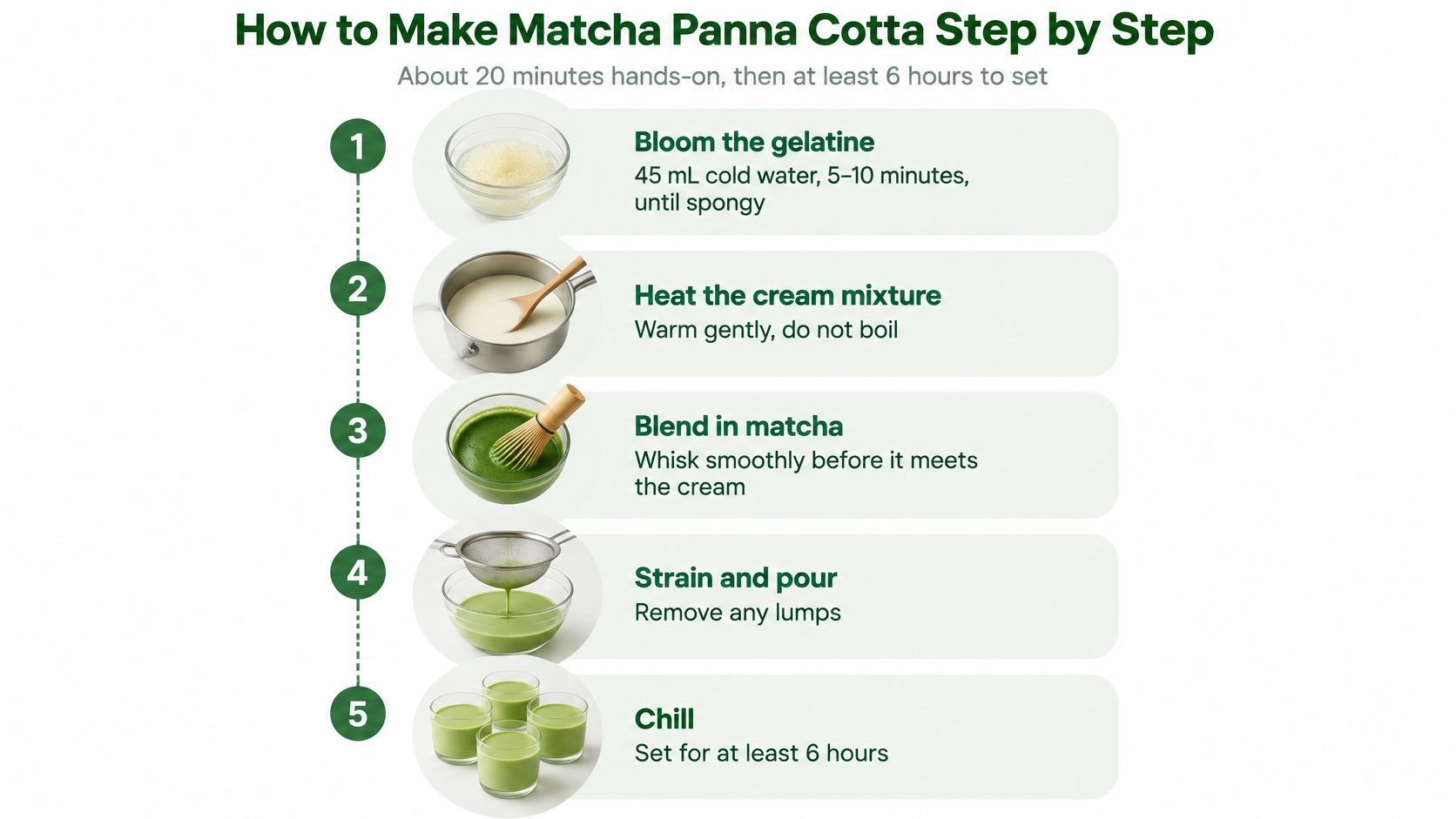
Allow about 20 minutes of hands-on work, plus cooling and at least 6 hours of refrigeration. Set out a saucepan, digital scales, small whisk, fine sieve, pouring jug and prepared moulds before you heat anything.
Chef Raymond Tan developed his version while testing recipes for Nimbo, the Melbourne dessert shop he operated with his cousin; Melbourne Food & Wine's published recipe uses four 120 mL moulds, a 5 to 10 minute bloom, about 15 minutes of cooling before adding matcha and approximately 6 hours to set.
Heat, hydrate and combine
- Bloom the gelatine. Sprinkle it evenly over the 45 mL cold water and leave for 5 to 10 minutes, until spongy throughout. Dumping it into a heap can leave dry powder trapped inside a wet shell.
- Heat the cream, milk and sugar over medium heat, stirring until the sugar dissolves and the mixture steams. Don't boil it; you're dissolving ingredients, not reducing the dairy.
- Remove the saucepan from the heat, then stir in the bloomed gelatine. Stir until no translucent granules remain on the spoon and none sit at the bottom of the pan.
- Let the base cool for about 15 minutes, until warm rather than hot, stirring occasionally. You want the dairy warm enough to keep the gelatine fluid but not hot enough to dull the matcha you are about to add.
- Sift the matcha into a small bowl and whisk in the 30 mL warm water, around 70 to 80°C. Work the whisk against the bowl until the paste is smooth, with no dry pockets around the edge.
- Whisk the paste into the warm dairy base until the colour is uniform, adding the optional vanilla. Scrape the matcha bowl thoroughly so the strongest part of the mixture doesn't stay behind.
- Strain into a pouring jug, then divide among the four moulds, reserving any excess in a small glass. Cover and refrigerate promptly for at least 6 hours; don't leave the portions on the bench to start setting.
- To unmould, dip the outside of each mould briefly in warm water for about 5 seconds, keeping water out of the dessert. Invert onto a plate and loosen gently rather than repeatedly heating the mould until its surface melts.
Blending Matcha Smoothly and Choosing a Grade
Disperse the matcha before it meets the cream. Dry powder dropped straight into a rich base tends to float, form little green rafts and leave concentrated flecks. A better grade won't correct that mixing problem.
Use the visual guide to check the preparation sequence.
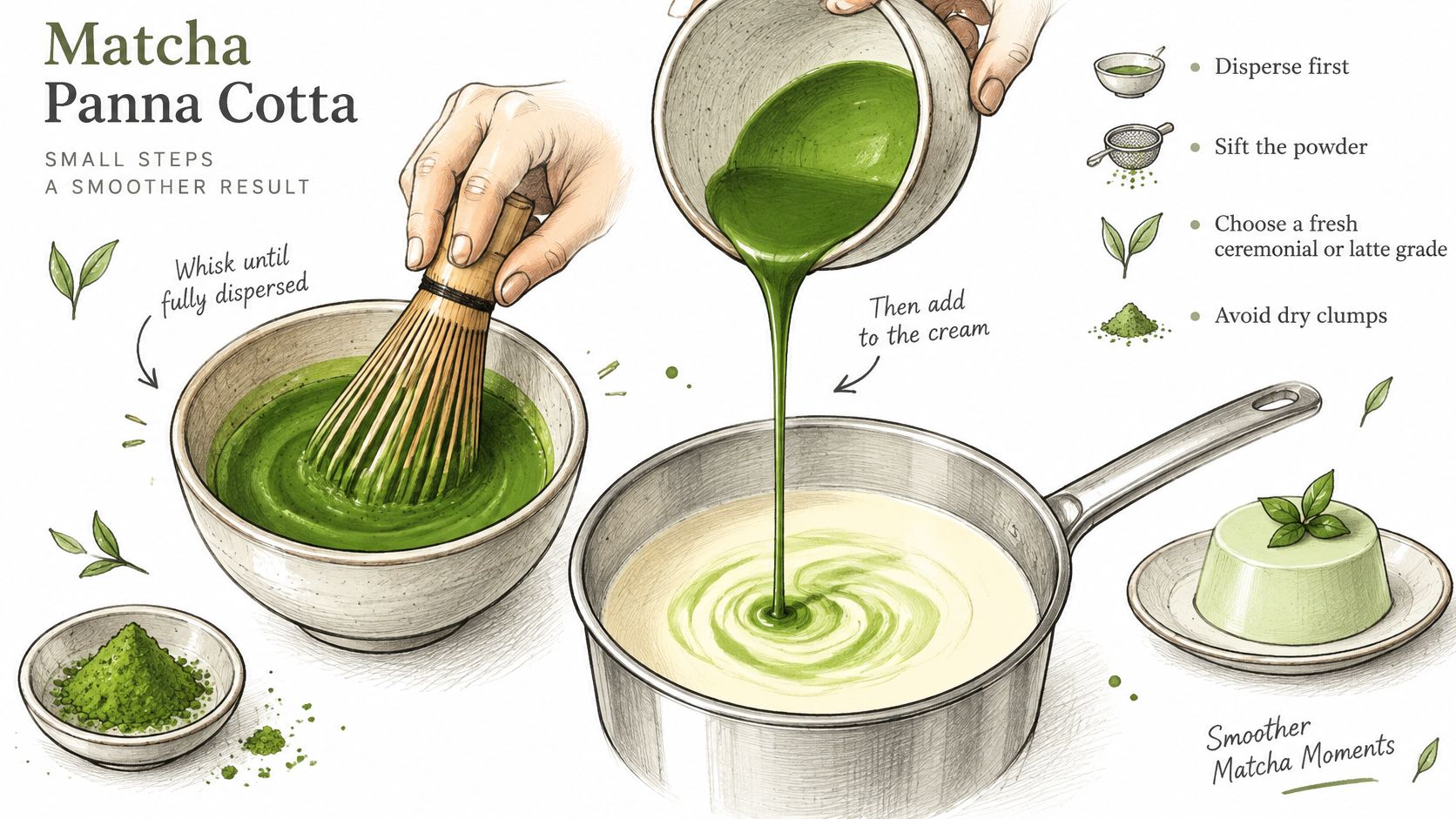
- Sift every time. Break up compacted powder before wetting it.
- Use hot, not boiling, water. Whisk a smooth slurry rather than trying to dissolve matcha like sugar.
- Keep the dairy base warm. Don't pour your carefully prepared slurry into boiling cream.
- Taste before pouring. Adjust sweetness while you can still dissolve the sugar evenly.
Choose flavour, not just a grade label
Culinary matcha is the practical default because its stronger earthy character stands up to cream and sugar. Ceremonial matcha can give a smoother, more delicate result, but its price doesn't guarantee a better dessert, and grade labels alone don't guarantee colour.
Matcha grades for panna cotta
| Option | Colour and flavour in panna cotta | Best choice when |
|---|---|---|
| Culinary grade | Bold, earthy; holds its flavour against cream and sugar | You want a reliable, good-value default |
| Ceremonial grade | Can be brighter green, smoother and more delicate | You want subtle flavour and accept the higher cost |
| Pre-sweetened matcha | Mild and sweet | You want convenience; start with about half the added sugar, then taste |
| Hojicha, roasted green tea | Toasted, brown-amber, not green | You want a toasted flavour rather than green colour |
The ceremonial versus culinary matcha guide helps distinguish their intended uses. Our Premium Culinary Grade Matcha 60g is a Japanese tea powder intended for cooking and creating, with a bold flavour suited to a dairy-rich dessert.
Watch the whisking technique before comparing powders.
For a useful comparison, make half batches with different grades while keeping everything else identical. Compare flavour and colour on day one and day two, under the same light, rather than assuming the greener dry powder must win.
Fixing Texture, Colour and Set Problems
Which symptom are you seeing, and at what stage? A soft set, a khaki cast and a bitter finish come from three unrelated causes, and the fix for one does nothing for the others. Judge every fault on a fully chilled portion, because a set that's still warm in the centre reads as loose when it is fine.
Symptoms, causes and fixes
| Symptom | Likely cause | Fix |
|---|---|---|
| Soft, weeping set | Gelatine short for the total liquid, or a weak-bloom powder | Chill two more hours; if still soft, trial 1 g more gelatine per batch next time |
| Rubbery, firm set | Too much gelatine for the texture you want | Trial 6 g for the same volume next batch |
| Bitter taste | Matcha load too high for the sugar level | Trial 5 g matcha, or raise the sugar before setting |
| Dull, khaki or uneven colour | Base too hot when the tea went in | Add the matcha to a warm, not simmering, base |
| Grainy texture | Gelatine granules not fully dissolved | Warm a portion gently, dissolve fully, recombine and re-chill |
| Pale colour after setting | Too little matcha for the dairy volume | Increase matcha by 1 g per batch and retest |
Flecks that survive the slurry and strain step are a dispersion fault, and they're fixed there, before the base ever meets gelatine.
Every quantity in this table is a starting point you test, not a rule. Bloom strength varies between brands and falls off as the powder ages, so a gram count that corrects one batch can overshoot the next. Change one variable per batch and write down what you changed. Two adjustments at once leaves you guessing which one worked.
A grainy batch is only worth reworking if you've held safe temperature control throughout. Reheating doesn't make a mishandled dairy dessert safe, and a finished batch that's already been served shouldn't go back into production.
Change one variable per test batch. Otherwise, you won't know which adjustment fixed the fault.
Judge the set when it's ready
Check a fully chilled portion, not a mould that's still warm in the centre. The dessert should release cleanly, hold its shape and yield easily to a spoon without leaving a puddle.
For larger batches, use small portions rather than one deep vessel; FSANZ's food-safety guidance identifies shallow containers and rapid cooling as practical controls. Record total liquid, gelatine weight, matcha weight and chilling time so a successful batch becomes repeatable.
Storing and Serving Matcha Panna Cotta Safely
Keep panna cotta refrigerated from setting to serving. That rule covers storage, transport and display, and it means taking out only the portions you are about to plate. A dairy gel left in a warm room softens at the edges first, then slumps; by the time the centre looks wrong, the batch is already past serving quality.
FSANZ's temperature-control guidance requires potentially hazardous food to be held at 5°C or colder, with cooling from 60°C to 21°C within 2 hours, then to 5°C within a further 4 hours, and sets a covered-mould storage limit of up to 2 days at that temperature. I treat the two-day mark as an outer limit and plan to serve inside it.
Storage and cooling limits
| Stage | Time limit | Temperature or texture note |
|---|---|---|
| Set in the fridge | At least 6 hours | 5°C or colder |
| Store covered in moulds | Up to 2 days | 5°C or colder |
| Cool a large batch, first stage | Within 2 hours | From 60°C to 21°C |
| Cool a large batch, second stage | Within a further 4 hours | From 21°C to 5°C |
| Out of the fridge while serving | Keep as short as possible | Return unserved portions promptly to 5°C or colder |
| Freezing | Avoid for best texture | Ice crystals disrupt the gel; thawing causes weeping |
For catering, check the thickest portion with a clean probe thermometer and record the cooling times. Aim inside the cooling windows rather than at their edge. Controlled cooling applies to a large batch going into the fridge; finished desserts still go straight back to 5°C or colder.
Garnish without hiding the tea
- Fresh berries give a sharp contrast to the creamy base.
- Toasted pistachio or black sesame adds crunch without needing a heavy sauce.
- Citrus zest lifts the earthy flavour without adding much liquid.
- Plain yoghurt brings tang, particularly alongside a sweeter batch.
Add crunchy garnishes just before serving so they don't soften against the dessert. For events, keep the moulds refrigerated until the last practical moment. Unmould one at a time onto ready plates rather than lining up the whole batch in a warm kitchen.
Vegan and Dairy-Free Matcha Panna Cotta Variations
Replacing the dairy changes flavour; replacing gelatine changes the set. For dairy-free panna cotta, swap double cream for full-fat coconut cream and milk for oat or almond milk. A vegan version also needs agar instead of gelatine, while yoghurt-style panna cotta replaces part of the cream with natural or Greek yoghurt and suits raspberry ice.
| Variation | Base and setting ingredient | Main trade-off |
|---|---|---|
| Dairy-free | Coconut cream, oat or almond milk, gelatine | Coconut flavour; not vegetarian or vegan |
| Vegan | Coconut cream, plant milk, agar | Firmer, quicker-setting texture with less wobble |
| Yoghurt-style | Cream or coconut base, natural or Greek yoghurt, gelatine | Tangier flavour; dairy remains unless plant yoghurt is used |
| Maple-sweetened | Maple syrup instead of caster sugar | Adds its own flavour, colour and liquid |
Well Nourished's matcha yoghurt panna cotta combines coconut milk or cream, natural or Greek yoghurt, sweetener, vanilla, matcha and gelatine, served with raspberry ice. It's a useful flavour direction, but yoghurt doesn't make a recipe dairy-free, and coconut doesn't make a gelatine-set recipe vegan.
Work with agar's different behaviour
For an agar trial, a starting formulation is about 2 teaspoons of agar powder per 500 mL liquid, simmered for 2 minutes. Check the product's directions because agar strength and required activation vary; flakes aren't a spoon-for-spoon substitute for powder.
Agar needs enough heat to activate, so heat it with the coconut and plant-milk base before adding the matcha. Cool slightly, blend in the slurry and pour while the mixture is still fluid, rather than waiting until it thickens in the saucepan.
Expect a clean, firmer bite from agar, not the same melting wobble as gelatine.
Don't automatically add more gelatine to a dairy-free batch. Test the substitution first, then adjust according to how it sets in your chosen serving vessel.
Caster sugar keeps the flavour relatively neutral; maple syrup adds its own colour and needs to count towards the liquid balance. Taste coconut-based mixtures before pouring, and use the green tea ice cream guide for another way to explore tea flavour in a cold, creamy dessert.
Choosing Your Batch Size and Caffeine Level
Matcha stays in the dessert, so a serve isn't caffeine-free. Weighing the powder tells you the matcha dose per portion, but it doesn't establish caffeine in milligrams unless you also have reliable caffeine information for that powder.
- Weigh the whole batch's matcha. Record the amount on the recipe card.
- Divide by the actual number of portions. Include any extra tasting portion when allocating the mixture.
- Calculate caffeine only with a product-specific value. Multiply grams of matcha per serve by the supplier's caffeine figure in milligrams per gram.
- Label estimates clearly. Don't present an untested calculation as a measured result.
For example, 5 g across four equal serves is 1.25 g of matcha per serve, while 7 g across four is 1.75 g. These are powder weights, not caffeine amounts.
The Australian Institute of Sport's caffeine guidance lists approximately 30–50 mg in a 250 mL cup of green tea. That's a rough beverage reference, not a conversion factor for panna cotta made with whole powdered tea.
Use this checklist when recording a batch.
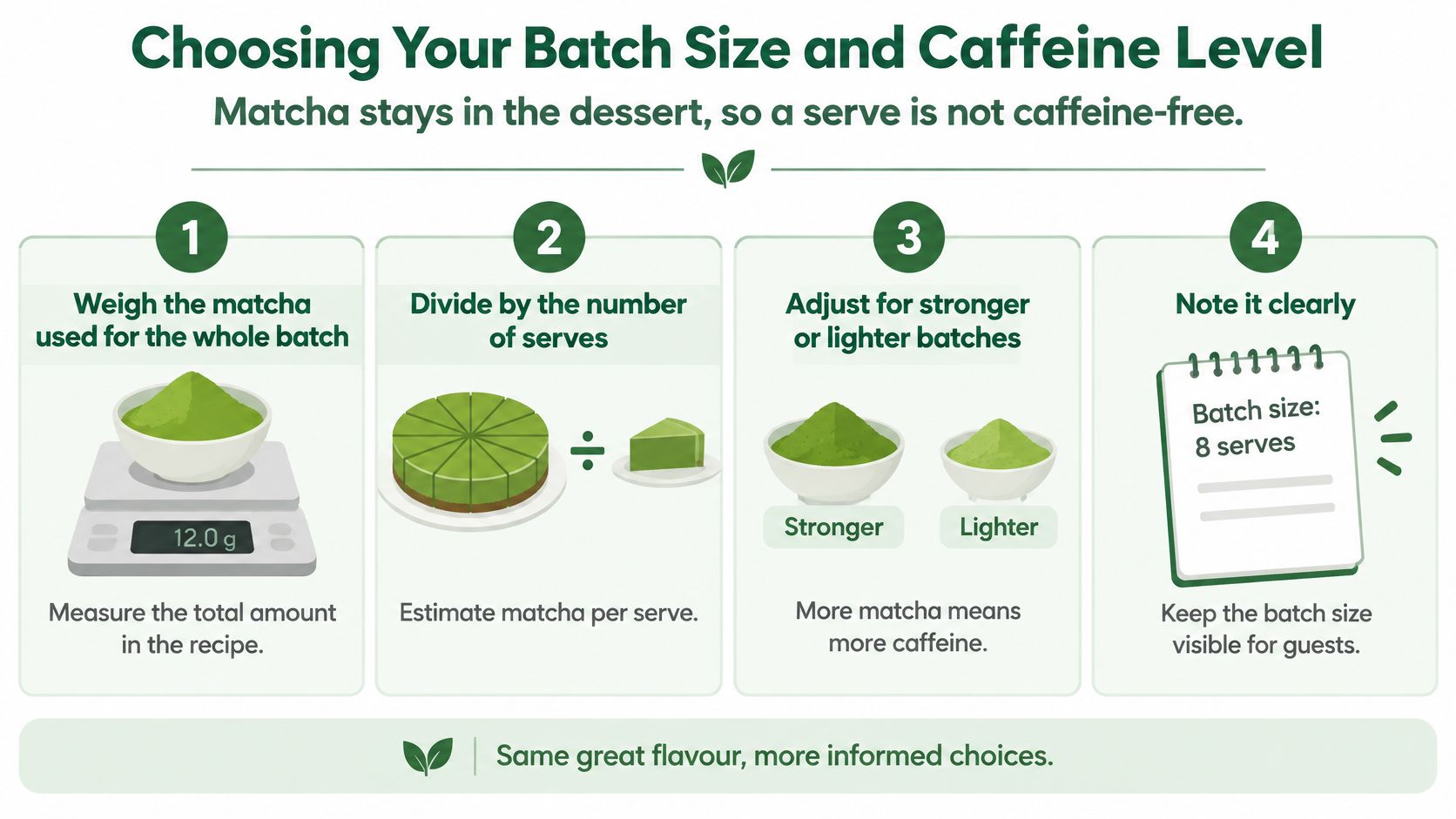
Start with a 5 g trial batch before scaling. To reduce the matcha contribution, trial 3–4 g, but don't promise a specific caffeine reduction from substituting hojicha without product information.
Be cautious when serving children, pregnant consumers or caffeine-sensitive guests, especially alongside coffee. The matcha latte caffeine guide offers useful context for considering the whole occasion's intake.
Before serving, check the cold temperature, clean release, garnish and ingredient disclosure. Keep the matcha dose visible on your recipe card.
TOO MATCHA. offers Japanese matcha and hojicha powders for home recipes, with culinary options suited to cream-based desserts. Visit TOO MATCHA. to choose a tea powder for your next trial batch, then record the dose and texture before scaling up.