Ceremonial Matcha Benefits: What the Evidence Shows

Buying the most expensive ceremonial grade won't make your drink healthier. That's the popular advice worth challenging first. Powder weight and what you mix it with set the caffeine, the sugar and the calories far more than the word ceremonial on the pouch. A small, unsweetened serve of a plainer grade can be the better habit, while a large, sweetened serve of a premium grade can work against you. Judge ceremonial matcha benefits by dose and format, not by price.
Table of Contents
- Ceremonial Matcha Benefits Ranked by Evidence
- What Ceremonial Grade Tastes Like and Where It Belongs
- How Much Caffeine One Serve Delivers
- Where L-Theanine Helps and Where Claims Overreach
- Serving Formats Compared from Usucha to Dessert
- Who Should Limit Matcha and Why
- Choose a Grade and Serving Plan Today
Ceremonial Matcha Benefits Ranked by Evidence
Ceremonial matcha has a few benefits worth claiming, and several that outrun the evidence. The label alone doesn't make it healthier. What matters is that you consume the whole powdered leaf, so the dose rises and falls with how much powder you whisk, not with the grade printed on the pack.
The Ranking at a Glance
Ceremonial matcha benefits by evidence strength
| Benefit | Evidence strength | What you can responsibly say |
|---|---|---|
| Caffeine alertness | Strongest, measurable | Caffeine can support alertness; the amount depends on powder weight |
| L-theanine and smoother focus | Plausible, not proven for matcha | Some people feel it is smoother than coffee; not guaranteed |
| Catechins and antioxidants | Plausible, limited matcha trials | Contains antioxidant compounds; not proof of disease prevention |
| Stroke and heart associations | Association seen in green tea research | Linked to green tea intake in dietary guidance; not proven for matcha |
| Disease prevention claims | Not established | Avoid claiming prevention or treatment |
Caffeine alertness sits at the top because caffeine is measurable in the cup and in your daily total. You can count it, adjust it and compare it with coffee or tea. That's a different class of claim from a vague promise about long term protection.
L-theanine and smoother focus comes next, but with a clear caveat. The mechanism is plausible, because tea contains both caffeine and theanine, yet that doesn't prove a specific ceremonial product will improve your concentration or remove jitters. Individual sleep, habituation and sensitivity change the result.
What the Lower Rows Really Mean
Catechins are present in green tea leaf, and matcha retains the leaf rather than discarding it after steeping. Presence isn't the same as a proven outcome. A compound can be in the powder without a trial showing that a daily bowl changes a disease endpoint in people.
The stroke and heart row is weaker still for matcha specifically. Australian dietary guidance discusses green tea associations and possible mechanisms involving tea polyphenols. An association across green tea drinkers doesn't prove that switching to ceremonial matcha prevents stroke, lowers your personal risk by a set amount, or treats blood pressure.
Responsible wording: Say matcha is a concentrated green tea containing caffeine and catechins. Don't upgrade that into a promise to prevent or treat disease.
Disease prevention claims fail the test entirely. No grade, origin story or vivid colour turns a food into a medicine. If a seller can't point to a measured dose and a relevant human outcome, treat the claim as marketing.
Start by deciding which benefit you're buying matcha for. If it's alertness, control the grams. If it's flavour without bitterness, choose the format that lets you taste the leaf plain. If it's a lower sugar café alternative, the milk and syrup matter more than the grade. That one decision makes the rest of your choices straightforward.
What Ceremonial Grade Tastes Like and Where It Belongs
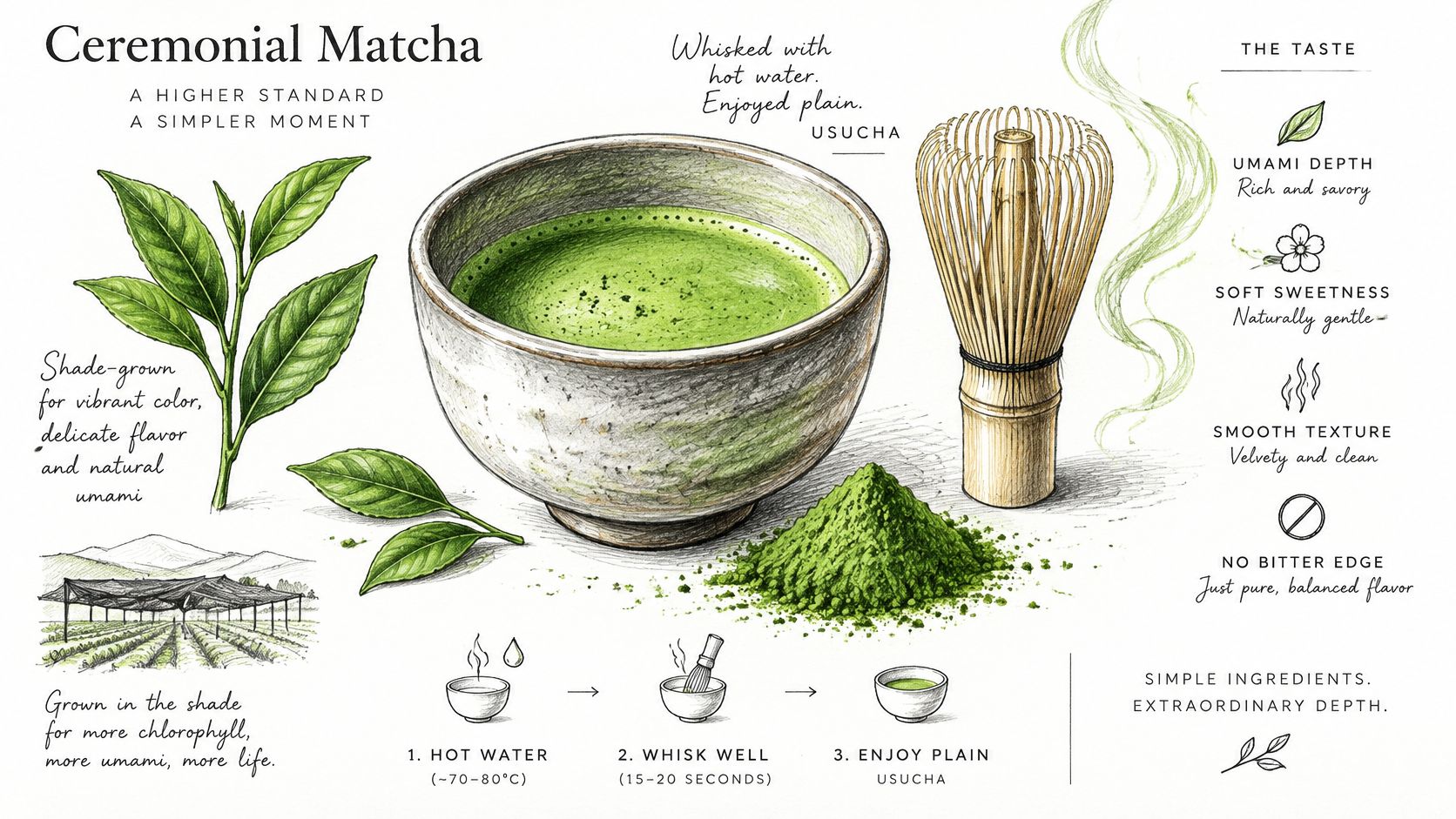
The ceremonial label does not determine a matcha's caffeine or calories. Powder weight and what you mix it with matter more. For flavour, ceremonial grade is delicate, umami-rich and well balanced, with strong intensity. It is intended for traditional whisked tea and pure sipping.
Matcha grades compared by flavour and use
| Grade | Flavour profile | Typical use | Best fit |
|---|---|---|---|
| Ceremonial | Delicate, umami-rich, balanced, with strong intensity | Whisked with water for usucha and pure sipping | Tasting the leaf itself |
| Culinary | Bold, earthy, medium intensity | Lattes, baking and recipes | Mixing into other ingredients |
| Pre-sweetened | Mild and sweet | Quick iced drinks and lattes | A consistent, ready-to-mix taste |
Matching Grade to Use
Choose ceremonial grade when the tea will be whisked with water and served on its own. Its balanced flavour is the focus. Culinary grade has a bold, earthy profile suited to baking, blending and recipes, where other ingredients share the cup or dish.
Pre-sweetened blends offer a mild, sweet flavour for lattes and iced drinks. Because the matcha and sweetener are combined, changing the amount of powder also changes the sweetness.
For a plain serve, Ceremonial Grade Matcha 60g is sourced from Japan's renowned tea-growing regions and milled by a partner business using an advanced method to produce an ultra-fine, clump-free powder. Its clean, vegetal flavour has natural sweetness and no bitterness. A 60g pouch gives you an option for trying the tea before choosing a larger size.
The Traditional Whisking Method
Sift about 2g of powder, roughly one level teaspoon, into a warmed bowl to remove clumps. Add 70 to 80ml of water at 70 to 80 degrees Celsius. Very hot water can make the drink taste harsher.
Whisk briskly in a quick W motion from the wrist until a fine, even froth forms. Slow circular stirring can leave powder settled at the bottom. Drink promptly, while the powder is evenly suspended.
For a flavour reference before judging your own bowl, use this guide to what matcha powder tastes like. A sharp, grassy or flat taste can reflect the grade or preparation. That is a flavour observation, not evidence of a health effect.
How Much Caffeine One Serve Delivers
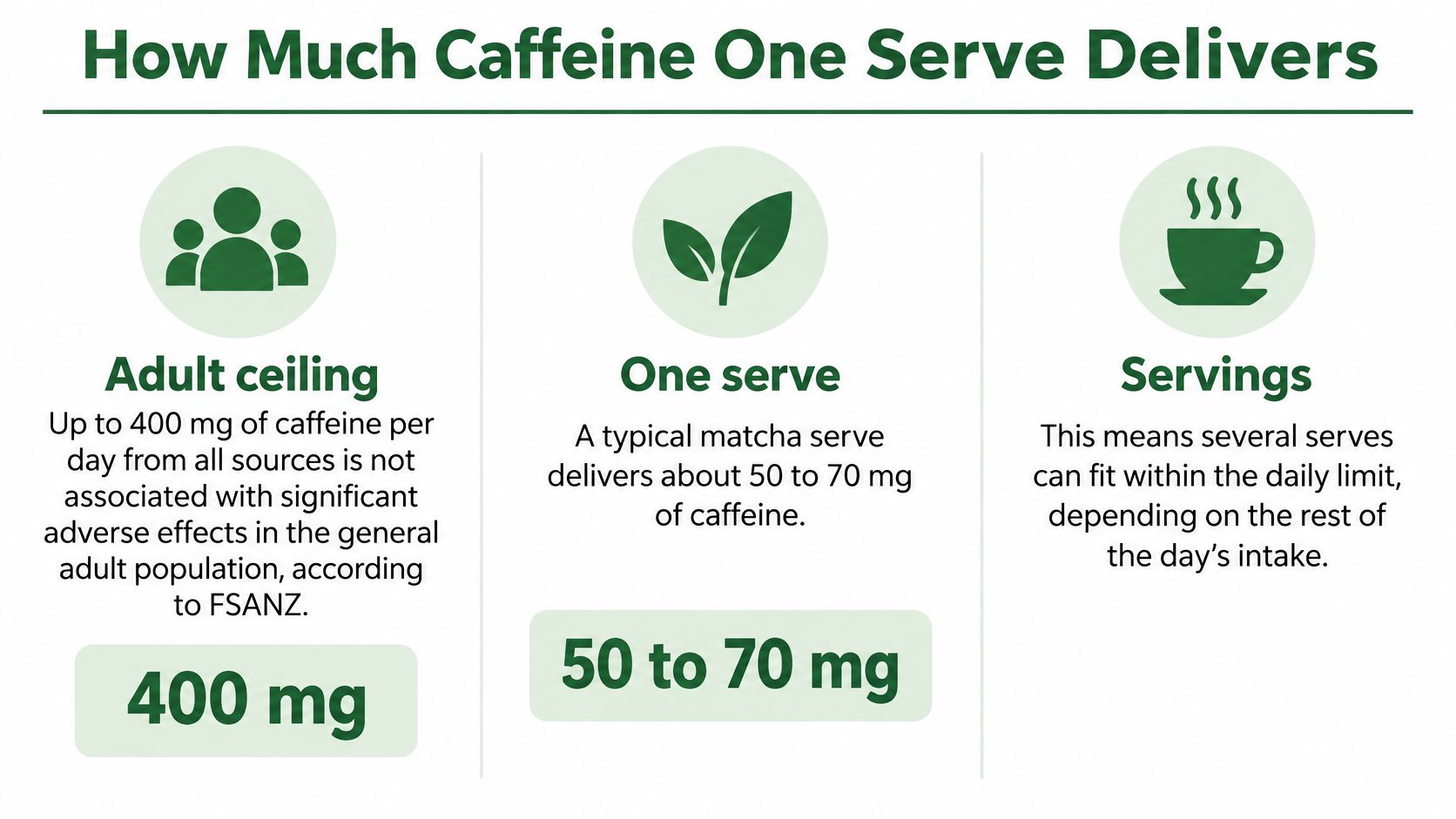
Caffeine depends more on the grams of matcha in your bowl than on the word “ceremonial” on the label. A standard serve is not a fixed dose: powder weight, the product's caffeine content and anything else you drink that day all affect your total.
Food Standards Australia New Zealand says daily caffeine intake up to 400mg is not associated with significant adverse effects for the general adult population. For pregnancy, Healthdirect recommends limiting caffeine from all sources to 200mg per day. These are daily totals, not allowances for matcha alone.
Reference Points You Can Add Up
Caffeine reference points for matcha drinkers
| Group or case | Reference limit | Basis |
|---|---|---|
| Healthy adults, all sources | Up to 400mg per day | FSANZ safety assessment |
| Pregnant or breastfeeding | 200mg per day from all sources | Healthdirect and FSANZ |
| Children and adolescents | Lower than adult limit | FSANZ |
| Matcha serve by calculation | Grams of powder × measured caffeine per gram | Product test data, not a fixed figure |
The table's practical takeaway is the calculation: a matcha dose depends on both the powder used and its measured caffeine concentration. Brewed tea figures and generic matcha estimates cannot establish the caffeine in your particular bowl.
Do the Arithmetic for Your Own Serve
Use product test data to estimate your serve:
- Step 1: Weigh the powder in grams rather than relying on a heaped teaspoon.
- Step 2: Multiply the weight by the product's measured caffeine per gram.
- Step 3: Add caffeine from coffee, tea, cola, energy drinks and any other matcha serves that day.
- Step 4: Compare the total with the daily limit that applies to you.
For illustration, if a product tests at 30mg of caffeine per gram, a 2g serve contains 60mg. Add an assumed 100mg coffee and an assumed 80mg energy drink, and the day's total is 240mg. That is below the general adult limit, but above the pregnancy limit. The same matcha serve can therefore fit one person's limit and exceed another's.
If your total is too high, reducing the powder weight lowers the caffeine dose while preserving the drink's format. A café serve or a second bowl can also change your daily total, even when the product name stays the same.
For context on how caffeine levels vary across Japanese teas, see this guide to Japanese green tea caffeine. Matcha's smooth taste does not make it caffeine-free. Powder weight and what you mix it with determine the dose and calories of your serve far more than the ceremonial label does.
Where L-Theanine Helps and Where Claims Overreach
L-theanine is the amino acid behind matcha's calm-focus reputation, and it's also where marketing runs furthest ahead of measurement. The compound is present. You consume the powdered leaf and its soluble components rather than steeping leaves and throwing them away, and matcha is naturally rich in L-theanine, the compound associated with smooth, sustained focus. What you rarely get is a measured amount per serve.
That missing number matters. Without milligrams of L-theanine per gram for your product and your serve weight, a seller can describe what's in the leaf but can't promise a clinical outcome. The word "ceremonial" on the pouch doesn't supply the figure either.
How Far the Evidence Goes
Laboratory and mechanistic evidence suggests caffeine and L-theanine can act on attention through different pathways, which gives a plausible basis for matcha feeling steadier than coffee at a similar caffeine dose. That kind of evidence describes how an effect could work. Demonstrating that a specific ceremonial grade improves focus, memory or work performance in people is a separate, harder claim.
Grade and price don't close that gap. A higher price may buy finer milling, younger leaf and better flavour, and none of those prove higher L-theanine or stronger antioxidant activity on their own. If a seller makes that leap, ask for a lab report giving L-theanine and caffeine per gram of powder. Two verified numbers let you compare products on chemistry rather than on copy, and your weighed serve turns them into an actual dose.
Three claims deserve particular scepticism:
- Prevents crashes: L-theanine doesn't cancel a large caffeine dose or a short night of sleep.
- Cancels jitters: A smooth taste doesn't stop caffeine raising heart rate or anxiety in sensitive people.
- Replaces sleep: No tea compound substitutes for sleeping properly.
Run Your Own One Week Test
Keep the test boring and consistent, or you'll learn nothing from it.
- Fix the recipe: Use the same powder weight, water volume and water temperature for one week.
- Record timing: Note when you drink each serve and what other caffeine you have that day.
- Rate the effect: Score focus and jitters from 1 to 5 at 30 minutes and again at 90 minutes.
- Compare fairly: On separate days, compare with coffee at a similar caffeine amount, not with your largest coffee.
If matcha scores better across several days, that's useful personal evidence. If it doesn't, believe your log over the label. Dose, habituation, sleep, medication and baseline sensitivity all shape the result, which is why one person's calm focus is another person's ordinary cup of caffeine.
Serving Formats Compared from Usucha to Dessert
The healthiest matcha habit usually isn't the most expensive grade or the largest serve. It's a modest, unsweetened preparation you can repeat without turning tea into dessert. Two variables set the caffeine and the energy of a serve: how much powder goes in, and what it's mixed with. The ceremonial label controls neither, because milk, syrup, flour and fat bring their own sugar and energy regardless of grade.
Matcha serving formats and what they add
| Format | Powder per serve | Added sugar | Health halo risk |
|---|---|---|---|
| Usucha, plain whisked | About 2g in water | None | Low |
| Unsweetened latte | About 2g in hot milk or plant milk | None added; milk sugars only | Low |
| Café sweetened latte | Roughly 2 to 4g, depending on scoop | Syrup or sugar, often high | High |
| Dessert recipe | Roughly 1 to 2g per portion | High, plus fat | High |
Powder weights above are typical ranges for a standard serve, not guaranteed measures. A kitchen scale settles your actual dose in seconds.
Reading the Table Line by Line
Usucha is the baseline. Powder and water, nothing else. You taste bitterness or sweetness directly, you know the powder weight, and there's no added sugar to argue about. If your goal is to judge ceremonial matcha benefits without interference, this is the cleanest test.
An unsweetened latte keeps the same measured powder and adds milk or plant milk. That adds protein and energy, and plant milks differ widely in both, so check the carton. The tea profile still holds because you haven't buried it under syrup. For many people, this is the easiest daily compromise between flavour and control.
In a café sweetened latte, control slips. Scoop size changes the caffeine, syrup changes the sugar, and a large cup changes the total energy. A 4g scoop alone delivers roughly double the caffeine of a 2g one before any syrup enters the picture. It can still be a drink you enjoy. Just don't credit the matcha for the whole nutritional profile when sugar and milk are doing most of the work.
Desserts sit furthest from tea. In pancakes, cakes and milkshakes, matcha is mainly a flavour and colour. A green crumb doesn't make butter and sugar disappear.
Judge the serve, not the halo: Check sugar, milk and portion size before you check whether the powder was ceremonial.
Check Nutrient Claims Against a Reference
Vitamin claims deserve the same discipline. The Australian Food Composition Database is a useful national reference for checking energy and caffeine values in foods available in Australia. It doesn't establish a validated ceremonial matcha figure for L-theanine or for vitamins A, B1, B2 or B3 that you can apply to every product.
That means no serve should be promised as providing clinically meaningful amounts of those nutrients without a matching laboratory-tested entry and a stated serving size. Antioxidant rich describes compounds present in the powder. It isn't proof that a sweetened latte prevents disease.
Choose the format that matches your aim. Plain usucha for tasting and dose control. Unsweetened latte for a fuller drink without added sugar. Sweetened café versions and desserts as occasional foods you choose for pleasure, with your eyes open.
Who Should Limit Matcha and Why
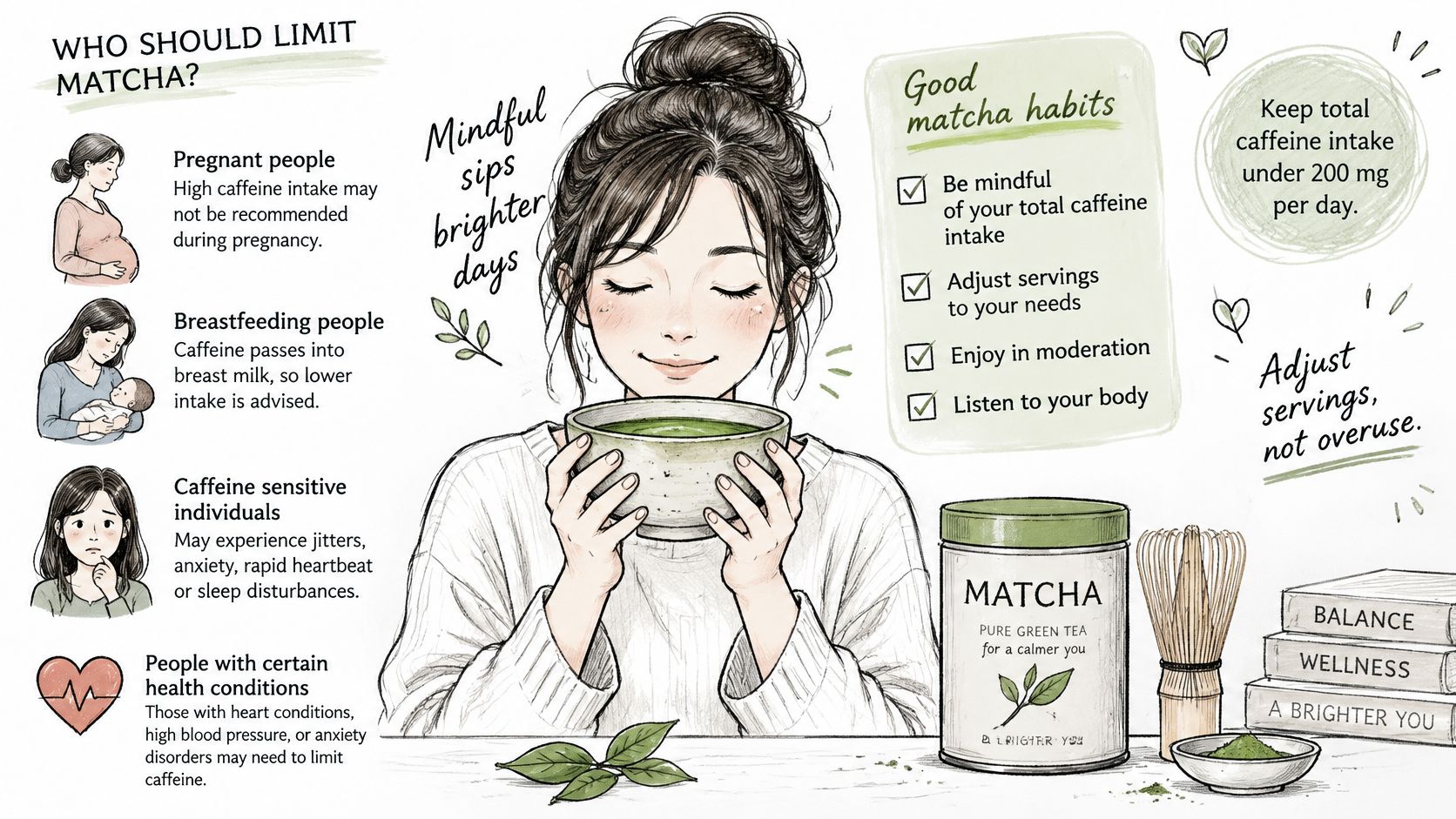
Some people shouldn't treat matcha as an unlimited daily default. That isn't alarmist. It's the same caffeine discipline you'd apply to coffee, with one extra complication, the strength changes every time the scoop changes.
The image below sets out the groups who need the most care with serve size and timing.
Pregnancy, Breastfeeding and Younger Drinkers
Healthdirect guidance on caffeine recommends pregnant and breastfeeding Australians limit total caffeine to 200mg per day, and explains that caffeine can cross the placenta, with reported associations between caffeine containing drinks during pregnancy and increased risks including miscarriage, stillbirth, low birth weight and developmental delay. Apply that limit to matcha, coffee, tea, cola and energy drinks combined, not to each drink separately.
Children and teenagers need lower limits than adults. For them, matcha should be a small, measured serve on occasion, not a large café latte assumed to be gentle because it's green tea. If you can't estimate the powder weight, you can't estimate the dose.
When to Check With a Clinician
Talk to your GP or pharmacist before daily use if you have anxiety, heart rhythm problems, high blood pressure, persistent sleep problems, or medication that may interact with caffeine. Do the same if ordinary coffee already gives you palpitations or shakiness. Smooth stimulation doesn't make caffeine safer, and L-theanine shouldn't override your individual limit or medical advice.
If you're trying to separate caffeine sensitivity from a possible reaction to the tea itself, this guide to matcha allergy symptoms helps you frame better questions for that conversation. Don't self diagnose from a single uncomfortable serve.
Watch this short preparation video before you settle on a daily serve size, because consistent whisking and measuring make your caffeine log far more reliable.
Use this checklist whatever your category:
- Watch the clock: Stop matcha after early afternoon if your sleep is sensitive.
- Respond to signals: Cut back if you notice a racing heart, shakiness or rising anxiety.
- Protect sleep: Never use matcha to replace sleep you've missed.
- Keep a total: Track all caffeine sources across the day, not just the green one.
Choose a Grade and Serving Plan Today
Pick the benefit first, then the grade, then the pack size. Reversing that order is how people end up whisking an expensive ceremonial powder into a sugary latte, then wondering why it tastes flat and costs too much per serve. One variable also sits above grade entirely: the grams you scoop and what you mix them with set the caffeine and calories of a serve far more than the label on the pouch does.
The Grade Decision in Brief
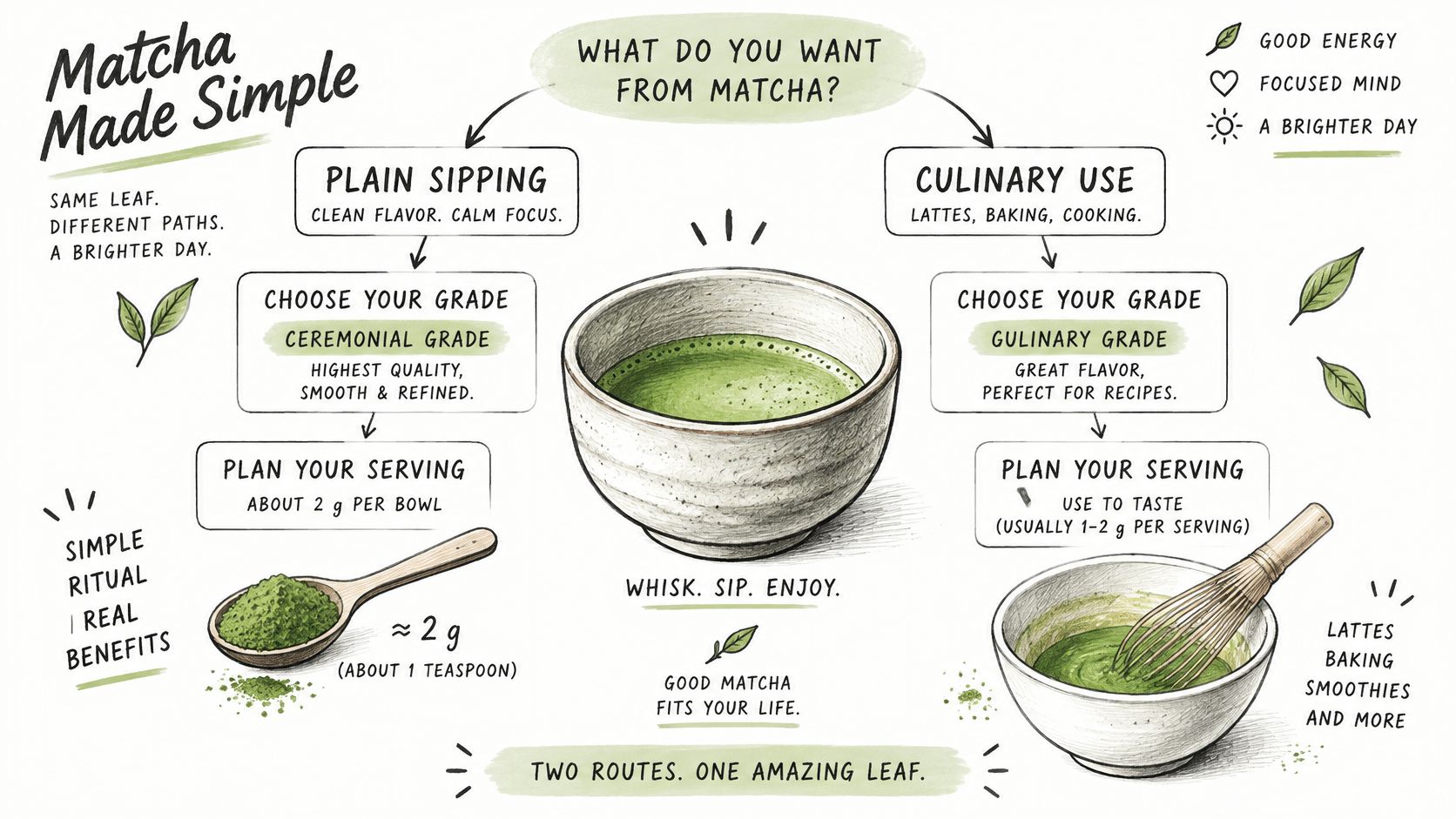
The earlier section on taste and grade walked through the matching logic in full, so a summary is enough here. Ceremonial grade exists for traditional whisked tea, where delicate, umami rich flavour stands on its own. Culinary grade is the bolder, earthier powder built to survive milk, sugar and heat. Pre-sweetened matcha handles a third job, speed, at the cost of sugar you can no longer measure yourself.
Notice what this choice does not decide. Caffeine follows powder weight, and calories follow milk and sweetener, so a culinary grade bowl whisked with water can deliver more caffeine and fewer calories than a ceremonial grade latte. Grade is a flavour and price decision; weight and mixer are the dose decision.
Australian Buying Checks That Matter
Check the label before you check the marketing copy:
- Origin and grade: Both should be stated plainly. A pouch that hides either is asking you to buy blind.
- Additives: Confirm what is in the pouch beyond tea, especially in sweetened blends where the sweetener is built in.
- Best before date: Buy a size you will finish while the powder is fresh.
- Batch size: Ask whether the powder is ground in small quantities, because freshness fades after milling and again after opening.
- Checkout currency: For Australian buyers, an AUD checkout keeps the delivered cost honest. TOO MATCHA. ships free on orders over $80.
TOO MATCHA.'s own product facts line up with those checks. The powder is milled in small quantities by a partner business for freshness, the matcha and hojicha pouches are free from additives, ethically sourced and carefully sealed, and stock ships fresh from Japan. Those are checkable claims. Treat any freshness or purity claim that a label cannot support as unproven, whoever makes it.
Ceremonial grade costs more per gram, so pack size matters as much as the grade itself. Ceremonial Grade Matcha runs from $74.99 for 60g up to $599.00 for 1kg, while Premium Culinary Grade Matcha starts at $64.99 for 60g. A smaller pouch you finish promptly usually beats a bulk bag that sits open for months. Store powder sealed, away from light, heat and strong odours, and press the pouch closed after every use. Stale matcha loses the natural sweetness you paid for, even when the caffeine is unchanged.
Your Next Seven Days
Run the one-week log described in the L-theanine section before you commit to a large pouch. Held at a fixed serve weight, it returns three answers no label can give you: your preferred grams per bowl, your latest sensible time of day, and whether plain sipping or a mixed drink fits your routine. Let those answers pick the pack. That is how ceremonial matcha benefits moves from a slogan to a measured daily choice.
Start with the benefit you want, then choose the grade and weighed serve that delivers it, whether that's ceremonial matcha for plain whisked sipping or culinary matcha for lattes and baking. Explore Japanese sourced matcha and hojicha in sizes built for home rituals, recipes and café use at TOO MATCHA. Pick your format, measure your first 2g serve, and let your own one week log decide what stays in your routine.