
Cup for Green Tea: How to Choose and Use the Right One

You've brewed sencha carefully, but the cup still tastes flat, thin, or strangely bitter. Then you use the same leaves in a glazed ceramic cup and the flavour suddenly feels fuller. That change isn't your imagination. The vessel affects temperature, aroma, mouthfeel, and even how pleasant the tea seems.
Choosing a cup for green tea isn't about copying a traditional Japanese shape or buying the most fashionable matcha bowl. It's about matching material, geometry, and volume to the way you drink tea. A small porcelain cup can suit a delicate infusion, while a wider ceramic bowl works better for everyday sencha. Matcha lattes need space for foam, ice, and milk, not a tiny ceremonial vessel.
Table of Contents
- Why the Right Cup Changes How Your Green Tea Tastes
- Matching Cup Material to Your Tea
- Shape, Rim, and Size That Bring Out the Best Flavour
- Sizing Your Cup for Matcha, Sencha, and Iced Drinks
- Heat Retention, Pour Control, and Daily-Use Features
- One Workhorse Cup or Two Building a Simple Green Tea Set
- Care and Cleaning to Keep Your Cup Performing
Why the Right Cup Changes How Your Green Tea Tastes
The same sencha can seem bright at home and dull at work because the cup changes what reaches your senses. Material affects heat transfer. Wall thickness affects how quickly the brew cools. Opening width controls how steam and aroma move towards your nose before the tea touches your lips.
A wide rim exposes more surface area, so the liquid cools faster and releases fresh grassy notes. A narrower opening holds warmth and concentrates vapour, which can make umami feel deeper. Neither shape is universally correct. The right choice depends on whether you want clarity and lift or warmth and concentration.
Material changes the first impression
Ceramic usually gives green tea a softer, rounder presentation. Porcelain feels cleaner and more precise, while glass keeps the vessel's influence relatively neutral and lets you watch the colour develop. A metal cup can feel sleek, but its heat conduction and possible metallic taste make it a poor default.
The effect isn't limited to temperature. A controlled study found that the same green tea was rated more pleasant in a ceramic cup than in a paper cup, and the cup material changed perceived taste attributes as well. Paper made the tea seem saltier than plastic in the study, even though the tea itself hadn't changed. The controlled tea vessel study supports a practical rule for home drinkers and Australian cafés: use ceramic or glazed porcelain when you want a clean, broadly appealing cup.
Practical rule: If a tea tastes harsh in one cup but balanced in another, test the vessel before changing the leaves.
The Australian context matters
Green tea has a long but specialised place in Australia. In the 12 months to March 2015, 11% of Australians aged 14 and over bought green tea specifically in an average four-week period, compared with 35% buying regular tea. The same survey recorded tea of any kind at 42%, confirming that green tea was established but narrower than standard tea purchasing. Roy Morgan's Australian tea survey also identified a strong age gradient, with regular tea reaching 54% among Australians aged 65 and over.
That history helps explain why green tea often feels associated with specialist preparation rather than a generic mug. Australian tea preferences shifted from Chinese green tea, which reportedly represented 90% of the market before the 1880s, towards Indian tea by 1900. Later, Tasmania trialled Japanese green tea cultivars imported in 1990, with commercial harvesting, processing, and marketing established by 2000. The Australian green tea historical account records that the production area had trebled by 2010.
Your cup should respect both sides of that story. Choose a refined vessel for delicate Japanese-style brewing, but don't reject a practical handled mug when your daily drink is a matcha latte.
Matching Cup Material to Your Tea
Material is the first filter, but it shouldn't be the only one. A cup can retain heat beautifully and still distort flavour, feel unsafe, or be awkward to clean. Look for food-safe, heat-stable construction and a glaze intended for repeated hot-drink use before you worry about decoration.
Ceramic, porcelain, glass, cast iron, and metal
Ceramic is the strongest all-rounder. Its thicker walls hold warmth and give sencha, genmaicha, and hojicha a rounded drinking experience. The trade-off is weight and slower cooling, which can be inconvenient if you're sensitive to heat. Cheap or poorly documented glazes are also a concern, so food-safe certification is essential.
Porcelain is thinner, lighter, and more revealing. It cools faster than thick ceramic, which makes it useful for delicate teas that become flat or overly warm in heavy vessels. Its pale surface also shows the colour of the infusion clearly. For light gyokuro or floral green teas, I'd choose thin porcelain over a chunky novelty mug.
Glass is visually excellent and usually flavour-neutral. It suits cold brew, iced matcha, and short drinking sessions, but it doesn't offer the same reassuring thermal mass as ceramic. Double-walled glass looks insulated, yet it's still a poor choice for a slow, lingering hot sencha session if heat retention is your priority.
Cast iron retains heat strongly and works particularly well with roasted hojicha or cold-weather service. It's heavier and needs disciplined drying. Store it damp and rust becomes a maintenance problem, especially around exposed surfaces or damaged enamel.
Metal is the modern-looking option I'd avoid for everyday green tea. It conducts heat quickly, can make the exterior uncomfortable, and may introduce a metallic note. Scratched stainless steel also deserves caution, since Australian tea guidance warns that scratched metal may leach nickel and iron into hot drinks. Australian guidance on selecting a tea cup recommends avoiding plastic for hot drinks because heat can cause non-inert plastics to leach, while an independent tea authority similarly favours nonporous, chemically inert glass or ceramic.
| Material | Heat Retention | Flavour Effect | Safety Notes | Best For |
|---|---|---|---|---|
| Ceramic | Strong | Rounded, soft | Check glaze and food-safe certification | Everyday sencha and hojicha |
| Porcelain | Moderate | Clean and precise | Choose reputable food-safe ware | Delicate green tea |
| Glass | Low to moderate | Neutral and transparent | Check thermal-shock resistance | Cold brew and iced matcha |
| Cast iron | Very strong | Warm, robust | Dry fully to prevent rust | Hojicha and slow service |
| Metal | Variable, often fast conduction | Possible metallic note | Avoid scratched surfaces and undocumented alloys | Short, modern serves |
BPA-free isn't a complete answer for a hot-drink cup. The better question is whether the material remains inert under heat, washing, and repeated use. A glazed ceramic or porcelain cup from a maker that clearly states food-safe use is the sensible default.
For a sweetened powder option, Premium Sweet Matcha 200g is described as a blend containing 30% authentic Japanese green tea leaves, with a naturally sweet, silky-smooth powder that's vegan, gluten free, dairy free, and additive free. Its format suits drinkers who want a straightforward matcha-based drink without building a large powder collection.
Shape, Rim, and Size That Bring Out the Best Flavour
Cup geometry is not decoration. It determines how quickly the tea cools, how much aroma reaches your nose, and how the liquid lands on your tongue.
Four design levers
Width controls cooling and aroma. A moderate opening of around 7 to 8 centimetres suits most loose-leaf green tea, giving the brew enough surface area to release aroma without making it cool immediately. A wide bowl works well for sencha because it lets you smell the tea as you sip. A narrow cup preserves warmth but can make delicate flavours feel compressed.
Height changes the aroma path. A taller cup holds steam closer to the drinking line and can concentrate floral notes. That's useful for aromatic teas such as dragon well. A low, broad cup gives a more open, cooler impression and makes the drink feel less formal.
The rim controls delivery. Thin porcelain gives a clean, direct flow and makes the tea feel lighter. A thick rolled rim spreads the liquid across more of your mouth and can make texture seem heavier. For matcha, a slightly flared rim helps distribute foam evenly rather than forcing it through a narrow opening.
Interior texture affects mouthfeel. A smooth, glassy surface can make astringency feel sharper and more defined. A subtly matte interior tends to soften the impression. Don't treat that as a substitute for proper brewing, but do recognise that the surface changes the sensory result.
A small, tall 60 ml Hagi-style cup suits a concentrated gyokuro session. A 180 ml wide ceramic bowl is more practical for daily sencha. Matcha belongs in a chawan with a flat enough base for whisk movement and enough width to prevent the bamboo whisk from striking the sides.
The 2024 sensory research on tea cups found that width, height, rim thickness, and smoothness all affected taste and aroma perception, with surface texture identified as the most influential factor. The sensory study on tea-cup geometry is useful because it confirms that small construction details can matter before you alter leaf quantity or water temperature.
For a practical look at Japanese vessel styles, see this guide to Japanese tea cups and their uses. My direct recommendation is simple: choose a smooth, moderately thin rim, a comfortable opening, and an interior that doesn't fight the tea.
Sizing Your Cup for Matcha, Sencha, and Iced Drinks
Cup volume should follow the preparation, not the other way around. Australian green-tea guidance commonly uses water around 70 to 80°C or 80°C, with a typical serving basis of 200 ml. T2's Australian green-tea guidance makes the practical problem clear: if you use a much larger mug without adjusting the tea, the brew can taste weak.
A standard Australian matcha benchmark uses 1.5 g of powder with 60 to 80 ml of hot water at about 80°C. The Australian matcha preparation benchmark points towards a small chawan-style vessel for concentrated matcha rather than a large breakfast mug.
| Preparation | Cup Volume (ml) | Leaf Dose (g) | Recommended Cup |
|---|---|---|---|
| Thick matcha | 60 to 80 | 1.5 powder | Flat-bottomed chawan |
| Usucha matcha | 150 to 200 | Adjust to recipe | Wide ceramic matcha bowl |
| Sencha | Around 180 to 200 | Adjust to tea style | Wide ceramic or porcelain cup |
| Hojicha | Around 180 to 200 | Adjust to tea style | Taller ceramic cup |
| Iced matcha latte | 350 to 500 | Adjust to drink strength | Handled glass or tumbler |
| Cold-brew sencha | 350 to 500 | Adjust to steeping method | Double-walled glass |
Match the vessel to the drink
For koicha-style matcha, use a small, stable bowl. Its limited volume keeps the mixture concentrated and gives you enough room to work the powder without splashing. For usucha, a wider bowl gives the whisk space to create foam.
For everyday sencha, start with a 180 ml wide cup. Sencha leaves expand as they steep, so a vessel that looks generous before brewing can feel correctly filled once the leaves open. A taller porcelain cup is preferable when aroma matters more than heat retention.
For hojicha, use a handled ceramic cup around the same everyday range. Roasted tea has a warmer, toastier profile, and ceramic supports that impression without demanding ceremonial equipment.
Matcha-latte culture changes the calculation. Australian consumer coverage places a 250 ml matcha drink at about 60 to 70 mg of caffeine, compared with 105 to 110 mg for coffee of the same size. The Australian comparison of matcha and coffee supports a smaller, balanced serve rather than automatically sizing matcha like a large coffee.
Use a 350 to 500 ml handled glass for iced lattes and cold brew, with enough headroom for ice and foam. Leave approximately 1 cm above the milk line so the foam has room to settle without spilling.
Heat Retention, Pour Control, and Daily-Use Features
A cup that looks beautiful on a shelf can be irritating by the third morning. Daily performance comes down to heat retention, grip, stability, and how confidently you can pour or sip.
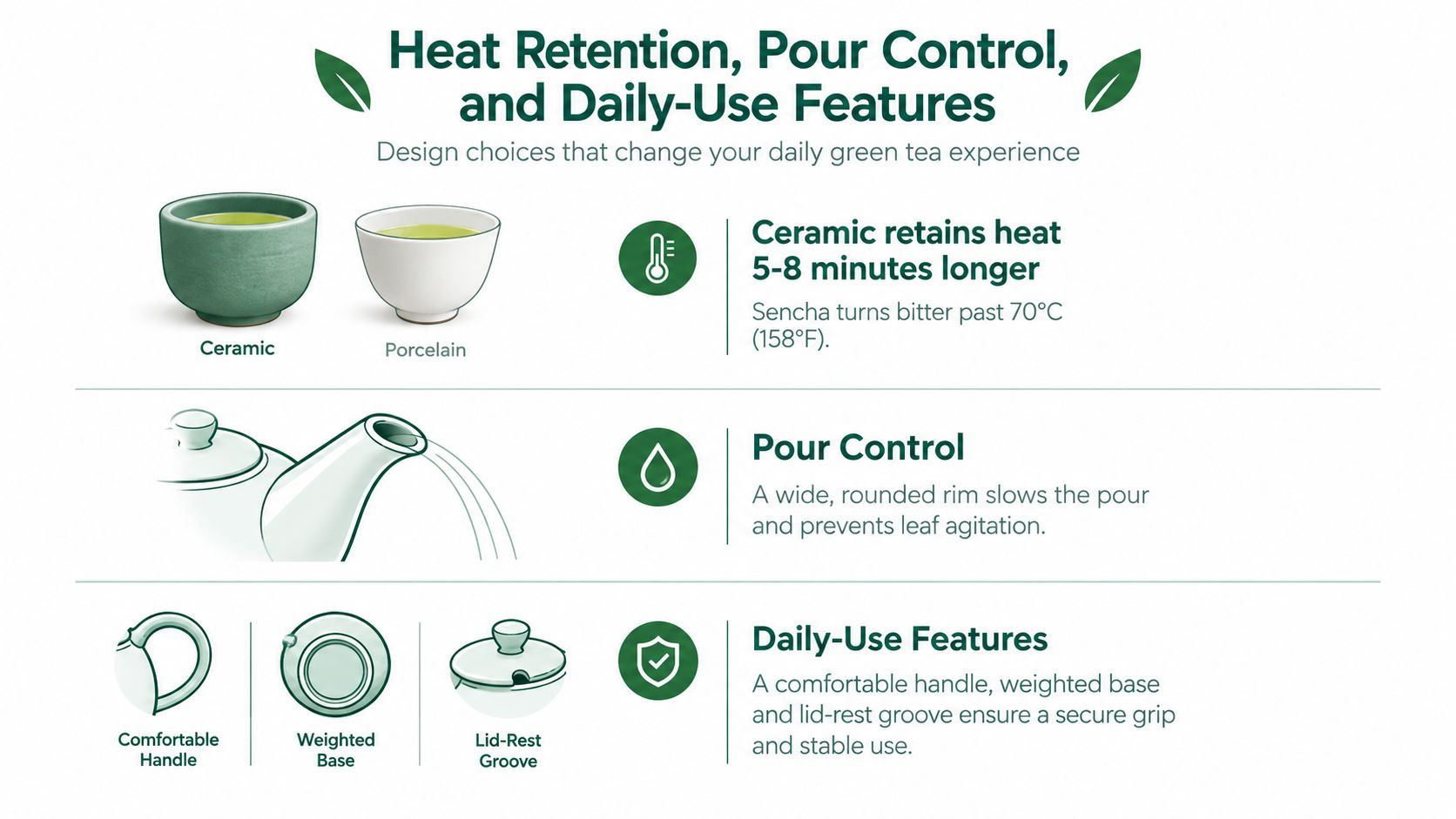
Thick-walled ceramic retains heat longer than thin porcelain, which helps if you drink slowly. That matters for sencha because hotter, longer extraction can push bitterness, so a cup that keeps the tea warm should still be paired with sensible brewing. Use a flared rim for foamy matcha drinks, and choose a straighter rim when you want a controlled, narrow flow from a serving pot.
Travel cups need closer inspection. Silicone seals are useful for hot drinks, but don't assume every lid tolerates extreme heat indefinitely. A seal that fits securely at ordinary serving temperature can warp when exposed to hotter conditions, so follow the manufacturer's temperature guidance and don't seal freshly boiled liquid in an unverified lid.
Double-walled glass is attractive and comfortable to hold, but it isn't my choice for a long sencha sitting. It suits iced drinks or a brief hot serve better. The double-wall glass mug guide is relevant if your priority is watching the drink and keeping your hand away from the heat rather than maximising retention.
Check the handle before buying. You want clearance for two fingers without forcing your knuckles against the body. A stable base matters at a desk, while a base diameter that fits your cup holder matters in the car. These details sound minor until the cup becomes your daily tool.
Test your shortlist with hot water at 80°C, wait 5 minutes, then compare how warm the exterior feels and how the drink tastes. The cup that feels stable, comfortable, and thermally predictable will outperform the one that only looks impressive.
One Workhorse Cup or Two Building a Simple Green Tea Set
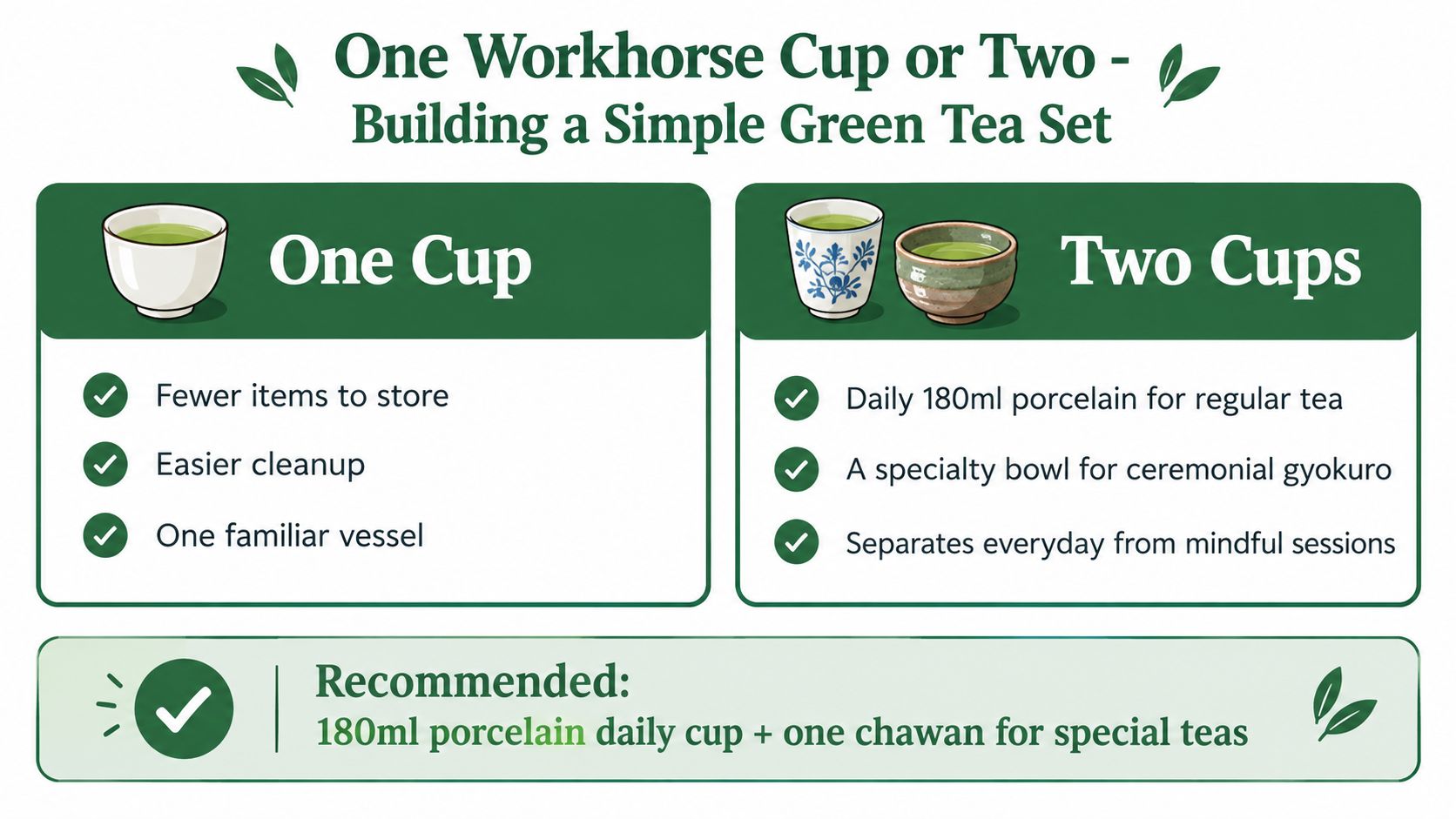
Most home drinkers need two vessels at most. Buy one reliable daily cup, then add a specialty bowl only when your drinking habits justify it. A cupboard full of matched cups won't make ordinary tea taste more thoughtful.
Your workhorse should be a 180 ml porcelain or thin ceramic cup. That size handles sencha, genmaicha, and hojicha without forcing you to overfill the vessel or dilute the tea. Porcelain gives you a clear, clean presentation, while thin ceramic adds a little more warmth and softness.
Choose the second cup by habit
If matcha is your daily drink, add a chawan with a stable base and enough width for whisking. If iced matcha lattes dominate your routine, choose a tall handled glass with space for ice and foam. If gyokuro is the tea you reserve for quiet sessions, a small yunomi with a broad base will make more sense than another general-purpose mug.
A mismatched pair can be better than a coordinated set. Different shapes make you notice how the same tea changes with temperature, aroma release, and rim contact. That attention teaches you more than buying several cups that all behave identically.
My buying rule: Put 60% of your tea-ware budget into the workhorse cup, because it'll carry most of the daily flavour responsibility.
The remaining budget can fund a more expressive vessel. Don't spend equally on two cups if one will sit unused. A specialty chawan earns its place when it supports a preparation you make, not when it merely completes a photograph.
For readers building a more traditional pairing, this overview of Japanese tea sets can help distinguish serving pieces from vessels intended for whisking or drinking. The simplest useful combination remains a daily 180 ml cup plus one specialty bowl.
Care and Cleaning to Keep Your Cup Performing
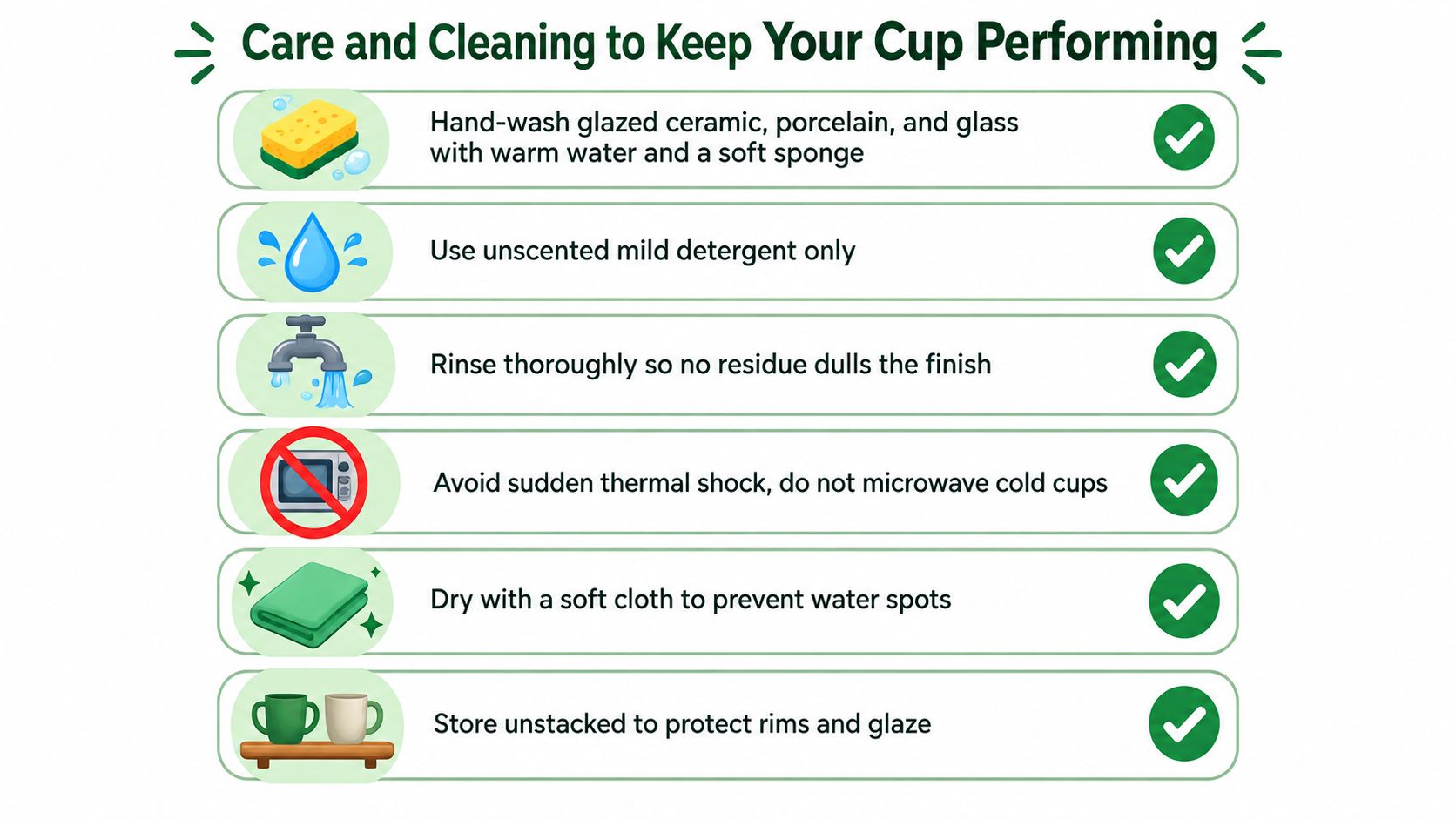
A good cup loses its advantage when tea oils, detergent residue, or tannin stains build up. Wash glazed ceramic, porcelain, and glass with warm water, a soft sponge, and an unscented mild detergent. Rinse thoroughly, because leftover detergent can dull the finish and contaminate the next pour's aroma.
Matcha stains don't need an abrasive scourer. Make a paste from baking soda and water, leave it on the mark for 10 minutes, then rub gently with a soft sponge. Aggressive pads can scratch glossy surfaces and create places for residue to collect.
Cast iron needs complete drying after washing, even when it has an enamel lining. Pay attention to seams and exposed edges. Unglazed yunomi should be treated differently, with a plain water rinse and upside-down air drying rather than dish soap, which can interfere with the vessel's aroma neutrality.
Prevent stains and rim damage
Monthly tannin removal keeps the interior from developing a dull film. Steep a tablespoon of rice tea or use diluted white vinegar, then rinse twice. Don't leave acidic mixtures sitting for extended periods, especially in vessels with uncertain finishes.
Store cups upside down on a lined shelf, away from direct sunlight. Never stack valuable cups without felt or cork dividers, because rim chips often begin with tiny points of contact. Avoid sudden thermal shock as well. Don't pour very hot water into a cold cup, and don't move a hot cup straight onto a cold stone surface.
Dry the outside with a soft cloth if water spots bother you, then inspect the rim periodically for chips or hairline cracks. Discard damaged ware if the defect could affect safe use. The following video offers another visual reference for basic tea preparation and service:
TOO MATCHA. offers Japanese matcha and hojicha powders in ceremonial, culinary, and sweetened formats, plus starter tools, recipes, and wholesale options for cafés and retailers. Choose your cup first, then visit TOO MATCHA. to find a tea powder suited to your everyday sencha-style drink, whisked matcha, or iced latte routine.