
Bamboo Whisk Matcha: A Practical Guide to Choosing and Using
You've just whisked a bowl of matcha, but the drink is cold, dotted with stubborn green clumps, and wearing a layer of foam that disappears before the first sip. The instinct is to blame the powder or your technique. Often, the actual problem is simpler: the tool in your hand isn't suited to the drink you're making.
A bamboo whisk, or chasen, changes the texture of matcha in a way a spoon and many metal frothers can't. Its fine split tines disperse powder through the water while drawing air into the surface, creating the fine foam that makes a cup feel creamy rather than merely stirred. In an Australian kitchen, that practical result matters as much as the cultural respect traditionally given to the chasen.
Table of Contents
- Why Your Bamboo Whisk Matcha Setup Matters
- Understanding Chasen Styles and Prong Counts
- Preparing Your Bowl and Matcha the Right Way
- The Whisk Technique That Actually Builds Foam
- Breaking In and Caring for Your Bamboo Whisk
- Buying a Bamboo Whisk That Suits Your Routine
Why Your Bamboo Whisk Matcha Setup Matters
A spoon can break up a few visible lumps, but it mostly pushes powder around the bowl. A steel frother can create dramatic bubbles quickly, yet its rigid head often produces coarse foam and makes accidental contact with the bowl more punishing. The chasen works through hundreds of flexible bamboo tines moving lightly across the liquid, a combination that disperses matcha and aerates it without treating the bowl like a mixing vessel.
The difference becomes obvious when the preparation goes wrong. Use unsifted powder, add water that's too hot, and stir lazily with a spoon. The result is a cup where the matcha settles unevenly, bitterness stands out, and the surface lacks structure. Use a dampened bamboo whisk, sift the powder, and work with a brisk wrist-led motion. The drink becomes smoother, more integrated, and visibly finer on top.
Practical rule: Foam is a preparation result, not a decoration. If it vanishes instantly, look at the powder, water, bowl, and whisk together.
Bamboo also gives the user useful physical feedback. The tines flex when they meet resistance, so you can feel when a clump remains or when the whisk is pressing too hard. A metal tool tends to hide that feedback behind speed and vibration. It can also scratch a delicate ceramic bowl if you force it against the base.
What the tines are doing
Matcha is finely milled tea suspended in water, not a leaf infusion that just dissolves. The chasen's split tines shear through compacted particles and pull small pockets of air into the suspension. That creates the fine micro-foam associated with a well-made bowl.
The water volume changes the challenge. A small amount of water creates a dense paste that needs controlled movement, while a larger amount gives the whisk more room to aerate. Either way, circles are usually less effective than a tight W or M pattern because circular stirring moves the liquid without creating the same repeated lift across the surface.
Australian retailers commonly describe the bamboo whisk as a functional necessity for matcha preparation. Guidance ranges from about 20 seconds to 30 seconds of whisking, with instructions also covering soaking, hand washing, and air drying, as shown in Australian bamboo whisk preparation guidance. That level of detail reflects the tool's real role. A chasen isn't just a cultural accessory placed beside a bowl. It's the part of the setup that determines whether the powder becomes a coherent drink.
Understanding Chasen Styles and Prong Counts
You can feel the difference between chasen styles before the foam appears. In an Australian kitchen, the right whisk is the one that suits your bowl, drink, and technique. Prong count affects how quickly the powder disperses, how fine the foam becomes, and how much control the whisk demands. Bamboo thickness, handle shape, and the way the tines curl matter too, so the number is a useful guide rather than a complete specification.
An 80-prong chasen is a dependable everyday option. Its tines usually feel more substantial, with enough spacing for powder and liquid to move freely during brisk whisking. That makes it practical for usucha and morning matcha lattes, where reliable foam matters more than an exceptionally fine surface. Australian retail guidance associates the 80-prong style with smooth, frothy matcha, while describing the 100-prong version as a more refined option, as shown in Australian bamboo matcha whisk retail guidance.
The 100-prong whisk occupies the useful middle ground. Its finer splits create more contact across the surface, helping produce an even foam without becoming too delicate for thicker or milk-based drinks. It is often the easiest choice for a home setup that serves straight matcha, iced preparations, and lattes.
A 120-prong chasen has a denser working end. It can produce a particularly creamy surface, but the closely packed tines need a lighter touch and sufficient bowl space. Press too hard or work in a narrow bowl, and the head can catch the rim or lose its shape.
| Prong Count | Foam Texture | Best For | Skill Level |
|---|---|---|---|
| 80 | Moderate, frothy, slightly more open | Everyday usucha and morning matcha lattes | Beginner-friendly |
| 100 | Fine and balanced | Usucha, milk-forward drinks, and versatile home use | Beginner to intermediate |
| 120 | Dense, silken, creamy | Thin tea where surface micro-foam is the priority | Intermediate |
Handle design changes the experience as much as prong count. A straight, slimmer handle feels quick in a shallow bowl, while a thicker carved handle offers steadier control in a deeper chawan. Some chasen use a kagoshi-style cut, giving the handle a shaped, carved profile instead of a plain cylinder. That feature does not guarantee better foam. It mainly changes how the whisk sits in your hand and how easily you control pressure.
Match the whisk to the drink
An 80-prong model is usually sufficient for a morning latte. Milk softens the sensory difference between a moderately frothy surface and a denser one, so a finer ceremonial-style whisk may offer little practical benefit in the finished drink.
Choose a 100-prong whisk if your routine changes from straight matcha to iced and milk-based preparations. It provides a broad working range without requiring a specialised tool.
A 120-prong model suits thin-tea drinkers who care most about fine surface micro-foam. Use it in a wider bowl, where its dense head can travel without scraping the sides. Small 16- and 24-tine koicha whisks serve a different purpose. They are designed for thick tea, where the target is a smooth, concentrated mixture rather than a large foam cap.
Sweetened matcha is more forgiving. The whisk still distributes the powder, but the preparation does not demand the same precision as a carefully textured bowl of thin tea. Premium Sweet Matcha 200g is described as a naturally sweetened blend containing 30% authentic Japanese green tea leaves, intended for matcha-curious drinkers and routine-builders. A chasen remains useful, though the cup can be approached as a practical daily drink rather than a technical test.
Preparing Your Bowl and Matcha the Right Way
A bamboo whisk can't rescue poor preparation indefinitely. Foam quality is largely decided before the first fast movement, through bowl temperature, powder distribution, dose, and water heat.
Start with the bowl
Rinse the chawan with warm water, swirl it briefly, then empty and dry it. Pre-warming reduces the sudden temperature change when hot water meets the ceramic and helps the liquid stay stable while you whisk. It also makes the bamboo feel less harsh during the first contact because the tines aren't moving through a cold bowl.
A wide ceramic bowl is the easiest option for most home users. Ceramic holds heat well and gives the whisk a predictable surface, while a glass bowl lets you watch the suspension but can feel less forgiving if its shape is narrow or its walls are steep. Choose a bowl where a 100-prong whisk can travel across the centre without striking the rim.
Sift before you add water
Measure about 2 grams of matcha and pass it through a fine mesh strainer into the warm bowl. Sifting breaks up compressed powder before water turns those lumps into paste. A fine matcha tea sifter guide is useful if you're unsure which mesh style suits your routine.
Add about 70 millilitres of water heated to roughly 80°C for usucha. Australian preparation guidance also uses a broader 60 to 80 millilitres range at 70 to 80°C, with brisk W or M whisking until an even froth forms, as described in Australian matcha preparation instructions. For koicha, use a much smaller volume, around 30 millilitres, and work the mixture into a thick, smooth consistency rather than chasing a foamy cap.
Water straight from the boil is a common cause of a flat, bitter cup. High heat can overpower the tea's softer flavour and leave you trying to compensate with extra whisking. If the drink tastes harsh despite good sifting and a sound whisk, lower the water temperature before changing the tool.
For cooking, baking, or a latte where the matcha will meet other ingredients, Premium Culinary Grade Matcha 60g is positioned as a Japanese-sourced powder for uses ranging from morning lattes to baking. Whatever grade you choose, the pre-whisk routine still pays off because a smooth concentrate mixes into milk more evenly than a clump-filled one.
The Whisk Technique That Actually Builds Foam
Hold the bowl steady with one hand and grip the chasen lightly with the other. Keep the handle close to vertical, relax your elbow, and let the wrist create the movement. The goal isn't to grind the tines into the ceramic. It's to skim them through the upper liquid quickly enough to break surface tension and pull air into the mixture.
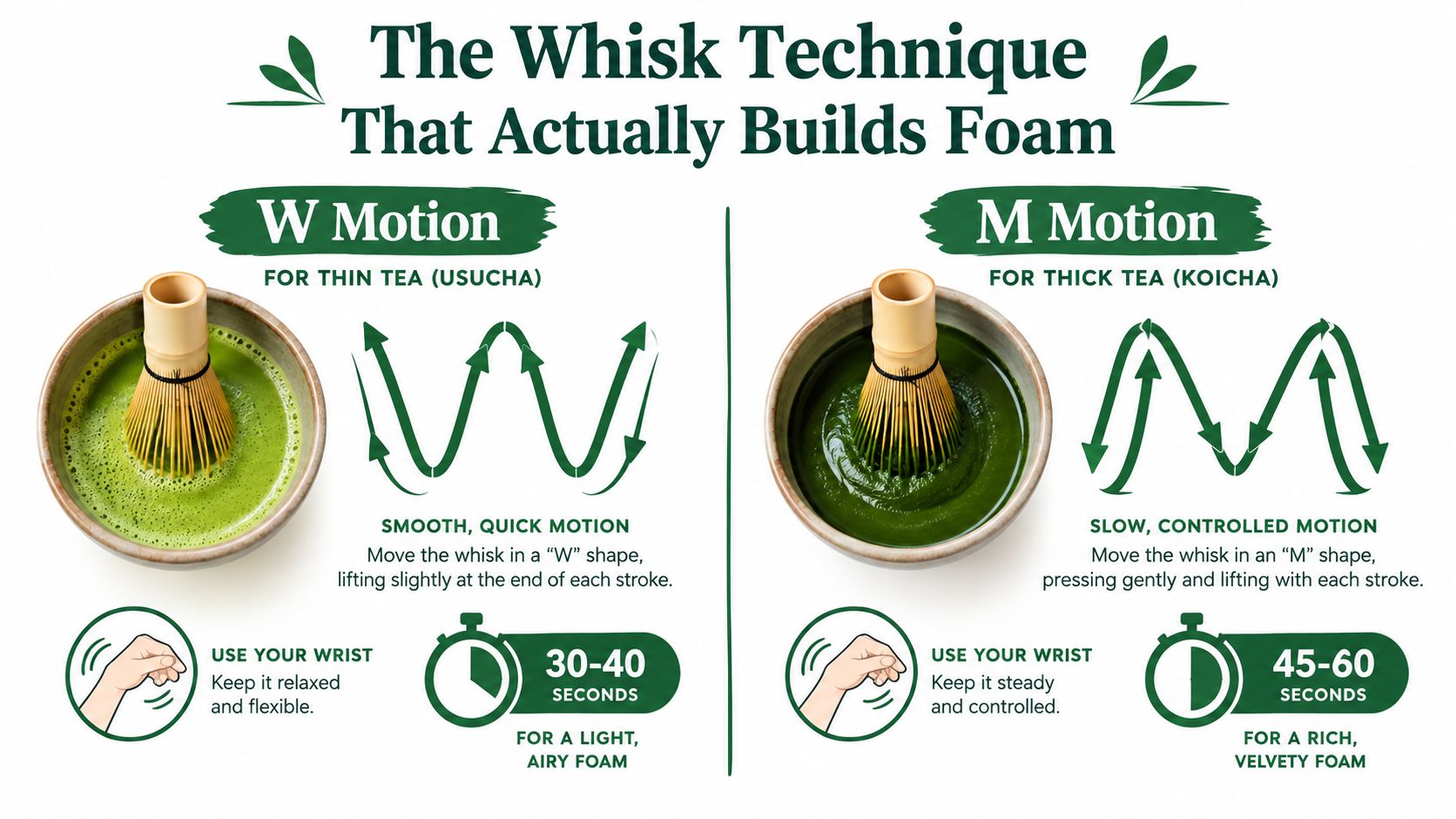
For thin tea, use a compact W motion across the centre of the bowl. Keep the movement fast but controlled, and avoid dragging the whisk in a broad circle. Australian technique guidance generally places the finishing phase between 15 and 30 seconds, with about 15 to 20 seconds suitable for a basic frothy drink and longer whisking used when a denser surface is wanted, as reported in Australian matcha whisking technique coverage.
For thicker tea, the movement is smaller and more deliberate. Use an M-like path, keeping the head in contact with the liquid rather than whipping aggressively as if you were making usucha. The mixture should become smooth and glossy, not airy and bubbly. If you're making an iced latte, whisk the warm concentrate until it's free of visible lumps before pouring it over milk and ice.
Watch your pressure: If you can hear the tines scraping the bowl, you're working too hard. Lift the whisk slightly and let speed, not force, do the aerating.
Three mistakes appear repeatedly in home kitchens:
- Pressing on the bowl floor: This bends or snaps the fine tines and prevents them from moving through the surface.
- Locking the elbow: A rigid arm turns a delicate wrist action into a tiring whole-arm swing.
- Whisking in circles: Circular movement stirs, but it doesn't distribute air across the surface as efficiently as a tight zig-zag.
The video below gives a visual reference for the hand position and movement.
If your foam collapses within seconds, check the basics before buying another whisk. The usual suspects are a worn or dry-condition whisk, water that's too hot, or powder that wasn't sifted properly. A fine, even foam is the stopping point. Continuing to whisk after the surface is already uniform can flatten the texture rather than improve it. The practical movements are also demonstrated in this matcha whisking tutorial.
Breaking In and Caring for Your Bamboo Whisk
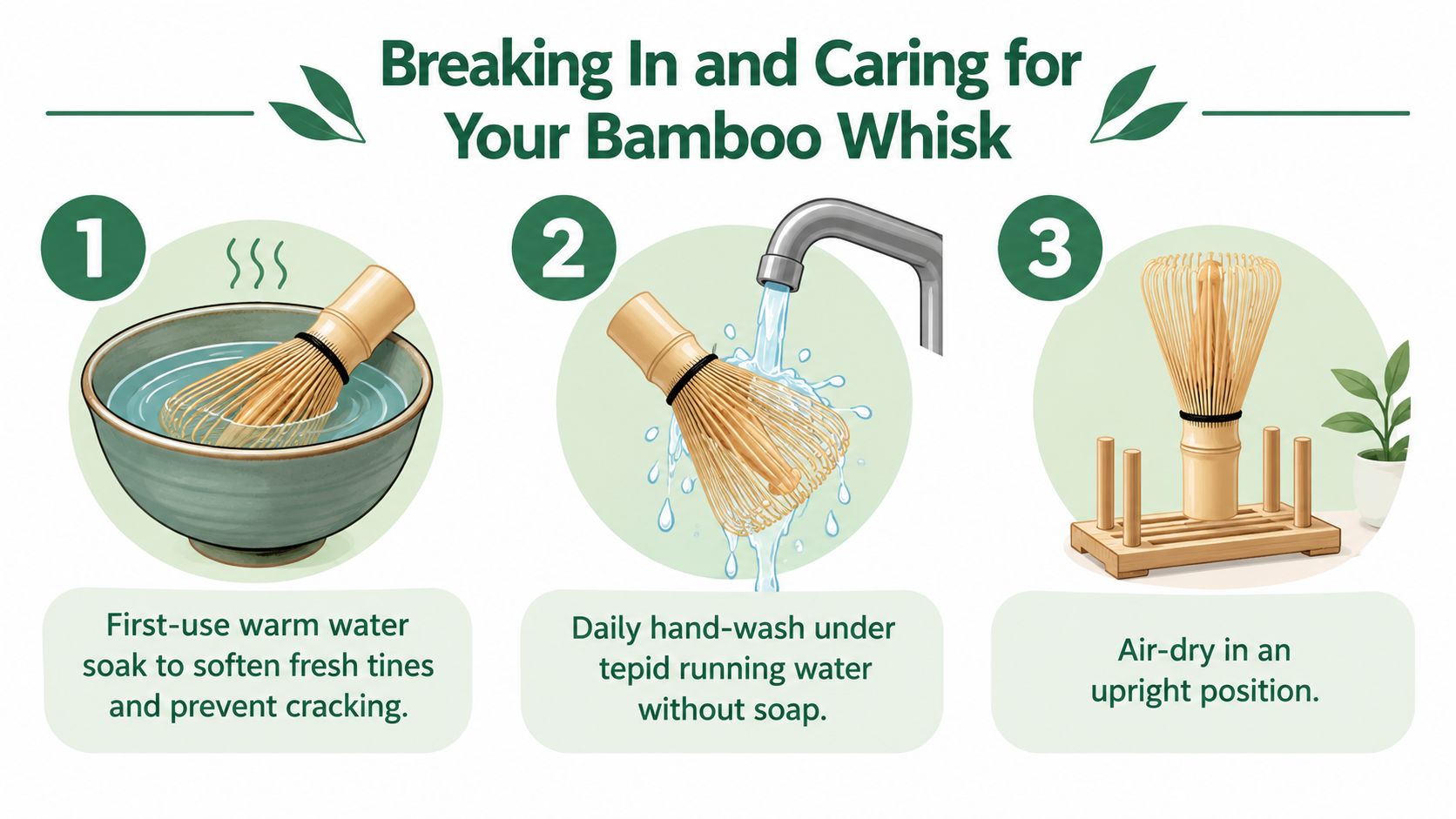
Fresh bamboo tines are more vulnerable when they're dry. Before the first use, place the whisk in warm water and let the tines soften. Don't force them open with your fingers. The bamboo should relax gradually so the curl can spread without cracking.
After each use, rinse the whisk under tepid running water. Use your fingers to remove residue gently, but skip soap unless the manufacturer specifically permits it. Soap can linger in the bamboo and affect the flavour of the next bowl. A bamboo matcha whisk cleaning routine keeps the maintenance simple: rinse, drain, and dry completely.
Drying prevents avoidable damage
Place the whisk with the handle down and the tines pointing up on a chasen holder or the edge of a cup. This lets water drain away from the curled working end instead of pooling where the tines meet the bamboo root. Don't leave it lying flat on a wet bench, where the inner curls can stay damp for too long.
Australian sellers commonly recommend soaking before first use, hand washing, and air drying. Those instructions aren't ornamental. Bamboo absorbs moisture, and the whisk needs time to return to a dry, stable condition before it's stored.
A damp chasen sealed in a cupboard is more likely to develop a stale smell and deteriorate than one left upright in open air.
The whisk is nearing the end of its useful life when the tines loosen, split, or fray so badly that they no longer move air through the bowl. A handle that wobbles where it meets the bamboo root is another warning sign. A few bent outer tines aren't necessarily a disaster, but a head that has lost its spring won't produce the same texture, no matter how carefully you whisk.
Keep the chasen out of sealed containers while it's damp. If you drink matcha daily, rotating two whisks gives each one time to dry fully and reduces the temptation to use a wet, tired tool.
Buying a Bamboo Whisk That Suits Your Routine
Choose the whisk for the drinks you make. A fine, delicate chasen can produce an impressive surface, but it becomes frustrating when your routine is a quick latte prepared in a narrow bowl. A sturdier everyday model may suit that job better, while straight usucha rewards a whisk with enough fine tines to build a smooth foam.
The Australian buying baseline
Australian retailers commonly list bamboo matcha whisks in 80, 100, and 120 prong formats. Listings also show compact dimensions, including an example measuring 118mm by 67mm. That small handheld shape is practical in a matcha bowl, where the whisk needs room to move without feeling oversized.
Local retail examples place these whisks around A$25 to A$30, with listings at A$24.80, A$26.45, A$29.00, and A$29.95. Treat that range as a buying reference rather than proof of equal construction.
| Prong Count | Best For | Handle Style | AUD Price Range |
|---|---|---|---|
| 80 | Everyday matcha and morning lattes | Straight or moderately carved | A$25 to A$30 |
| 100 | Lattes, iced drinks, and mixed routines | Medium carved handle for control | A$25 to A$30 |
| 120 | Fine-foam usucha | More delicate handle and careful grip | A$25 to A$30 |
Inspect the head before buying. The tines should be evenly split, the handle should feel secure, and the curls should open without visible cracks. Price matters less than how the whisk is treated. A modestly priced chasen that is rinsed, dried, and used with light pressure can outperform a premium one that is neglected or dragged across a dry bowl.
Choose by habit
Choose 80 prongs for an uncomplicated daily tool. It handles casual usucha and latte preparation, and its less crowded head is more forgiving when water volume or preparation time changes between cups. The foam may be less fine than that from a denser whisk, but the difference is often minor in a milk drink.
Choose 100 prongs when one chasen needs to cover several routines. It is a practical general-purpose option for straight matcha, milk-forward drinks, iced preparations, and occasional thicker bowls. Use it in a bowl wide enough for the tines to travel freely, rather than forcing the head against the sides.
Choose 120 prongs when surface texture is the main reason for buying a bamboo whisk. The finer head can create a denser, creamier foam, provided the powder is sifted and the wrist stays light. It needs more careful handling and maintenance. In a latte, milk can conceal much of that extra surface texture, so the upgrade makes more sense for straight usucha.
The prong count describes what the head can deliver, not the quality of every whisk in that category. Handle shape affects comfort rather than flavour. Straight handles work well with shallow bowls and quick preparation. Thicker carved handles give more control in a deeper chawan and suit slower, more deliberate whisking. Choose the shape that lets your wrist remain relaxed.
Bamboo treatment also affects how the whisk behaves over time. Kiln-dried bamboo is processed with controlled heat, while sun-dried bamboo relies on extended natural drying. Neither label guarantees a better result, but drying quality influences how the tines respond to moisture and repeated use. Reject a chasen with brittle ends, loose splits, or a handle that moves at the root.
Your powder changes the workload too. Pure, finely milled matcha benefits from careful sifting and a well-suspended mix. Sweetened blends can suit quick drinks, while culinary powder is practical for milk drinks, baking, and blending. Australian cafés and coffee vans also use matcha made from young green tea leaves that are stone-ground into a fine powder, according to this Australian wholesale matcha listing. The same buying logic therefore applies outside the home kitchen.
Check the product information if you drink matcha regularly. Australian treatment of products containing Camellia sinensis extract is controlled when the daily dose exceeds 300mg of EGCG, and food use is prohibited above that threshold under the September 2026 legal summary cited in this Australian matcha product information. Matcha can also contain caffeine and L-theanine. One Australian supplier reports 21.3mg of L-theanine and 33.3mg of caffeine per gram, so consider the product details and your total daily intake, as shown in these Australian matcha potency test results.
TOO MATCHA. offers Japanese-sourced ceremonial, culinary, and sweetened matcha powders, plus starter sets, accessories, recipe guidance, and wholesale options for cafés and hospitality teams. Visit TOO MATCHA. to compare a powder and bamboo whisk setup with the drinks in your routine.