
Glass Double Wall Mug Guide for Matcha and Hojicha
You've just whisked matcha, poured a hojicha latte, or set an iced drink beside your laptop. The first sip is lovely, but the mug is either too hot to hold, leaving a damp ring on the table, or cooling faster than you'd like. A glass double wall mug addresses those small frustrations with a simple construction: two glass walls separated by an insulating cavity.
The appeal isn't only visual. Clear glass lets you watch vibrant matcha foam settle and hojicha deepen to amber, while the outer surface stays more comfortable in your hand. For Australian home kitchens and small cafés, the right mug can make the drink easier to hold, easier to serve, and less vulnerable to everyday temperature changes. The important part is knowing how the insulation works, which construction suits your routine, and what signs suggest the mug is reaching the end of its life.
Table of Contents
- Why a Glass Double Wall Mug Feels Different in Your Hand
- How the Double Wall Actually Keeps Drinks Warm
- Matcha and Hojicha Meet Double Wall Glass
- Glass Types and Construction That Hold Up
- Sizing and Shape for Home Sipping and Café Service
- Care, Cleaning, and Failure Modes to Watch For
- Choosing the Right Mug for Your Routine
Why a Glass Double Wall Mug Feels Different in Your Hand
The difference often appears before the first sip. You wrap your fingers around a thin ceramic mug and pull them back slightly because the heat has travelled through the wall. A moment later, you lift a double-wall glass mug holding a steaming drink, and the surface feels warm rather than harsh.
That comfort comes from the space between the inner and outer glass walls. The drink sits inside a clear inner chamber, while the outer wall creates a buffer between the heat and your skin. You can see the tea suspended inside the glass, almost as if it's floating, because light passes around the inner wall instead of meeting a solid, opaque body.
The visual effect changes the ritual, too. A freshly whisked matcha shows its green colour and fine foam, while brewed hojicha reveals a clear roasted amber tone. The mug becomes part of the preparation rather than something that hides it.
Small details you notice at the table
Cold drinks bring out another benefit. A chilled matcha latte or iced hojicha produces less moisture on the outside than a single-wall glass, so the mug is less likely to leave a condensation ring on a wooden table. You'll still need to manage melting ice and spills, but the outer surface stays noticeably drier during ordinary serving.
The weight can feel balanced rather than concentrated at the base. A well-made mug distributes its glass across the walls, so it doesn't feel like a heavy vessel with a thin upper section. The rim also sits lightly against the lip, which matters when you're taking several small sips of straight matcha rather than drinking a large latte quickly.
The first test is comfort: if the mug feels awkward when full, its insulation and appearance won't rescue it from daily use.
A handle changes the experience. A loop gives your fingers clearance from the body and adds a familiar café feel, while a handle-free tumbler lets you hold the vessel more directly and see more of the drink. Neither style is automatically better. The useful choice depends on whether you value a secure grip, a lighter silhouette, or a clean view of the layers inside.
How the Double Wall Actually Keeps Drinks Warm
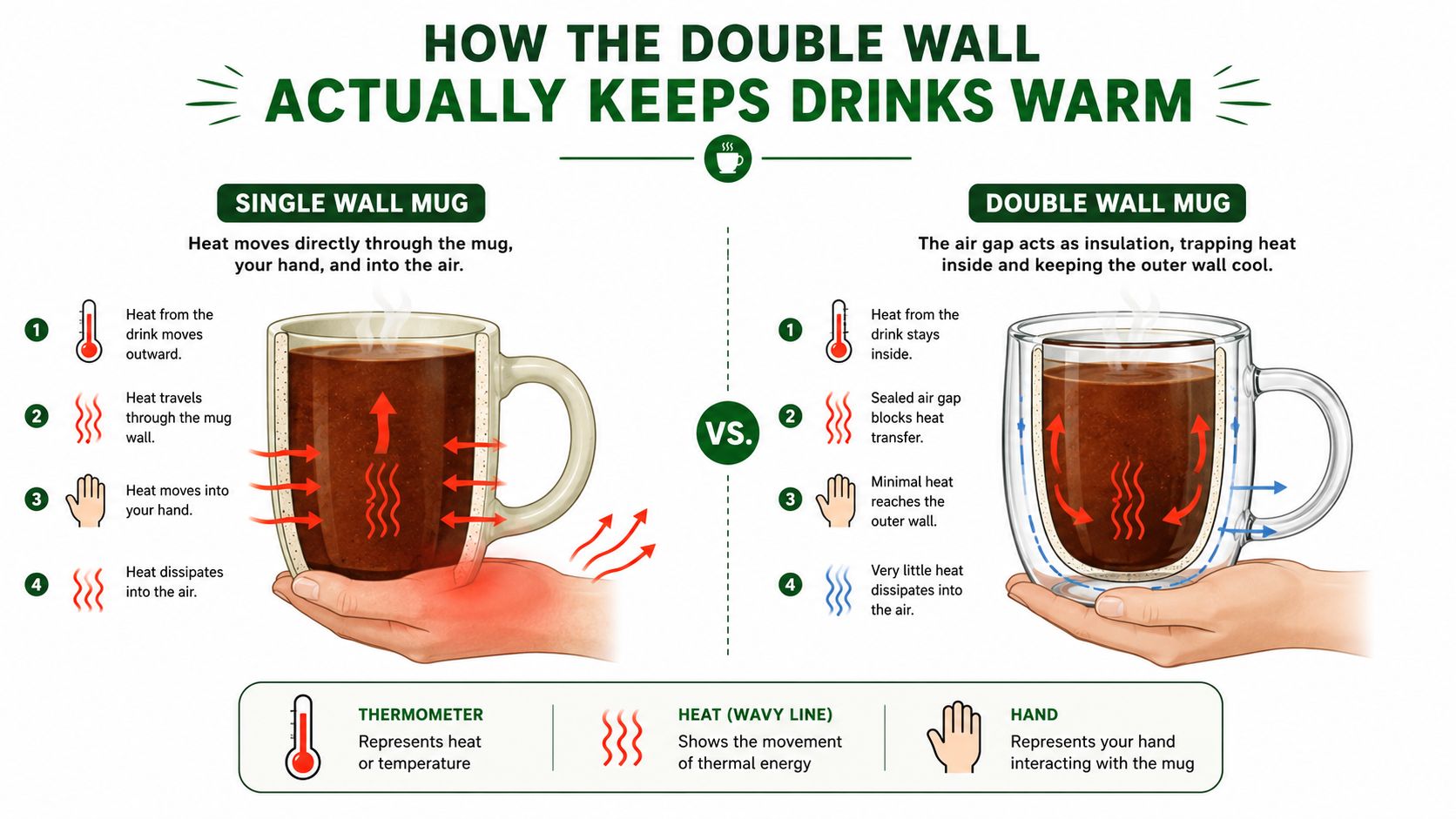
A single-wall mug gives heat a fairly direct route. Heat moves from the liquid into the mug wall, through the material, and towards your hand or the surrounding air. It's a little like wearing a thin jumper. The fabric creates some separation, but warmth still reaches your body quickly.
A double-wall mug adds another barrier. Between the glass walls, it traps a low-conductivity gas layer that slows conductive heat transfer. Air's thermal conductivity is about 26.06 mW/(m·K) at 25 °C, much lower than glass, so the cavity interrupts the easiest path for heat to travel. The mug doesn't stop heat loss completely, but it makes the journey from the drink to your hand more difficult. This material-based explanation of double-wall glass mugs describes the insulating role of the air space in practical drinkware terms.
Follow the heat path
Think of the wall as a short route compared with a longer one:
- Single wall: liquid, mug wall, hand or air.
- Double wall: liquid, inner glass, trapped gas layer, outer glass, hand or air.
- Result: the outer surface receives less heat as quickly, so the mug feels more comfortable.
This is why the insulation effect is useful in a matcha ritual. A freshly prepared drink can remain enjoyable for longer, while the hand holding the mug doesn't receive the full heat of the liquid immediately. The outer wall stays cooler than the drink because the cavity reduces the transfer between them.
A temperature-controlled kettle can make the preparation more repeatable. If you're adjusting water heat for matcha, the guide to an electric kettle with temperature control can help you think about the kettle and mug as one preparation system.
For a pure, carefully whisked cup, Ceremonial Grade Matcha 60g is described as Shizuoka-sourced, shade-grown, stone-ground, and made for a smooth, frothy cup. A clear double-wall mug won't improve the powder itself, but it can make the colour, foam, and serving temperature easier to appreciate.
Matcha and Hojicha Meet Double Wall Glass
Matcha and hojicha behave differently in the cup, so insulation doesn't serve them in exactly the same way. Whisked matcha is delicate and expressive. Its fresh green colour, foam, and savoury-sweet character are easiest to enjoy while the drink remains warm and lively, rather than sitting forgotten in a thin vessel.
The double wall slows the rate at which the drink loses heat to your hand, the table, and the surrounding air. That gives you more freedom to drink in small sips and notice changes in texture. For iced matcha latte, the same barrier works in reverse. It helps keep the cold contents separated from the warmer room, while the drier exterior reduces the wet ring that often forms beneath a single-wall glass.
Three drinks, three useful roles
Hojicha brings a roasted aroma and a deeper amber appearance. Those aromas can feel less pronounced as the drink cools, so a mug that moderates temperature loss supports a more consistent tasting experience. The transparent walls also make the pour part of the ritual. You can watch green matcha fold into milk, or see hojicha settle into a warm, tea-coloured layer.
The temperature information below is a practical guide for matching drink style to mug behaviour. It should be treated as a preparation reference rather than a guarantee, because room temperature, serving volume, milk, ice, and whisking all affect the result.
| Drink | Typical Serving Temp | Why Double Wall Helps | Best Drinking Window |
|---|---|---|---|
| Whisked matcha | Around 70 to 80 °C | Slows heat loss while keeping the green colour visible | Small, attentive sips while foam is fresh |
| Matcha latte | Warm, depending on milk and preparation | Helps moderate heat and keeps the outside easier to hold | While the milk texture remains smooth |
| Brewed hojicha | Around 85 to 90 °C | Helps preserve warmth and the roasted aroma | During the first relaxed part of the cup |
| Iced matcha latte | Chilled | Reduces exterior condensation and helps the drink stay cold | Before ice dilution becomes noticeable |
| Iced hojicha | Chilled | Keeps the vessel drier and the drink visually clear | While the tea and ice remain distinct |
The guide to matcha brewing temperature is useful when you're refining water heat before choosing a serving vessel. The mug can support consistency, but it can't compensate for water that's too hot, poorly whisked powder, or milk that has been overheated.
For a pre-sweetened option, Premium Sweet Matcha 200g is described as a blend containing 30% authentic Japanese green tea leaves, designed for quick preparation without adding separate sweetener. A double-wall mug suits that style of drink because the transparent body shows the colour and layers of a latte while the insulation supports both warm and iced serving.
Glass Types and Construction That Hold Up
The word “glass” doesn't tell you enough about a mug's durability. Two vessels can look similar yet respond differently to a hot drink, cold rinse, dishwasher cycle, or knock against a stone bench.
Comparing the glass
Borosilicate glass is the common quality choice for thermal drinkware. Australian product and lab-glass sources describe it as resistant to thermal shock because it expands less when temperature changes. Some Australian sellers list borosilicate drinkware operating ranges around -20 °C to 150 °C, as shown in this Australian borosilicate glass mug listing. Those figures describe listed operating conditions, not permission to move a mug abruptly from one extreme to another.
Soda-lime glass is familiar and can be perfectly suitable for ordinary tableware, but it generally offers less tolerance for sudden temperature gradients. If a product page doesn't identify the glass type, treat its hot-to-cold claims cautiously.
Hand-blown glass can bring attractive variation and an artisan feel. That character may come with less uniformity in wall thickness, rim shape, or balance. It's often a better fit for occasional serving than for a tightly organised service station where matching pieces and repeatable handling matter.
The base is just as important
The insulating cavity also needs a way to manage pressure and moisture. Some mugs use a bonded or adhesive-based base, while others include a valve or vented construction that helps equalise pressure during temperature changes. Adhesive designs can keep the cavity sealed, but a failed bond may allow moisture inside. Vented designs may manage pressure more deliberately, although the vent and surrounding construction still need protection from water entry.
| Type | Thermal Shock Resistance | Typical Cost Tier | Best For |
|---|---|---|---|
| Borosilicate | Higher resistance to sudden gradients, though not immune to cracking | Mid-market to premium | Daily hot and cold drinks |
| Soda-lime | Lower tolerance for abrupt temperature changes | Entry to mid-market | Gentle, mostly room-temperature use |
| Hand-blown glass | Varies with the maker and wall consistency | Artisan or premium | Visual presentation and occasional service |
| Bonded base | Depends on seal and adhesive quality | Varies | Users who keep the mug dry and handle it carefully |
| Vented base | Designed to equalise pressure, with moisture protection still important | Varies | Repeated temperature changes and busy routines |
A mug used near a commercial sink needs a different assessment from one used for a quiet morning drink. If you're comparing a double-wall mug with an insulated tumbler, this guide to an insulated tumbler with straw helps frame the difference between open-rim serving and lidded, portable drinking.
Sizing and Shape for Home Sipping and Café Service
Capacity should follow the drink, not the other way around. A small whisked matcha needs room for the water and the whisking motion without becoming a large, diluted beverage. A latte needs enough height and width for milk, foam, and comfortable sipping. Iced drinks need extra space for ice, but a very large mug can make a modest serving look lost.
For traditional preparation, a 150 to 180 ml vessel suits usucha and koicha-style serving. A 250 to 300 ml mug fits a standard matcha latte more naturally, especially when you're adding milk and a layer of foam. Straight brewed hojicha commonly sits around 200 to 250 ml, while iced hojicha or iced matcha needs more room once ice is included.
Match shape to preparation
A handle-free tumbler offers a direct, balanced grip and keeps the transparent walls visible. It works well when you're carrying the mug a short distance from bench to desk, or when you want the drink to resemble a small café pour.
A looped handle creates clearance between your fingers and the vessel. That's useful for hot sipping and repeated service, particularly when staff need to lift several filled mugs during a busy period. The trade-off is a different centre of gravity. A broad handle can make a light mug feel more stable, while a narrow handle can feel less forgiving when the vessel is full.
Rim diameter deserves attention. A wide rim makes foam and aroma more accessible, but it can also expose more surface area to the air. A narrower rim concentrates the drink towards the mouth and can feel more precise for straight tea. Look at the filled weight as well. A 220 g home mug may feel easy to lift repeatedly, whereas a 380 g service mug can feel more planted on a café table but tiring during constant handling.
Use the pour as your test
Before buying, measure the volume you prepare in a kitchen jug. Leave room for foam and ice rather than filling the mug to its lip. A 300 ml or larger model can suit generous lattes and takeaway-style iced drinks, but it won't automatically improve a small bowl of matcha.
For home use, choose the smallest size that holds your regular recipe comfortably. For café service, prioritise repeatability, stackability where appropriate, handle clearance, and a rim that staff can clean quickly.
Care, Cleaning, and Failure Modes to Watch For
A product page may say “dishwasher-safe” or “microwave-safe”, but those labels don't explain every way a double-wall mug can fail. The most overlooked problems involve rapid temperature change, moisture entering the cavity, and repeated mechanical stress during washing.
Thermal shock is still possible
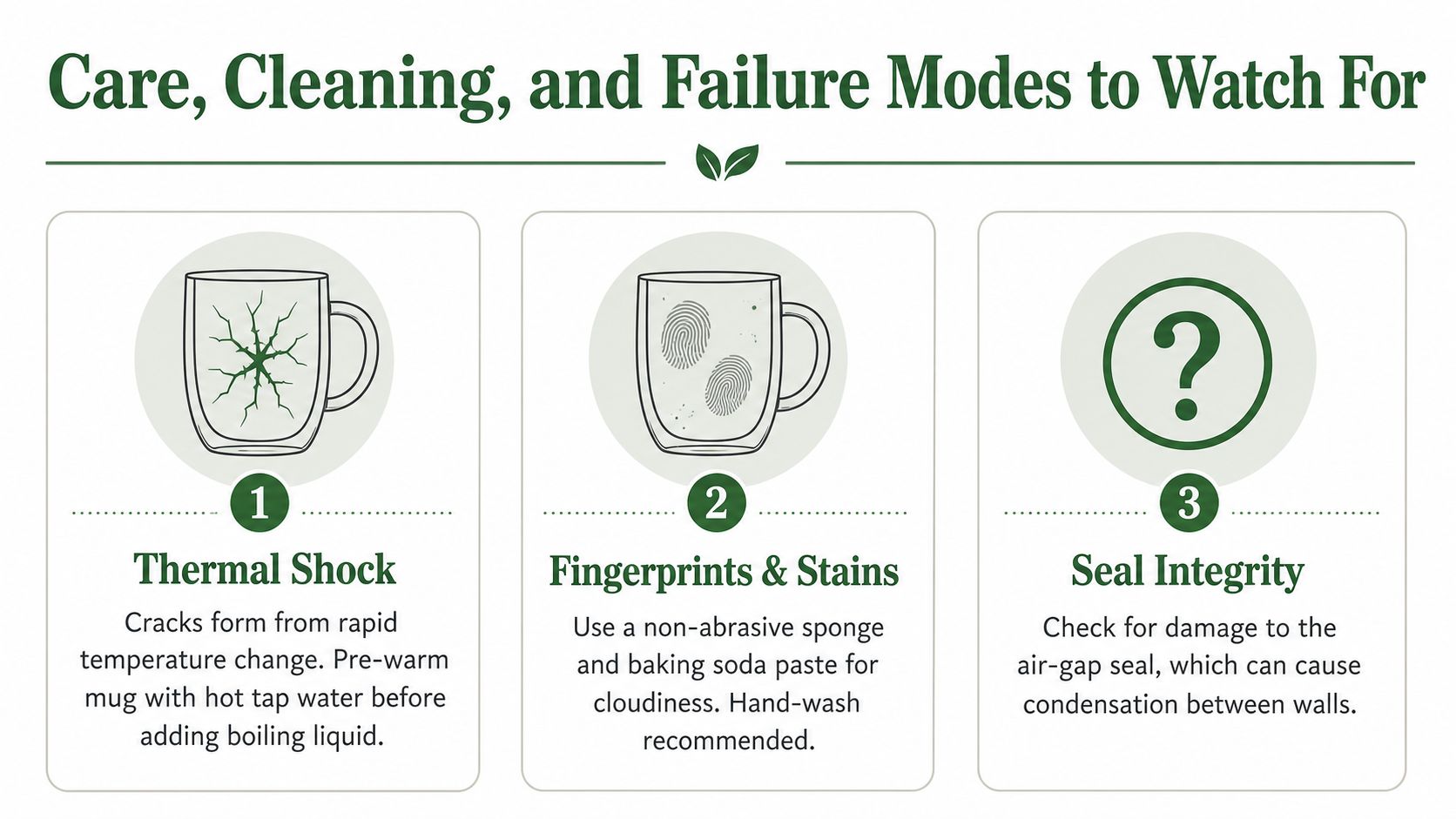
Borosilicate glass resists sudden temperature gradients better than many ordinary glass types, but it isn't indestructible. A hot mug placed on a cold stone bench can experience uneven cooling. Rinsing it immediately under cold water creates another abrupt change. A chilled mug filled with boiling liquid faces the same basic problem in reverse.
Pre-warm the mug with warm water before adding a hot drink. For iced matcha or iced hojicha, let the glass adjust gradually rather than moving it straight from a very cold environment to a hot preparation area. Avoid pouring boiling liquid into a visibly cold vessel.
Fogging means more than a cosmetic mark
Clear glass can develop ordinary fingerprints or tea residue on the outside. Fogging between the walls is different. If moisture appears inside the insulating cavity, the seal or bonded construction has likely been compromised. The trapped layer is no longer behaving as intended, and the moisture may become permanent.
This issue is particularly relevant for mugs with bonded bases or adhesive construction. Australian review discussions of double-wall glassware highlight the importance of distinguishing pressure-equalising bases from designs where a failed bond can admit moisture, with possible permanent fogging or mould concerns. The Bodum Pavina discussion on Australian ProductReview shows why construction details deserve more attention than a simple safety label.
Retire a fogged mug: don't keep using it as though the cavity is still sealed, especially if the moisture persists after the exterior has been cleaned and dried.
Reduce dishwasher stress
Dishwasher heat, detergent, water pressure, and contact with other pieces can all add strain. Even when a product is labelled dishwasher-safe, place it where it won't rattle against cutlery or heavier glassware. A top rack, mild detergent, and adequate spacing are sensible precautions, provided they match the manufacturer's care instructions.
Before purchase, inspect the rim for chips and look at the base for a visible seam, valve, or vent. A gentle tap can reveal an obvious crack or damaged edge, but it can't certify structural quality. Ask how the cavity is sealed, whether the mug is intended for dishwasher use, and what replacement or warranty policy applies if fogging develops.
Clean cloudy surfaces with a non-abrasive sponge. Avoid aggressive scouring pads that can scratch the glass and make everyday marks more visible. The safest routine is simple handling, gradual temperature changes, and prompt retirement when the internal cavity no longer looks clear.
Choosing the Right Mug for Your Routine
The useful choice isn't the mug with the longest feature list. It's the one that matches your drink volume, hand position, cleaning habits, and service environment.
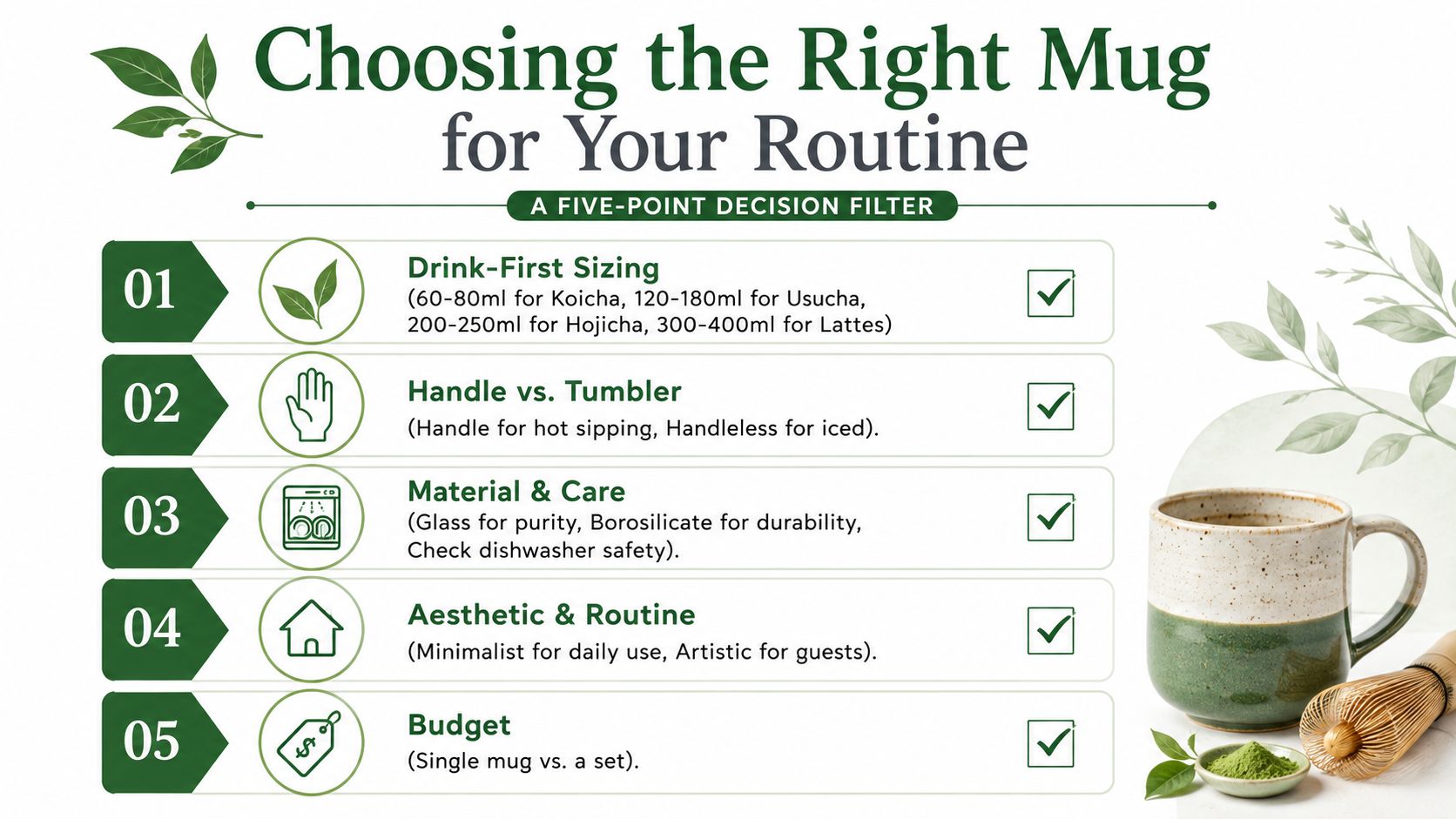
Start with the drink. A 60 to 80 ml vessel suits koicha-style servings, while 120 to 180 ml works for usucha. Straight hojicha generally fits 200 to 250 ml, and generous lattes or iced matcha may need 300 to 400 ml. These capacities are starting points, not strict recipes. Leave room for whisking, milk foam, and ice.
Apply the five-point filter
- Choose capacity first. If your daily drink is straight hojicha, a compact mug will feel more natural than a large latte vessel. If iced matcha is your regular order, allow space for ice without forcing the liquid to the brim.
- Choose the glass second. Borosilicate is the sensible starting point for hot and cold routines because it offers stronger resistance to thermal shock than ordinary soda-lime glass. You'll still need to avoid abrupt temperature changes.
- Inspect construction. For a mug that sees frequent washing, understand whether the cavity uses a vented or bonded base. A vented design may suit repeated temperature changes, while any design with an exposed or vulnerable seal deserves careful washing and drying.
- Match the grip to the setting. A handle gives clearance for hot sipping and repeated café handling. A handleless tulip shape feels direct and visually clean, particularly for iced drinks and home use.
- Be honest about care. If you hand-wash every cup, you can consider a wider range of constructions. If the dishwasher does most of the work, choose a clearly specified dishwasher-safe model and give it space during the cycle.
For a quiet home hojicha ritual, a 200 ml handleless borosilicate mug is a practical fit. It keeps the serving compact, shows the tea's colour, and avoids the bulk of a café-sized vessel.
For an Australian small café pouring iced matcha lattes, a 350 ml vented-base model with a slim handle offers more room for ice and milk while keeping the grip clear of the chilled body. The right mug is the one that matches the drink, the dishwasher, and the hand.
TOO MATCHA. offers Japanese-sourced matcha and hojicha powders in formats for home preparation, lattes, recipes, and foodservice, alongside preparation accessories and recipe guidance. Visit TOO MATCHA. to choose a tea style and serving routine that suits your new glass double wall mug.