Unsweetened Matcha Powder: A Practical Buyer's Guide
You're standing in an Australian kitchen with three green tins on the bench. One promises a smooth café-style latte, another is labelled ceremonial, and the third just says matcha. A friend swears matcha gives them steadier energy than coffee, while you're trying to work out whether the powder should be sweet, bitter, whisked, blended, or baked.
That confusion usually starts with the word unsweetened. It tells you the powder contains no added sugar or flavouring, but it doesn't tell you whether the matcha is suited to sipping, lattes, baking, or everyday caffeine use. The right choice depends on the leaf, the grade, the way you prepare it, and how quickly you'll use the tin.
Table of Contents
- Why Unsweetened Matcha Powder Is Suddenly Everywhere
- What Unsweetened Matcha Powder Actually Is
- Unsweetened Matcha vs. Sweetened Matcha
- Ceremonial vs. Culinary Grade and How to Choose
- Caffeine, L-Theanine, and the Calm Focus Claim
- Brewing, Lattes, and Baking With Unsweetened Matcha
- Storage, Freshness, and Getting the Most From Every Tin
- Choosing the Right Unsweetened Matcha for You
Why Unsweetened Matcha Powder Is Suddenly Everywhere
A Melbourne home barista might begin with an iced matcha latte, then discover that the sweetened café blend they bought has limited flexibility. A Sydney baker may want vivid green flavour in cookies without adding extra sugar. A café owner may be comparing powders for a menu while trying to keep each drink consistent.
Those buyers are all looking at matcha, but they're solving different problems. Unsweetened matcha powder is the flexible starting point because you decide how much milk, syrup, fruit, or sugar goes into the finished drink. You can whisk it with water, turn it into a latte, blend it into a smoothie, or sift it through a cake batter.
Australia's interest in Japanese green tea has expanded sharply. Reporting that cited Japanese Tea Export Promotion Council data said Japan shipped 195,319 kilograms of green tea to Australia between January and August 2025, a 131% year-on-year increase, with Australia ranking as the eighth-largest export destination globally. The same report put Australia's matcha market revenue at more than $54 million in 2024 and projected annual growth of more than 7%. Read the Australian matcha market reporting.
That growth explains the tins appearing in supermarket aisles, specialty shops, cafés, and online stores. It doesn't make every powder interchangeable, though. Before choosing a colourfully packaged product, you need to know what is in the tin, which grade suits your routine, how much caffeine you're comfortable with, and how to protect the powder once it's open.
What Unsweetened Matcha Powder Actually Is
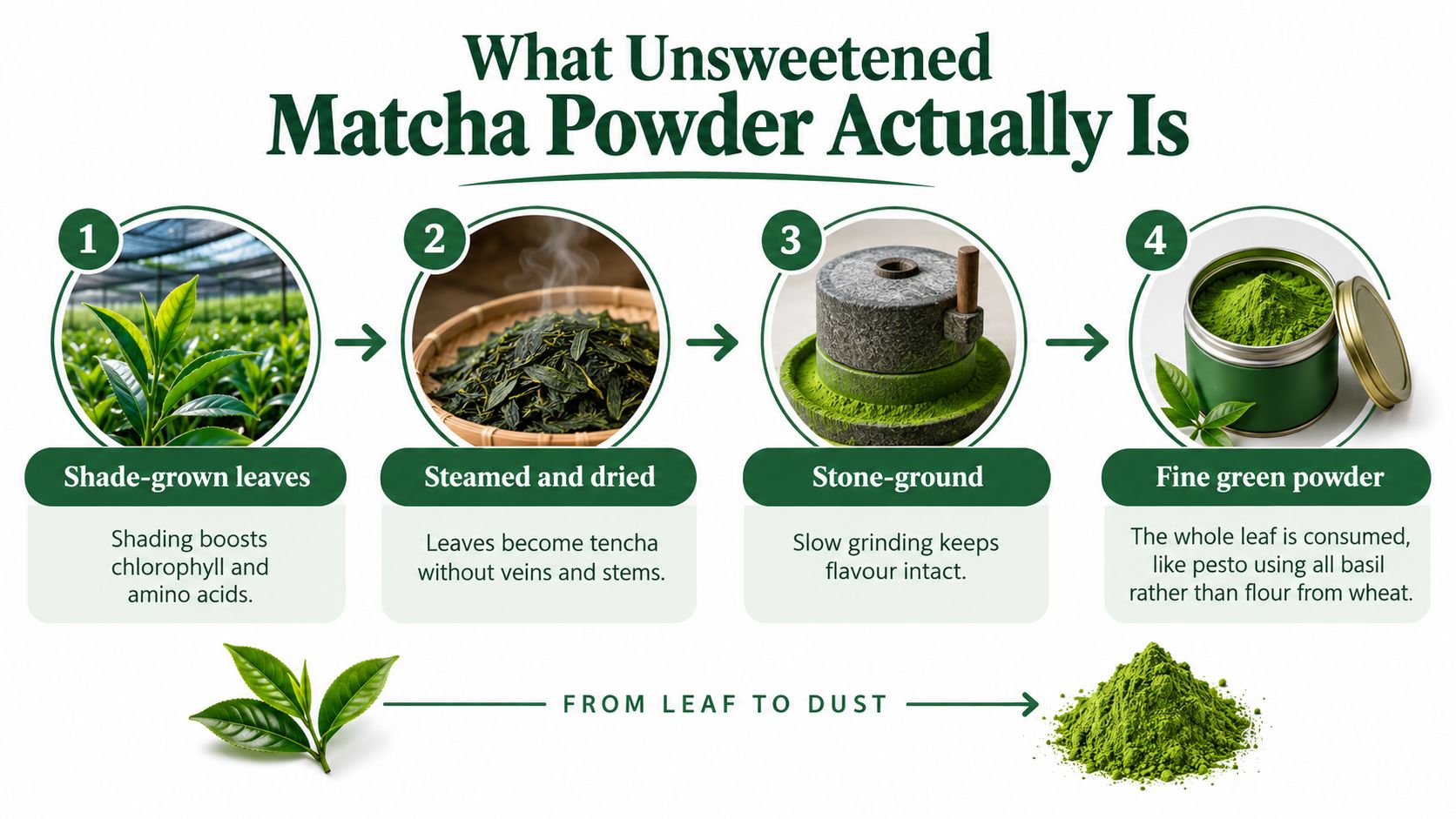
Matcha begins with tea leaves, not a brewed tea that has been dried afterwards. The plants are shade-grown before harvest, then processed into tencha, the leaf material used for matcha. Shading encourages a deeper green colour and greater amino-acid accumulation, which contributes to the savoury umami character and softer sweetness associated with good matcha.
The leaves are steamed and dried, with stems and veins removed. The clean leaf material is then ground slowly into an exceptionally fine powder. Think of the difference between making pesto from whole basil leaves and extracting only a fine flour from wheat. Matcha is closer to the pesto idea. You consume the leaf itself, rather than steeping it in water and throwing the leaves away.
What the word unsweetened means
Unsweetened matcha powder is pure powdered tea leaf with no added sugar, milk powder, or flavourings. That makes it different from several products that can look similar:
- Regular green tea powder may be made from leaves processed for a stronger, more astringent cup and may not have the same shade-grown, stem-free production.
- Instant green tea is designed to dissolve quickly and can be produced through extraction and drying rather than whole-leaf stone-grinding.
- Pre-mixed latte powder contains matcha alongside sweeteners or other ingredients, so you have less control over the final drink.
- Unsweetened matcha gives you the powder alone, which means you supply the water, milk, sweetener, and serving size.
Look beyond the front label. A vibrant green colour, fine particle size, and fresh grassy or sweet aroma are useful quality signals. A dull or yellowish appearance can suggest an older or less delicate powder, while coarse particles make whisking harder and create a gritty mouthfeel.
For a smaller introduction to traditional preparation, Ceremonial Grade Matcha 60g is described as sourced from Shizuoka, Japan, shade-grown, stone-ground, and sold as a pure powder without artificial additions.
Unsweetened Matcha vs. Sweetened Matcha
The choice isn't a contest between a virtuous product and a guilty pleasure. It's a decision about control versus convenience.
Unsweetened matcha lets you adjust the drink around the person drinking it. You can make a sharper, more concentrated cup, add only a small amount of maple syrup, or leave the flavour completely plain. It also works in savoury or lightly sweet recipes where a pre-sweetened powder would make the balance difficult.
Sweetened matcha is more predictable for quick drinks. A busy café can use a prepared blend to reduce the number of separate ingredients, while a beginner can make a consistent latte without judging how much sweetener to add. For a closer look at the alternative format, see this guide to sweetened matcha powder.
Unsweetened vs. Sweetened Matcha at a Glance
| Factor | Unsweetened | Sweetened |
|---|---|---|
| Ingredient control | You control the sweetener and milk | Sweetness is built into the blend |
| Flavour | More direct tea, umami, and bitterness | Softer and more immediately dessert-like |
| Best for | Whisked tea, custom lattes, smoothies, baking | Fast lattes, iced drinks, and consistent service |
| Recipe flexibility | Works in sweet and less-sweet recipes | Better suited to recipes designed around its sweetness |
| Preparation | Needs measuring and mixing | Fewer decisions at drink time |
| Sugar management | You choose whether and how much to add | The blend determines the sweetness |
Choose unsweetened when you want a clean tea flavour, control over sugar, or one powder that can move from a bowl to a batter. Choose sweetened when speed, repeatability, and a ready-to-mix drink matter more than ingredient control.
A useful middle path is unsweetened powder with a measured sweetener. Start with the tea plain, then add a small amount of honey, sugar, or syrup after tasting. That keeps the powder useful for baking and smoothies while making a morning latte more approachable.
Ceremonial vs. Culinary Grade and How to Choose
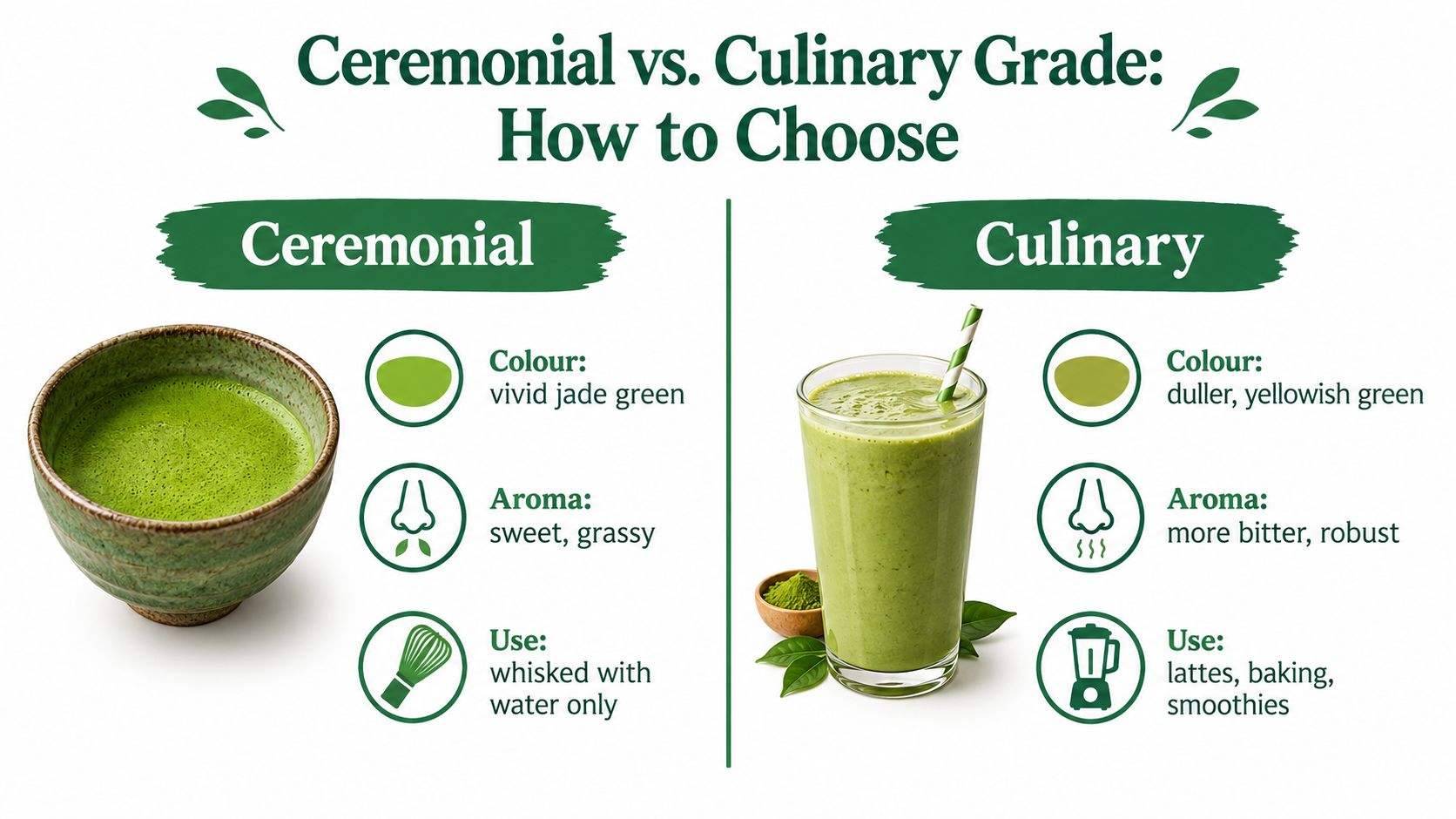
The word ceremonial describes a powder intended to be tasted mainly with water. Culinary describes a powder made for recipes and stronger combinations, where milk, fruit, sugar, cocoa, or flour can compete with the tea.
Neither grade is automatically right for every buyer. A person who drinks a plain bowl of matcha will notice the differences in aroma, texture, and finish more clearly than someone blending the powder with oat milk and ice. Paying for a delicate sipping grade for a daily banana smoothie may not improve the experience.
Use three quick cues
Colour gives you an initial clue. Ceremonial matcha is commonly a vivid jade or bright green, while culinary powder may look duller or more yellowish green. Colour alone doesn't prove quality, but a lively appearance is useful when combined with freshness and aroma.
Aroma tells you what the powder may taste like. A ceremonial powder should smell fresh, grassy, and gently sweet. Culinary powder can have a more intense, bitter, or assertive tea aroma, which helps it remain noticeable after you add milk or other ingredients.
Intended use makes the final decision simple:
- Whisked with water only: Choose ceremonial when the tea itself is the centre of the drink.
- Simple milk drinks: Either can work, depending on whether you want delicate flavour or a stronger tea presence.
- Lattes, smoothies, baking, and energy bites: Culinary is usually the practical choice because it can stand up to other ingredients.
Price can reflect leaf selection, processing, and labour, but it shouldn't become a status test. Buy the grade that matches what you'll prepare. Ceremonial suits pure sipping. Culinary suits the kitchen.
Caffeine, L-Theanine, and the Calm Focus Claim
Matcha can feel smoother than coffee for some people, but smooth doesn't mean caffeine-free. Australian coverage describes a typical matcha serving as containing about 60 to 75 milligrams of caffeine, compared with about 100 milligrams in a 250 millilitre cup of coffee and 24 to 45 milligrams in green tea. Compare matcha and coffee caffeine in this Australian coverage.
The amount varies because serving size, powder strength, leaf material, and preparation all affect the final cup. Another Australian retail listing illustrates why checking the product label matters. It declares 72.1 milligrams of caffeine per 100 grams and 4.0 milligrams per serving for a matcha-based latte powder. That product's serving definition isn't necessarily the same as a traditional bowl of matcha, so labels and actual scoop sizes need to be read together. See the Australian product analysis reference.
Where L-theanine fits
One Australian seller's laboratory testing for a ceremonial product reported 33.3 milligrams of caffeine per gram and 21.3 milligrams of L-theanine per gram. In practical terms, a 1 gram serve would provide roughly 33 milligrams of caffeine and 21 milligrams of L-theanine from that tested product. Review the matcha lab-testing details.
L-theanine is an amino acid associated with a calmer form of alertness, which helps explain why many drinkers describe matcha as less abrupt than coffee. That pairing doesn't guarantee a particular feeling, however. Your sleep, caffeine tolerance, meal timing, and total daily intake still matter. This guide to matcha and L-theanine offers further context on the relationship.
Practical rule: Treat matcha as a caffeinated food, not a harmless green flavouring.
Start with a modest serve earlier in the day if you're sensitive to caffeine. Avoid assuming that a larger scoop will deliver proportionally better focus. High intake can produce effects similar to coffee, including restlessness, a racing heart, or disrupted sleep, and people who are pregnant, taking certain medicines, or managing caffeine sensitivity should seek individual medical advice.
Brewing, Lattes, and Baking With Unsweetened Matcha
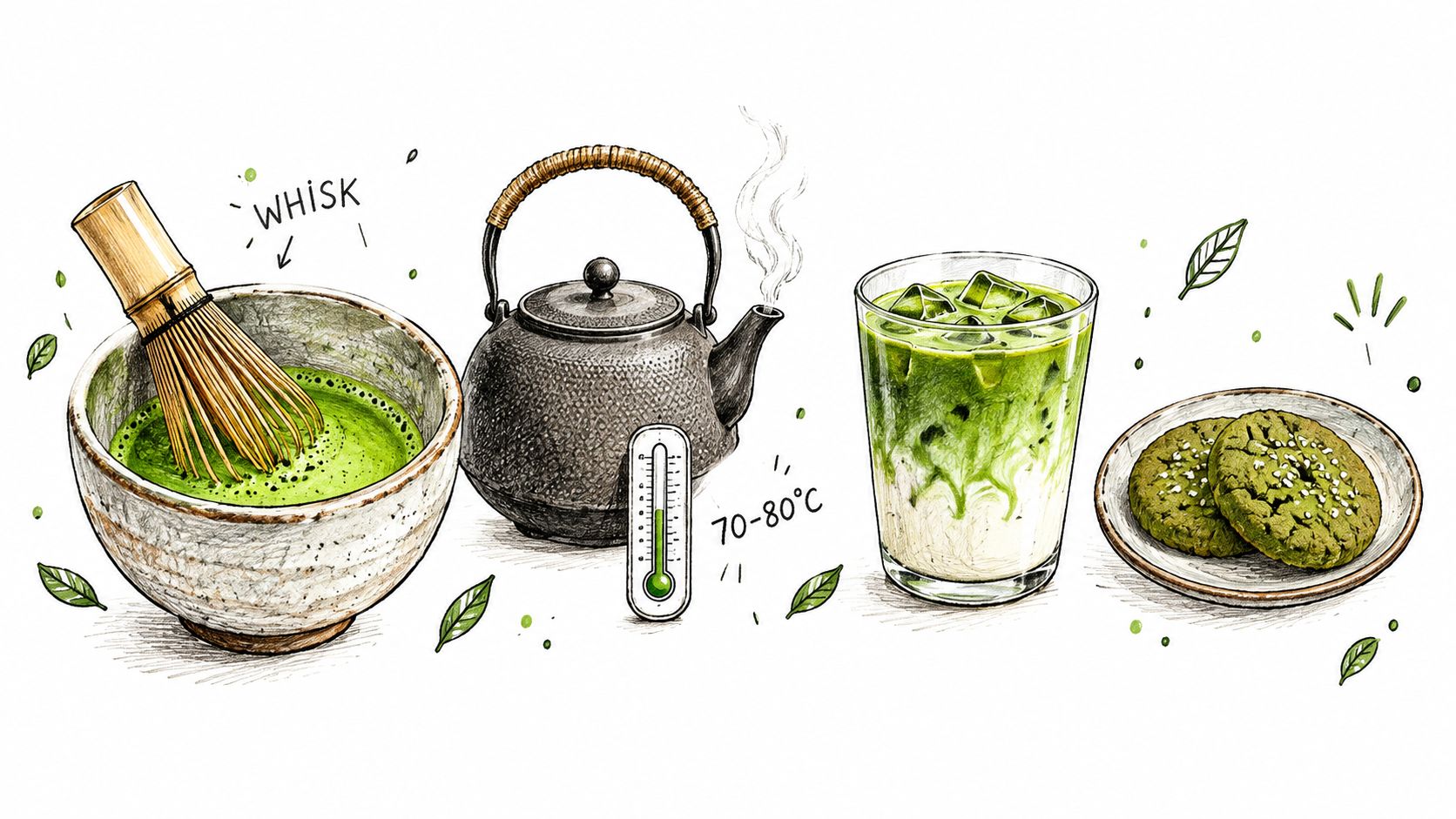
A good first cup doesn't need elaborate equipment. It needs fresh powder, a dry fine-mesh sieve, water that isn't boiling, and a whisk that can break up clumps.
Start with whisked matcha
Use 1 gram of powder with roughly 60 to 70 millilitres of water heated to around 70 to 80°C. Sift the powder into a bowl, add a small splash of water, and work it into a smooth paste before adding the rest. Whisk briskly in a loose zigzag motion until the surface looks lightly foamy.
The most common mistake is using aggressively boiling water. Excessive heat can make the tea taste more bitter and flatten the delicate sweet, grassy notes. If the cup tastes harsh, reduce the water temperature and check that you haven't used an oversized scoop.
For a more detailed technique, follow this guide to whisking matcha.
Turn it into a latte
For a daily latte, use culinary grade if you're adding a generous amount of milk. Sift the powder, mix it with a small volume of warm water until smooth, then add steamed or chilled milk. A practical starting ratio is 1 gram of matcha to about 30 millilitres of water, followed by 180 to 200 millilitres of milk. Adjust the tea upward if the drink tastes washed out, or add a controlled sweetener if the bitterness is too prominent.
Clumps are the usual problem here. Don't drop dry powder straight into a full glass of milk, because the surface liquid makes it harder to disperse. A small slurry first gives you a smoother iced or hot drink.
The same base works for an iced latte. Chill the milk, pour it over ice, and add the smooth matcha mixture last so you can see whether it has fully dispersed.
Add it to baking
Sift unsweetened matcha into muffins, cookies, sponge cakes, or energy bites alongside the dry ingredients. Start with a modest amount, then balance the tea against ingredients such as white chocolate, citrus, coconut, or vanilla. Strong cocoa, dark chocolate, and heavily spiced mixtures can hide the more delicate notes.
If the batter turns muddy rather than green, the powder may be old, the quantity may be too small for the other ingredients, or the mixture may contain ingredients with a strong brown colour. Sifting also matters here. It prevents green pockets and distributes the powder before liquid activates the batter.
A simple technique beats expensive accessories. Good powder, measured water, and thorough mixing will take you further than a crowded tea drawer.
Storage, Freshness, and Getting the Most From Every Tin
Matcha behaves more like a delicate fresh ingredient than an indestructible pantry staple. Air, light, heat, and moisture gradually affect its colour, aroma, texture, and flavour. An open bag left beside the kettle may taste noticeably flatter than the same powder protected in a sealed container.
Consider a 200 gram bag in a home pantry. If you only make an occasional latte, the package may stay open long enough for the bright aroma to fade before you reach the bottom. A smaller format can be more sensible because you rotate through fresh powder rather than buying a large amount that sits unused.
A practical freshness routine
Keep the original package tightly sealed, or transfer the powder to an airtight, opaque container if the packaging doesn't protect it from light. A cool, dark cupboard works for many households. If your kitchen is warm, refrigerate the sealed powder after opening, but let the container come to room temperature before opening it so condensation doesn't reach the tea.
- Seal it promptly: Close the tin or pouch immediately after measuring.
- Use a dry spoon: Water introduced into the powder can create clumps and encourage spoilage.
- Keep it away from heat: Don't store it beside an oven, kettle, or sunny window.
- Avoid the freezer: Repeated temperature changes and condensation can damage the powder's texture.
- Rotate small formats: Aim to finish an opened bag within four to six weeks for peak taste.
Fresh matcha should smell like tea when you open it. If the aroma has become faint, stale, or dusty, the powder may still be usable in a strongly flavoured recipe, but it won't deliver the same pure-cup experience.
Write the opening date on the package. Taste a small whisked sample when you first open it, then use that as your reference point for later cups. If colour fades rapidly or the flavour becomes flat, review where you're storing it before blaming your brewing technique.
Choosing the Right Unsweetened Matcha for You
A confident purchase comes down to four decisions.
First, choose the format. Pick unsweetened matcha if you want to control sweetness, prepare more than lattes, or use the powder in baking. A sweetened blend makes more sense when you want a quick, repeatable drink with fewer ingredients to measure.
Second, choose the grade by habit. Ceremonial grade is intended for whisking with water, where aroma, texture, and finish are exposed. Culinary grade is the practical option for milk, smoothies, cookies, muffins, and other recipes with competing flavours.
Third, fit the caffeine to your day. Matcha can sit below coffee in caffeine while still having a meaningful effect. Begin with a smaller serve if you're changing from coffee, keep stronger drinks earlier in the day, and pay attention to sleep and physical symptoms rather than relying on the phrase “calm energy”.
Fourth, create a storage plan before buying a large format. Estimate how often you'll drink matcha, choose a size you can finish while it's fresh, and keep the package sealed between uses. A smaller ceremonial pouch can suit occasional sipping, while culinary powder may fit a household that bakes or makes lattes regularly.
Australian buyers also need to allow for supply changes. Independent Australian coverage valued the domestic matcha market at $53.75 million in 2024 and forecast $82 million by 2030, while café operators have reported record-high import costs and shortage pressure. The same coverage said the wholesale price of Kyoto tencha rose 69% in the past year, with some venues rationing stock or using hybrid drinks such as dirty matcha. Read the Australian café and supply coverage.
That makes sensible rotation useful for both homes and cafés. Keep ceremonial powder for plain servings, use culinary grade where other ingredients are involved, and consider hojicha as an alternative menu powder when matcha supply is tight. The best unsweetened matcha is the one that matches your preparation, caffeine tolerance, and consumption rhythm, then stays fresh long enough to be enjoyed properly.
TOO MATCHA. offers Japanese matcha and hojicha powders in formats suited to whisked tea, lattes, baking, home use, foodservice, and wholesale supply. Visit the range to choose an unsweetened grade that fits your routine, then start with a fresh, measured cup rather than guessing from the label.