Sweetened Matcha Powder: A Practical Guide for Lattes
You're probably here because you like the idea of matcha more than the process of making it.
The alarm's already been snoozed, the sink has yesterday's mug in it, and the thought of sifting powder, judging water temperature, and whisking until smooth feels like one task too many. That's the moment many people reach for sweetened matcha powder. Not because they've given up on “real” matcha, but because they want a drink that fits an ordinary morning.
That shortcut can be useful. It can also change what ends up in your cup. Sweetened matcha powder isn't just matcha made easier. It's a formulated product with its own trade-offs around sweetness, caffeine strength, and label reading. If you understand those trade-offs, you can decide whether it belongs in your daily routine or only in the occasional café-style drink.
Table of Contents
- The Moment Sweetened Matcha Powder Solves
- What Sweetened Matcha Powder Actually Is
- Reading the Nutrition Label Honestly
- Sweetened Versus Unsweetened Matcha
- Where Sweetened Matcha Powder Shines
- Simple Recipes to Try at Home
- Choosing Sweetened Matcha Powder Wisely
The Moment Sweetened Matcha Powder Solves
It is 7:15 am, the milk is open, and you want something green and caffeinated before work. Plain matcha can be lovely in that moment, but it asks you to make several little choices in a row. How much powder. How much sweetener. Whether it needs more whisking. Whether the bitterness is part of the drink or a sign you missed the balance.
Sweetened matcha powder solves that specific problem. It acts like matcha with part of the recipe decided for you.
That can matter more than tea purists like to admit. For many Australians, the goal is not a careful bowl of whisked tea. The goal is a drink that goes from packet to cup with fewer clumps, fewer corrections, and less trial and error, especially in cold milk where plain matcha often shows every speck.
Why it feels easier
A sweetened blend works like a pre-mixed cake mix compared with flour, sugar, and baking powder measured separately. You give up some control, but you save time and reduce the chance of getting the balance wrong.
In practice, that usually means three things. You are not adding a separate sweetener. The flavour is built to taste rounder and less sharp. The powder often mixes more willingly into iced drinks and latte-style drinks.
That convenience is the appeal. It is also the catch.
A sweetened blend does not just save effort. It changes the formula in your cup. Once sugar or other fillers take up part of the scoop, the amount of actual matcha per serve can drop, which can change both the nutrition profile and the caffeine hit. If you enjoy the flavour side of that trade-off, this guide to sweet matcha benefits adds useful context.
Sweetened matcha powder is a ready-built drink base, not simply plain matcha made easier.
What to ask instead
A better question than “Is it authentic?” is much more practical.
Ask what has been added, how much room that leaves for real matcha, and whether that version suits the drink you make at home. If you mostly want quick iced lattes, the answer may be yes. If you want the leaf-forward taste, lower sugar, or a stronger caffeine lift from the same spoonful, the answer may be no.
What Sweetened Matcha Powder Actually Is
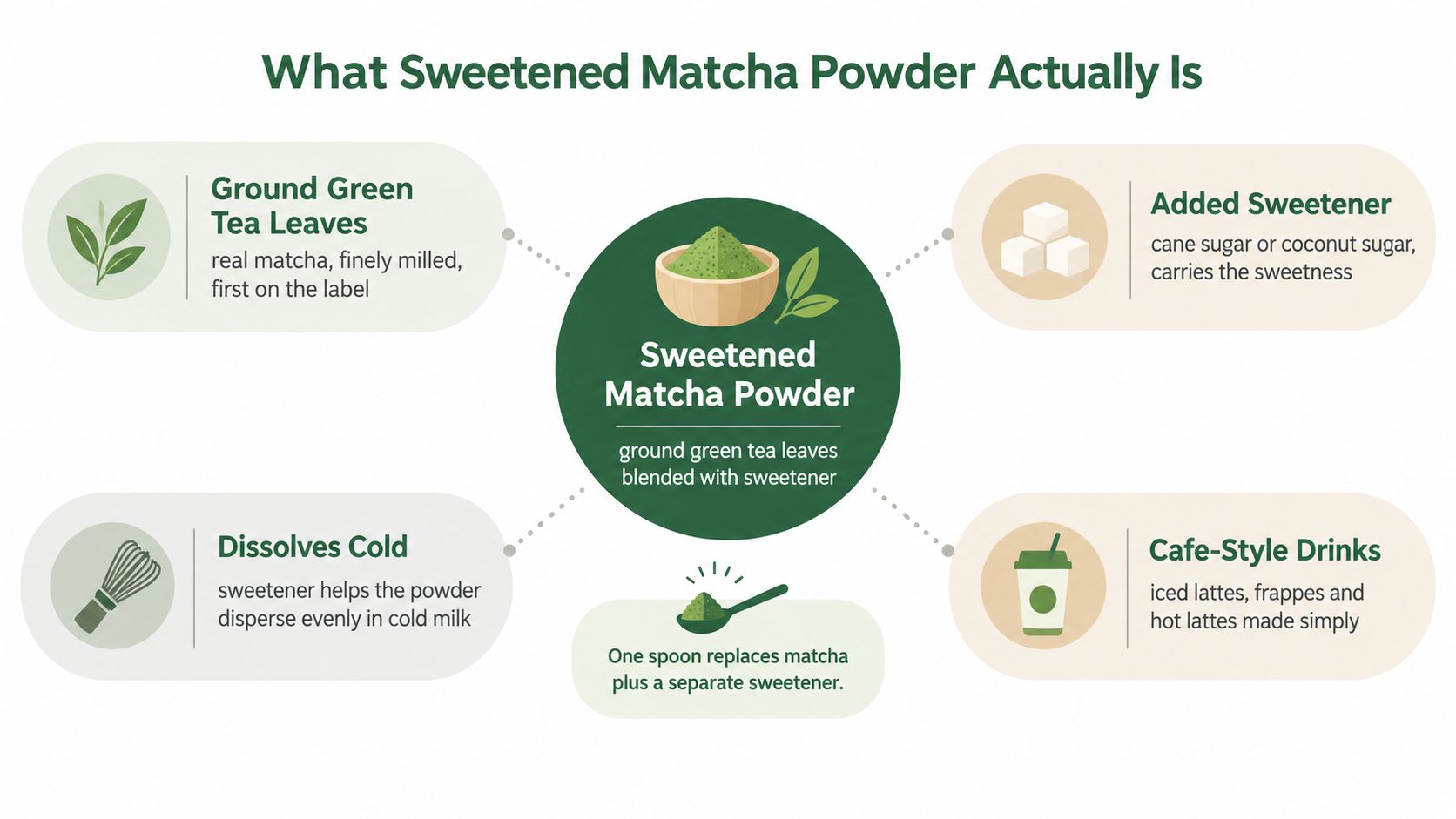
At its simplest, sweetened matcha powder is a blend of ground green tea leaves and a sweetener. Instead of buying plain matcha and adding sugar or syrup yourself, you buy a powder that's already designed to taste more like a ready-made latte base.
What's usually inside
The matcha portion may come from Japanese or Chinese green tea leaves. The sweet part may be cane sugar, coconut sugar, palm sugar, or a lower-sugar sweetener in some blends. Some products also include ingredients that help the powder stay free-flowing and mix more easily.
That last part is worth noticing. In Australia, one widely visible formulation example listed by McDonald's Australia is “Sugar, Maltodextrin, Matcha, Salt, Colours (100, 141)”, which shows the sweetener and bulking ingredients can come before the tea itself in the ingredient list as discussed in Australian coverage of sweetened matcha formulations.
Why solubility changes
Plain ceremonial matcha is delicate and fine, but it's still fussy. It likes warm water first, careful whisking, and a little patience. Sweetened blends are usually built for speed. The added sweetener and carrier ingredients help the powder disperse more evenly, especially in cold milk.
That's why these products often behave better in an iced latte than pure matcha stirred straight into a glass from the spoon. The flavour changes too. Sweetness softens grassy, savoury, or astringent notes, so the result tastes closer to a café drink than a traditional bowl of tea.
Where it sits on the matcha spectrum
Ceremonial matcha is for drinking as tea. Culinary matcha is usually chosen for mixing, baking, and stronger milk drinks. Sweetened matcha powder usually sits closer to the culinary end because its job isn't purity. Its job is repeatability.
One example of that convenience-first format is Premium Sweet Matcha 200g, which is described as a 200 g sweetened blend made with 30% authentic Japanese green tea leaves and positioned as a simple scoop-and-whisk option for people who want a pre-balanced drink.
Reading the Nutrition Label Honestly
A sweetened matcha label can look healthy at first glance because the front often leans on the word “matcha”. The back panel tells the more useful story.
In Australia, the biggest practical difference is usually sugar. Retail nutrition panels show that pre-sweetened matcha products can contain about 3.6 g sugars per 4.1 g serve, or 72.1 g per 100 g, while a plain organic matcha powder in the same market shows 0.1 g sugars per 1 g serve, or 5.3 g per 100 g in Australian retail comparisons.
What to look at first
Start with three things:
- Ingredients order tells you what dominates the blend. If sugar or maltodextrin comes first, the powder is acting more like a flavoured drink base than pure tea.
- Serve size tells you how much of the blend the nutrition panel is measuring.
- Sugars per serve tells you what reaches your cup before you add milk or any extra syrup.
Here's a simple way to compare formats.
| Nutrient (per serve) | Plain Matcha (1 tsp) | Sweetened Matcha Powder (1 sachet) | Iced Cafe Matcha Latte |
|---|---|---|---|
| Sugar | Very low by comparison | Often clearly present on label | Depends on powder, milk, and any extra syrup |
| Carbohydrate | Naturally low | Usually higher because sweetener is added | Usually higher again if a full café-style recipe is used |
| Caffeine | Depends on dose of matcha used | Can vary with how much actual matcha is in the blend | Can vary widely based on scoop size and recipe |
| Best label check | Matcha source and serve weight | Ingredients order and sugars per serve | Ask how many scoops and whether syrup is added |
If you want a broader look at how milk and sweetener change the drink, matcha latte nutrition facts is a sensible next read.
Practical rule: Don't assume a green drink is a low-sugar drink.
Caffeine needs a closer look too
Australian explanations commonly describe matcha as providing about 60 to 75 mg of caffeine per 250 mL serving, compared with about 100 mg for a typical 250 mL coffee in ABC reporting on matcha and caffeine. That makes matcha feel like a middle ground for many drinkers.
But a sweetened blend can make caffeine harder to judge by eye. If part of every spoonful is sugar or bulking ingredient, then not all of that spoonful is tea. That doesn't make it bad. It just means you shouldn't assume one scoop of sweetened powder equals one scoop of plain matcha.
Sweetened Versus Unsweetened Matcha
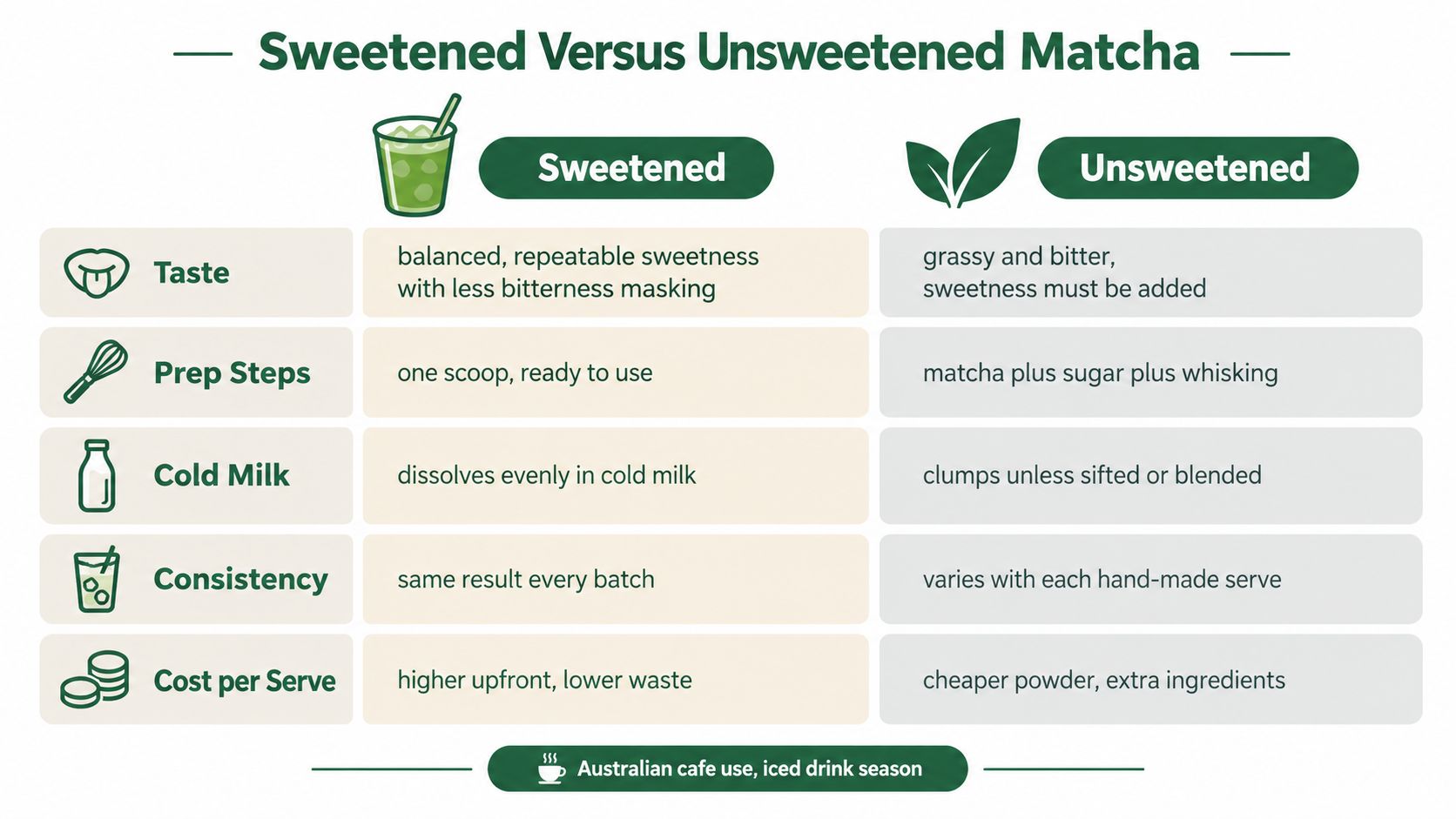
If you're choosing between sweetened and unsweetened matcha, taste is only one part of the decision. The more useful comparison is what each format lets you control.
Taste and texture
Sweetened matcha powder usually gives you a softer landing. The sweetness rounds off the sharper edges, so beginners often find it easier to enjoy in milk. It also tends to feel more familiar because the flavour lands closer to a café latte than to straight tea.
Unsweetened matcha shows the leaf more clearly. You get the grassy notes, the savoury depth, and sometimes the brisk finish that sweetened blends are designed to cover. Some people love that. Some people taste it once and decide they'd rather have help from sugar.
Speed and repeatability
Sweetened blends often win.
For a café, a premix cuts steps. For a home kitchen, it cuts hesitation. One scoop into milk is simpler than powder plus sweetener plus tasting plus adjusting. The result is also easier to repeat because the sweetness is already fixed.
A plain matcha gives you more freedom, but freedom can be messy. One day you add honey. The next day less. Then a different milk. Then an extra half scoop. If you value consistency, sweetened powder does some of the thinking for you.
Later in this section, this short video helps show the practical difference in latte-style preparation.
Control and trade-offs
Unsweetened matcha is better if you want to control sweetness precisely. You choose the sugar, or skip it. You choose the strength. You decide whether the drink is delicate or punchy.
Sweetened powder gives up some of that control. If the blend tastes too sweet for you, there's only so much you can do without weakening the tea flavour as well.
Consider these side-by-side trade-offs:
- If you want convenience, sweetened powder is easier to use in a rush.
- If you want flavour control, unsweetened powder gives you a blank canvas.
- If you drink matcha daily, sugar content matters more over time.
- If you mostly make iced drinks, sweetened powder often mixes more smoothly.
Unsweetened matcha is an ingredient. Sweetened matcha powder is more like a recipe base.
Where ceremonial fits in
This is also where people get confused about grade. Sweetened matcha products are usually not trying to deliver a ceremonial experience. They're built for latte behaviour, not tea ritual.
If you want to taste what plain, traditional-style matcha is doing without added sweetness, Ceremonial Grade Matcha 60g is described as a Shizuoka-sourced, stone-ground powder for whisked drinking, with a naturally sweet, smooth flavour profile and rich umami depth. That's a different use case from a pre-sweetened blend, even when both end up in a cup.
Where Sweetened Matcha Powder Shines
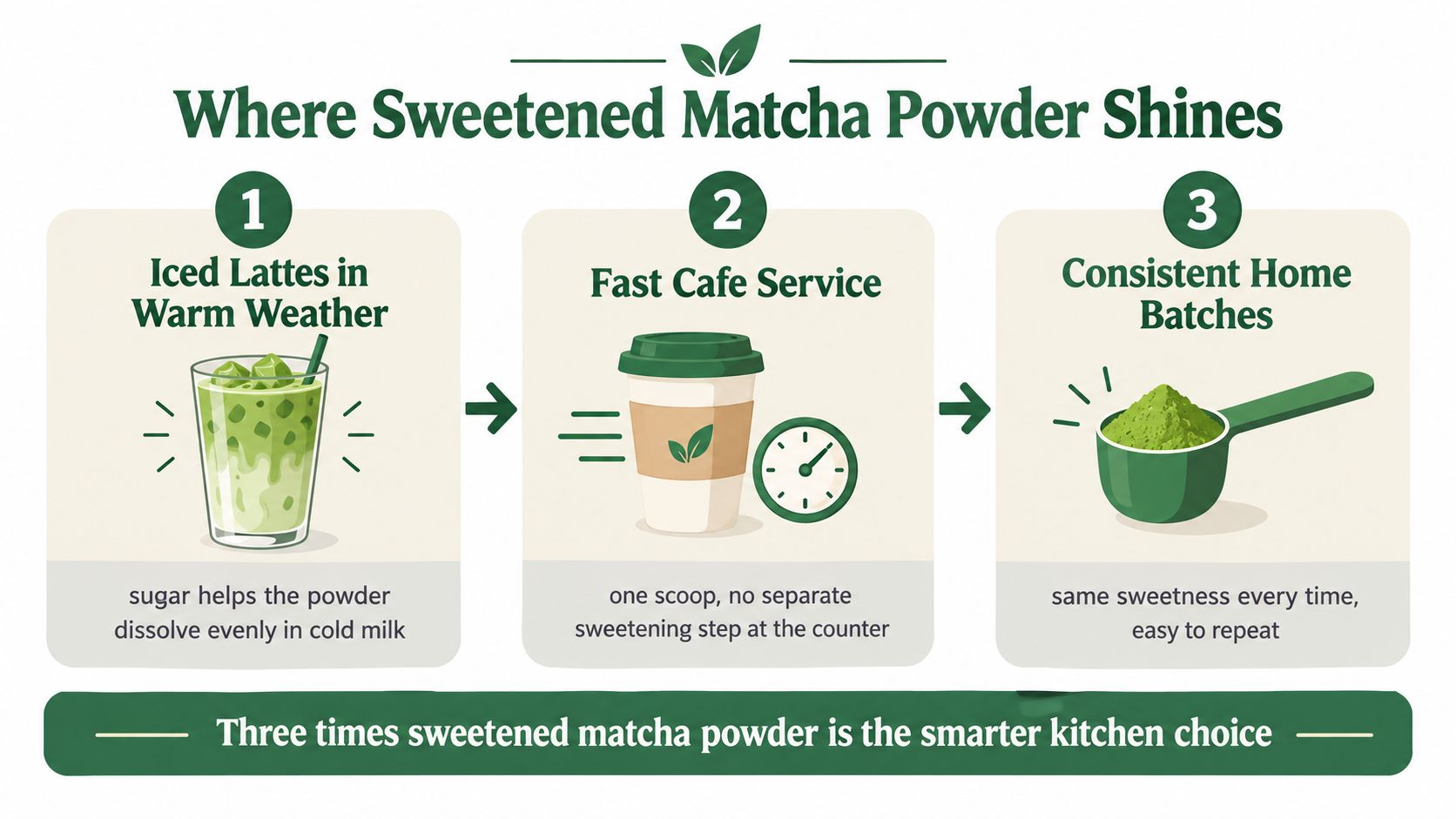
Some products are most useful when you stop asking them to do every job. Sweetened matcha powder shines in a few specific situations.
Iced lattes in warm weather
This is probably the clearest use case. Cold milk makes plain matcha harder to disperse evenly, especially if you stir by hand. A sweetened blend usually dissolves more readily, so you get fewer clumps and a smoother first sip.
Use a shaker bottle or a sealed jar. Add the powder first, then a small splash of milk, shake into a paste, and top up the rest. Ice goes in last. That order helps the powder spread before the cubes get in the way.
Fast hot drinks before work
On a busy morning, a handheld milk frother does the job well. Warm your milk, add the powder, and froth briefly until it looks even.
The sugar in the blend helps here too. It rounds the drink quickly, so you're less likely to end up with a hot cup that tastes thin, grassy, or unfinished because you skipped the separate sweetening step.
Flavoured café-style drinks at home
Sweetened matcha powder also works well when you want vanilla, coconut, caramel, or fruit-led drinks. In that setting, the blend acts as a stable base.
Use a blender when you're adding multiple ingredients. The base sweetness helps the extra flavour sit on top instead of fighting a bitter tea edge. That's useful if you want a home version of the flavoured drinks now common across Australian menus. Australian trend reporting has noted matcha moving into flavours such as strawberry, pistachio, coconut, and banana, alongside broader growth in menu presence in Australian trend commentary.
Simple Recipes to Try at Home
These recipes lean into what sweetened matcha powder does well. They're quick, forgiving, and easy to repeat.
Classic iced matcha latte
You'll need:
- 1 teaspoon sweetened matcha powder
- 200 ml cold full-cream milk or oat milk
- Ice
- Optional splash of cream
Add the powder and milk to a sealed jar or shaker bottle. Shake for about 15 seconds, then pour over ice. If you want a fuller café-style texture, add the small splash of cream at the end.
This works because the premix is designed to dissolve with less resistance than plain matcha.
Quick hot matcha
You'll need:
- 1 teaspoon sweetened matcha powder
- 200 ml milk warmed to about 65°C
Warm the milk, add the powder, and whisk lightly or use a handheld frother until foamy. Drink straight away.
If the drink tastes a little too sweet, don't add water first. Use a touch more milk instead, so you keep the texture pleasant.
A good beginner cup is the one you'll actually make again tomorrow.
Coconut matcha over ice
You'll need:
- 1 teaspoon sweetened matcha powder
- 150 ml coconut milk
- 50 ml water
- Ice
- Pinch of toasted coconut
Shake the powder with the coconut milk and water, then pour over ice and finish with toasted coconut. The pre-set sweetness suits coconut especially well because both ingredients soften the earthier side of matcha.
How to adjust strength without ruining balance
If you want a stronger cup, increase the powder slightly before you reduce the milk. If you want a milder cup, add a bit more milk rather than cutting the powder too sharply. That keeps the drink tasting intentional instead of watered down.
Choosing Sweetened Matcha Powder Wisely
Buying sweetened matcha powder is less about chasing a trend and more about knowing what kind of drinker you are.
If you want a quick latte, reliable sweetness, and fewer steps, it can be a smart pantry item. If you want full flavour control, minimal sugar, or a more traditional bowl of tea, plain matcha is usually the better fit.
A better buying checklist
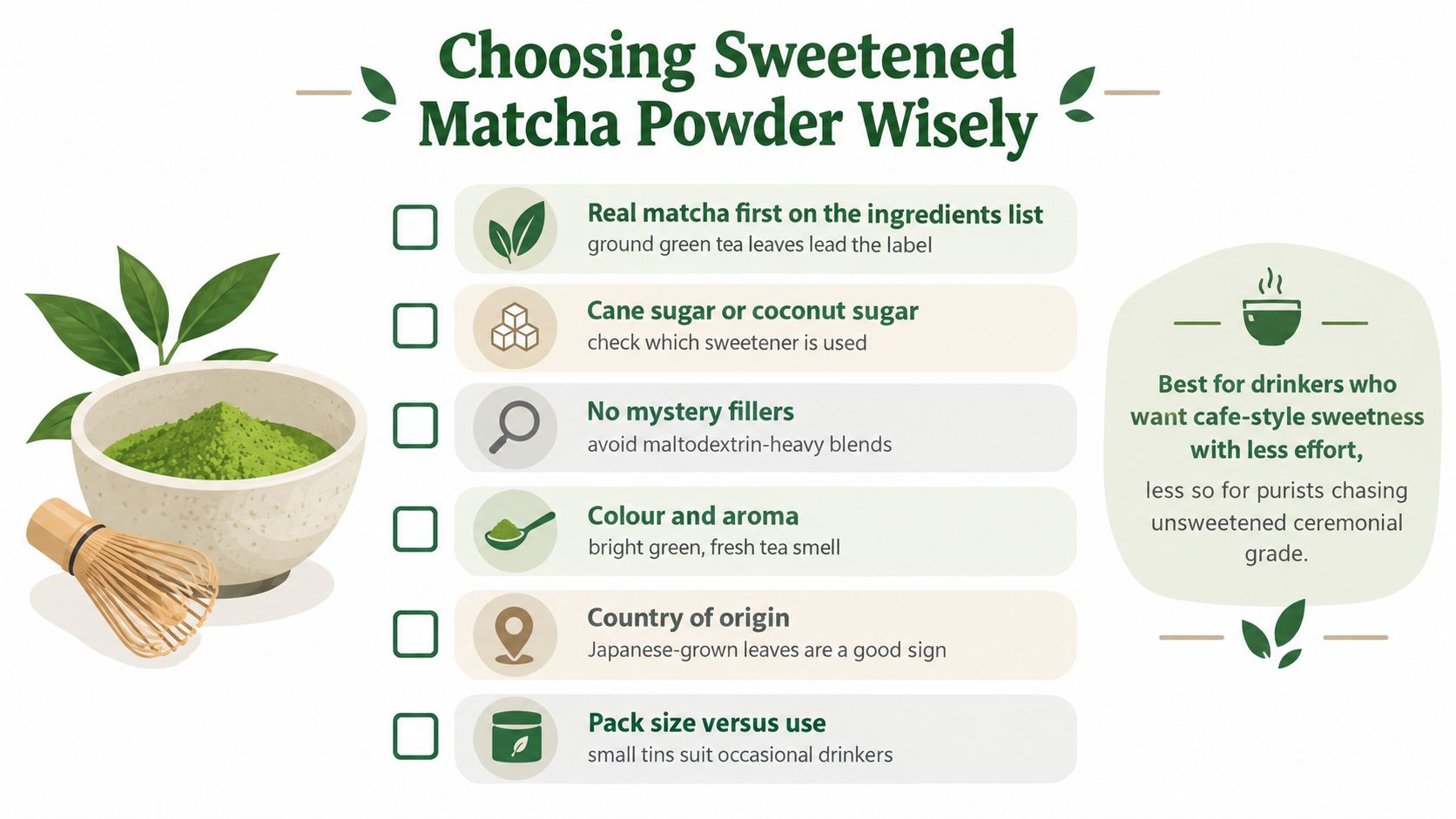
Use this when you compare products:
- Check the ingredient order. If sugar and fillers come before matcha, you're buying more drink base than tea.
- Look for caffeine guidance. Some Australian sellers give clear serving advice and warnings that the powder contains caffeine and isn't recommended for pregnancy or children as shown on an Australian product page.
- Read the serve size carefully. A small scoop can carry very different amounts of actual matcha depending on the blend.
- Consider how often you drink it. If it's daily, sugar matters more. If it's occasional, convenience may matter more.
- Match the product to the job. Sweetened powder for lattes and flavoured drinks. Plain matcha for ritual, stronger tea character, and full control.
Who it suits best
Sweetened matcha powder usually suits three groups well. Beginners who find plain matcha too sharp. Busy drinkers who want a repeatable morning cup. Home baristas making iced and flavoured drinks more often than traditional tea.
If you're comparing formats for latte use, best matcha powder for lattes adds more buying context.
One final honesty test
Ask yourself one simple question before buying: am I looking for matcha as tea, or matcha as a ready-to-mix drink base?
If it's the second one, sweetened matcha powder can be a very sensible choice. Just read the label like a buyer, not like a trend follower.
TOO MATCHA. offers both plain Japanese tea powders and pre-sweetened formats, which makes it easier to choose the style that fits how you drink matcha at home. If you want to compare ceremonial, culinary, and sweetened options with that real-world use in mind, visit TOO MATCHA..