Matcha Buttercream Recipe: Ingredients, Method and Fixes
The most repeated advice about a matcha buttercream recipe is that you should keep adding matcha until the flavour is strong enough. That advice is expensive and wrong. Matcha isn't cocoa. Cocoa is roasted, low in bitterness and forgiving of a heavy hand. Matcha is unroasted leaf powder, and 10 g in a 500 g batch already reads as a clear, full flavour. Push to 15 g and you get astringency that no amount of icing sugar will hide, plus a colour that drifts from jade to khaki.
The second most popular line is worse: "one to two teaspoons". A level teaspoon of culinary matcha lands somewhere between 2 g and 3 g depending on how the powder settled in the tin, so the same instruction gives you a pale, sweet frosting one weekend and a bitter one the next. Weigh it in grams and treat that number as the one variable you control.
From there, everything else is technique and temperature. Butter sits at 18-21°C. The egg base gets cooked to the pasteurisation point printed on the pack. The finished cake goes into the fridge at 5°C or below. Those three numbers do more for the result than any brand claim on the tin.
Table of Contents
- Choosing the Right Matcha Grade for Buttercream
- Matcha Buttercream Ingredients and Quantities
- How to Make Swiss Meringue Matcha Buttercream
- Fixing Dull, Bitter or Grainy Matcha Buttercream
- Storing Matcha Buttercream and Cakes Safely
- Serving Matcha Buttercream on Cakes and Cupcakes
Choosing the Right Matcha Grade for Buttercream
| Grade | Flavour and colour | Best use in buttercream | Cost per batch |
|---|---|---|---|
| Culinary grade | Bold, earthy, full-bodied; medium intensity | Everyday frosting, cupcakes, larger batches | Lower; suits repeat batches |
| Ceremonial grade | Smooth, sweeter, vivid green with umami | Pale frosting, macarons, visible finishing layer | Higher; suited to small or showcase batches |
| Generic green-tea powder | Grind and intensity vary | Only after a test batch | Unpredictable; test before scaling |
Choose matcha for the frosting's job. Butter and sugar soften its flavour, so a powder intended for recipes gives a clearer matcha character in a substantial batch. TOO MATCHA's Premium Culinary Grade Matcha has a bold, earthy flavour with medium intensity and is made for baking, blending and recipes.
Ceremonial grade has a smoother flavour and a vivid green colour. It suits frosting where the colour and flavour will be prominent, such as a thin layer on a light sponge or a macaron filling. For a first batch, culinary grade is the practical choice: the powder's flavour must still come through after mixing with butter and sugar.
Compare the amount of matcha each batch uses with the size of the pack. At 10 g per batch, a 60 g pouch makes about six batches. Buy a quantity you can use while the powder is still fresh, rather than choosing a larger bag solely for its lower cost per gram.
For a fuller comparison, read about ceremonial and culinary matcha grades. Premium Culinary Grade Matcha 60g is a useful pack size for initial recipe trials.
When substituting another powder, adjust the matcha by 2–3 g at a time and expect changes in both bitterness and colour. Generic green-tea powder can vary in grind and intensity, so make a small test batch before scaling up.
Matcha Buttercream Ingredients and Quantities
Matcha quantity is the easiest part of this buttercream to get wrong. Weigh it in grams: for one 500 g batch, start with 10 g culinary matcha, then adjust in 2–3 g steps after tasting. Australian heat makes accurate measuring and safe handling matter; a warm kitchen can soften butter quickly, so keep the ingredients controlled rather than guessing by volume.
| Ingredient | Quantity | Role in the buttercream |
|---|---|---|
| Pasteurised egg whites | 120 g (about four whites) | Structure for the Swiss meringue base |
| Caster sugar | 200 g | Sweetens and dissolves into the meringue |
| Unsalted butter | 500 g at 18–21°C | Adds body and a smooth texture |
| Culinary matcha | 10 g to start, then adjust in 2–3 g steps | Provides colour and flavour |
| Icing sugar | 30 g | Sifted with the matcha to help prevent clumps |
The matcha is about 2% of the batch by weight. A gram scale gives you a repeatable result; teaspoons do not, because powder settles and packs differently. Add too much at once and bitterness can dominate before the buttercream has had a chance to come together. Keep a note of the final weight that suits your cake, then use it for the next batch.
Matcha contains caffeine, and the amount varies between products and batches. A larger dose in the frosting means more caffeine in each serving, so avoid describing matcha buttercream as caffeine-free or universally calming.
Use pasteurised egg whites for home or café preparation, especially when serving people who need to avoid the risks associated with incompletely cooked eggs. Keep the measured ingredients separate and follow the method's heating and cooling steps before adding butter.
How to Make Swiss Meringue Matcha Buttercream
Swiss meringue is the right base for matcha. The cooked meringue carries the powder's colour without the raw sugar grain of an American buttercream, and it pipes cleanly at room temperature for a couple of hours.
Here's the whole sequence at a glance before you start weighing.
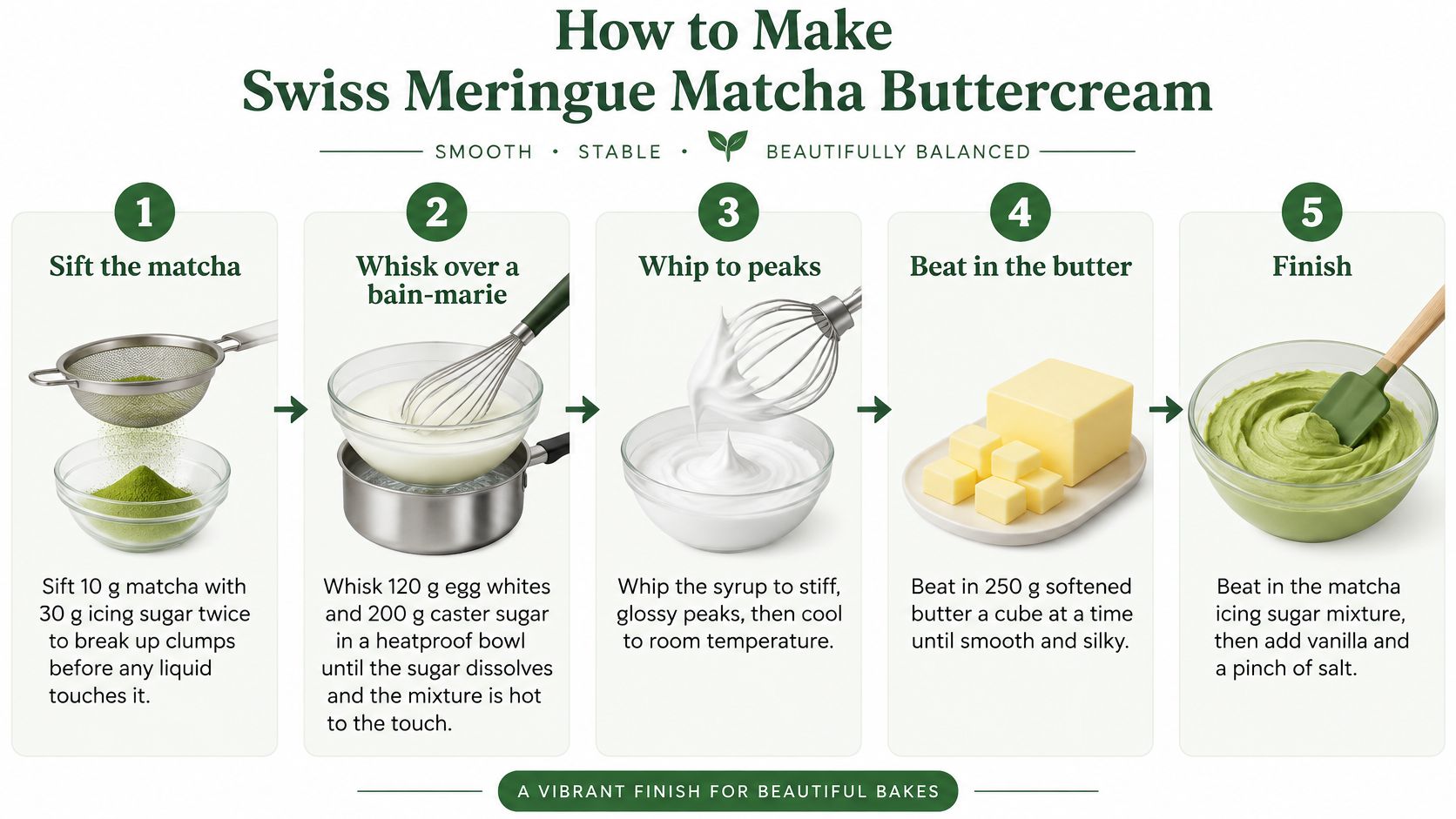
- Sift the matcha twice with the icing sugar. 10 g matcha and 30 g icing sugar, through a fine sieve, twice, before any liquid touches it. Dry powder dropped into a whipped emulsion stays as speckles; sifting breaks the clumps while the starch keeps them apart.
- Whisk the whites and sugar over a bain-marie. 120 g egg whites and 200 g caster sugar in a heatproof bowl set over simmering water, bowl not touching the water, whisking constantly, until the sugar dissolves and the mix reaches the pasteurisation temperature stated on your egg product. This is the food-safety step and the reason the meringue won't taste gritty. Rub a drop between your fingers; you shouldn't feel granules.
- Whip to a cool, glossy meringue. Off the heat, on medium-high, roughly 8-10 minutes, until stiff peaks form and the bowl no longer feels warm. Humidity slows this down. Warm meringue melts the butter later and you get soup.
- Beat in the butter a few cubes at a time. 500 g unsalted butter at 18-21°C, cut into cubes, added gradually and fully incorporated before the next batch. Cold butter curdles the emulsion; warm butter collapses it.
- Disperse the matcha in a spoonful of butter. Whisk a spoon of the finished buttercream with the sifted matcha to a smooth paste, then fold that slurry through the whole bowl. Adding the powder dry knocks air out and leaves grit.
- Rescue rather than restart. Slack buttercream goes into the fridge for 10-15 minutes, then gets re-whipped. A curdled look gets a brief warm bowl edge and more whipping, not more flour and not a fresh batch.
The only variable worth changing between batches: the matcha weight. Everything else is technique, and technique you can rescue mid-bowl.
What Good Looks Like
Finished matcha buttercream is silky, a pale jade green, and holds a soft peak on the whisk without slipping. It should taste of green tea rather than grass clippings, and a pinch of salt plus a teaspoon of vanilla at the end keeps the butter from dominating. It should not weep at the base of the bowl. Weeping means the emulsion broke, which usually traces back to butter temperature.
Fixing Dull, Bitter or Grainy Matcha Buttercream
Too much matcha is the usual cause of bitterness. Adding sugar masks the flavour rather than correcting the dose, so start by reducing the powder.
| Symptom | Likely cause | Fix |
|---|---|---|
| Dull, olive or brownish colour | Heat exposure or stale powder | Use fresher powder, keep the bowl cool and avoid prolonged whipping |
| Bitter or astringent taste | Too much matcha for the batch | Reduce matcha by 2–3 g; adding more will intensify the flavour |
| Grainy or speckled texture | Powder was added dry or left unsifted | Sift the matcha, then disperse it in a spoonful of buttercream |
| Soft, slack buttercream | Butter above about 21°C | Chill for 10–15 minutes, then re-whip |
| Curdled, broken look | Butter below about 18°C | Briefly warm the bowl edge and keep whipping |
| Firm, stiff frosting | Chilled for too long | Re-whip briefly or rest at cool room temperature |
If the frosting is bitter, reduce the matcha by 2–3 g and taste again before changing anything else. A dull olive tone points to heat exposure or stale powder. Keep the bowl cool, seal the matcha tin and avoid whipping longer than needed.
Sift matcha before adding it to the frosting. The matcha tea sifter guide explains how sifting helps break up clumps. TOO MATCHA matcha is milled by a partner business using an advanced method that produces an ultra-fine, clump-free powder.
Australian heat can warm buttercream quickly and affect its colour and flavour. Keep the bowl out of direct sun, and don't leave frosting on the bench through a hot afternoon. For a flavour adjustment, follow the single-variable rule from the method section: change the matcha weight only, then taste before making another adjustment.
Storing Matcha Buttercream and Cakes Safely
A butter-based Swiss meringue frosting needs different handling from a cream-cheese or whipped-cream topping. The difference is food safety, which makes it a storage rule rather than a texture preference.
Keep cakes with perishable frosting refrigerated at 5°C or colder. Refrigerated shelf life depends on the cake and topping: allow roughly 4–5 days for chocolate cake with buttercream, 3–4 days for red velvet with cream-cheese frosting, and 2–3 days for whipped-cream frosting. Store the cake covered, and keep time at room temperature as short as practical.
High-risk food held between 5°C and 60°C for more than four hours should be discarded. Pipe frosting onto a fully cooled cake, not a warm sponge, and use shallow containers so a batch chills evenly.
Label it. Date the container and record the matcha weight. Frostings can look identical even when their matcha quantities differ.
For safe storage, temperature and time matter more than whether the frosting still looks pipeable. Keep it covered in the refrigerator, then re-whip briefly after chilling if needed.
Serving Matcha Buttercream on Cakes and Cupcakes
Say you're building a birthday cake for someone who drinks matcha every morning. A plain vanilla sponge split into three layers, with a thin scrape of matcha buttercream between each, gives you the flavour without the density of a fully frosted cake.
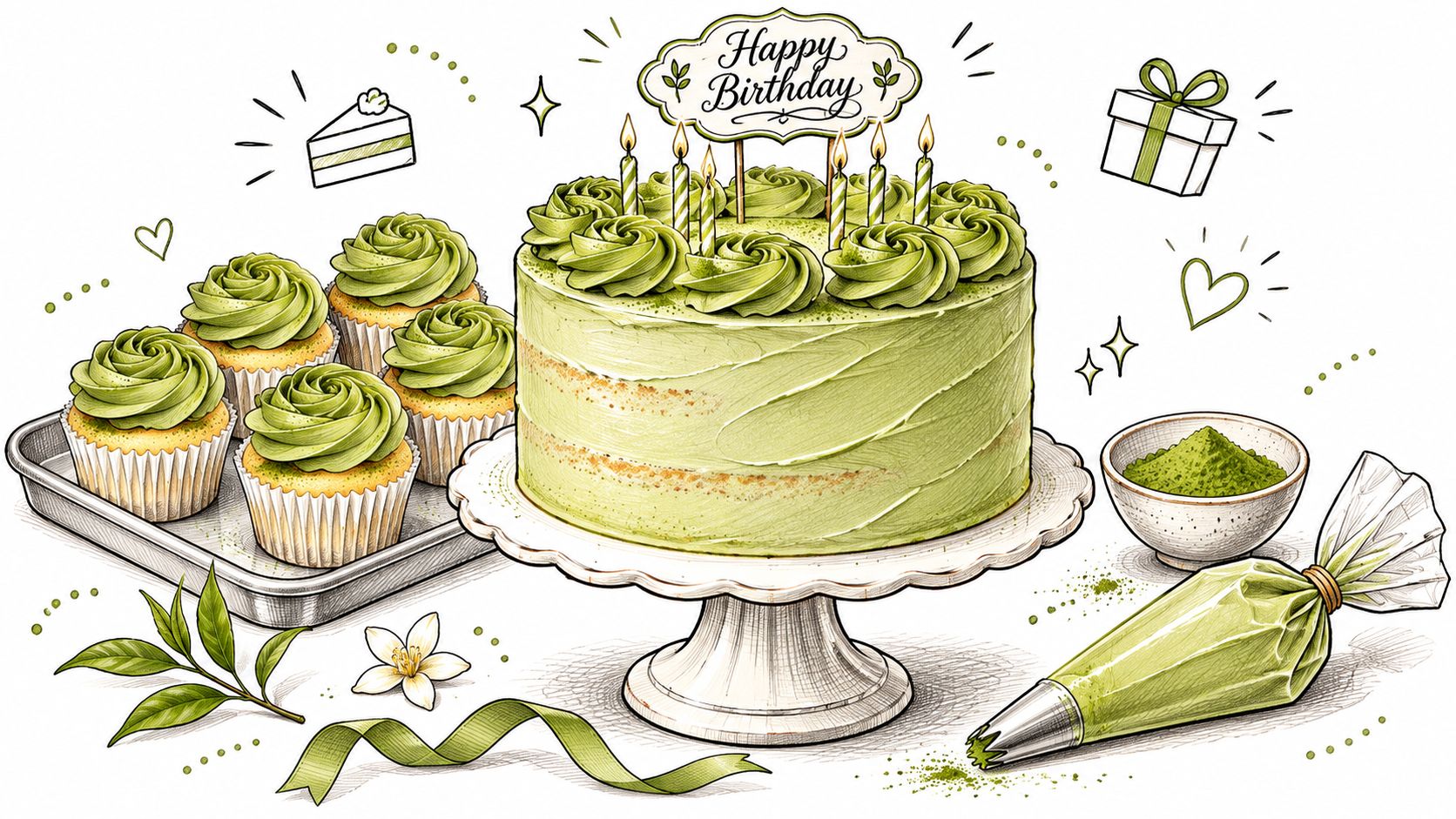
Chill a crumb coat for 30 minutes before the final layer, and the sponge stops shedding crumbs into the finish. Cupcakes take a star tip and a single swirl; anything more elaborate fights the colour you worked for. If you want a full build, our matcha green tea cake guide covers layering and assembly.
Pair the earthy, slightly bitter note with white chocolate filling, strawberries, or lemon and yuzu curd between layers. A chocolate sponge gives contrast and stops the green reading as savoury. Reserve a paler ceremonial grade for macarons and cookies, where the powder isn't competing with much.
Here's the process from start to finish for a layered cake.
Dust extra sifted matcha at serving rather than hours ahead, so the surface colour stays vivid. Take the cake out of the fridge 15-20 minutes before slicing, long enough for the butter to soften without the surface sweating.
Serve it cool, not cold. Twenty minutes out of the fridge is the difference between buttercream that tastes of green tea and buttercream that tastes of nothing.
Weighing, sifting and chilling only get you as far as the powder you start with, and that's the part we can help with. TOO MATCHA. supplies culinary and ceremonial grade matcha in 60 g, 500 g and 1 kg formats, freshly shipped from Japan and ground in small quantities so the colour and flavour arrive intact, with wholesale supply for cafés and bakeries testing at volume. Start with a 60 g pouch, run three 500 g batches at 10, 12 and 14 g, and settle on your own number before you scale. Browse the range at TOO MATCHA..