Tencha vs Matcha: Key Differences and Which to Buy
The usual advice is to buy the highest-grade tea you can afford. For tencha vs matcha, that skips the most important question: are you buying leaf that still needs processing, or powder you can whisk into a drink? Tencha isn't a premium substitute for matcha. It's the material from which matcha is made, and that distinction matters more than an impressive label when you're making a latte, testing a cake or ordering café stock.
Table of Contents
- Tencha vs Matcha at a Glance
- How Tencha Becomes Matcha and What Changes the Powder
- Caffeine and Theanine Per Serve
- Which Powder Suits Each Drink, Bake or Menu
- What Tencha and Matcha Cost in Australia
- Choose the Right Powder for Your Next Brew
Tencha vs Matcha at a Glance
Tencha is shaded, steamed and dried tea leaf, processed without rolling and finished by removing stems and veins. Matcha is the fine powder milled from that leaf. At the point of purchase the difference is practical: tencha is an intermediate material sold for milling, matcha is a finished ingredient you can whisk, blend or bake with. One is a step in the chain, the other is what reaches the cup, and the milling between them decides how fine and how clump-free that powder can be.
Tencha vs matcha side by side
| Feature | Tencha | Matcha |
|---|---|---|
| What it is | Processed, unground tea leaf | Finely ground powder milled from tencha |
| Shading before harvest | Yes, for more than 20 days in the Japanese production process described in the compositional review of Japanese matcha production | Inherited from the shaded tencha leaf |
| Rolling | Not rolled; dried flat | Not applicable; made from flat leaf |
| Form | Flakes with stems and veins removed | Fine powder for whisking or mixing |
| Typical use | Raw material for matcha production | Whisked tea, lattes, smoothies and baking |
| Drink directly? | Generally no for matcha-style preparation; it needs milling | Yes, dispersed in water or milk |
Shading is the shared inheritance. A supplier listing tencha has sold you leaf that still needs a mill; a supplier listing matcha has sold you powder a café can scoop and whisk. Settle that question first, before grade names enter the conversation.
What Australian buyers should check
Australia has negligible commercial production of true tencha and matcha. An IndexBox Australian matcha market analysis estimates that more than 90% of domestic demand is met by overseas supply, with Japan accounting for roughly 65 to 75% of import value and China supplying approximately 20 to 30% of import volume, mainly in culinary and commodity grades.
Read those two figures as different instruments: import value shows where the expensive ceremonial supply originates, import volume shows who fills the bulk culinary end, and neither reveals the grade inside a specific pouch.
For a shopper, the practical consequence is simpler: packed in Australia doesn't mean grown in Australia. Read the leaf origin, ingredient list and intended use rather than treating the packing address as evidence of agricultural origin. Local packing can still mean fresh stock. It cannot change where the leaf was grown.
Grind fineness also changes how much powder you scoop per serve, which is why a price per gram comparison only means something once the intended drink is fixed.
Use this label checklist before buying:
- Origin: Identify where the tea was grown, not just where it was packed.
- Finished form: Look for matcha powder intended for whisking, blending or baking.
- Application: Choose a stated drinking or culinary use rather than assuming a premium label suits everything.
- Ingredients: Check whether you're buying pure tea powder or a sweetened preparation.
This video provides a visual companion to the leaf-to-powder distinction.
How Tencha Becomes Matcha and What Changes the Powder
Grinding dried green tea does not make matcha. The leaf first has to pass through shading, steaming, flat drying and sorting, and each stage sets a limit on what the finished powder can do. Tencha is the intermediate material that comes out of that chain, and knowing where it ends tells you what you are buying.
The process illustration shows where tencha ends and matcha begins.
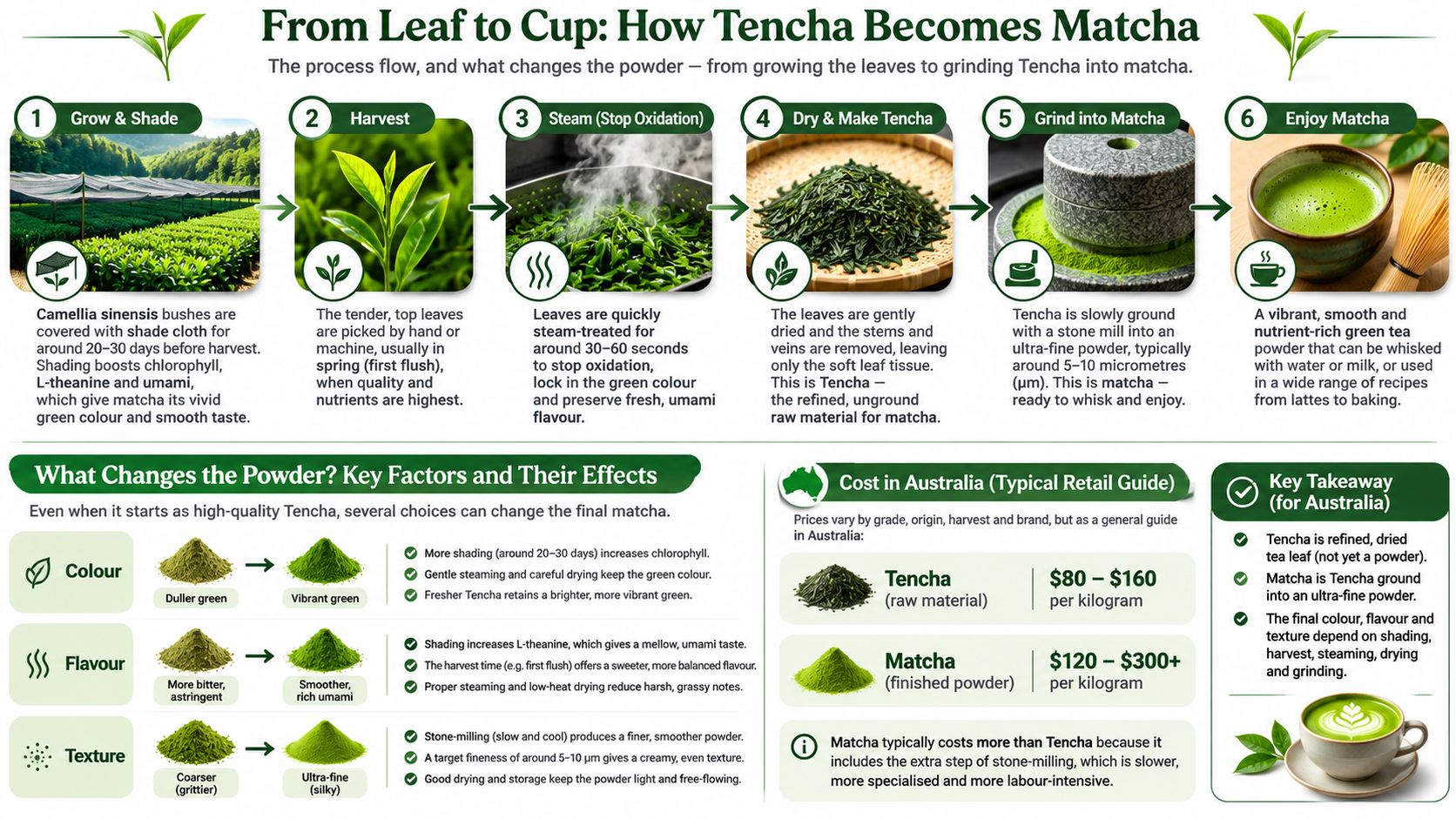
Growing and stabilising the leaf
- Shade the tea bushes before harvest.
Growers cut the light reaching the developing leaves. That stress pushes the plant toward the chemistry and colour people associate with matcha: a deeper green, plus shifts in amino acids and catechins that shape savouriness and bitterness.
A Kanaya field experiment described in a matcha-processing guide compared uncovered Yabukita plants with plants under roughly 75–80% shade and 90–95% shade, covered for about 20 days before the first-flush harvest. Shade-grown is therefore not one uniform treatment; the level of light exclusion varies from field to field. A brief covering does not reproduce a long, heavy one. The flavour potential of the leaf is decided in the field, long before a mill touches it.
- Harvest and steam the leaves promptly.
Steaming stops oxidation and fixes the green character of the leaf before drying.
The risk at this stage is timing. A delay between picking and effective steaming lets the leaf keep changing, and no later step recovers that. Promptness separates well-handled leaf from leaf that has already begun to drift.
- Dry the leaves without rolling them.
Processors cool and dry the steamed leaf in dedicated tencha equipment, keeping it flat rather than kneading it into the shapes used for most other Japanese green teas. The absence of rolling is part of what identifies tencha.
A rolled green tea can still be ground, but grinding alone does not recreate the production chain. Ordinary loose-leaf green tea plus a kitchen grinder is not a route to authentic matcha. Flat drying produces a different intermediate material, and that difference survives into the powder.
Finishing and milling
- Separate stems, veins and tougher material.
Finishing strips out the fibrous portions so the softer tissue can go to the mill. The sorting is functional, since it changes what the mill receives. For a café buyer, the question is whether the material has actually completed finishing; a loose description such as tea leaf for grinding does not say whether stems and veins remain. Grinding everything together leaves more fibre in the cup.
- Mill the prepared leaf into fine powder.
Stone mills are the traditional option, and other milling systems exist. What reaches the drink is fineness, consistency and how readily the powder disperses.
A tencha processing guide gives a stone-milling output estimate of roughly 30–40 grams per hour. That slow throughput explains why milling capacity becomes a constraint once a buyer needs large volumes of finely finished tea. A coarse home grind is not the same product as a controlled fine-milling process.
Buyer's test: Ask what arrives in the bag and what processing remains. A production story is not a substitute for a finished-product specification.
What grinding changes in the cup
Particle size governs how readily the powder disperses and how smooth it feels. Matcha forms a suspension rather than dissolving like sugar, so even well-made powder benefits from sifting and thorough whisking.
A summary of a 2023 stirred-media milling study reports that extending grinding time from 20 to 140 minutes sharply reduced median particle size, and that milling conditions also affected brightness and green hue. The direction of that change is the useful part: longer, controlled milling yields a finer powder that behaves differently in liquid. It is not a specification to shop by.
That distinction helps when troubleshooting. If the powder contains soft clumps that break apart in a sieve, preparation may be the issue. If the drink stays fibrous or gritty after careful mixing, look harder at the product itself.
The guide to Japanese tea powder separates finished powders by intended use. The matcha is milled by a partner business using an advanced method that produces an ultra-fine, clump-free powder, and it is ground in small quantities to maintain freshness.
The recognition test is simple: finished tencha is flat leaf material; matcha is fine powder ready for preparation. Appearance will not settle every quality question, but it stops you mistaking an upstream ingredient for a whisk-ready purchase.
Caffeine and Theanine Per Serve
A compositional review of matcha samples reports approximately 31.6–39.6 mg of caffeine per gram and identifies 200 mg as a single-intake limit, 400 mg per day for healthy adults and 200 mg per day during pregnancy or breastfeeding; the same review associates first-flush material with higher theanine and caffeine than later harvests.
Serving size is the variable you control. Multiply the powder weight by that per-gram range to estimate a cup, rounded to whole milligrams.
Estimated caffeine by matcha serve size
| Powder per serve | Estimated caffeine | How to read it |
|---|---|---|
| 1.5 g | 47–59 mg | A typical latte dose at the lower end |
| 2.0 g | 63–79 mg | A standard whisked serve before recipe dilution |
These are estimates from sample concentrations, not guaranteed values for every pouch. Cultivar, cultivation, harvest and processing all shift composition, so a product-specific caffeine declaration is more useful when one exists.
Dilution doesn't remove caffeine
Adding milk, water or ice lowers the caffeine concentration in each mouthful while the total in the drink stays the same. A larger latte raises caffeine only when the recipe uses more powder. Those figures are reference limits rather than targets, and your own tolerance can sit lower.
Pregnant or breastfeeding people, adolescents, people with anxiety and anyone sensitive to caffeine should treat serving size cautiously. Adult guidance is not a serving allowance for adolescents, and personal medical advice takes priority where relevant.
Theanine can make a drink taste smooth and savoury, while the caffeine dose stays exactly where it was. A gentle cup can still carry a meaningful amount of caffeine.
Use weight rather than a spoon estimate
Ceremonial grade can be comparatively high in caffeine. First-flush leaf pairs a delicate, well-balanced flavour with high theanine and caffeine, so flavour is a poor proxy for dose.
- Weigh the powder: use a digital scale rather than a heaped teaspoon.
- Calculate the range: multiply the powder weight by the caffeine-per-gram range.
- Count the whole day: include coffee, other teas, energy drinks and additional matcha servings.
- Record the recipe: keep the powder dose consistent when you change cup sizes.
Our Japanese green tea caffeine guide compares caffeine across tea formats. A promise of smooth energy does not tell you how much powder is in the bowl.
Which Powder Suits Each Drink, Bake or Menu
The useful question is not “Which powder is best?” It is “What will this powder meet?” A delicate cup with water exposes every rough edge, while milk, sugar, chocolate and flour change the job. Treat the grade as a tool. Ceremonial matcha is for traditional whisked tea, with a delicate, umami-rich, well balanced profile and strong intensity. Culinary matcha is for a stronger flavour in lattes, pancakes and baked treats.
Tencha still matters here, even though you rarely brew it directly. It is the intermediate leaf, the stage before the finished powder. Think of it as the flour before the cake: it shapes what the final ingredient can do, but the recipe decides which version you want on the shelf. Once the leaves are picked, steamed, dried and ground, the powder moves into a role: pure sipping, mixing, baking or sweetened drinks.
Which matcha grade to use for each job
| Use | Best powder | Grade to buy | Why it fits |
|---|---|---|---|
| Traditional whisked tea | Matcha | Ceremonial | Delicate umami and strong intensity for pure sipping |
| Lattes with milk and sugar | Matcha | Culinary | Bold, earthy flavour stands out alongside milk |
| Iced drinks and smoothies | Sweet matcha | Pre-sweetened | Sweet, smooth and mild taste for quick, repeatable drinks |
| Baking and desserts | Matcha | Culinary | Bold, earthy, robust flavour works in baking, blending and recipes |
| Direct drinking from raw leaf | Tencha | Finished leaf for specialist use, not a drinking-powder grade | Generally needs milling to food-grade powder first for matcha-style drinks |
The Japan External Trade Organization's green-tea guide describes the finishing and grinding that turn tencha into matcha. That processing distinction is why adding raw flakes to a blender is not equivalent to choosing a finished culinary powder. Tencha may be the intermediate ingredient, but matcha is the one portioned into the cup.
Three practical buying situations
For a first whisked bowl, choose ceremonial matcha and use approximately 2 g, matching the serving framework above. Sift it, add a small amount of water to make a smooth mixture, then whisk with the remaining water. That method gives the tea room to show its clean, vegetal flavour, natural sweetness and lack of bitterness without milk or sugar covering it.
Our Ceremonial Grade Matcha 60g is sourced from Japan. It provides a small-format option for testing traditional preparation before moving to a larger pouch. Its role is traditional whisked matcha and pure sipping, where balance matters more than a powder built for heavy ingredients.
For cakes and cookies, choose culinary matcha and weigh the amount specified by a tested recipe. For a controlled flavour comparison, divide a plain batter into equal portions and trial 1.5 g and 2 g in matching small batches. Those amounts are experimental, not universal baking ratios.
Keep the flour, fat, sugar and portion sizes unchanged during that test. Premium Culinary Grade Matcha has a bold, earthy, full flavour with medium intensity and is used for baking, blending and recipes. It suits pancakes and baked treats because the tea needs to remain noticeable after other ingredients enter the mixture.
For daily café lattes, begin recipe trials around 1.5–2 g of unsweetened culinary matcha per drink, then assess the result with the actual milk and sweetness you will serve. Weighing the dose makes staff training, flavour checks and ingredient costing more repeatable. A spoon can look consistent while delivering very different amounts.
Premium Sweet Matcha needs a separate recipe because its total weight includes sweetener, not just tea. It is sweet, smooth and mild with no bitterness, and suits lattes, iced matcha and smoothies. Do not substitute it gram for gram and assume the same tea strength or caffeine content. The recipe has changed, so the serving needs its own check.
Choose for what you'll taste
Our ceremonial versus culinary matcha guide explains the intended-use split in more detail. A large sweet latte does not automatically benefit from a ceremonial upgrade, just as a plain whisked bowl leaves little room to hide an unsuitable powder. Buy for the drink or bake in front of you, then keep the dose consistent.
What Tencha and Matcha Cost in Australia
Compare price per gram, not pouch price. Divide the listed price by the net weight, then compare products intended for the same job. A $74.99 pouch and a $329.99 pouch can look far apart until you divide by grams.
Prices are in AUD and cover finished matcha, the milled powder you use, not tencha leaf. Per-gram amounts are rounded to the nearest cent; check the current listing before buying, because prices can change.
Price per gram for matcha sizes
| Product | Size | Price (AUD) |
|---|---|---|
| Ceremonial Grade Matcha | 60 g | $74.99, approximately $1.25/g |
| Ceremonial Grade Matcha | 500 g | $329.99, approximately $0.66/g |
| Ceremonial Grade Matcha | 1 kg | $599.00, approximately $0.60/g |
| Premium Culinary Grade Matcha | 60 g × 3, 180 g total | $175.47, approximately $0.97/g |
| Premium Culinary Grade Matcha | 500 g | $229.99, approximately $0.46/g |
| Premium Sweet Matcha | 200 g | $54.99, approximately $0.27/g |
| Premium Sweet Matcha | 1 kg | $209.99, approximately $0.21/g |
Compare equivalent ingredients
The culinary multipack contains 180 g in total, so that total weight belongs in the calculation. Without a confirmed single-pouch price in this comparison, it's not possible to quantify its saving against buying individual pouches.
Sweetened powder has the lowest listed price per gram, but it's a different formulation. You're buying tea plus sweetener, so its total powder weight isn't directly comparable with the same weight of unsweetened ceremonial matcha.
For a café, the more useful calculation is:
Costing rule: Multiply the powder price per gram by the grams in your finished recipe. Compare drinks customers would actually receive, not bags with different ingredients.
Premium grades also reflect upstream constraints. Too Matcha's sourcing work points to seasonal harvesting and limited Japanese stone-grinding capacity as limits on high-grade supply, plus the importing stage between producer and Australian buyer.
Buy for your rate of use
A larger bag can lower ingredient cost without being the best first purchase. If the flavour doesn't suit your recipe, the lower unit price won't make the unused powder useful.
Start with a small ceremonial pouch for pure drinking, or a small culinary format for recipe testing. Once the flavour and dose are settled, choose a larger format that matches how quickly you'll use it, and keep the package carefully closed between preparations.
Choose the Right Powder for Your Next Brew
For nearly every home or café application, choose a finished matcha and match the grade to the drink or recipe. Tencha is the intermediate leaf material; milling turns it into the powder you whisk. The distinction matters when you are judging a supplier's production claims or sourcing leaf for specialist milling. Ask precise questions about finishing, remaining fibrous material, and the processing still required before use.
Make the choice practical
Ceremonial matcha is delicate, umami-rich and well balanced with strong intensity, suited to traditional whisked preparation and pure sipping. Delicate describes the character you can appreciate without a heavily flavoured base. Sweet matcha is sweet, smooth and mild with no bitterness, intended for lattes, iced matcha and smoothies. It suits anyone who wants a prepared sweetened format with fewer steps.
Use the label guidance from the buying section to confirm you have finished milled powder, then let the drink decide the grade. Ceremonial fits pure sipping and traditional whisking, sweet fits quick iced drinks and lattes, and culinary fits baking and blending. Start with the smallest pouch that lets you test the recipe and settle the dose, then move to a larger format that matches your rate of use. A larger bag lowers the cost per gram only when the flavour and dose already work for you.
TOO MATCHA. offers Japanese ceremonial, culinary and pre-sweetened matcha for pure sipping, recipes and café-style drinks. Visit TOO MATCHA. to choose the format that fits your next brew, then start with a small pouch and scale up once the dose and flavour are settled.