Green Tea in Japanese: Word, Pronunciation and Writing
Green tea in Japanese is ****, read ryokucha (), and the word you'll hear most often in a Japanese café is **** (ocha), which in everyday speech usually means green tea when no other tea has been named. One belongs on the label. The other belongs at the table.
So why do learners who can say "matcha" perfectly still end up with the wrong drink? Because matcha is a product name, not the word for the thing itself. The category word, the one printed on tins, dictionaries and menu headings, is . Until you can read it and say it, you're matching shapes and guessing.
The good news is that the term is short, regular and forgiving. What takes practice isn't volume. It's knowing which of two words to reach for, how to say the r-and-y opening without turning it into two syllables, and what the characters look like on a shelf.
Table of Contents
- The Japanese Word for Green Tea
- How to Pronounce Ryokucha Correctly
- How to Write the Characters for Green Tea
- Choosing Between Ocha and Ryokucha
- Everyday Phrases With Ryokucha
- Mistakes That Make Learners Sound Unnatural
- Reading Green Tea on Japanese Labels and Menus
- Practise and Check Your Word
The Japanese Word for Green Tea
How can you tell the general term for green tea from the names of particular styles? Start with ryokucha (), the precise written term found on packaging, product labels and in dictionaries. Learning its reading alongside its characters helps you recognise the category, rather than mistaking a specific tea for the general word.
| Term | Japanese writing | Reading | Meaning |
|---|---|---|---|
| Green tea (standard term) | ryokucha () | Green tea in general, used on labels and in dictionaries | |
| Tea, usually green in everyday speech | ocha () | Tea; in Japan it often means green tea | |
| Sencha | sencha () | Steamed loose-leaf green tea, the most common style | |
| Matcha | matcha () | Shade-grown green tea ground into fine powder | |
| Genmaicha | genmaicha () | Green tea blended with toasted brown rice | |
| Hojicha | hojicha () | Green tea roasted for a toasty flavour | |
| Gyokuro | gyokuro () | High-grade tea shaded before harvest |
The table puts the category word beside the names you may see for individual teas. This makes it easier to read a label without confusing green tea in general with one particular style.
On packaging, the written form **** is paired with the reading ryokucha. The characters stay the same whether you encounter the term on a menu, a tin or a dictionary page. In English-language study materials, you may see “ryoku-cha” with a hyphen to show the sound parts. Treat that as a reading aid, not as the Japanese spelling to copy onto a shopping list.
Use the table as a small reading exercise: say each name aloud, then match it to its Japanese writing and meaning. Pay particular attention to ****, the written category term, and to the distinct names listed beneath it.
How to Pronounce Ryokucha Correctly
Ryokucha runs on three beats. Japanese counts morae, units of timing rather than English-style syllables, and each one takes the same length of time. Get the beat even and the word lands correctly.
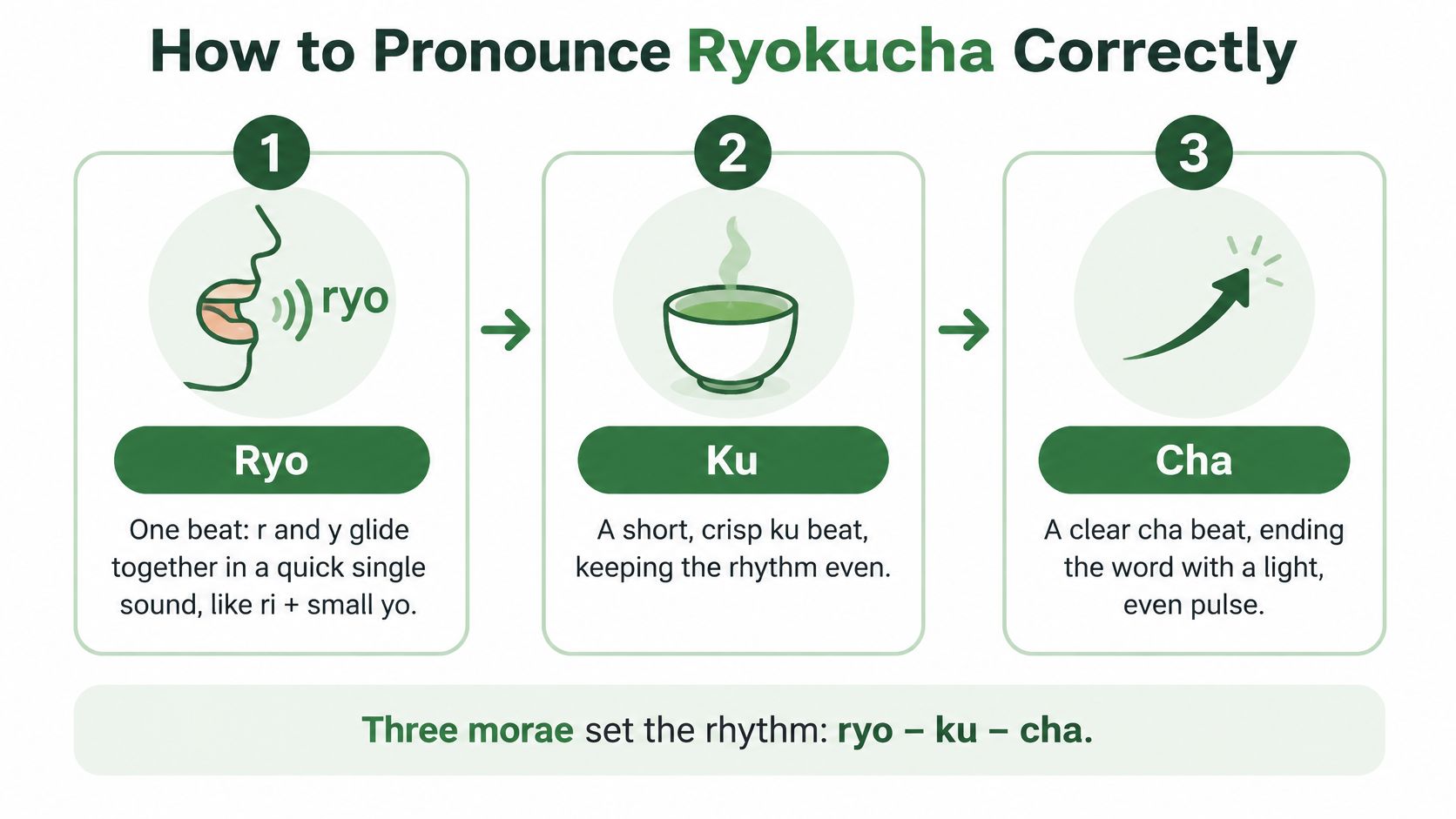
- Ryo (). One unit. It's built from ri plus a small yo, so the r and y glide together into a single quick sound, close to English "ree-oh" said fast with no gap in the middle.
- Ku (). A short, light beat. The vowel is barely voiced, and the word doesn't lean on it.
- Cha (). The English "ch" of "charm" with a short a. Not a long, drawn-out vowel.
The rule that fixes most accents: three even beats with no stress. English speakers naturally hit the first syllable hard, and that single habit makes the word sound foreign even when every sound is right.
Three slips account for most of the damage. Stretching the vowels turns a crisp word into a slow one. Turning cha into "cha-ah" adds a beat that isn't there. And slipping an extra syllable between ku and cha produces "ryoku-cha", four beats where there should be three.
Hearing the word at speed is worth twenty silent repetitions. Listen for the flat, even pulse rather than a melody:
Then check yourself. Say it slowly, then at conversational speed, keeping the same three beats in both. The word is short enough that it's worth practising inside phrases too, since rhythm is easier to hold across a whole sentence than across three isolated sounds.
How to Write the Characters for Green Tea
Two characters, and both are worth writing by hand at least once. Knowing the parts makes them stick far better than copying the shape.
Start with ****, which has 14 strokes. On the left sits the thread radical ****, known in Japanese as (itohen). On the right sits the component ****. Read on its own, is midori, the colour green, which is why it also turns up in (midoriiro) when you need the colour as a noun.
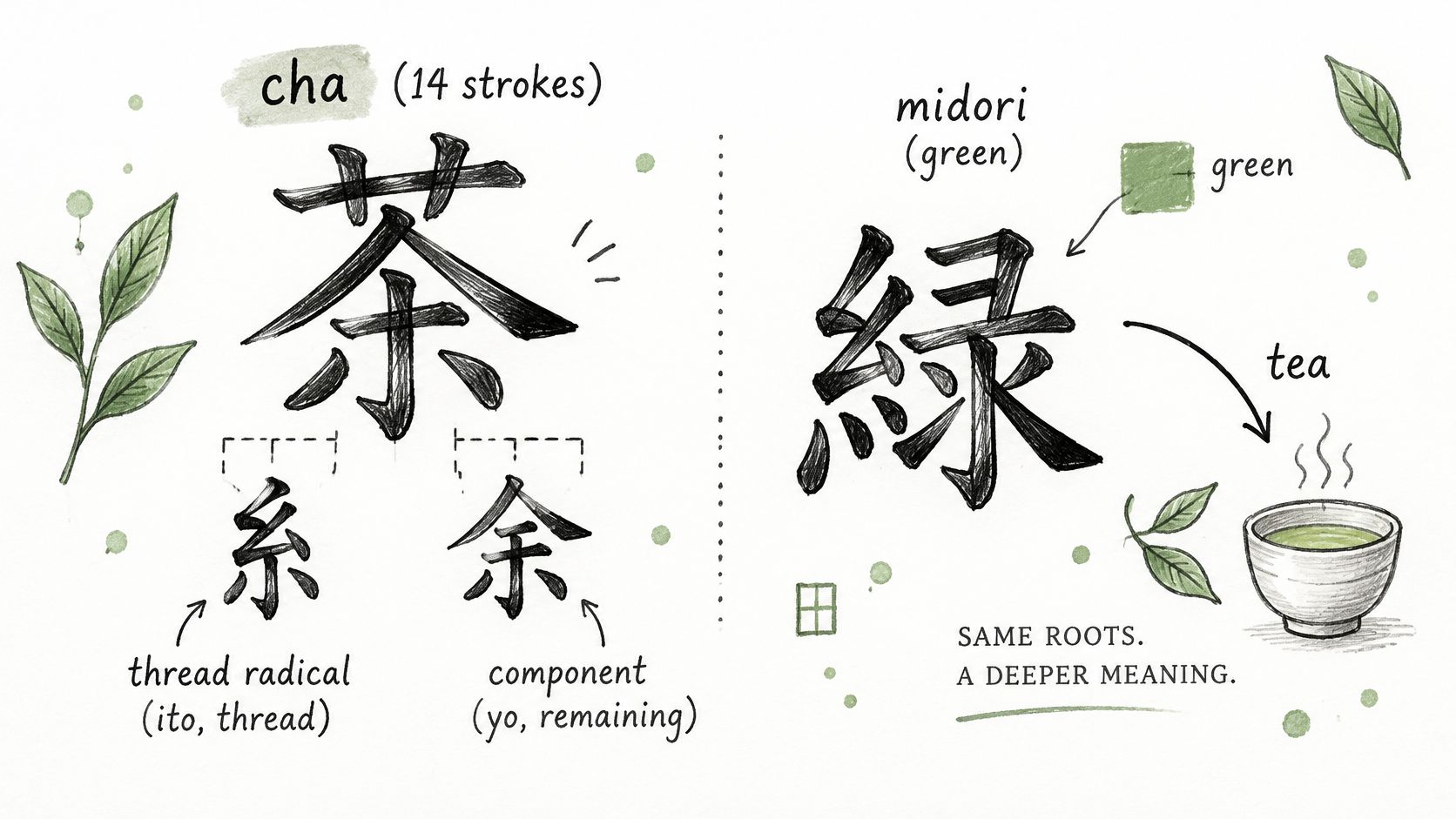
Now ****, which has 9 strokes. The grass radical **** runs across the top, and the lower section is built from **** and **** beneath it.
The stroke order follows the same logic in both characters: top to bottom, left to right. So comes before, and the grass radical comes before anything underneath it.
One warning worth taking seriously. Japanese uses the traditional ****, not the simplified **** you'll see in Chinese text. Copy the Japanese form, even if a font or a search result hands you the other one.
In kana, is five characters, ****. The and the are small kana, written noticeably smaller than the kana beside them. That size difference changes the reading, so it isn't decoration.
A short routine covers it. Write three times, then write underneath, checking that both small kana are reduced. Those stroke counts, 14 and 9, are also what you'd use to look either character up in a paper dictionary.
Choosing Between Ocha and Ryokucha
Which word should you use when ordering tea or reading a menu? Choose ocha for an everyday request, and ryokucha when you need to identify green tea precisely. The difference is useful: ocha is the familiar general word, while ryokucha is the specific written term you may see on labels and menus.
At a café, a meal menu might list ocha. On a tea-shop menu with several varieties, ryokucha points more clearly to green tea. The choice works like using “tea” for the general category and a more precise name when options are listed.
Other tea names show why precision matters. Kōcha means black tea, while mugicha means roasted barley tea. If a shop lists these alongside green tea, naming ryokucha or the particular style you want helps make your order clear.
The test: If a product label or menu names a tea, use ryokucha to identify green tea. For an everyday drink request with a meal, ocha is a natural choice. If you want a specific style, name it.
For example, if a menu offers sencha and matcha, ask for the style rather than relying on a broad tea term. When choosing a product, the same distinction helps: the label's precise name tells you more than the general word for tea. This guide to Japanese green tea explains the main styles by flavour. A pre-sweetened powder is another specific product type, so check its name on the pack rather than treating it as a general tea label.
If you are unsure, say ocha and name the style you want, or point to the menu item. That keeps the request clear without needing a long explanation.
Everyday Phrases With Ryokucha
Japanese sentences about tea are short, and three particles do most of the work.
The three particles that do the work
** (o)** marks the object, the thing you drink or order. ** (ga)** marks what you like or want. ** (wa)** marks the topic when you're asking whether something exists. Swap them and the sentence changes meaning, not just tone.
| Japanese | Romaji | English |
|---|---|---|
| Ryokucha o nomimasu | I drink green tea | |
| Maiasa ryokucha o nomimasu | I drink green tea every morning | |
| Ryokucha ga suki desu | I like green tea | |
| Ryokucha o kudasai | Green tea, please | |
| ? | Ryokucha wa arimasu ka? | Do you have green tea? |
| Ryokucha o irete kudasai | Please make some green tea |
Each row is a model, not a fixed sentence. The first two differ only by (maiasa, every morning), which is how a single action becomes a habit. The question row uses because you're asking whether the item exists, not asking for it to be brought.
To adapt any row, swap ryokucha for another tea name such as sencha or hojicha and keep the structure. The particle pattern doesn't change, which is why learning one sentence properly gives you a dozen.
**** and **** make the phrases polite, which suits shops, cafés and new acquaintances. Casual speech drops them among friends, where the same ideas come out shorter. At a counter, (kudasai) is the phrase you'll use most.
Say each row aloud using the three even beats from earlier, then say one sentence of your own about your tea habit. That's the point where the table stops being a reference and starts being language.
Mistakes That Make Learners Sound Unnatural
The slip that gives learners away fastest isn't pronunciation. It's calling every powdered tea ryokucha.
- Calling matcha ryokucha. If the product is a powder for whisking or for a latte, the word is **** (matcha). is the category, and using it for a specific powder sounds like calling every hot drink "beverage".
- Using ryokucha for the colour. The colour word is midori (), or (midoriiro) when you need it as a noun. names a drink and nothing else, so a green jumper is never ryokucha.
- Swapping the particles. marks the drink you order, marks what you like, and marks the topic in a question about availability. Move them around and the sentence still has the right words in the wrong jobs, which is exactly what makes it sound off rather than wrong.
None of these takes long to fix. Each is a habit rather than a knowledge gap, and the phrase table above gives you the correct patterns to copy until the particles stop feeling like a choice.
Before you speak or write, run a three-part check: name the drink, check the particle, and check that the small kana are reduced in size. Ten seconds, and it catches nearly everything.
Reading Green Tea on Japanese Labels and Menus
A Japanese tea pack reads in a predictable order, and once you know the sequence you can assess a product in about twenty seconds.
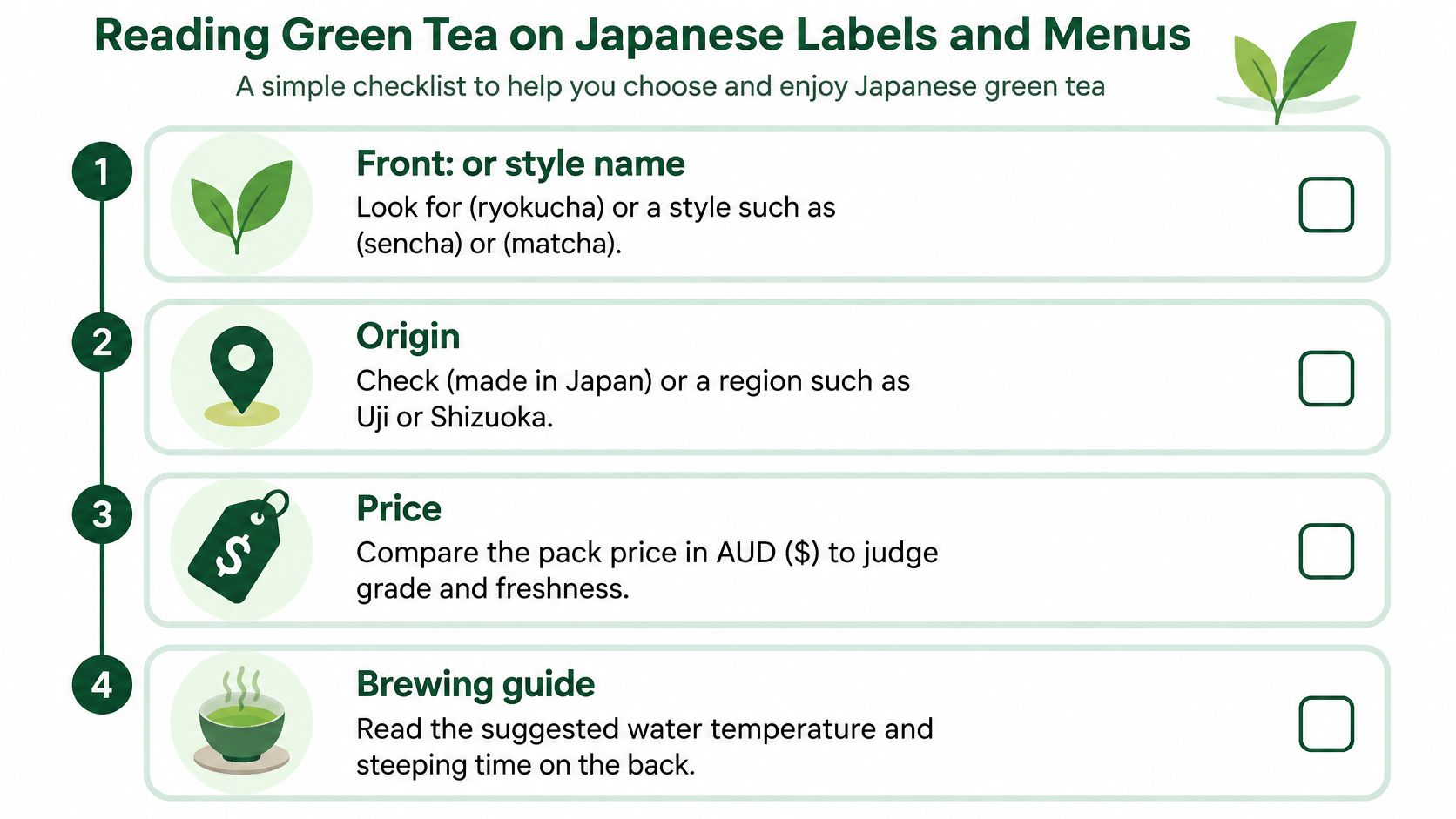
On the pack
- Front, first line: (ryokucha) or a style name such as (sencha) or (matcha). This tells you what you're buying.
- Origin: (made in Japan) or a region such as (Shizuoka). Region names usually signal a graded product.
- Ingredients: (ingredients). For plain tea it should show or alone. Anything else is a blend.
- Net contents:, normally in grams.
- Dates and storage: (best-before date) and (storage instructions), which often tell you to keep the tea away from light and moisture.
- Responsibility: (maker) or (seller).
On the menu
Look for (matcha latte), (chilled tea), (genmaicha) and (pot) for a standard pot to share. Café menus tend to use style names rather than the general term, which makes them easier to read than a supermarket shelf.
The same checks work in a supermarket aisle or on an online listing. Look at the front for the category, then the ingredients for what else went in, since some products add flavourings or sugar and are no longer plain green tea. Matching sencha against matcha side by side is a good exercise, and this comparison of sencha and matcha covers how the two differ in processing and use.
Practise and Check Your Word
Turn ryokucha from a word you recognise into one you can say, write, and use. Start by saying its three even beats, ryo, ku, cha. Keep the vowels short, without stressing the first beat, then use the word in a sentence and repeat it at a natural pace.
Next, write the word from memory. Begin with a blank sheet, then check that the small characters are visibly smaller than their neighbours. Try again without a model, noticing whether you can recall the strokes in the right order.
Now choose a real pack or menu. Use the checklist from the previous section, note the tea term, net contents, and ingredients, and check whether it says ryokucha or names a style. To prepare a cup alongside the exercise, follow this guide to how to make Japanese green tea.
Say the product phrase aloud once more. This links the written word to the way you would say it. TOO MATCHA.’s bulk matcha and hojicha powders are sourced directly from Japan.
For more practice with Japanese tea powders, TOO MATCHA. offers ceremonial matcha for whisking and hojicha for lattes and baking, freshly shipped from Japan. Read the pack as you use the tea to connect the vocabulary with a real product. Visit TOO MATCHA. to browse the range.