
Season in Japan May Guide for Tea and Travel
Most popular advice treats Japan in May as the leftovers of cherry blossom season, a mild month you choose when April doesn't work. That's the wrong starting point. The season in Japan in May isn't a quieter copy of April, and it isn't early summer everywhere either. It's a bridge month where late spring greenery, Golden Week, shifting rain and the first-flush tea harvest overlap, sometimes in the same week and very differently by region.
Table of Contents
- Why May Offers More Than a Second Spring
- Understand Japan's Late-Spring Transition
- Compare May Weather Across Japan
- Plan Around Golden Week and Late-Month Demand
- Experience Golden Week Beyond the Holiday Dates
- Connect May to Japan's First-Flush Tea Calendar
- Choose Matcha Experiences for Your Journey
- Build a Flexible May Itinerary
Why May Offers More Than a Second Spring
Think of May as three calendars running at once. The weather calendar is moving from spring toward warmer, wetter conditions. The holiday calendar concentrates domestic travel in early May, then eases. The tea calendar is at its freshest point in several growing regions, with young leaves being picked while travellers are walking through bright green streets and gardens.
That overlap confuses people because each calendar points to a different decision. A traveller who only checks average temperature might book early May and walk straight into the busiest domestic holiday period. A tea lover who only chases harvest language might assume anything bought in May was picked in May. Neither assumption is safe.
The Question Behind a May Trip
The practical question isn't whether May is good or bad. It's what May is like once the blossoms have passed, in the specific places on your route, on your specific dates. Tokyo, Kyoto and Osaka can feel warm and green, Hokkaido can stay cooler, and southern Japan can feel summer-like earlier. One national label hides those differences.
Australian travellers feel this contrast clearly. You're leaving Australian autumn and landing in Japan's late spring, so your body and your suitcase are set for the wrong season if you pack from habit. Demand shows Australians are working this out anyway. 78,900 Australians visited Japan in May 2025, an 18.7% year-on-year increase, and Australian arrivals reached 507,800 in January to May 2025, up 26.9% year on year, according to Japan National Tourism Organization figures.
May rewards travellers who plan by region and date. It disappoints travellers who expect one mild, dry, quiet month across the whole country.
That doesn't make May difficult. It makes it interesting. You get fresh green scenery without needing blossom forecasts, cultural holidays you can join or deliberately avoid, and a tea season you can taste with some understanding of where leaves are being harvested. If you hold those three ideas together, destination, departure date and rain readiness, the rest of your planning becomes much simpler. Treat May as a single condition and you'll keep making small mistakes. Treat it as a transition and it becomes one of the most flexible months in the Japanese year.
Understand Japan's Late-Spring Transition
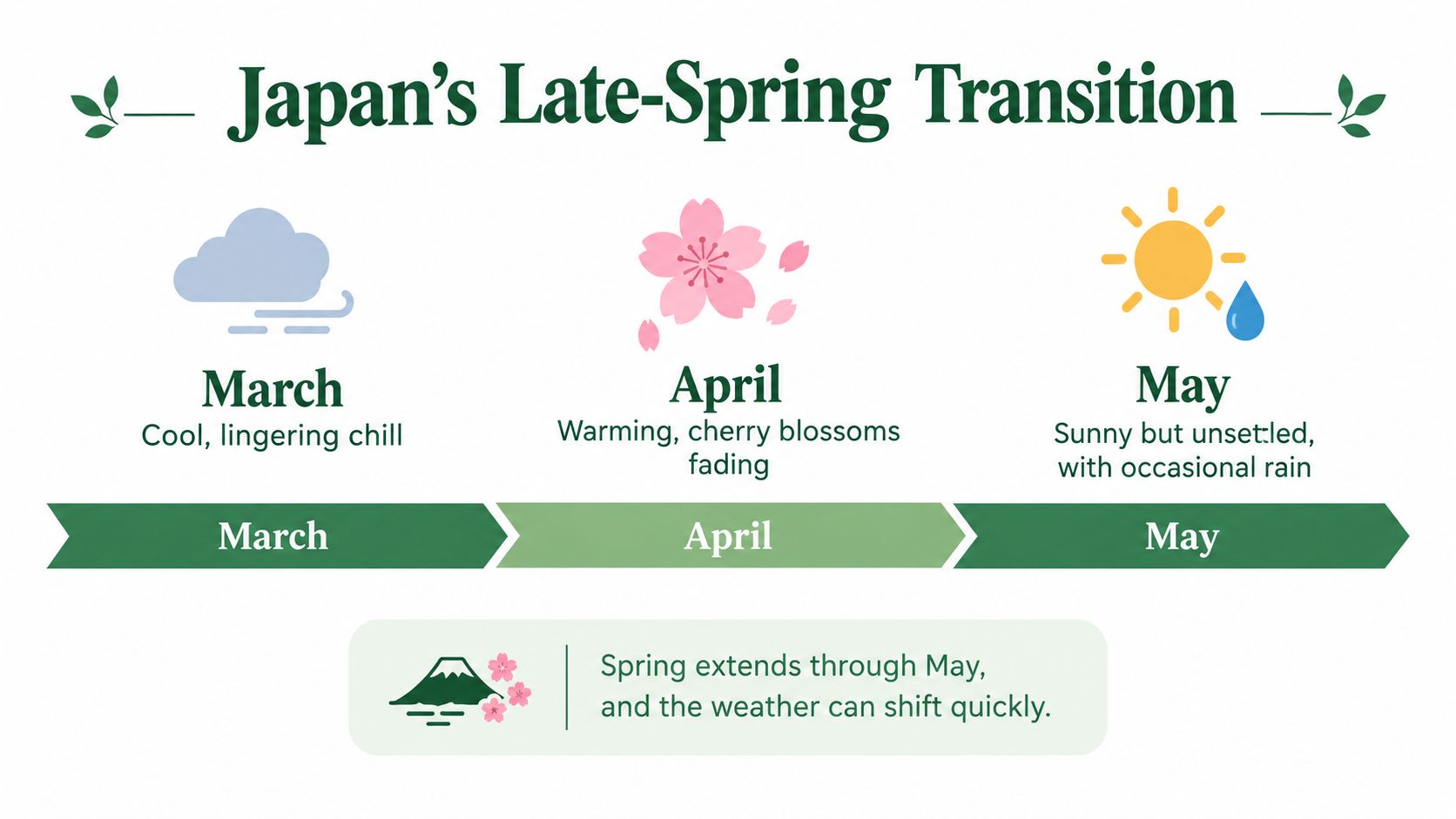
Japan's meteorological spring runs from March through May. That surprises visitors who arrive in late May expecting settled summer warmth. Temperatures generally rise through the season, but the rise isn't smooth, and a warm afternoon doesn't guarantee the next day feels the same.
The Japan Meteorological Agency describes spring as a period of alternating migratory cyclones and anticyclones. In plain language, weather systems keep passing through. Warm southerly air can arrive ahead of a cyclone, then colder northerly air follows behind it, so you can get noticeable short-term swings within a few days. Sunshine duration typically increases in late spring as anticyclonic conditions become more common, which is why May often looks bright in photos even when it feels changeable on the ground.
Spring Weather Is Not the Same as the Rainy Season
A second confusion sits here. People hear that rain increases around May and assume the rainy season has started everywhere. The Baiu rainy season begins much earlier in the southwest, around early May in Okinawa and mid-May in Amami, while much of Honshu remains outside the main rainy season at that point. So a traveller in Naha and a traveller in Kyoto can both be in May and face quite different rain risk.
For central Japan, a sensible default is breathable layers, sun protection for brighter daytime walking, and a light waterproof layer for frontal rain. For Okinawa and Amami, raise your rain readiness and build indoor alternatives into the same days as beach or island plans. Neither approach is complicated once you stop packing for an imaginary national average.
Why Averages Need Careful Reading
Monthly averages describe a pattern, not a promise for Tuesday. A city can average mild conditions and still give you a cool, wet morning followed by a warm afternoon. That's why flexible plans matter more in May than perfect forecasts made weeks ahead.
- Plan outdoor highlights early in a stay: You keep spare days to move them if rain arrives.
- Keep one indoor option per city: A museum, market, tea house or shopping street stops a wet day becoming a lost day.
- Check forecasts by destination: Conditions in your next city may differ from where you're standing.
This is also where tea fits naturally into travel planning. Warmer urban afternoons suit cold whisked matcha and iced lattes, while cooler or rainy intervals make hot indoor service feel right. The weather isn't an obstacle to a tea experience. It helps you choose which kind you want that day.
Compare May Weather Across Japan
Three cities show why a single May forecast misleads. Mishima in Shizuoka, Kanazawa in Hokuriku and Okayama in western Japan are all plausible stops on a spring itinerary, yet their May figures point to different clothing, different walking comfort and different rain planning.
Mishima records an average high of 23°C, an average low of 14°C and approximately 161 mm of precipitation in May, according to Japan National Tourism Organization monthly data. That's mild enough for outdoor sightseeing, with cool starts that justify a layer, but wet enough that you'd be unwise to leave rain protection at the hotel. Rainfall there rises sharply to 228 mm in June, so May sits before the wetter early summer period without being dry.
Three Cities and Three Different Mays
| Destination | Average high | Average low | May precipitation | Planning implication |
|---|---|---|---|---|
| Mishima | 23°C | 14°C | 161 mm | Mild days, cool mornings, carry rain protection |
| Kanazawa | 26°C | 17°C | 87 mm | Warmer walking weather with moderate rain risk |
| Okayama | 28°C | 24°C | 305 mm | Early summer warmth combined with heavy rainfall |
Kanazawa is warmer and considerably drier in these figures, with an average high of 26°C, a low of 17°C and 87 mm of May precipitation. Its rain then climbs to 103 mm in June and 231 mm in July, which makes May look comparatively manageable before wetter midsummer conditions. For a traveller who wants garden walks and older districts without dressing for cool mornings, Kanazawa's profile is attractive, provided you still pack for changeable days.
Okayama challenges the gentle image of May most strongly. It records an average high of 28°C and a low of 24°C, but also about 305 mm of rain for the month, rising to 456 mm in June. That's early summer warmth paired with substantial rainfall, not a dry spring postcard. Light clothing makes sense there, but so does a serious wet weather plan and shoes you don't mind getting damp.
Turning Figures Into Decisions
Read the table as a matching exercise. If you dislike heat, Mishima's cooler range may suit you better than Okayama, even though Mishima is wetter than Kanazawa. If rain frustrates you more than warmth, Kanazawa's lower precipitation matters, while Okayama needs the strongest indoor backups.
Practical rule: Choose the city whose likely discomfort you mind least, then pack for the discomfort that remains.
Every destination still needs the same basics. Carry sun protection, drink water during long walking days, and keep a compact rain layer reachable rather than buried in luggage. May averages help you choose where to go. Daily forecasts, checked close to departure, help you decide what to wear once you're there.
Plan Around Golden Week and Late-Month Demand
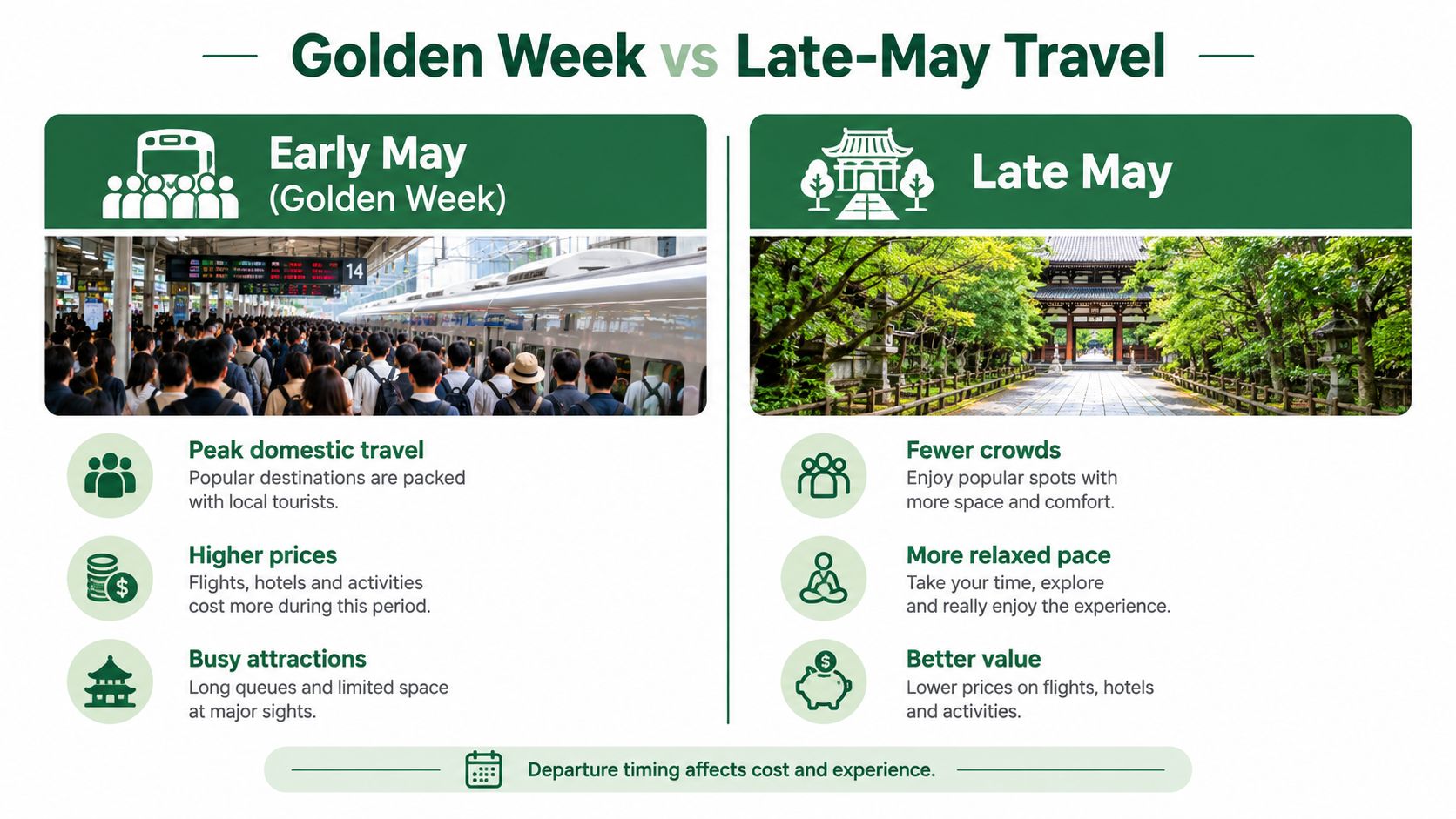
Departure timing changes a May trip more than many travellers expect. Early May contains Golden Week, when domestic travel pressure builds around a cluster of national holidays. Later in May, that concentrated holiday movement has passed, and itineraries usually feel easier to adjust, even though you shouldn't promise yourself empty cities or low prices.
Tourism Australia lists Japan's principal travel periods as January to March, July to September and December, and describes booking activity as occurring approximately one month before travel. That places May outside those listed peak periods in Australia-specific market guidance. The useful reading is nuanced. May is a shoulder-period option overall, but its first days contain a domestic peak that international shoulder season labels can hide.
Choose Early May Deliberately or Not at All
Travelling during Golden Week can be rewarding if you want the holiday atmosphere and family energy. It needs earlier commitment, though. Book key trains and hotels with less assumption that you can change them, allow longer transfers, and avoid stacking several must-do attractions into one crowded day.
If your priority is a calmer pace, later May is the simpler choice. You still get late spring greenery and tea season context, but you remove the sharpest domestic congestion from the equation. For many Australian visitors, that's the sweet spot, especially when the trip is built around walking, gardens, food and regional rail travel rather than one famous sight.
Build Disruption Into the Plan
May also sits inside Japan's official typhoon season, which runs from May to November, although activity is generally greatest from July to September. The distinction matters. May isn't peak typhoon season, but it isn't a month where disruption is impossible, and routine issues such as rain, strong sun and temperature swings are more likely to affect your days.
- Favour flexible bookings: Changeable rail and hotel arrangements help around early May demand and weather shifts.
- Pair outdoor plans with alternatives: Put a market, museum or tea experience on the same day's list.
- Check official alerts while travelling: Local updates beat assumptions made before departure.
- Consider travel insurance carefully: Make sure you understand what weather disruption is and isn't covered.
Australia's Japan market keeps growing, with 1,058,300 Australian visitors in 2025, a record and a 15% increase from 2024, reported by the Japan National Tourism Organization. More interest makes good timing more valuable, not less. Decide first whether Golden Week is part of the experience you want. Then choose regions, and only then lock the details that are hardest to change.
Experience Golden Week Beyond the Holiday Dates
Golden Week is a sequence of national holidays extending from late April into early May. In May itself, the principal dates are Constitution Memorial Day on May 3, Greenery Day on May 4 and Children's Day on May 5. Together they create the concentrated break that shapes early May travel behaviour.
The history explains why the break feels continuous. Japan's National Holiday Law was enacted in 1948, initially establishing holidays on April 29, May 3 and May 5 in this period. A 1985 legal revision made a weekday between two national holidays an additional holiday, effectively creating the continuous break that includes May 4. Greenery Day was later moved from April 29 to May 4 in 2007, while April 29 became Shōwa Day.
What Each Holiday Adds
Constitution Memorial Day commemorates Japan's postwar constitution, which was promulgated in 1946 and came into force on May 3, 1947. Greenery Day reflects appreciation of nature, which fits the fresh green scenery visitors notice at this time of year. Children's Day on May 5 developed from the traditional Boys' Festival and brings a strong family focus to the end of the sequence.
You feel those meanings indirectly as a visitor. Parks and gardens draw families, trains carry people visiting relatives or taking short breaks, and cities feel busy in a domestic, everyday way rather than purely touristic. A traveller who enjoys observing how a country spends its own holidays may find that energy appealing. A traveller who wants quiet temple paths will probably prefer arriving after the break.
Imagine two arrivals in Kyoto. One visitor lands during the holiday cluster, joins crowded station concourses, and needs patience at popular sites, but sees families out enjoying the season. Another arrives later, walks the same streets with less pressure, and can spend an unhurried afternoon learning about the Japanese green tea ceremony and its seasonal setting. Neither trip is wrong. They're different cultural experiences created by dates that look close together on a calendar.
Golden Week isn't only a crowd warning. It's a cultural event you can choose to experience, provided you choose it knowingly.
That's the decision to make before booking. If the holidays themselves interest you, plan for congestion and enjoy the atmosphere. If they don't, slide your dates later and let May's greenery and tea season carry the trip instead.
Connect May to Japan's First-Flush Tea Calendar
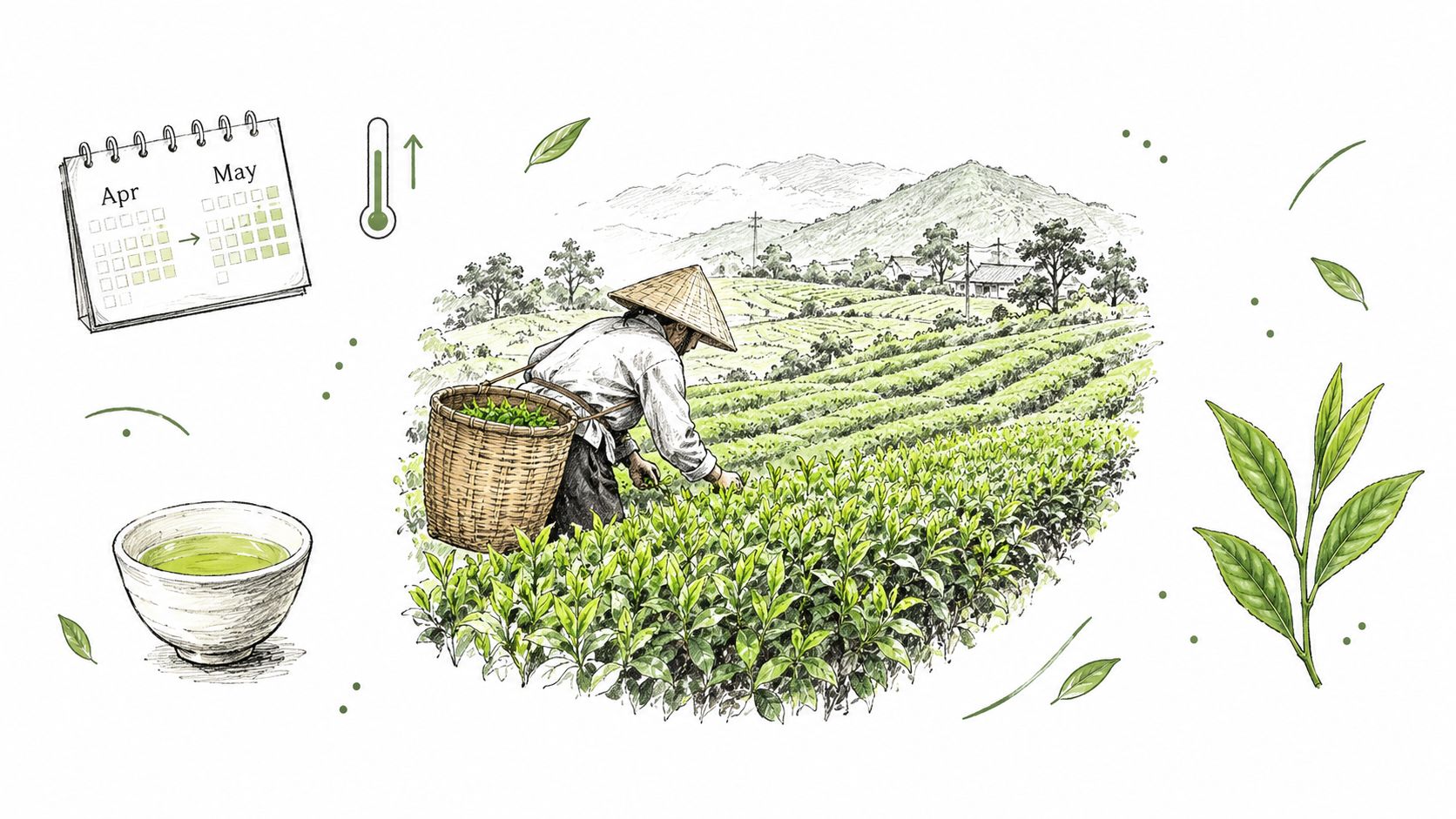
May matters to tea drinkers for a concrete agricultural reason. It overlaps the first flush, or shincha, harvest. A Japanese government publication identifies April to May as the new-tea season, when young leaves are carefully hand-picked for fresh aroma and invigorating sweetness. This isn't a marketing label attached to spring. It's the period when new growth is being harvested in major regions.
The harvest moves geographically as temperatures warm. Warmer Kagoshima generally begins in early April and continues into May. Shizuoka harvests from roughly mid-April through May, and Kyoto's first harvest is concentrated from early to late May. The cause and effect is straightforward. Warmer southern conditions accelerate bud development, while cooler or higher-latitude areas reach harvest later.
Why Shizuoka Sits on Both Maps
Shizuoka contains more than 20 tea-producing areas and about 40% of Japan's tea plantations, according to the same government publication. For a traveller, that makes it more than a name on a packet. A route through central Japan can connect the mild, relatively wet May conditions around Mishima with a living tea setting, and a tasting there carries regional context you can picture later at home.
Kyoto tells a later story. If your trip runs through May, you may be there while its first harvest is concentrated, which pairs naturally with learning how leaf teas differ from powdered teas, including through background reading on sencha green tea loose leaf styles and preparation. Sencha and matcha come from the same broad tea world, but they're processed and prepared differently, so harvest timing is only one part of what ends up in your cup.
The short video below is useful before a tea region visit because it puts preparation into a visual sequence rather than leaving it as written steps.
Seasonal Does Not Automatically Mean Fresh
Here's where readers often get confused. Buying tea in May doesn't prove that tea was harvested in May, and a spring trip doesn't verify the freshness of every product you see. Seasonal relevance and verified freshness are separate questions, and careful sellers should be able to answer both.
- Harvest year: Ask which year's harvest you're buying, not just which season is printed on display material.
- Milling date: For matcha, when the leaves were ground matters alongside when they were picked.
- Origin: A named region lets you connect flavour claims to a real growing area.
- Storage and light protection: Good handling protects aroma and colour after harvest and milling.
Use May as a sourcing and learning checkpoint. Fresh spring character can mean aroma, sweetness and umami potential, but you confirm it through details, tasting and transparent labelling, not through the calendar alone.
Choose Matcha Experiences for Your Journey
Once you understand the season, choosing a matcha experience becomes a practical decision about weather, time and preparation style. A rainy afternoon in central Japan suits a different drink from a warm walking day in western Japan. Neither is more authentic in a simple ranking. They answer different needs.
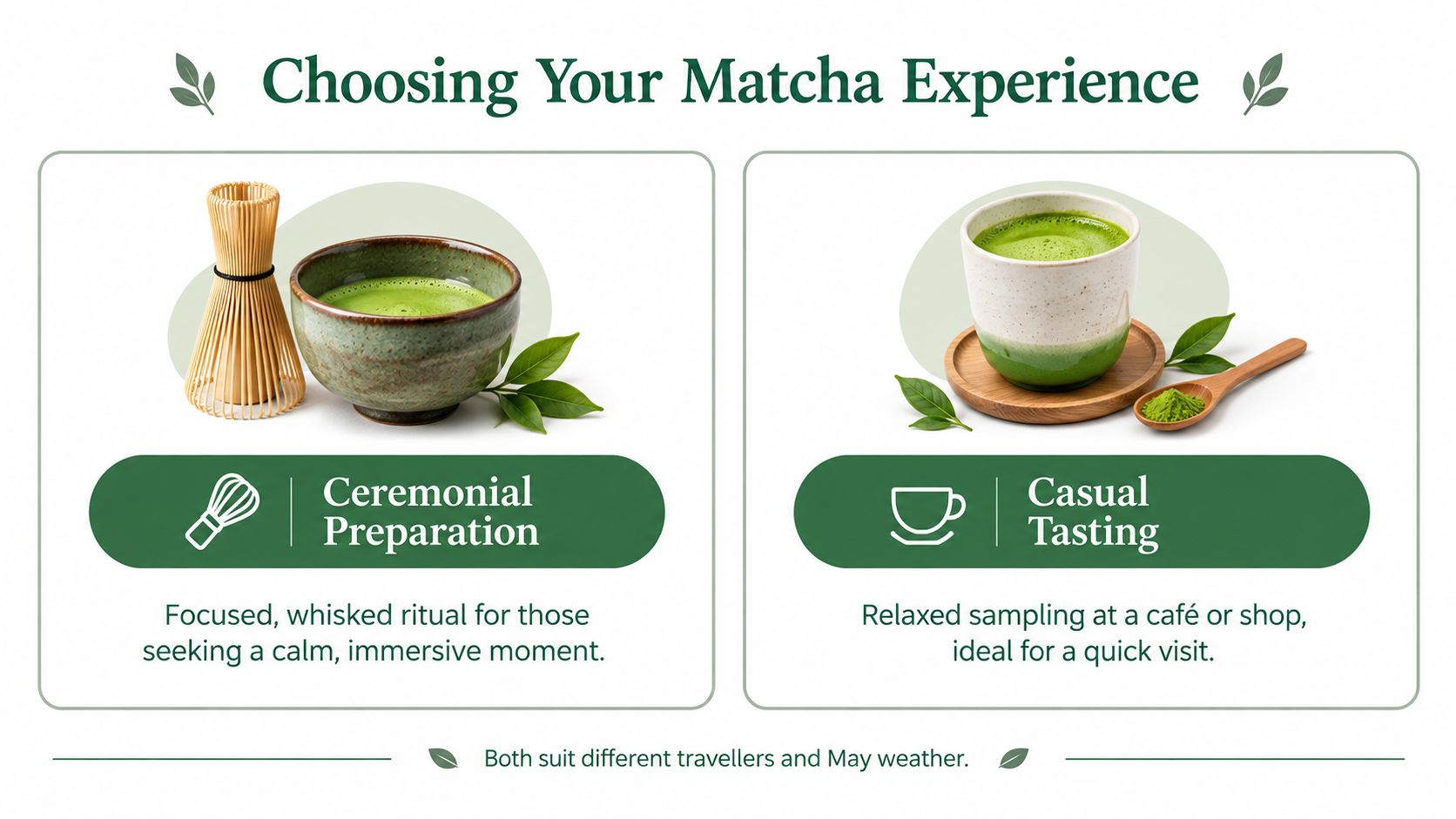
A ceremonial preparation is the focused option. You whisk matcha with water, pay attention to aroma, texture and flavour, and give the drink a few quiet minutes rather than treating it as fuel between sights. That suits an indoor pause on a cooler or wet day, or a traveller who wants traditional preparation to be part of the trip itself. Background on regional identity can deepen that choice, especially if you're comparing what you taste with Uji matcha powder and its Kyoto associations.
Match the Format to the Moment
A culinary-grade drink or recipe serves another purpose. Its more concentrated profile works through milk, ice, baking and blending, so it suits an iced latte after a warm walk or a dessert you make after visiting a tea region. A pre-sweetened option reduces steps and helps keep sweetness consistent, which appeals to beginners or anyone making quick drinks for several people. Convenience isn't a lesser goal. On a busy travel day, it's often the reason a drink happens at all.
These format choices shouldn't be confused with harvest claims. Choosing ceremonial, culinary or sweet matcha tells you how the powder is intended to be used. It doesn't, by itself, tell you when its leaves were picked.
For home preparation after a trip, TOO MATCHA. offers Ceremonial Grade Matcha 60g as one option for whisked preparation. It's sourced from Shizuoka, shade-grown to develop a naturally sweet, smooth flavour profile with rich umami depth and vibrant green colour, and stone-ground to a fine powder. The 60g size suits someone who wants to try the ceremonial experience without a larger commitment, and it's described as vegan, gluten free, dairy free and additive free.
A simple test helps you decide in the moment. If you want to slow down and taste matcha on its own, whisk it hot. If you're warm, thirsty and moving between sights, choose it iced. If you want to cook or share flavours at home, let the recipe choose the grade for you.
Build a Flexible May Itinerary
A strong May itinerary starts with five questions, answered in order. Are you travelling during Golden Week or after it? Which regions match the temperature and rain you enjoy? Which outdoor plans need indoor alternatives? Is tea preparation central to the trip or a pleasant extra? And if freshness matters to you, which sourcing details will you ask for before buying?
Those questions stop small errors compounding. A traveller who hates crowds but books early May has made the trip harder before packing. A traveller who loves warm weather may prefer Okayama's profile, while someone who walks all day may choose Mishima's cooler range and carry better rain gear. There's no universal right answer, only a better match.
Separate Fixed Plans From Movable Ones
Lock the commitments that are hard to change, such as key hotels and major transport during busy dates. Keep daily sightseeing movable where you can. Put one headline outdoor experience into each city early enough that you can swap its day, and hold a tea house, museum or covered market as the natural replacement if rain arrives.
- Dates first: Decide whether Golden Week is an attraction or an obstacle.
- Region second: Use destination figures, not a national average, to set expectations.
- Clothing third: Pack layers, sun protection and a light waterproof shell you can carry daily.
- Tea last: Choose format by preparation and taste, then verify harvest details separately.
Check destination-specific conditions again shortly before departure. May can swing, and a forecast for your actual cities is worth more than general seasonal advice read a month earlier. The same discipline applies to tea. Enjoy the first-flush context, visit regions where harvest timing is part of the scenery, and still ask about harvest year, milling date, origin and storage before treating freshness as proven.
The seasonal verdict is encouraging but conditional. May offers fresh greenery, meaningful national holidays and first-flush tea context in one month, often after the intensity of blossom season. Its best itineraries respect regional differences, time Golden Week deliberately and keep a little room to move when the weather changes its mind.
If May has you thinking about whisking matcha at home, exploring a tea region through flavour, or choosing between ceremonial, culinary and sweet formats for different drinks, TOO MATCHA. brings those Japanese tea powders and preparation guides together in one Australian store. Visit TOO MATCHA. to compare grades, learn the preparation that suits your routine, and choose a matcha you can enjoy long after your May itinerary ends.