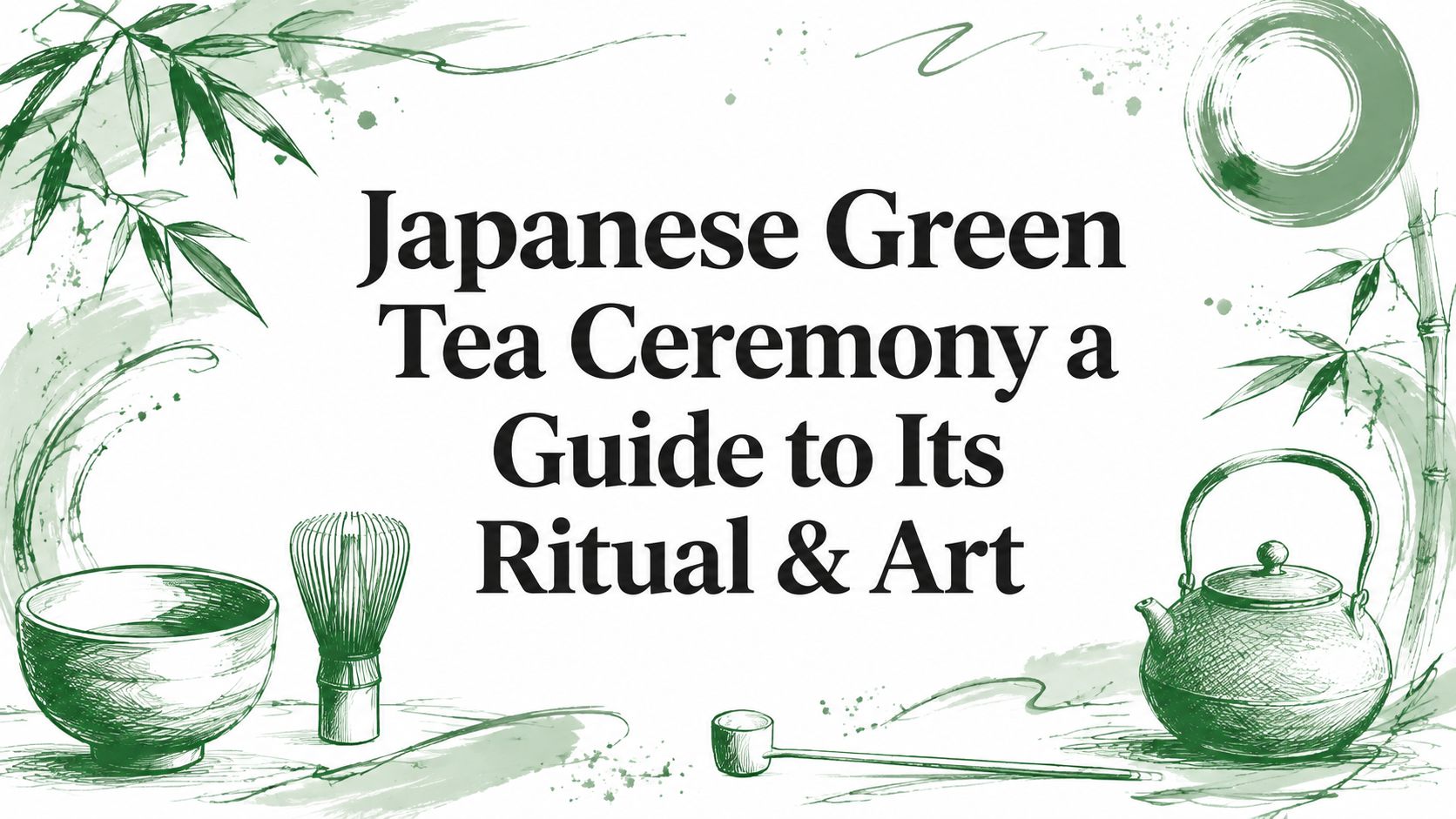
Japanese Green Tea Ceremony a Guide to Its Ritual & Art
You might be standing at a café counter, holding a bright green latte and wondering whether this is the same thing as a Japanese tea ceremony. Or maybe you're planning a trip, looking at tea house experiences, and trying to work out what happens once you sit down. The answer is both simpler and richer than commonly anticipated, because chanoyu is not just tea drinking, it's a disciplined art of hospitality, attention, and restraint.
If you want a quick primer on the drink itself before the ritual, this overview of Japanese green tea is a useful starting point. The ceremony, though, goes far beyond flavour. It turns matcha, tools, gestures, silence, and timing into a single shared experience.
Table of Contents
- An Introduction to the Way of Tea
- The Heart of the Ceremony History and Philosophy
- Essential Tools of the Tea Ceremony
- The Ritual Unfolded Steps of Chanoyu
- Understanding Different Ceremony Styles
- A Guests Guide to Tea Ceremony Etiquette
- Creating Your Own Tea Moment at Home
An Introduction to the Way of Tea
A tea room changes the way people move. Shoes come off. Voices soften. A bowl is turned in both hands before a sip is taken, and the room seems to ask for more attention than a normal café ever does. That feeling is the heart of the Japanese green tea ceremony, where tea becomes a practice of presence rather than a quick drink.
More than tea in a bowl
The ceremony is usually called chanoyu or sadō, and it's best understood as a complete form of hospitality. The host serves tea, but also arranges a sequence of objects and gestures so the guest can step into a quieter pace of mind. The tea itself is matcha, whisked rather than steeped, which already tells you this isn't casual tea drinking.
This is why the ceremony has such a strong pull for travellers. You're not watching performance for its own sake, you're entering a system where preparation, texture, scent, and movement all matter. The room, the bowl, the whisk, the sweets, and the host's posture all work together to create one coherent experience.
Practical rule: if something feels slow or deliberate in a tea gathering, that's the point. The pace isn't there to impress you, it's there to help you notice what's in front of you.
For home enthusiasts, that same spirit still translates. You don't need a formal tearoom to respect the logic of the practice. You need a calm setup, a clean bowl, properly prepared matcha, and enough quiet to let the moment unfold without distraction.
Why the ceremony feels different
Matcha is often first encountered as a latte ingredient, but ceremonial tea is built on a different idea. In formal practice, the tea's texture, colour, aroma, and temperature are not background details, they are the whole point. The ceremony turns those elements into something shared and meaningful.
That's why the tea gathering can feel almost meditative, even if you know nothing about Japanese aesthetics when you arrive. It's not asking you to become an expert. It's asking you to pay attention, receive the tea properly, and recognise the care that went into the bowl in your hands.

The Heart of the Ceremony History and Philosophy
The Japanese tea ceremony has a long documentary history, and that history matters because it explains why the practice still feels so structured today. One of the earliest recorded milestones dates to 815, when Buddhist monk Eichū served tea to Emperor Saga, followed by imperial cultivation of tea plantations in the Kinki region in 816. That early record helps show how tea moved from courtly and religious use into a larger cultural practice over time, before later codification in the medieval period. The historical record of the tea ceremony places those early milestones at the centre of its development.
From early tea to a formal way of life
By the 15th and 16th centuries, tea culture had become more clearly shaped by masters and institutions. Sen no Rikyū is widely credited with formalising the modern form of chanoyu, and the Metropolitan Museum of Art notes that the ceremony as recognised today emerged in the 16th century. Japan Society also describes chanoyu as having been created in the 15th and 16th centuries, with powdered tea reserved for the Japanese tea ceremony. This historical summary from the Japanese government's multilingual tourism material is useful because it ties the ceremonial form directly to its medieval codification.
That timeline matters for Australian readers because ceremonial matcha isn't just a trendy green powder. It comes from a ritual system that was shaped over centuries, and its preparation style still reflects that older lineage. The beverage you see in a bowl today isn't a new invention disguised as tradition, it's a continuation of a documented cultural practice.
Four principles that shape every gesture
The philosophy of the ceremony is usually framed through four ideas, wa, kei, sei, and jaku, which stand for harmony, respect, purity, and tranquility. Senbird Tea's history guide describes these as the core principles of the ritual and links them to the broader development of tea culture in Japan. Its summary of the philosophy of chanoyu is especially helpful because it connects the values to how the gathering feels.
- Harmony, or wa: the room, utensils, season, and guest are meant to belong together.
- Respect, or kei: both host and guest act with care, not casual familiarity.
- Purity, or sei: cleaning the tools becomes part of the mental shift into the ceremony.
- Tranquility, or jaku: calm appears when the earlier principles are in balance.
You can see why this is more than etiquette. The values don't sit in the background, they shape every decision, from the bowl the host chooses to the order in which the tea is served. Even if you only attend once as a traveller, you'll feel the difference between a ritual designed for speed and one designed for presence.
Essential Tools of the Tea Ceremony
The tools in chanoyu aren't decorative extras. Each one exists because matcha is prepared in a particular way, whisked from pulverised or stone-ground tea leaf rather than steeped like ordinary leaf tea. The Japanese government's multilingual tourism text makes that point directly, and it's the reason the whisk, bowl, and scoop are central rather than optional. Its description of chanoyu and matcha preparation shows how closely the utensil order is tied to the drink itself.
The main utensils and what they do
The most recognisable piece is the chawan, the tea bowl. It's not chosen only for appearance, because the shape, weight, and seasonal feel of the bowl change the guest's experience. A bowl in winter might feel different in the hand from one used in warmer months, and that tactile difference is part of the ceremony's atmosphere.
The chasen, or bamboo whisk, is what makes the tea possible. It breaks up the powder and suspends it in water, creating the smooth, cohesive texture that defines ceremonial matcha. Without it, the tea would clump, and the experience would lose the fine foam and body that guests expect in usucha.
The chashaku, a slender bamboo scoop, gives the host a measured way to transfer powder into the bowl. It's a small object, but it changes the rhythm of the ritual because the host handles the tea with care rather than grabbing or pouring casually. The natsume, a small tea caddy, keeps the powder ready for service and often adds a lacquered visual note to the set.
The best utensil sets don't try to modernise the ceremony into something faster. They preserve the physical logic of the tradition, which is why the tools and the method belong together.
A tea kettle, or kama, heats the water and anchors the whole process. The bowl can be beautiful, the whisk can be finely made, but the kettle is the reminder that temperature and timing still govern the tea. If you've ever wondered why ceremonial matcha feels so distinct from a café drink, the answer starts here, in the tools that define the method.
For readers who like seeing the objects together, this guide to Japanese tea sets shows how the bowl, whisk, and scoop work as a coordinated group rather than separate accessories.

The Ritual Unfolded Steps of Chanoyu
A ceremony begins before the tea is poured. Guests enter with a quiet greeting, and the room already feels different because the host has arranged everything to reduce noise, clutter, and haste. Even before the first bowl appears, the gathering is shaped by order.
From arrival to farewell
The sequence is deliberate, but it isn't stiff when done well. Guests are welcomed with a bow, then move through cleansing gestures that signal a transition from the ordinary world into the tea room. The host's role is to make that transition feel smooth enough that it doesn't need explanation once the gathering starts.

Sweets usually come before the tea. That order matters because the sweetness prepares the palate for the intensity of matcha, especially when the tea is made in the thicker style used for more formal service. After that, the host prepares the bowl and serves the tea with the kind of care that makes every movement legible to the guest.
The end of the gathering matters as much as the beginning. Utensils are cleaned, the host acknowledges the guests, and the room returns to stillness. That closing can feel surprisingly moving because the tea has been treated as a shared moment, not a commodity.
The meaning of flow
The ritual works because each action answers the one before it. Guests don't interrupt the host's rhythm, and the host doesn't rush the guest's response. In practice, that means the ceremony rewards patience, observation, and a willingness to let small acts carry weight.
If you're attending one as a visitor, don't worry about memorising every motion in advance. Watch the host, follow the pace of the room, and let the sequence teach you. The ceremony is built so that the structure itself does most of the guiding.
Understanding Different Ceremony Styles
Not every tea gathering carries the same level of formality. A more open, accessible gathering can feel quite different from a full ceremonial occasion, even though both still belong to the same tradition. The main difference lies in how much time, preparation, and tea are involved, and in the balance between koicha and usucha.
Koicha and usucha in practice
In formal Japanese tea ceremony, the host typically prepares koicha first, using about 2–3 scoops of matcha with very little water to create a thick, emulsion-like beverage. Then comes usucha, which uses roughly 1 teaspoon per cup of water and is whisked into a foam. ByFood's guide to the tea ceremony is clear on that split, and it's one of the most practical ways to understand how different levels of formality affect the tea itself.
That distinction helps explain why some gatherings feel solemn and communal, while others feel lighter and more visitor-friendly. In a more formal setting, the thick tea asks the room to slow down and focus on one concentrated bowl. In a lighter service, the tea becomes more approachable, but it still relies on the same logic of care and preparation.
Why the format matters to visitors
Travellers sometimes assume all tea ceremonies are identical, but that's not how the tradition works. Some events are designed to give guests a fuller cultural immersion, while others are easier for first-timers to attend without feeling overwhelmed. The tea being served tells you a lot about the tone of the event before a single word is spoken.
Practical rule: if the tea is thick and concentrated, expect a more formal atmosphere. If it's lighter and frothier, the gathering is usually more accessible and less demanding on the guest.
Understanding these styles helps you choose well. If you want a deep ceremonial experience, you'll recognise the markers of formality more easily. If you're looking for a first encounter, you'll know that a lighter tea service can still carry real cultural weight without requiring prior training.
A Guests Guide to Tea Ceremony Etiquette
The guest's role is simpler than many first-time visitors fear, but it still matters. In a tea ceremony, etiquette isn't about being perfect, it's about showing that you understand the host has prepared something carefully for you. The gestures are small, yet they carry the whole tone of the gathering.
What to do with the bowl and your attention
Authoritative cultural guidance says that guests bow, turn the bowl to avoid drinking from the front, and follow specific receiving and returning gestures. Japan Guide's explanation of tea ceremony etiquette is one of the clearest public references for these actions, and it confirms that the ritual is highly codified. That means the form isn't arbitrary, it's a set of shared behaviours that help the ceremony run smoothly.
The bowl rotation is especially important because it shows respect for the bowl's front, which is usually treated as the most visually significant side. By turning it before drinking, the guest avoids placing lips directly on that face. It's a quiet sign that the object matters and that the host chose it with intention.
How to behave without overthinking it
You don't need to speak much. In fact, silence often fits the room better than a stream of questions. Watch what the host does, accept the tea with both hands when appropriate, and respond with the kind of calm attentiveness that tells the host you're present.
- Bowing gently: acknowledge the host's effort before and after receiving tea.
- Turning the bowl: rotate it so you don't drink from the front.
- Receiving sweets respectfully: take them when offered, since they're part of the order of the gathering.
- Returning the bowl carefully: place it back the way you were shown, without haste.
That's enough for a newcomer to participate well. The ceremony doesn't ask you to perform knowledge, it asks you to behave with care. If you do that, you're already meeting the spirit of the practice.
Creating Your Own Tea Moment at Home
A quiet tea moment does not require a formal tearoom. A kitchen bench can hold the same spirit if you approach it with care, attention, and a little patience. For travellers who want to carry the experience home, and for home enthusiasts who want a respectful starting point, the aim is to borrow the ceremony's values and let them shape an ordinary pause in the day.
Start with the right basics
The tea itself sets the tone. Ceremonial matcha should whisk into a smooth bowl and stand on its own, without milk or sugar hiding its character. A proper bowl and a chasen help you create the frothy texture that gives the practice its recognisable form.
Small details shape the whole mood. Clear the bench, set your phone aside, and leave enough time to whisk without hurrying. Those simple choices change the drink from something you finish into something you attend to.
Practical rule: do not aim for perfection on the first try. Aim for a clean bowl, fresh powder, steady whisking, and one calm sip taken with attention.
Temperature matters too. Tea-culture guidance notes that high-quality Japanese teas are generally brewed below 80°C, with premium varieties often around 50–60°C to avoid harshness and keep sweetness and umami more visible. Mizuba Tea's explanation of tea ceremony temperature and whisking supports that lower-temperature approach, and it is especially useful when you are making matcha at home. Hotter water can flatten the aroma and sharpen the bitterness, while cooler water helps the tea feel rounder and more balanced.
Make the ritual fit your life
A home version works best as a sequence you can repeat calmly. Warm the bowl, measure the powder with care, add water at a sensible temperature, then whisk until the tea looks alive in the bowl. That order keeps the experience connected to chanoyu even if the setting is a small apartment kitchen rather than a formal tea room.
The value of the practice shows up in ordinary moments. A busy morning can still hold a short tea pause if you choose to slow down for one bowl. A weekend afternoon can become a small ritual if you prepare the tea in silence and drink it without trying to do three other things at once.
For a step-by-step guide, see how to make ceremonial matcha at home. It gives newcomers a practical way to bridge formal tradition with everyday preparation, so the ceremony can be understood, adapted, and enjoyed without losing its calm centre.
The oldest lesson of the ceremony still applies at home. A bowl of matcha becomes more than a drink when you treat it as an act of care, not convenience.
If you want to bring that spirit into your own routine, explore the full range of tea powders, starter tools, and preparation ideas at TOO MATCHA.. Their matcha-focused range offers a practical way to support the calm side of this tradition at home, whether you are learning the basics or refining an existing tea ritual.