Matcha Tea Powder Australia: Grades, Prices and Sourcing
Japan exported 195,319 kilograms of green tea to Australia between January and August 2025, a 131% increase on the same period a year earlier, according to SBS News. That figure covers green tea beyond matcha, but it highlights the import-dependent supply behind many Australian matcha products. For buyers, the practical question isn't just where to find matcha tea powder in Australia. It's which grade and pack size will taste right for your usual drink and stay fresh long enough to be good value.
A low price per gram can look appealing, especially on a large pouch. But the true cost depends on what you're making, how much you use and how quickly you'll finish the powder. Choose the grade first, then work out the pack size that fits your routine.
Table of Contents
- Matcha Grades at a Glance for Australian Buyers
- How Matcha Is Made and Why Grade Depends on It
- Matching Grade to Use Without Overpaying
- Japan Versus Local Imports and How to Read the Label
- Keeping Matcha Fresh After It Arrives in Australia
- Matcha Cost per Gram and When Bulk Actually Pays
- How Much Caffeine Is in Matcha Powder
- Matcha FAQs for Australian Buyers
- Choose Your Grade, Pack and Seller Before You Buy
Matcha Grades at a Glance for Australian Buyers
Three tins can look almost identical on a shelf, yet the powder inside can make a whisked drink taste smooth and sweet or bitter and flat. Grade labels help, but they don't work like a universal certification: sellers don't all use one official grading scale, so check the stated use and the powder's colour rather than relying on the word “ceremonial” alone.
Australia's matcha market generated more than AUD 54 million in 2024 and was forecast to exceed AUD 81 million by 2030, with approximately 7.1% annual growth, according to SBS News reporting based on industry data. The growing choice can make shopping easier, but it also makes it useful to know what each product is intended to do.
| Grade | Colour and flavour | Best uses | Common formats |
|---|---|---|---|
| Ceremonial | Vivid green, smooth, sweet-umami, low bitterness | Whisked drinks and sipping straight | 60g, 500g, 1kg |
| Culinary | Bold, earthy, robust, medium intensity | Baking, blending, lattes and smoothies | 60g, 500g, 1kg |
| Sweet, pre-sweetened | Sweet, smooth, mild, no bitterness | Quick lattes, iced matcha and smoothies | 200g, 500g, 1kg |
| Hojicha, roasted and not matcha | Toasty and nutty | Beverages and desserts | 60g, 500g, 1kg |
A quick label-reading test
Start with the drink you make most often. For a plain, whisked bowl, look for a vivid green colour and a smooth, low-bitterness profile. For a latte, smoothie or bake, a bolder culinary powder can make more sense because milk and other ingredients share the stage with the tea.
Sweet matcha is a different convenience option: it comes pre-sweetened, so you don't need to measure sugar separately. Hojicha belongs on the comparison table because it's a roasted green-tea powder used in similar ways, but it isn't matcha.
Give a product page half a minute. Check the colour in the photo, read the intended use, and ask whether that description matches the drink you plan to make. If the label doesn't tell you how to use the powder, don't treat the grade name as a substitute for useful product details.
How Matcha Is Made and Why Grade Depends on It
Matcha is closer to first-press olive oil than to the bulk oil in a fryer: it comes from the same plant as ordinary green tea, but the way growers handle the leaves changes the final product. That journey starts in the field and continues through processing and milling.
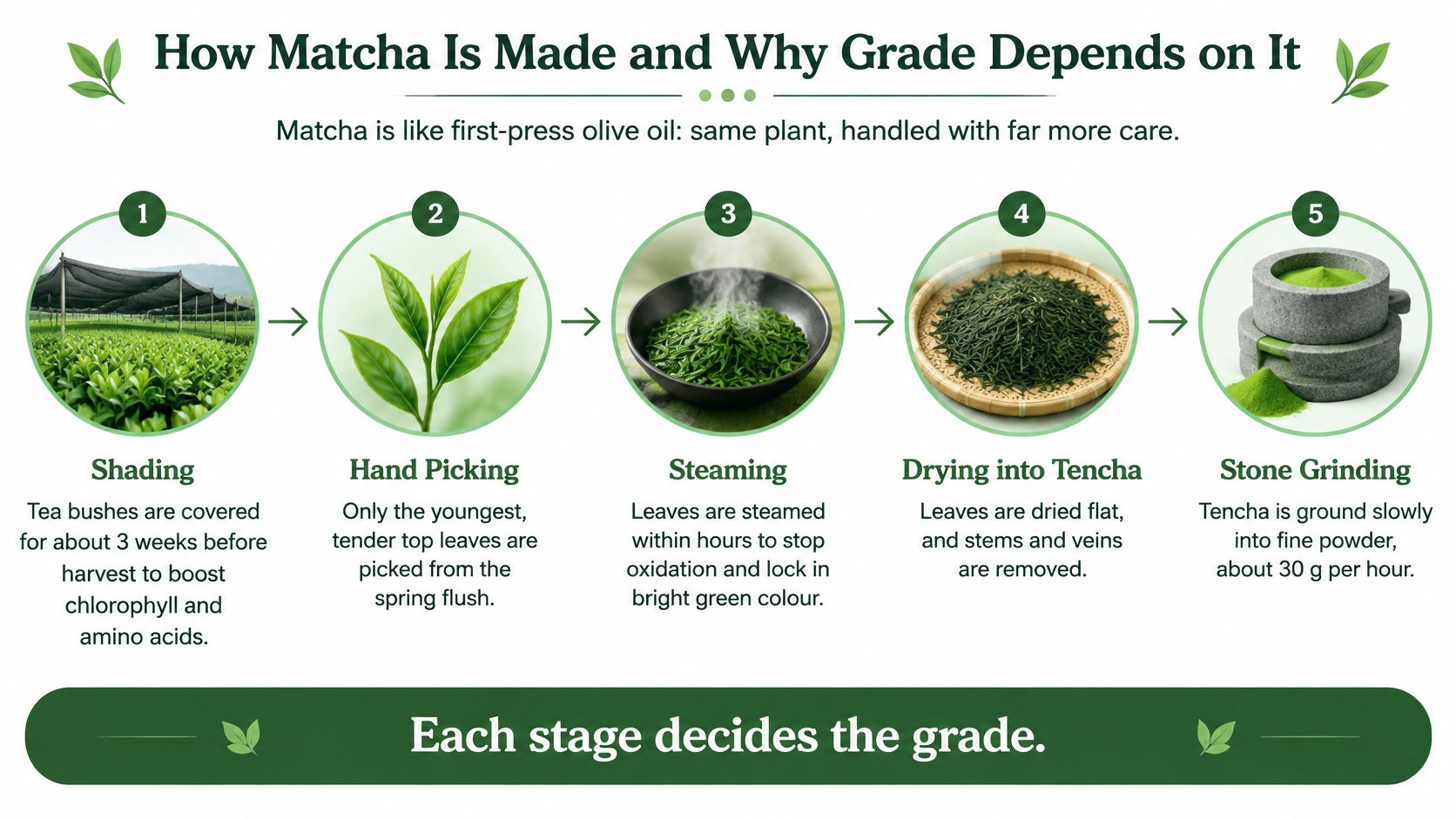
- Shade the bushes. Growers cover tea bushes for roughly three to four weeks before harvest. Shading helps develop a deeper green colour and changes the balance of compounds in the leaf. A cheaper product may use leaves grown with less shading, so look for a clear description of growing practice if it matters to you.
- Pick young leaves. The youngest top leaves are tender and sit higher on the usual quality ladder than later-season growth. If a seller says when or where the tea was harvested, that gives you more to assess than a grade label on its own.
- Steam promptly. Steaming stops oxidation and helps preserve the leaves' green character. It's a key step in producing Japanese green tea, including the tea processed into matcha.
- Dry into tencha. The steamed leaves are dried flat and processed to remove stems and veins. More coarse stem material can affect the texture and flavour of a powder, so ingredient and production details are useful clues.
- Mill slowly. The dried tencha is stone-ground into fine powder. Faster grinding can generate more heat and produce a coarser result, while careful milling helps retain a fine texture and fresh aroma.
Follow the trail on the label
Matcha's grade isn't decided by one word or one stage. Leaf selection, processing, colour, aroma and harvest all contribute to the finished powder. When a label gives you details such as origin, harvest information and milling method, you can make a more informed judgement about whether the product suits your intended use.
For a close look at the production journey, this video about matcha making offers a visual companion to the stages above. Treat it as context, then return to the product label: the more of the leaf's journey a seller can trace, the easier it is to judge what you're buying.
Matching Grade to Use Without Overpaying
Buy ceremonial for what you taste on its own, and culinary for what you mix into something.
Ceremonial works like a singer performing a cappella: every subtle note stays exposed, for better or worse. Culinary is more like a voice inside a band, sitting beneath milk, fruit, flour or sugar. Culinary grade is built for a different job, not a lesser one.
Four everyday buying decisions
- A whisked morning bowl: Choose ceremonial if you'll drink it plain. With no milk or sweetener to soften the flavour, bitterness and sweetness are easy to notice.
- A milky latte with honey: Culinary is usually the practical choice. Milk mellows the tea, and honey adds another strong flavour, so you may not taste the finer distinctions you paid extra for.
- Banana bread or brownies: Use culinary. Its bold, earthy flavour holds up in baking and blending, where a delicate powder's subtleties would disappear anyway.
- Iced drinks for guests: Consider sweet grade if you want a consistent, quick drink. It is blended to taste smooth and mild with no bitterness, so there is no sugar to measure for each glass.
Australian hospitality suppliers reported price increases of 15–20% across ceremonial and culinary grades during 2025, according to SBS Food's reporting on the global matcha shortage. That makes sensible substitutions worth more for buyers who use matcha regularly. A home drinker making a couple of milk-based drinks each week may not get much benefit from paying ceremonial prices. A café serving many lattes can use culinary for those drinks and reserve a smaller amount of ceremonial powder for a whisked menu item.
The same logic helps when choosing your first pack. The Ceremonial Grade Matcha 60g costs $74.99 AUD and is freshly shipped from Japan. At this size, stepping up from Premium Culinary Grade Matcha 60g at $64.99 adds ten dollars, so a smaller pack is a low-risk way to find out whether you enjoy ceremonial matcha plain before committing to a larger format.
Use this substitution test: if the drink is mixed, try stepping down a grade first; if it is plain, match the powder to the taste you want. Grade, pack size and how quickly you will use the powder together decide your real cost per serve. The best choice is the grade that does its job in your cup or recipe.
Japan Versus Local Imports and How to Read the Label
Origin matters because many Australian matcha products depend on imported tea. Australia's matcha import trend increased 62.91% from 2023 to 2024, according to 6Wresearch's Australia matcha tea market analysis. That trend makes it worth checking what a label establishes, rather than treating Japanese-style packaging or a seller's description as proof of origin.
Five useful label checks
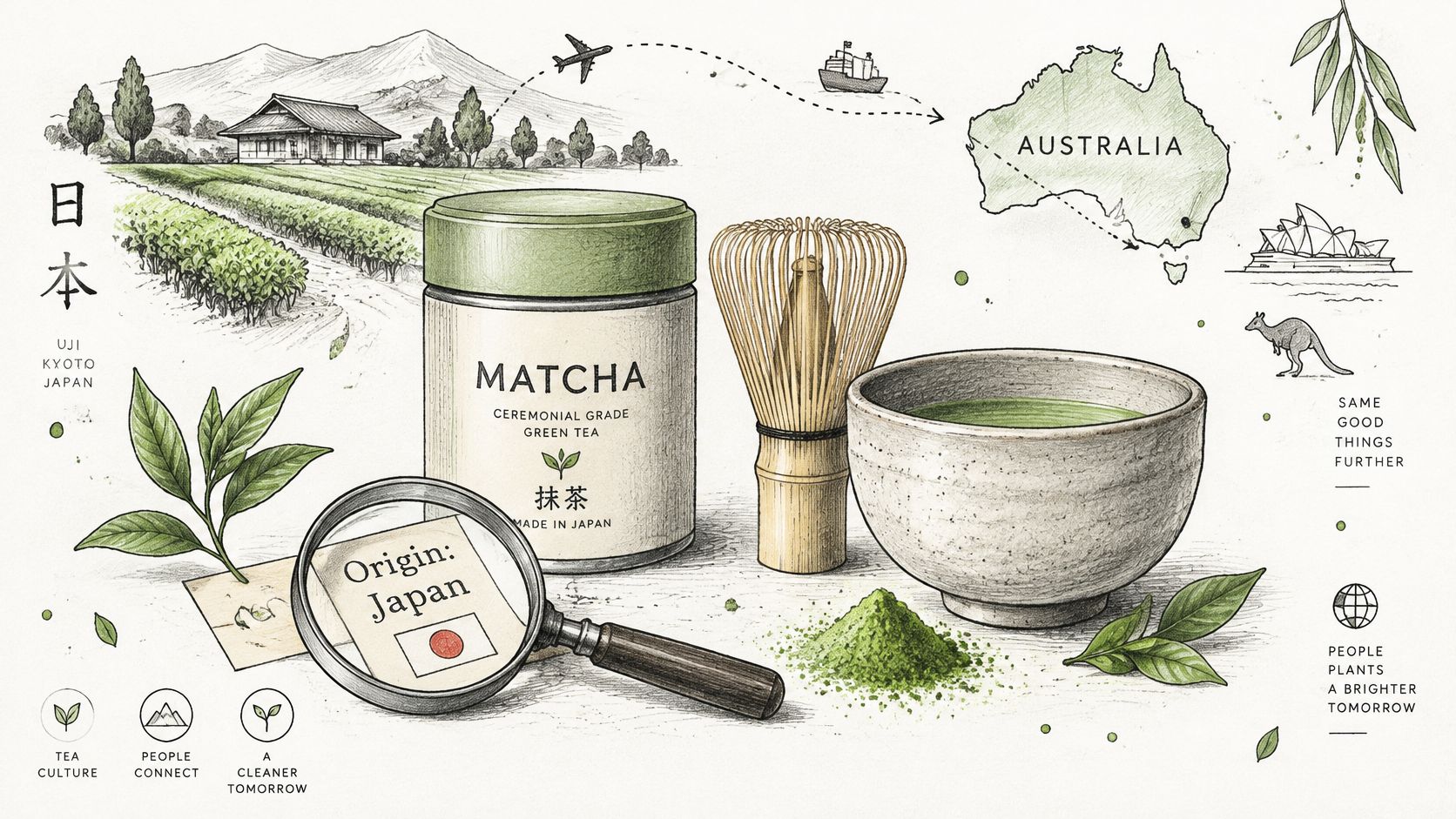
- Country of origin: Look for wording such as “Product of Japan”. A growing region, such as Shizuoka or Uji, offers more detail about where the tea comes from.
- Ingredients: Pure matcha should list green tea only. A sweetened mix or a hojicha blend should list its additional ingredients.
- Harvest or lot information: A harvest or lot date can help you assess freshness and trace a batch if you need to ask the seller a question.
- Packaging: Check that the pack is airtight and resealable. Powder exposed to air and moisture can lose the colour and aroma you're paying for.
- Supplier details: Ask who supplied the Japanese tea and what documentation supports its identity and origin.
An Australian brand can buy Japanese powder and repack it locally without that automatically making the tea poor quality. What matters is whether the route back to the Japanese producer is clear and whether the brand can substantiate its claims.
Pure tea and blended products aren't the same case
The Australian Department of Agriculture, Fisheries and Forestry's plant-product import guidance says importers should check BICON for the commodity and exporting country, then meet any conditions that apply. Pure green tea made from Camellia sinensis is classed as minimal biosecurity risk and generally doesn't require an import permit or mandatory inspection on arrival. Blends containing other botanical ingredients can fall under different requirements, which is why sellers should keep documentation for pure tea separate from paperwork for mixed products.
Origin is a claim about where the leaf was grown and milled; the ingredient list and documents are the proof.
Keeping Matcha Fresh After It Arrives in Australia
Light, heat, moisture and air are the four enemies of matcha. Exposure can make vivid green powder fade towards olive or yellow, while the fresh aroma becomes flat and hay-like. Storage time is a guide to best quality, not a reason to ignore how the powder looks and smells.
| Condition | Storage method | Best-quality window | Warning sign |
|---|---|---|---|
| Unopened, sealed pouch | Cool, dark cupboard | Until the best-before date | Light or heat exposure before opening |
| Opened, airtight tin | Room temperature, away from light | About 1 month for best colour and aroma | Greying or yellowing, flat smell |
| Opened, airtight tin | Refrigerator, wrapped | Up to 2 to 3 months | Condensation when opened cold |
| Opened, airtight tin | Freezer, thawed fully sealed | Up to about 6 months | Clumping after repeated thawing |
A careful storage routine
- Keep the powder in its original pouch if it seals well, or move it to a clean, airtight tin.
- Press out excess air before sealing the pouch.
- Store it in a cool, dark place away from the stove, windows and other heat sources.
- If you refrigerate it, wrap the container well and let it reach room temperature before opening. Opening it while cold can invite condensation.
- Use a dry spoon. Water inside the container encourages clumping and can affect the powder.
For a large pouch, split the powder into smaller working tins so you open only one container at a time. Keep the rest sealed rather than repeatedly exposing the whole supply to air. The retailer's guide to storing matcha powder offers another practical reference for protecting powder after opening.
Before using an older pack, check three things: the colour in the bowl, the aroma when the lid comes off and the taste in a drink with milk. A slightly softer flavour may still suit a latte, but a dull appearance and flat smell are signs that the powder has lost some of what made it appealing.
Matcha Cost per Gram and When Bulk Actually Pays
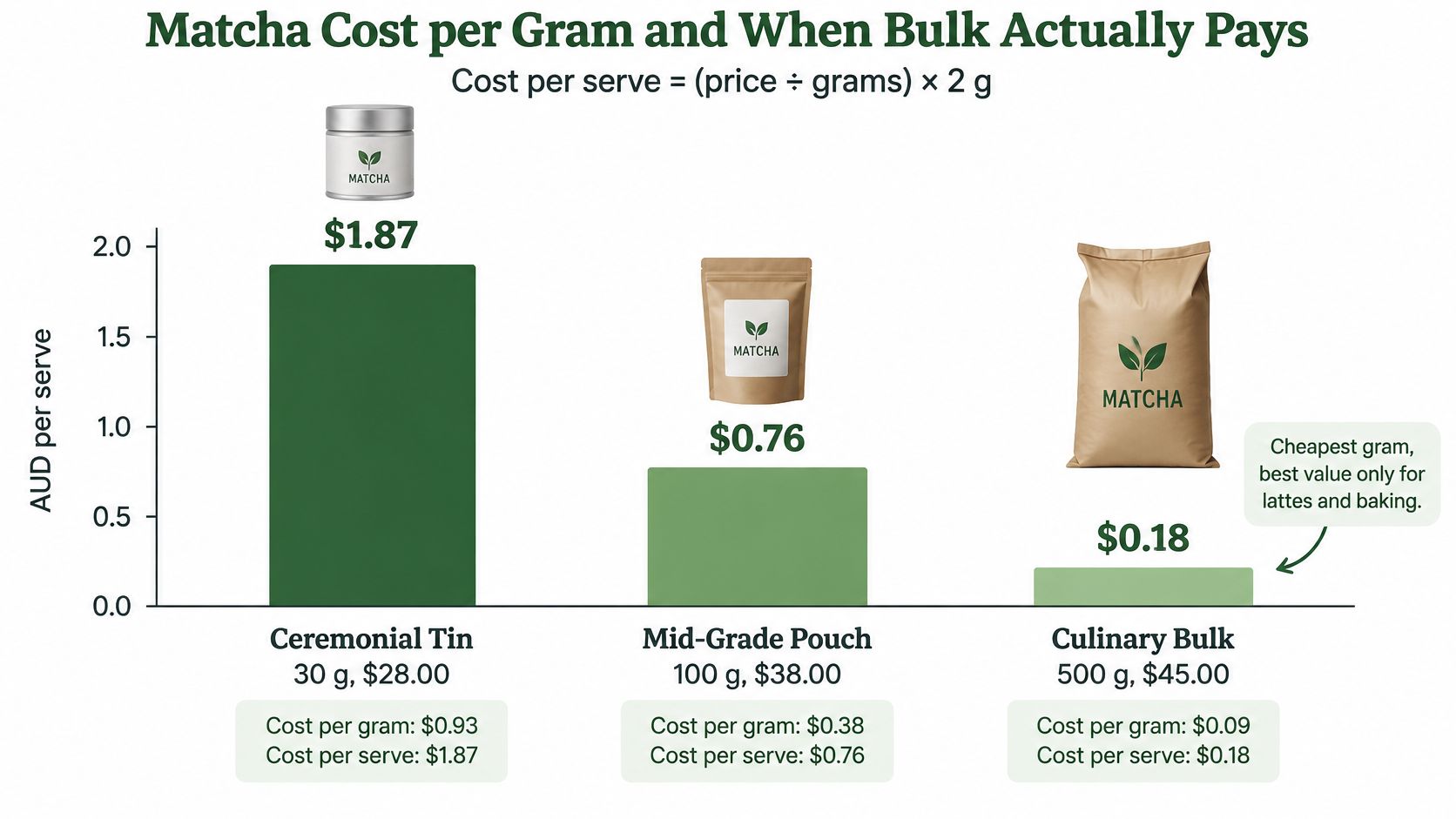
Is the cheapest gram the best value? Only when the pouch is emptied while the powder still has its colour and aroma. To compare packs fairly, divide the price by the grams to get a cost per gram, then multiply that figure by the grams you use in one serve.
A ceremonial 60g pack works out to A$74.99 ÷ 60 g ≈ A$1.25 per gram. At a guideline of about 2 g per whisked serve, that is roughly A$2.50 per serve. The same grade in the 1 kg format is A$599 ÷ 1,000 g ≈ A$0.60 per gram, or about A$1.20 per serve. On paper the larger pack halves the serve cost; in practice it pays only if the kilogram is finished while it still tastes good.
| Grade and pack | Price (AUD) | Grams |
|---|---|---|
| Ceremonial 60g | $74.99 | 60 g |
| Ceremonial 60g 3-pack | $215.97 | 180 g |
| Ceremonial 500g | $329.99 | 500 g |
| Ceremonial 1kg | $599.00 | 1,000 g |
| Culinary 60g | $64.99 | 60 g |
| Culinary 60g 3-pack | $175.47 | 180 g |
| Culinary 500g | $229.99 | 500 g |
| Culinary 1kg | $429.99 | 1,000 g |
| Sweet 200g | $54.99 | 200 g |
| Sweet 200g 3-pack | $148.47 | 600 g |
| Sweet 500g | $109.99 | 500 g |
| Sweet 1kg | $209.99 | 1,000 g |
These are example prices recorded from one Australian specialist retailer. Prices change, so check the current listing before buying. The arithmetic makes the pack-to-pack comparison possible, but it does not account for delivery charges, how much of the powder you will use, or how long the pack will sit open.
Choose the pack for your actual pace
Run the same division on the biggest formats and the catch becomes clear. A culinary 1 kg pouch is A$429.99 ÷ 1,000 g ≈ A$0.43 per gram, about A$0.86 per 2 g serve, but at 2 g a day that kilogram is roughly 500 serves, well over a year for a single household. Even the 500g culinary pouch, at A$229.99 ÷ 500 g ≈ A$0.46 per gram, yields about 250 serves at that pace, around eight months of supply. The lower per-gram price turns into real savings only when monthly use is high enough to finish the pack while it is still lively; otherwise the cheaper gram buys powder that fades before it is drunk.
- Light drinker: At one or two serves a week, a 60g or 200g pack is far easier to finish than a bulk format bought on price alone.
- Daily drinker: At 2 g a day, a 60g pack gives about 30 serves, close to a month. A 500g pack gives about 250 serves, so step up only when your pace clearly justifies it.
- Café with steady sales: A 500g or 1 kg format can suit predictable throughput. Open one working pack at a time and keep the remainder sealed.
For wholesale planning, fold delivery and expected wastage into the sums rather than comparing sticker prices alone. The retailer's guide to wholesale tea in Australia helps business buyers weigh supply format against per-gram cost.
Copy this calculation into a note: grams per serve × serves per month, then divide pack grams by that result to get months of supply. When the answer stretches well beyond the time an opened pack stays at its best, the cheapest gram becomes the more expensive choice in practice.
How Much Caffeine Is in Matcha Powder
Because you drink the leaf itself as a powder, your caffeine dose rises and falls with the grams you stir in. Doubling a 2 g serve to 4 g roughly doubles the caffeine, which is why a teaspoon isn't a reliable measure for every powder or preparation. Weigh the serving if you want to track your intake. The same scale that controls your caffeine also tells you your true cost per cup, so gram-accurate serves matter for both.
Australian rules distinguish ordinary tea from concentrated caffeine products. The FSANZ guidance on caffeine powders and high-caffeine-content foods says foods containing 5% or more caffeine in solid or semi-solid form, including powders, are banned from retail sale to the public, but naturally caffeinated tea is excluded. Matcha is powdered tea, not pure caffeine powder.
For context, FSANZ's supporting material on formulated caffeinated beverages sets a maximum of 320 mg of caffeine per litre for those products. That limit doesn't apply to ordinary tea or matcha powder. The amount of powder in your recipe is the variable you control.
What to check before serving
- Serving mass: Weigh the powder in grams rather than spoons. A level teaspoon and a heaped one hold noticeably different amounts, and gram-for-gram is the only honest comparison between products.
- Measured or estimated: Check whether a caffeine figure is lab-tested for a stated serving or a general estimate.
- Healthy adults: In its consumer guidance on caffeine powders and high-caffeine-content foods, FSANZ states that acute caffeine intake of up to 200 mg isn't associated with safety concerns for healthy adults. That doesn't mean every matcha serve contains the same amount.
- Children: The same FSANZ guidance reports increased anxiety in children at intakes of about 3 mg per kg of body weight per day, which works out to about 60 mg for a child weighing 20 kg.
- Pregnancy, caffeine sensitivity or stimulant medication: There isn't one number here that suits everyone. Ask a GP or pharmacist for advice relevant to your situation.
For a closer look at how caffeine varies across teas, see this guide to Japanese green tea and caffeine. Natural doesn't mean caffeine-free or suitable for everyone, and "calm energy" slogans can't tell you how much caffeine is in your own cup. Choose a format based on how many grams you plan to drink, and check the figures for the product you buy rather than assuming a fixed number.
Matcha FAQs for Australian Buyers
Is a 1kg pack worth it for a home drinker?
The per-gram saving is real. Whether you capture it depends on your pace. Premium Culinary Grade Matcha 1kg is $429.99, about 43 cents a gram, against $64.99 for 60g, about $1.08 a gram. At 2 g a day, a kilo delivers roughly 500 serves, well beyond the window where opened powder stays at its best. Bulk pays when your household or baking volume can finish it fresh.
Can I use ceremonial matcha for baking?
You can, but the case for it is weak. Premium Culinary Grade Matcha is made for baking, blending and recipes: bold, earthy, medium intensity. Heat and sugar flatten the subtleties ceremonial buyers pay more for, so keep ceremonial for the bowl and bake with culinary.
Is sweetened matcha still matcha?
Premium Sweet Matcha blends 30% authentic Japanese green tea leaves with a balanced touch of sweetness. The result is sweet, smooth and mild with no bitterness, and it suits lattes, iced matcha and smoothies. Prefer to control sweetness yourself? Start with an unsweetened powder.
How do I measure a 2 g serve without scales?
Weigh once, then count. Measure how much your usual scoop or teaspoon holds, work out how many level scoops reach 2 g, and count scoops from then on. Scoop sizes differ between brands, so the number is yours to learn once rather than a figure to guess every morning.
Why does my matcha clump, and how do I fix it?
Even powder milled to an ultra-fine, clump-free consistency benefits from sifting through a small strainer. Then whisk a splash of water into a smooth paste before adding the rest. The paste step, not whisking speed, does most of the work.
Is a matcha subscription worth it?
Only if your pace matches the delivery rhythm. Premium Sweet Matcha 200g can arrive every 2 or 4 weeks at 5% off, $52.24 per delivery. At 2 g a day, 200 g lasts about 14 weeks, so scheduled deliveries would stack up faster than you drink. Daily latte drinkers using bigger serves are the better fit.
Choose Your Grade, Pack and Seller Before You Buy
Most disappointing matcha purchases trace back to a decision made in the wrong order. Fix your main use first, then let it dictate the grade, the pack size and the seller. The cheapest gram is not automatically the best value: a low-priced powder you cannot verify, or a large pouch that fades before you finish it, costs more per good serve than a pricier pack you actually enjoy.
| Seller type | What you typically get | Freshness and shipping check | Best for |
|---|---|---|---|
| Specialist online matcha retailer | Grade-labelled ranges in several sizes, with origin and use stated | Check dispatch date, resealable packaging and stated origin | Regular drinkers and home bakers |
| Japanese grocer or tea shop | Imported Japanese brands, often in smaller sizes | Check best-before date and import labelling | Buyers who want Japanese brands |
| Supermarket or general grocer | Mostly culinary or blended powders | Many supermarket tins do not show a harvest date, so check colour and best-before date in store | Occasional bakers and first-time buyers |
| Café or foodservice wholesale | Bulk 500g to 1kg packs in pouches | Ask for batch details and storage advice | Cafés, restaurants and offices |
| Online marketplace | Widest price range, mixed sellers | Verify origin and reviews; mislabelling risk is higher | Price-conscious buyers able to verify claims |
No channel is automatically the safest. Each row pairs a seller type with the gap most likely to catch you out, so read the check column as the price of shopping there.
Six checks before you place an order
- Name your main use. Whisked drinks, milk-based drinks, baking, iced drinks and mixed recipes each point to a different grade and pack, so settle this before looking at prices.
- Match the grade to that use. The grade-to-use comparison above settles the choice. Apply its result here before you compare sellers.
- Estimate monthly use. Run the serves-per-week calculation from the cost section so the pack size decision rests on a real figure.
- Pick a realistic pack size. Choose the smallest pack you can finish inside its freshness window, unless your regular use makes a larger format practical.
- Verify origin and ingredients. The label checks from the Japan-versus-imports section apply to every seller in the table, supermarkets included.
- Calculate landed cost. Add shipping to the sticker price, then divide by grams. A small pack with a delivery charge can cost more per gram than a larger pouch collected locally or shipped free.
The arithmetic is easiest to see in multipacks. A Premium Sweet Matcha 200g 3-pack is listed at A$148.47, while three single 200g packs at A$54.99 each would total A$164.97, a difference of A$16.50 for identical powder. A subscription to the same 200g pack can be set for delivery every two or four weeks at 5% off, or A$52.24 per delivery. Bundles and repeat schedules only pay off when each delivery is finished inside its freshness window. A discounted pack that goes stale is the most expensive gram in the cupboard.
Skip products with no stated origin, dull or yellowish powder, a price far below what the grade would lead you to expect, or a seller who will not identify the supplier. For a first purchase, a 60g ceremonial or culinary tin matched to your main use is enough. Drink it for about two weeks, then move up to a 500g pouch once you know you like the flavour and can finish it in good condition.
Compare grades, pack sizes and Japanese tea powders at TOO MATCHA., with options for home preparation, baking and foodservice. Choose a small pack that fits your usual drink first, then scale up only when your routine and freshness window make the larger format worthwhile.