L Theanine for Focus How It Works and How to Use It

You're halfway through a report, lecture, or study session when the coffee that was meant to help starts working against you. Your eyes are open, but your thoughts feel hurried. Small sounds become distracting, your attention jumps between tabs, and the focus you wanted has turned into nervous energy.
L-theanine for focus offers a different idea. Rather than pushing the brain harder, it may help reduce the stress-related interference that makes attention difficult. The result isn't supposed to feel like sedation. It's closer to turning down background noise so the important signal is easier to follow.
Table of Contents
- Introduction to Calm Focus and Why It Matters
- What L-Theanine Is and Where It Comes From
- How L-Theanine Supports Focus and Works With Caffeine
- What Human Studies Show About Attention and Clarity
- How to Use L-Theanine for Focus Safely and Effectively
- Food Sources of L-Theanine and Why Matcha Stands Out
- Your Next Steps for Steadier More Reliable Focus
Introduction to Calm Focus and Why It Matters
Calm focus is easy to recognise once you've experienced it. You can read a page without repeatedly returning to the same paragraph. You can work through a spreadsheet without checking your phone every few minutes. You remain alert, but you don't feel as though your mind is racing ahead of you.
That distinction matters because stimulation and attention aren't identical. Caffeine can make you feel more awake, yet wakefulness alone doesn't guarantee organised thinking. If stress, restlessness, or mental clutter is competing for attention, adding more stimulation may make the experience less comfortable.
L-theanine has attracted interest because it appears to fit the gap between relaxation and alertness. Human research has examined it in stressful conditions, attention tasks, working-memory tests, and combinations with caffeine. The findings don't support a magical productivity switch, but they do suggest a practical possibility: some people may focus better when their nervous system is less reactive.
A useful way to think about it: caffeine can raise the volume of the signal, while L-theanine may help reduce some of the noise around it.
This guide keeps the idea grounded. You'll learn what L-theanine is, why tea naturally combines it with caffeine, what human studies have measured, and how Australian research and regulation affect the way you interpret products. You'll also see why a tea-based serving and a supplement capsule aren't automatically equivalent.
The most suitable use case is usually a defined period of demanding work, study, reading, or creative concentration. It's less convincing as an all-day stimulant replacement, and it shouldn't compensate for poor sleep, excessive caffeine, or an untreated health issue.
What L-Theanine Is and Where It Comes From
If coffee helps you start a demanding task but leaves your thoughts feeling scattered, tea offers a different combination of compounds. L-theanine is a naturally occurring amino acid found in tea leaves. Unlike amino acids used to assemble proteins, it acts as a specialised tea compound that may influence how the brain and nervous system respond to stimulation.
Tea plants produce many compounds, yet L-theanine is especially associated with green tea and matcha. Shade cultivation can increase theanine content, which helps explain why growing conditions and processing methods matter when comparing tea products.
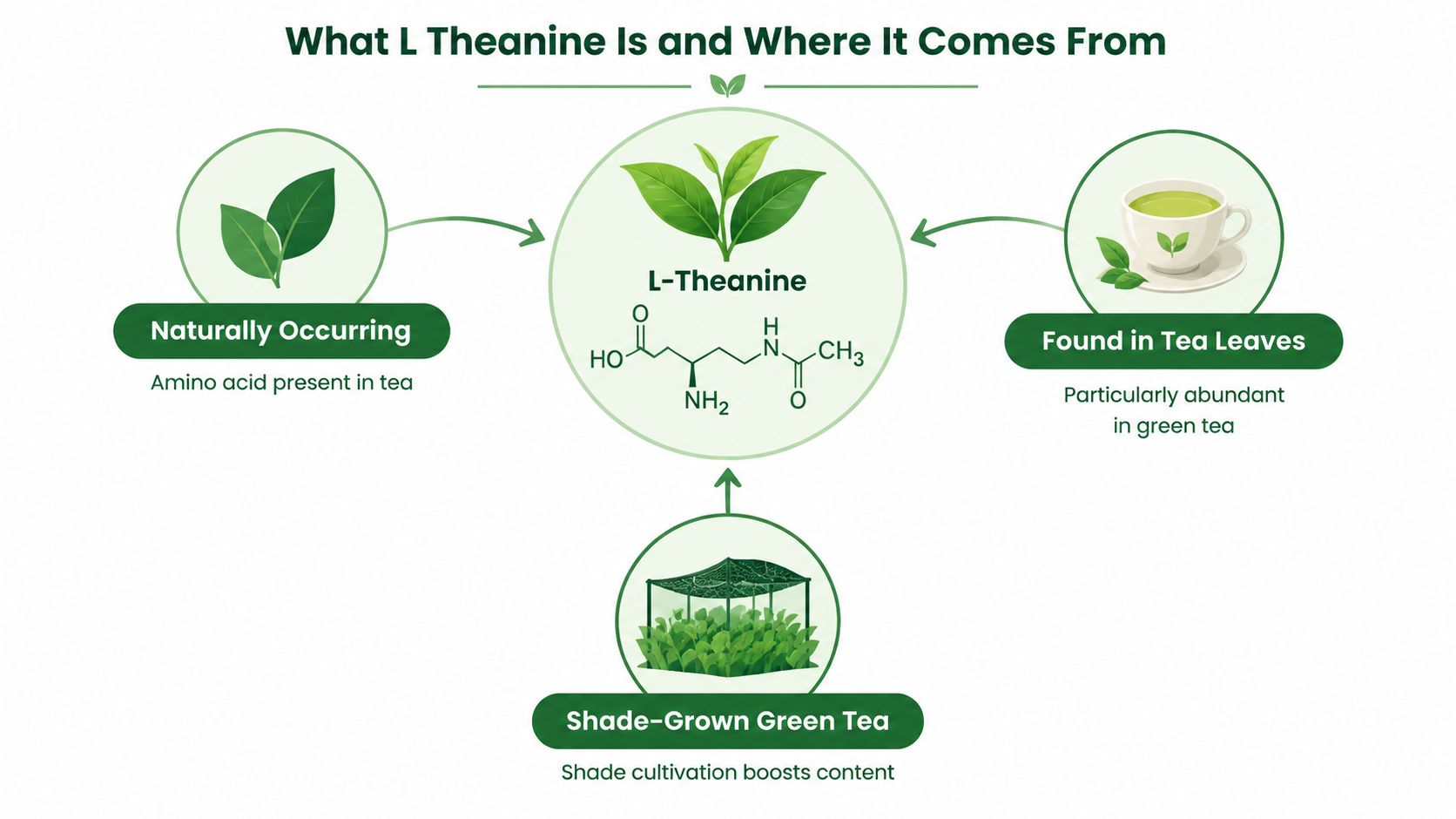
Tea behaves like a small chemical ecosystem rather than a single active ingredient. Caffeine contributes wakefulness, while L-theanine contributes a different influence, one associated with calm alertness. The final experience depends on the plant, cultivation, preparation, serving, and your own sensitivity.
Why shade growing matters
Tea leaves grown under shade receive less direct sunlight, changing the plant's chemistry. That helps explain why shade-grown material is relevant when people discuss matcha and L-theanine. It does not mean every shade-grown product delivers an identical amount. It does show why origin and production details deserve attention.
Matcha also differs from brewed tea because you consume the powdered leaf, rather than only drinking water that has extracted some of the leaf's compounds. Preparation and portion size therefore matter. A smooth-tasting powder can still contain caffeine, and a pleasant ritual does not remove the need to understand your total intake.
For readers curious about the tea experience itself, Ceremonial Grade Matcha 60g is sourced from Shizuoka, Japan, and described as shade-grown, stone-ground, vegan, gluten free, dairy free, and additive free. Its smaller format may suit someone exploring ceremonial matcha without choosing a larger bag.
Why purity matters in supplements
A capsule provides a labelled quantity of one ingredient. Tea provides a broader plant matrix with naturally variable amounts. For Australian consumers comparing formulations, the Therapeutic Goods Administration recognises theanine as an ingredient in therapeutic products and specifies a compositional benchmark of at least 98% L-theanine using USP/FCC methods, as recorded in its theanine ingredient document.
That benchmark does not make every product identical or guarantee a better personal outcome. It gives you a concrete quality and labelling point to check when consistency matters.
How L-Theanine Supports Focus and Works With Caffeine
L-theanine may support focus by reducing stress-related interference with attention. Pressure, background noise, and internal restlessness can all draw mental resources away from a task. Lowering that interference may leave more attention available for reading, planning, or sustained work.
Researchers often describe this effect through relaxed alertness and alpha activity. A busy radio channel carries the message, but static makes it harder to hear. L-theanine is being studied as a possible filter for some of that static, rather than as a stimulant that turns up the volume.
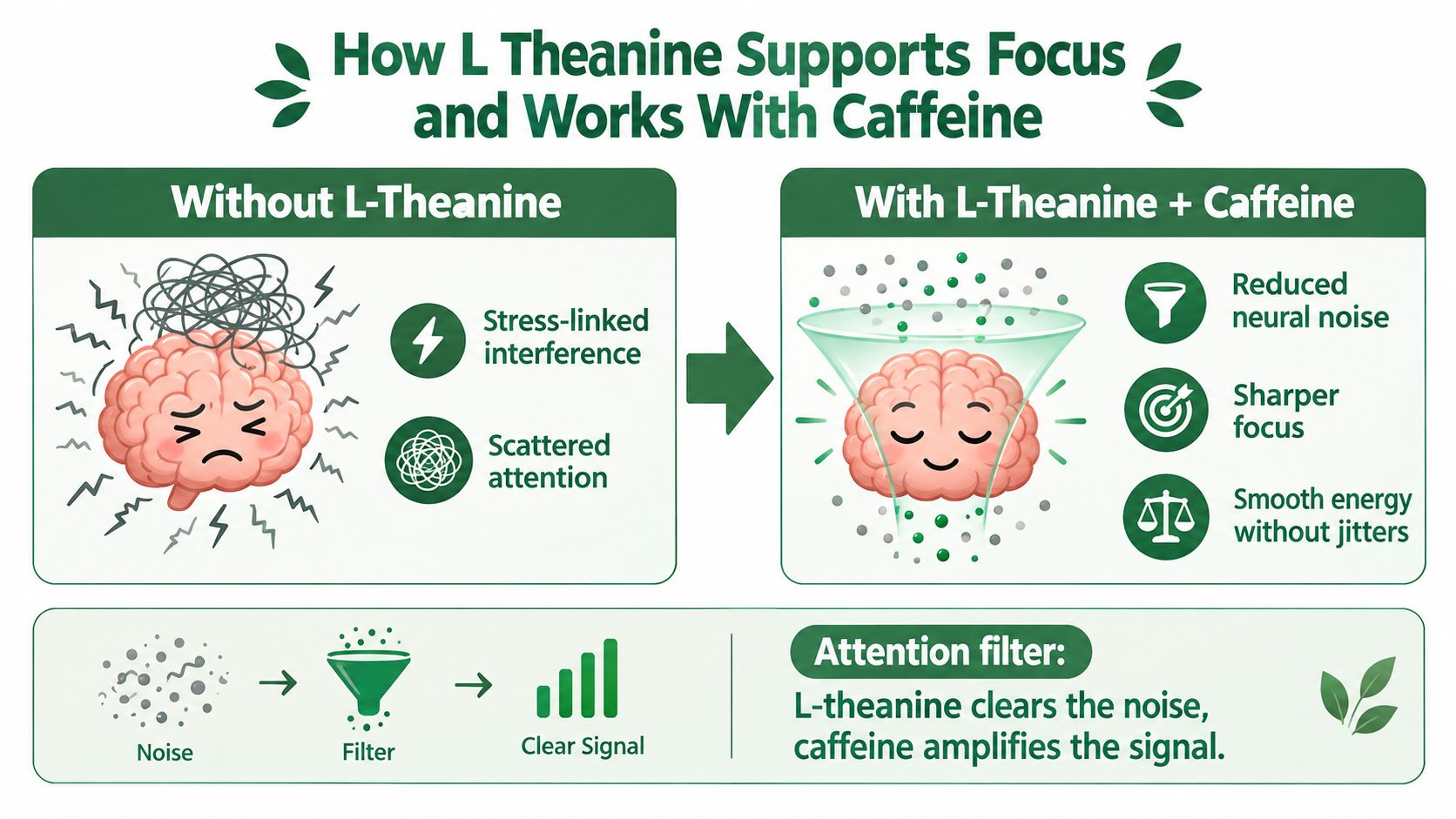
That may explain why the experience, when it occurs, can feel smoother instead of forceful. You still need sleep, motivation, and a workable plan. The possible benefit is a less crowded mental space, where irrelevant thoughts compete less with the task.
The caffeine pairing
Tea naturally brings caffeine and L-theanine together. Caffeine supports alertness, while L-theanine is studied for a calmer form of attention. One randomised, double-blind, placebo-controlled crossover study gave 97 mg of L-theanine and 40 mg of caffeine to 44 young adults. The combination improved task-switching accuracy and self-reported alertness, while reducing self-reported tiredness, according to this clinical trial.
The ratio is a research setup, not a universal prescription. Your response can change with caffeine sensitivity, sleep, food, stress, and regular caffeine intake. In Australia, that distinction also matters because a tea drink and a labelled supplement offer different levels of dosing precision.
A systematic review and meta-analysis of 11 randomised placebo-controlled human studies found moderate effects during the first two hours after combined caffeine and L-theanine dosing for alertness and attentional switching accuracy. The analysis also reported that caffeine dose appeared to affect effect sizes more strongly than L-theanine dose, especially during the first hour, as described in the published analysis.
For a practical explanation of how matcha's caffeine profile can fit a daily routine, read about green caffeine in matcha.
The pairing may suit someone who finds caffeine helpful for staying awake but unpleasantly edgy. Palpitations, anxiety, or disrupted sleep still deserve attention. L-theanine does not erase those concerns, so reducing caffeine may be the more sensible first adjustment.
A tea-based option such as Premium Sweet Matcha 200g combines Japanese green tea leaves with a sweetened powder format. It is a beverage, not a precisely measured L-theanine supplement. Treat it as part of your overall tea and caffeine routine rather than assuming capsule-level dosing.
What Human Studies Show About Attention and Clarity
The strongest way to interpret the evidence is to look at what researchers asked participants to do. Attention isn't one single ability. A person can feel awake yet struggle to switch tasks, hold information in mind, respond quickly, or avoid missing important signals.
A 2021 clinical trial in middle-aged adults found that a single L-theanine dose reduced reaction time on a Stroop attention task. It also improved working-memory performance by increasing correct answers and reducing omission errors on a four-part continuous performance test, with the authors concluding that L-theanine may improve attention in a way that supports working memory and executive function. The findings are described in the clinical trial report.
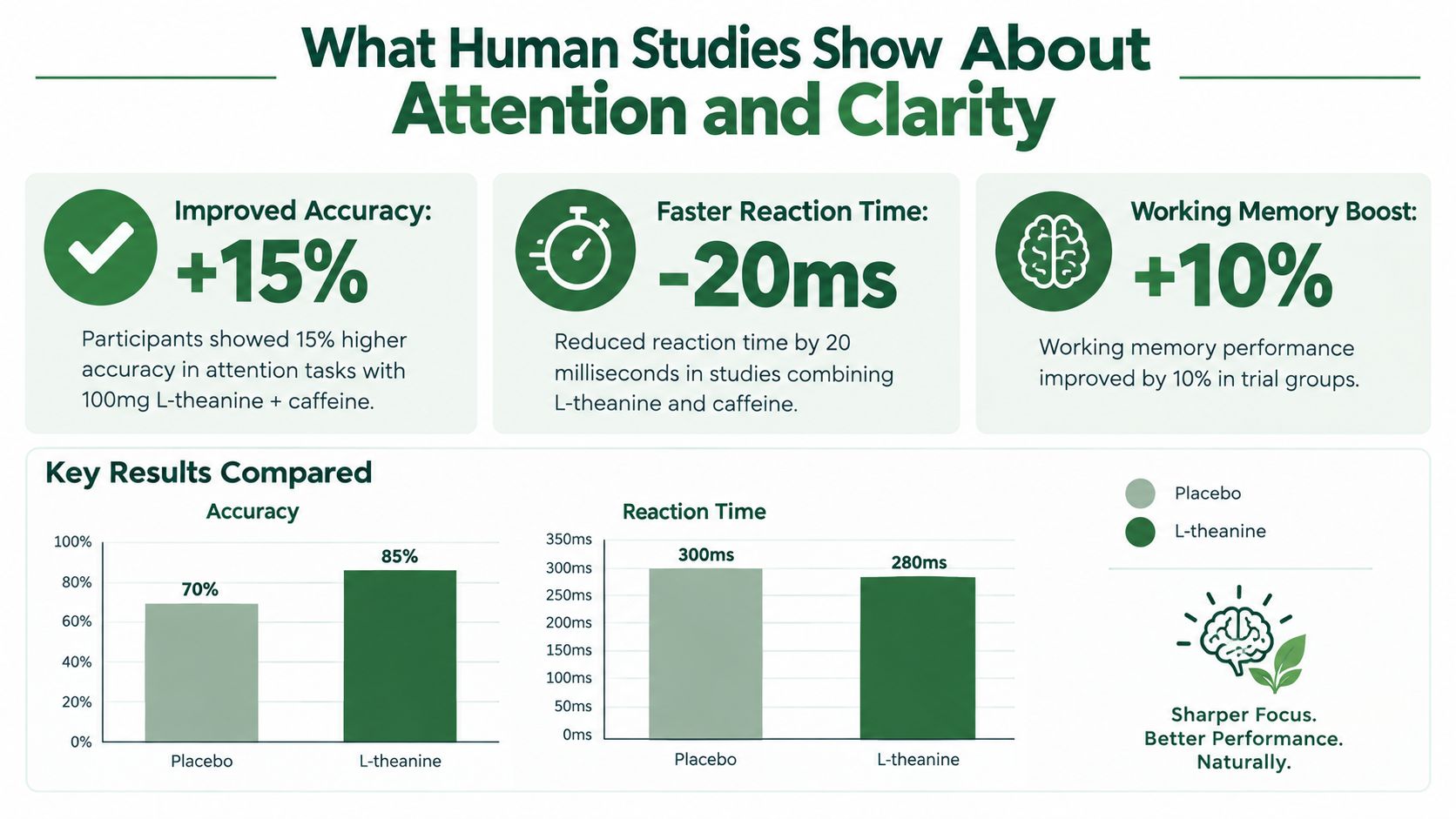
In everyday terms, fewer omission errors may mean missing fewer target signals during a sustained task. Better working-memory performance may help you keep a short instruction, calculation, or sequence active while you use it. These are useful clues, but they don't mean a capsule will automatically improve every kind of work.
What stress has to do with focus
An Australian systematic review led by researchers associated with the University of Canberra and Flinders University evaluated 9 human randomised controlled trials on pure L-theanine supplementation. Published in 2020, it found that daily intakes of 200 to 400 mg per day may help reduce stress and anxiety in people exposed to stressful conditions, while also emphasising the need for larger and longer-term studies. You can read the systematic review.
That matters for focus because stress can consume attention. If a stressful task makes you monitor your heartbeat, worry about mistakes, or repeatedly rehearse what might go wrong, reducing that interference could make concentration feel more accessible.
A separate randomised crossover study of 9 healthy adult men examined L-theanine and caffeine together. The researchers reported faster target responses, including 27.8 milliseconds for L-theanine alone and 26.7 milliseconds for the combination, with results compared with placebo, while fMRI findings suggested reduced activity linked to mind wandering. The study is available through PubMed.
Reading the evidence honestly
These studies measured short-term outcomes in controlled settings. They don't establish that L-theanine produces lasting improvements in productivity, treats an attention disorder, or replaces clinical care. They do provide a reasonable basis for expecting a subtle, time-limited effect that may be easier to notice during demanding or stressful work than during a relaxed afternoon.
How to Use L-Theanine for Focus Safely and Effectively
A sensible approach starts with purpose. Are you trying to make a stressful work block feel less noisy, reduce the edge from caffeine, or compare tea with a measured supplement? Defining the goal makes it easier to judge whether the experience is useful.
Australian research has tested several practical doses. A University of Canberra pilot trial in the Greater Australian Capital Territory region was registered as a 3-week study with 60 participants, comparing placebo with 100 mg, 200 mg, and 400 mg dose groups while measuring sleep, stress biomarkers, alertness, and focus. The Sleep Project study design included measures such as heart-rate variability, salivary cortisol, and alpha amylase.
A simple timing framework
An Australian research protocol selected a 0.2 g dose because acute effects were expected to begin about 30 to 50 minutes after ingestion and last up to 90 minutes. The protocol also measured visual acuity, contrast sensitivity, saccadic eye movements, salivary cortisol, blood pressure, heart rate, and heart-rate variability, as shown in the University of Canberra protocol.
That timing suggests using L-theanine before a defined focus window rather than expecting an all-day effect. If you have a presentation, study block, writing session, or quiet administrative period, taking it around half an hour beforehand is a more testable routine than taking it randomly.
Practical rule: start with the lowest studied dose that fits your plan, change only one variable at a time, and record what happened.
The Australian systematic review discussed above found potential stress benefits in the 200 to 400 mg per day range, but that doesn't mean everyone should begin at the top of that range. A cautious adult might first discuss a lower amount with a pharmacist or healthcare professional, especially if they use medication or have a health condition.
What to monitor
For several focus sessions, note:
- Timing: when you took it and when you began work.
- Attention: whether you stayed with one task more easily.
- Caffeine response: whether your usual tea or coffee felt smoother or unchanged.
- Body signals: any dizziness, headache, stomach discomfort, unusual sleepiness, or other change.
- Sleep: whether the timing affected your ability to settle at night.
Don't use L-theanine to push through severe sleep deprivation, unexplained fatigue, or escalating anxiety. People who are pregnant, breastfeeding, managing a medical condition, taking blood-pressure medication, or using multiple medicines should seek individual advice before starting a supplement.
For tea preparation, portion size matters because matcha is a powdered leaf rather than a brewed infusion. The practical guide to how much matcha powder per cup can help you keep your beverage routine consistent, but it won't convert a matcha serving into a precise L-theanine capsule dose.
Food Sources of L-Theanine and Why Matcha Stands Out
Tea is the simplest food source because it naturally brings L-theanine and caffeine together. Matcha goes a step further in the way it's prepared. You whisk the powdered tea leaf into the drink, rather than steeping the leaf and discarding it, so the beverage retains the material that was ground into the powder.
That doesn't make every matcha serving nutritionally or functionally identical. Cultivar, shading, harvest, processing, powder quality, serving size, and preparation all influence the final drink. Taste also affects consistency. If a tea is too bitter or complicated to prepare, you're less likely to use it regularly.
Tea, matcha, and supplements compared
| Format | Main advantage | Main limitation |
|---|---|---|
| Brewed green tea | Familiar ritual with naturally occurring L-theanine and caffeine | The amount varies, and the drink may provide a milder experience |
| Matcha | Powdered tea leaf with a concentrated tea ritual and both compounds present | Portion size and preparation influence caffeine and overall intake |
| L-theanine supplement | Labelled ingredient quantity and convenient timing | It doesn't recreate the broader tea matrix or beverage ritual |
The Australian Sports Commission lists 30 to 50 mg of caffeine in a 250 mL cup of green tea, which provides useful context for ordinary tea intake and why tea-based focus can feel milder than a high-caffeine product. See the Australian Sports Commission caffeine guidance.
For a deeper comparison of the compounds and preparation styles, read matcha and L-theanine benefits.
The Australian regulatory distinction
In Australia, the TGA lists theanine or L-theanine as an active ingredient for listed medicines. Multiple L-theanine products were added to the Australian Register of Therapeutic Goods between 2024 and 2026, including products positioned around calm and focus, according to the TGA ingredient and product information.
That regulatory context helps explain why Australian shoppers ask whether tea intake is comparable with a supplement. It usually isn't a direct comparison. A listed medicine has a labelled formulation and regulated product context, while a beverage is a food or drink whose composition can vary.
Your Next Steps for Steadier More Reliable Focus
Start with the central distinction. L-theanine isn't primarily interesting because it stimulates you. It's interesting because it may reduce some of the stress-related interference that competes with attention.
A practical experiment can stay simple:
- Choose one focus task. Use a writing session, reading block, study period, or demanding desk task.
- Keep caffeine familiar. Don't increase coffee or tea at the same time you test L-theanine.
- Choose your format. Tea or matcha suits a beverage ritual, while a supplement may offer more predictable labelled dosing.
- Time it deliberately. The Australian protocol's expected 30 to 50 minute onset and possible 90 minute duration suggest planning around a defined work window, as described in the earlier research source.
- Track the result. Record attention, restlessness, task completion, physical sensations, and sleep.
- Stop if it feels wrong. A supplement that creates discomfort isn't a useful focus tool for you.
The best result may feel quiet rather than dramatic. You might notice fewer interruptions, a smoother response to caffeine, or less resistance when starting a mentally demanding task. If you need treatment for anxiety, ADHD, sleep problems, or another health concern, speak with a qualified healthcare professional instead of relying on L-theanine alone.
TOO MATCHA. offers Japanese matcha and hojicha powders in ceremonial, culinary, and sweetened formats for home preparation, recipes, lattes, and iced drinks. Visit TOO MATCHA. to explore tea-based options for a calmer, more consistent focus ritual.