Best Matcha Australia Reddit: How to Choose Well in 2026
Open any 'where to buy matcha in Australia' thread and the top reply reads the same: just buy the best ceremonial grade you can afford.
For a latte drinker, that advice costs more and tastes worse.
Searching the best matcha Australia Reddit threads recommend surfaces favourites ranked by enthusiasm. Enthusiasm skips the two questions that decide value: which drink the powder goes into, and what each gram costs at the pack size you buy.
I rank matcha by the drink it's going into first, then by cost per gram across pack sizes. Reddit's favourites still get a hearing. They just have to survive the maths.
Table of Contents
- Quick Picks by Drink and Budget
- Where Reddit Advice Holds Up and Where It Misleads
- Reading Grade, Origin and Harvest Labels
- Caffeine per Serve and Why Freshness Matters
- What Each Pack Size Costs per Gram
- How to Prepare Matcha So the Grade Shows
- Confirm the Grade and Pack Before You Order
Quick Picks by Drink and Budget
Choose the drink first, then the grade and pack. Every price below is listed on the TOO MATCHA. site in Australian dollars.
| Drink or use | Grade to start with | Pack and AUD price |
|---|---|---|
| Straight whisked tea | Ceremonial Grade Matcha | 60g $74.99; 500g $329.99; 1kg $599.00 |
| Milk latte or iced drink | Premium Sweet Matcha (pre-sweetened) | 200g $54.99; 500g $109.99; 1kg $209.99 |
| Baking, smoothies and blending | Premium Culinary Grade Matcha | 500g $229.99 |
Ceremonial for water. This grade is sold for traditional whisked preparation, where you taste the powder directly. The Ceremonial Grade Matcha 60g at $74.99 is the sensible entry point, and the 500g bag suits someone whisking a bowl most mornings.
Premium Sweet Matcha for milk and ice. The blend is sweet, smooth and mild with no bitterness, which is what a latte or iced matcha needs. It's already sweetened, so you skip the syrup step and get the same taste every time. The 200g bag at $54.99 is the low-risk way to test it in your usual drink, and the larger sizes bring the gram price down if you're blending daily.
Culinary for the kitchen. Baking, smoothies and blending dilute and mask flavour, so a stronger, more assertive powder at a lower cost per gram does the job. Premium Culinary Grade Matcha is sold for recipes and mixed drinks, and the 500g bag is the working size.
Buy the pack you'll actually finish
Premium Sweet Matcha is a sweetened blend, so if you prefer to control your own sugar, check the ingredient list before comparing its gram price against single-ingredient matcha.
- One drink, most days: buy the smallest pack you'll finish while it's still fresh. If Premium Sweet Matcha 200g is that pack, a subscription delivers it every 2 or 4 weeks at $52.24 per delivery, and you can skip or cancel anytime.
- Café or heavy household use: look at the 500g and 1kg formats first, then work out storage.
- Still experimenting: don't buy bulk to save cents per gram you won't drink.
Practical rule: buy the smallest pack that fits your weekly habit, and let your actual usage decide whether the next size earns its shelf space.
Where Reddit Advice Holds Up and Where It Misleads
A commenter raves about a bright, expensive tin, calls it the best matcha they've bought in Australia, and posts a photo of the powder. Two weeks later the same person is asking why their lattes taste thin and grassy. Nothing went wrong with the matcha. They bought a sipping tea and made a milk drink with it.
That pattern repeats across Australian threads. Some posters want nutty, full-bodied, naturally sweet powder that stays pleasant in milk. Others want complex umami for drinking straight. Both groups reply to each other with brand names, and neither group's favourite works in the other's cup.
The contrarian point is worth stating plainly: the most ceremonial powder in your cupboard can be the worst value in a latte. Milk fat and sweetness soften delicate top notes, while a stronger, more astringent culinary profile stays noticeable through dilution. Paying double for subtlety that milk erases is a straightforward loss.
A three-part filter for any recommendation
- Does the poster name the drink? "Best matcha" means nothing without knowing whether it was whisked with water, poured over oat milk, or baked into a cake.
- Does the poster name the product and grade? A brand sells several grades. A recommendation for the ceremonial tin doesn't transfer to the same brand's culinary bag.
- Does the poster say what they paid in AUD? Without a price and a pack size, you can't calculate cost per gram, and you can't tell whether the praise is about the tea or about the buyer's budget.
A post with all three is evidence. A post with one is an opinion, and opinions are cheap in a thread where nobody's taste has been calibrated against yours.
The other blind spots are quieter. Threads rarely mention harvest year, how long the tin had been open before the review was written, or whether the reviewer sifted the powder. Freshness and technique change the cup as much as grade does, and neither shows up in a brand list.
So test a suggestion in the drink it was recommended for. If someone praises a ceremonial powder for straight whisked tea and you make lattes, treat that recommendation as a description of a different product, not a shortcut for your own.
Reading Grade, Origin and Harvest Labels
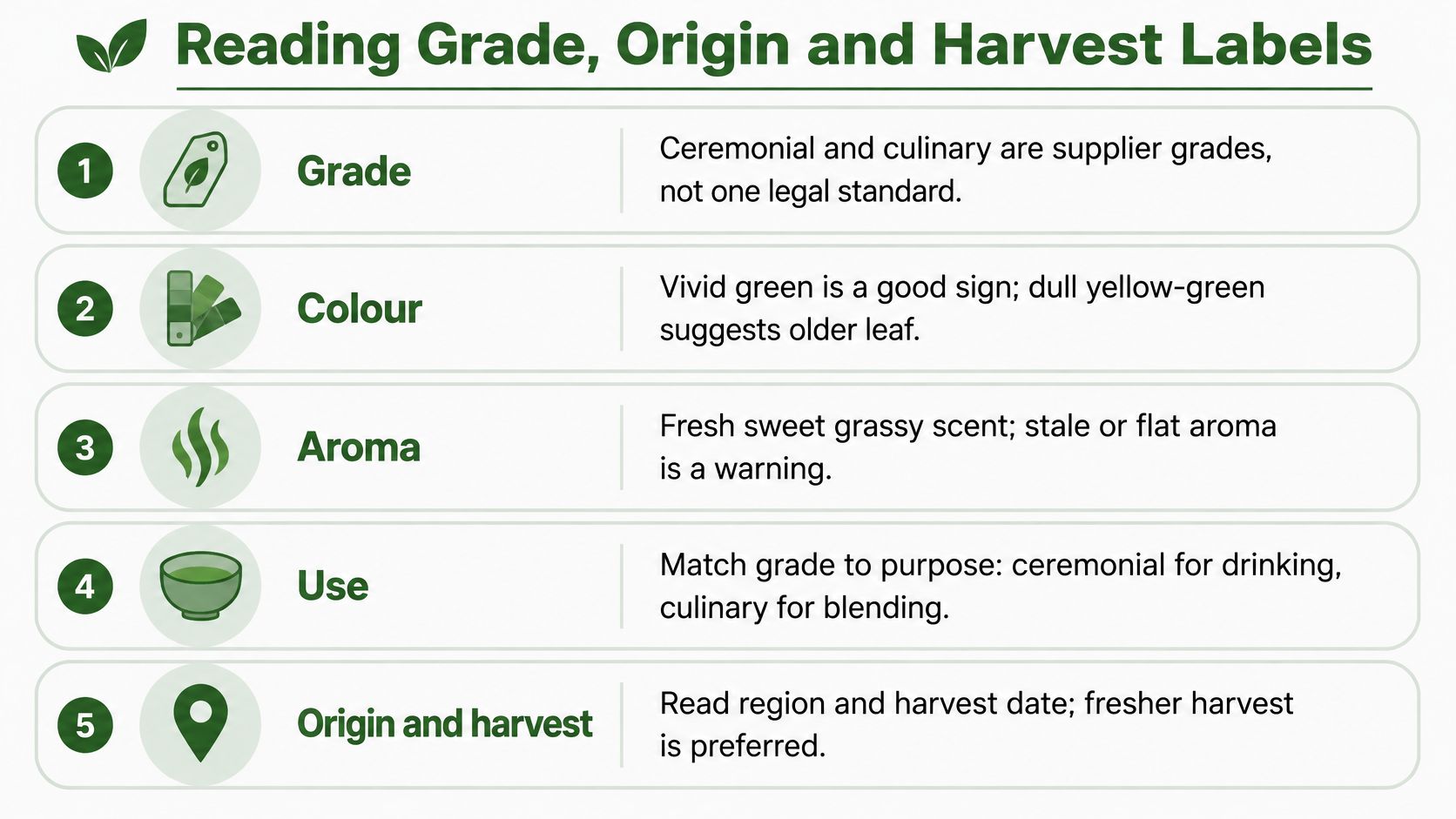
Ceremonial and culinary are supplier grades, not a single legal standard. Two suppliers can use the same word for very different powders. Treat the label as a starting hint, then judge colour, aroma, texture and the use the supplier describes.
What each label term tells you
Colour is the fastest screen. Vivid green points to well-shaded leaf handled carefully after milling. Dull, yellowish or olive powder suggests age, poorer shading or a lower grade. Whisking will not fix that.
Shade-grown describes the growing method that builds sweetness and umami in the leaf before harvest. TOO MATCHA's teas are shade-grown and stone-ground, and the matcha is freshly shipped from Japan. Region can matter, but country-level origin still leaves the farm and harvest open. Use the grade and intended drink to narrow the choice.
Texture should be ultra-fine and clump-free. TOO MATCHA's matcha is milled by a partner business using an advanced milling method that produces an ultra-fine, clump-free powder, so it whisks into a smooth paste rather than floating specks. For a fuller breakdown of how the grades differ, our guide to matcha green tea grades sets out the distinctions we work to.
Use case is the term buyers skip. A supplier who tells you a powder suits lattes and baking is giving you more useful information than one who calls everything ceremonial. TOO MATCHA sells ceremonial grade for traditional preparation and culinary grade for lattes, smoothies and baking, so the drink should decide the grade.
Supply conditions sit behind all of this. Demand for green tea in Australia has been rising sharply, which puts more pressure on availability, price and stock consistency. That matters when a thread recommends a tin that may no longer be at the same price or pack size.
The label checklist
- Grade stated: ceremonial, culinary or a named blend with a clear intended use.
- Origin named: Japan is useful; a region is more useful when the supplier gives it.
- Harvest or milling date: any dated freshness information beats none.
- Ingredient list: check for added sweetener before comparing to plain matcha.
- Claims confirmed: organic, vegan, dairy free and gluten free should appear on the label, not only in the ad copy.
Our Premium Sweet Matcha 200g shows why the whole label matters. It is sweet, smooth and mild with no bitterness, and it suits lattes, iced matcha and smoothies. The 1kg format of Premium Sweet Matcha is blended with 30% authentic Japanese green tea leaves and a balanced touch of sweetness. That makes the sweet format a practical mixer, closer to a quick café-style drink than a bowl of straight tea.
Caffeine per Serve and Why Freshness Matters
Threads argue about flavour and almost never weigh the powder. Dose is the variable that decides both caffeine and bitterness, and it's the one thing you can control with a $15 digital scale.
| Powder weight | Caffeine per serve (estimate) | Best fit |
|---|---|---|
| 1g | Light end of a typical serve | Caffeine-sensitive drinkers or a late-day cup |
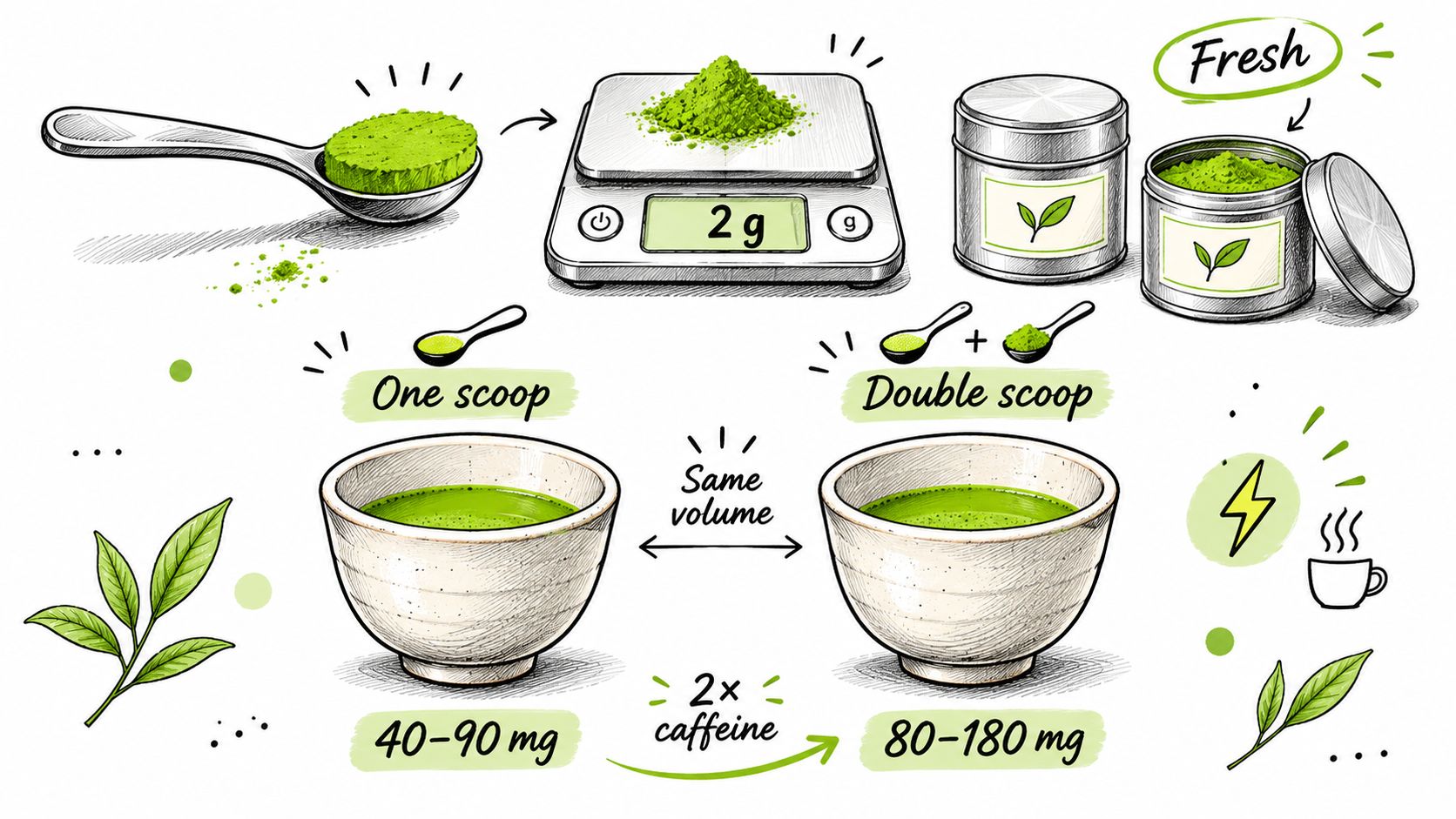
| 2g (about one teaspoon) | Standard single serve | Everyday latte or usucha |
| 4g | Roughly double the 2g serve | Strong serve or double dose |
A level teaspoon of matcha sits around 2 g, and caffeine scales almost linearly from there: double the powder and you double the caffeine, even if the drink volume stays identical. You also double the cost of the cup, which matters if you're weighing out ceremonial at over a dollar per gram. That's the whole mechanism, and it's why a "large" café matcha can hit far harder than the cup size suggests.
Don't compare a matcha serve to a steeped cup
A brewed green tea is leaf steeped in water and then removed, so a portion of the caffeine stays behind in the spent leaf. Matcha is the whole milled leaf suspended in the drink, so you consume everything the leaf contains. Treat a café-style matcha as its own category rather than a brewed cup in disguise. Retail tea tins don't print a reliable milligram figure, which makes your scale the only dependable reference you have.
If you're counting caffeine across the day, work backwards from the weighed dose and count every serve, including the afternoon iced latte. Daily caffeine guidance sets a lower ceiling during pregnancy than for the general adult population, so the same 2 g scoop doesn't carry the same margin for every drinker. Our explainer on how much caffeine is in matcha tea covers the serving maths in more detail.
Freshness changes flavour directly
Because you consume the entire leaf, oxidation shows up directly in the cup: colour drifts towards olive, the sweet grassy aroma flattens, and bitterness rises. A fresher powder forgives a slightly heavy hand with the scoop; a stale one punishes it. Our matcha is freshly shipped from Japan, which shortens the gap between milling and your kitchen.
Keep powder sealed, cool and out of light, and finish an open pack within a sensible window rather than nursing it for a year. If caffeine makes you jittery, weigh a smaller dose, skip late-day serves, and treat "smooth energy" claims as marketing.
What Each Pack Size Costs per Gram
Sticker prices reward the wrong habit. Cost per gram shows which pack suits a daily latte, a baking habit, or careful sipping. It also exposes when a bigger tin saves money and when it just ties up cash.
| Pack | Price (AUD) | Cost per gram (AUD) |
|---|---|---|
| Premium Sweet 200g | 54.99 | 0.28 |
| Premium Sweet 200g (3 pack) | 148.47 | 0.25 |
| Premium Sweet 500g | 109.99 | 0.22 |
| Premium Sweet 1kg | 209.99 | 0.21 |
| Ceremonial 60g | 74.99 | 1.25 |
| Ceremonial 60g (3 pack) | 215.97 | 1.20 |
| Ceremonial 500g | 329.99 | 0.66 |
| Ceremonial 1kg | 599.00 | 0.60 |
| Culinary 500g | 229.99 | 0.46 |
| Culinary 60g | Not listed | Not listed |
Ceremonial in the smallest tin costs $1.25 per gram, falling to about $0.66 at 500g and $0.60 at 1kg. That works when the powder is being whisked and drunk on its own, where the grade is the point. It is a poor fit for a milky daily drink if the same result can be had from a grade built for recipes. Premium Sweet is the cheapest per gram across the range, from about $0.28 at 200g down to $0.21 at 1kg. Its sweet, smooth and mild profile suits lattes, iced matcha and smoothies. Culinary at 500g sits near $0.46 per gram, which makes it the practical middle ground for baking, blending and lattes.
What that means for your kitchen
Multipacks shave a little off. The Premium Sweet 200g three-pack at $148.47 lowers the cost to about $0.25 per gram, and it keeps each bag sealed until needed. That matters with powdered tea because an open bag is a moving target. A sealed kilo looks efficient on paper, but only if the kitchen can use it while the flavour stays bright.
If you drink the same latte every day, the subscription is the tidier option. Premium Sweet Matcha 200g can be delivered every 2 weeks or every 4 weeks at 5% off, which is $52.24 AUD per delivery. Subscriptions auto-renew, with the option to skip or cancel anytime. That suits a predictable routine better than a one-off bulk buy.
Best value is not the lowest number in the table. Buy the smallest pack that matches the drink, then step up only when the per-gram saving is worth the storage and freshness trade-off. A ceremonial tin is hard to justify for baking, and a sweet blend is a poor choice if you want plain whisked tea.
For reference, Australian cafés charged approximately AUD 6–8 for a matcha latte in Sydney, Melbourne and Brisbane in 2025. At those numbers, a home latte made from a 500g bag pays for the bag quickly, especially when the powder is chosen for milk rather than sipping.
How to Prepare Matcha So the Grade Shows
Grade sets the ceiling. Dose, water temperature, water volume and milk ratio decide whether a powder reaches it, and those four numbers are what separate a smooth bowl from a harsh one.
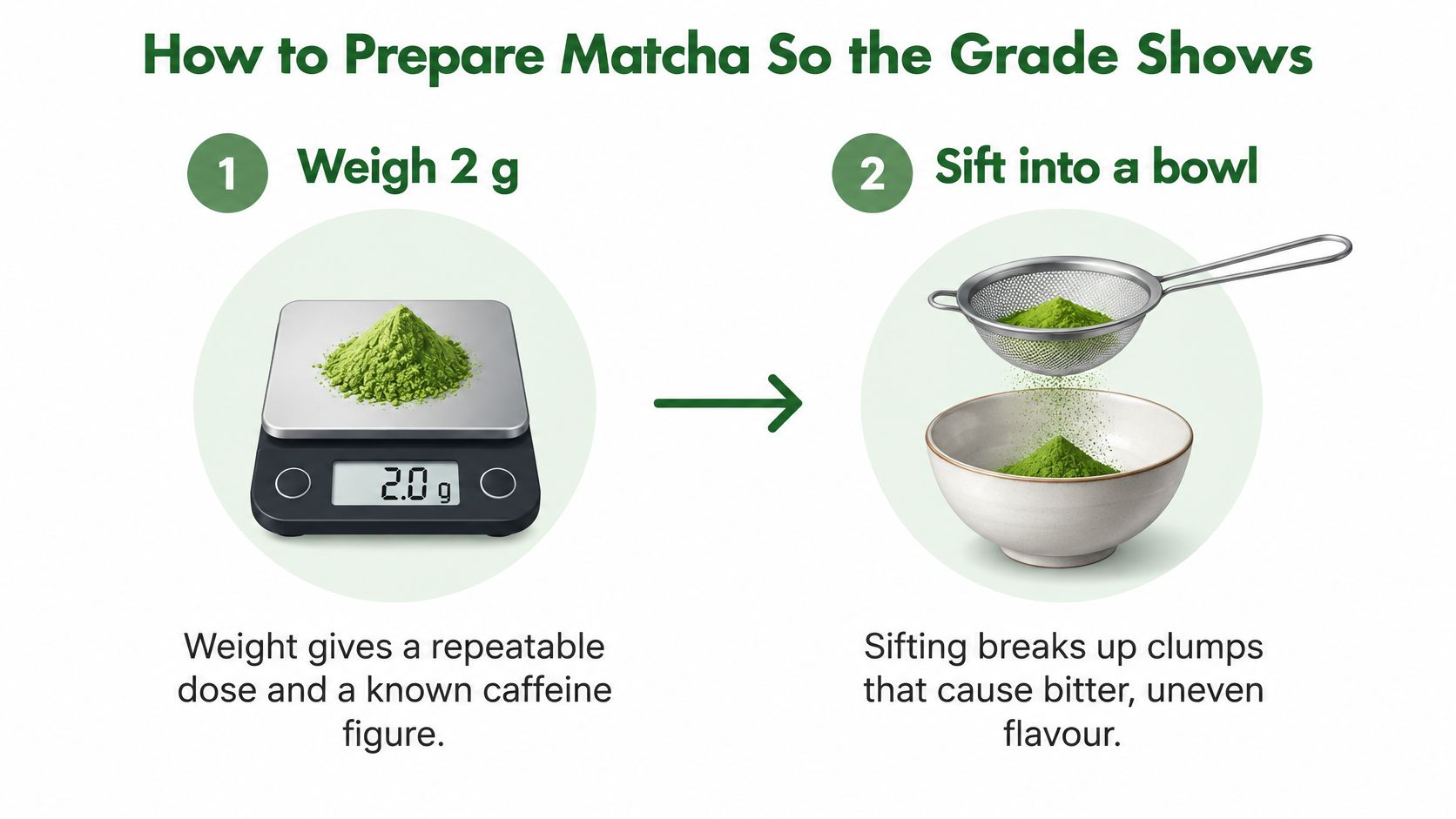
- Weigh 2 g on a digital scale. Teaspoon scoops vary with how packed the powder is. Weight gives a repeatable dose and a consistent caffeine figure, which is why weighing beats scooping by eye.
- Sift into the bowl. A tea strainer or fine mesh sieve breaks up clumps. Even a well-milled powder can hold dry pockets that hydrate on the outside only, and no amount of whisking disperses them afterward.
- Add a little warm water, held off the boil. Boiling water pulls more bitter and astringent compounds from the leaf. Start with just enough water to work a smooth paste.
- Whisk in a fast W or M motion. A bamboo chasen suspends the leaf, while circular stirring pushes powder to the edges. Work the paste until no dry specks remain.
- Add the remaining water and whisk again until fine foam forms. Large bubbles mean air is being whipped rather than leaf suspended, and the texture stays thin.
- For a latte, pour warm milk into the bowl. Add sweetener only to plain matcha. Our Premium Sweet blend already carries a balanced touch of sweetness, so extra syrup pushes the drink into cloying territory.
- For an iced drink, pour the slurry over ice, then top with cold water or milk. Building the paste first stops powder floating on a cold drink.
- Taste, then record the numbers. Dose, water amount, milk ratio, and whether the cup ran bitter or weak. Change one variable next time so you know what fixed it.
The mistake that ruins good powder
Scalding water over an unsifted scoop is the usual cause of bitterness in home matcha. Both problems are free to fix, and neither calls for a higher grade. A modestly priced blend prepared with care will outdrink ceremonial powder drowned in boiling water.
The matcha green tea preparation guide sets out the method with the ratios used for each grade. Café owners should write the dose, water temperature and milk ratio onto the recipe card and weigh every serve. Descriptors like "smooth" or "strong" don't survive a shift change.
Confirm the Grade and Pack Before You Order
Run one check before you check out, and the mismatched purchases you'd otherwise return never happen.
Name your drink first. You already settled this in the quick picks: the drink on your bench decides the grade. If it's milk and ice, you don't need a sipping powder.
Match the pack to your frequency. A daily drinker gets through a small bag fast enough to keep it fresh. An occasional weekend drinker should buy the smallest format available, even at a higher cost per gram, because a stale 1kg bag is the most expensive matcha you can own.
Check the live per-gram figure. Prices in AUD change, and the amount that applies is the one set out in your order confirmation. Do the division on the current page rather than trusting a screenshot from a forum post.
Read the label against the checklist. Grade, origin, freshness information, and any added sweetener. Those four items tell you whether you're buying plain milled leaf or a blend, and both are legitimate purchases for different drinks.
First order, then scale up
For a first purchase, buy small and test in the drink you plan to make: the 60g ceremonial tin for straight tea, or the 200g Premium Sweet bag for lattes. Once the taste is settled and you know your weekly usage, move to the 500g or 1kg format and bank the lower per-gram cost.
Subscriptions suit settled habits rather than first orders. Premium Sweet Matcha 200g subscriptions auto-renew on a two-week or four-week schedule, and you can skip or cancel anytime, which matters if your consumption is seasonal or you're still deciding between grades.
Brew it the way you drink it, note the dose and the milk ratio, and judge the result against the Reddit recommendation that sent you searching. A cup you made yourself, with numbers you wrote down, beats a stranger's favourite tin every time.
We sell ceremonial grade for straight whisked tea, culinary grade for baking and blending, and a pre-sweetened Premium Sweet blend for lattes and iced drinks, in packs from 60g to 1kg with prices in AUD. Pick the grade that matches the drink you make most, start with a small pack, and check the cost per gram before you commit to bulk. Visit TOO MATCHA. to compare the grades and pack sizes side by side and order the one that fits your cup.