Matcha Tea Has Caffeine
You're halfway through your morning routine. The kettle is warm, your laptop is open, and you've ordered a matcha latte instead of your usual flat white because someone said matcha feels like smoother, calmer energy. Then a practical question interrupts the ritual: does matcha tea have caffeine, and how much am I drinking?
The honest answer isn't one universal number. Matcha caffeine depends on the amount of powder, the grade, the recipe, and whether you're drinking a small whisked bowl or a large café latte. The useful question is not “how much caffeine is in matcha?” It's how many grams of matcha are in this particular drink?
Table of Contents
- Why Matcha Caffeine Is the Question You're Actually Asking
- How Matcha Delivers Caffeine in the First Place
- How Much Caffeine Matcha Has by Grade and Preparation
- Matcha vs Coffee, Black Tea, Green Tea, and Hojicha
- L-Theanine, Caffeine, and the Myth of Crash-Free Energy
- How to Manage Your Matcha Caffeine Intake
- Matcha Caffeine for Sensitive Groups and Special Situations
- A Simple Framework and Common Matcha Caffeine Questions
Why Matcha Caffeine Is the Question You're Actually Asking
A search for matcha caffeine often carries a second question underneath it. You may be wondering whether matcha will provide enough alertness to replace coffee, but without the shaky feeling, sudden drop in energy, or late-afternoon regret. You may also be trying to work out whether a bright green iced latte counts as a gentle tea or as a serious caffeinated drink.
Both questions make sense. Matcha is tea, so it naturally contains caffeine, but it doesn't behave like an ordinary tea bag in the cup. The amount you consume changes according to the powder quantity and preparation, which means two drinks with the same menu name can deliver different doses.
The practical answer: matcha is caffeinated, but the drink's caffeine level is preparation-driven rather than fixed.
Consider two morning orders. One café uses a level scoop in a small hot bowl. Another uses several scoops in a large iced latte, then adds milk and ice. The second drink may look lighter because it's diluted, yet it can contain more matcha powder. Cup size changes the presentation, while powder mass controls the underlying tea dose.
Grade matters, too, although it shouldn't be treated as a guaranteed caffeine ranking. Ceremonial, culinary, and sweetened products are made for different flavour profiles and uses, while hojicha is a roasted tea option with a different character. The recipe still determines how much powder reaches your cup.
This guide starts with the leaf itself, then moves to Australian reference points, comparisons with coffee and other teas, and a simple way to estimate your own intake. By the end, you'll be able to ask a café a more useful question than “is this strong?” You'll know to ask how many grams of powder go into the drink.
How Matcha Delivers Caffeine in the First Place
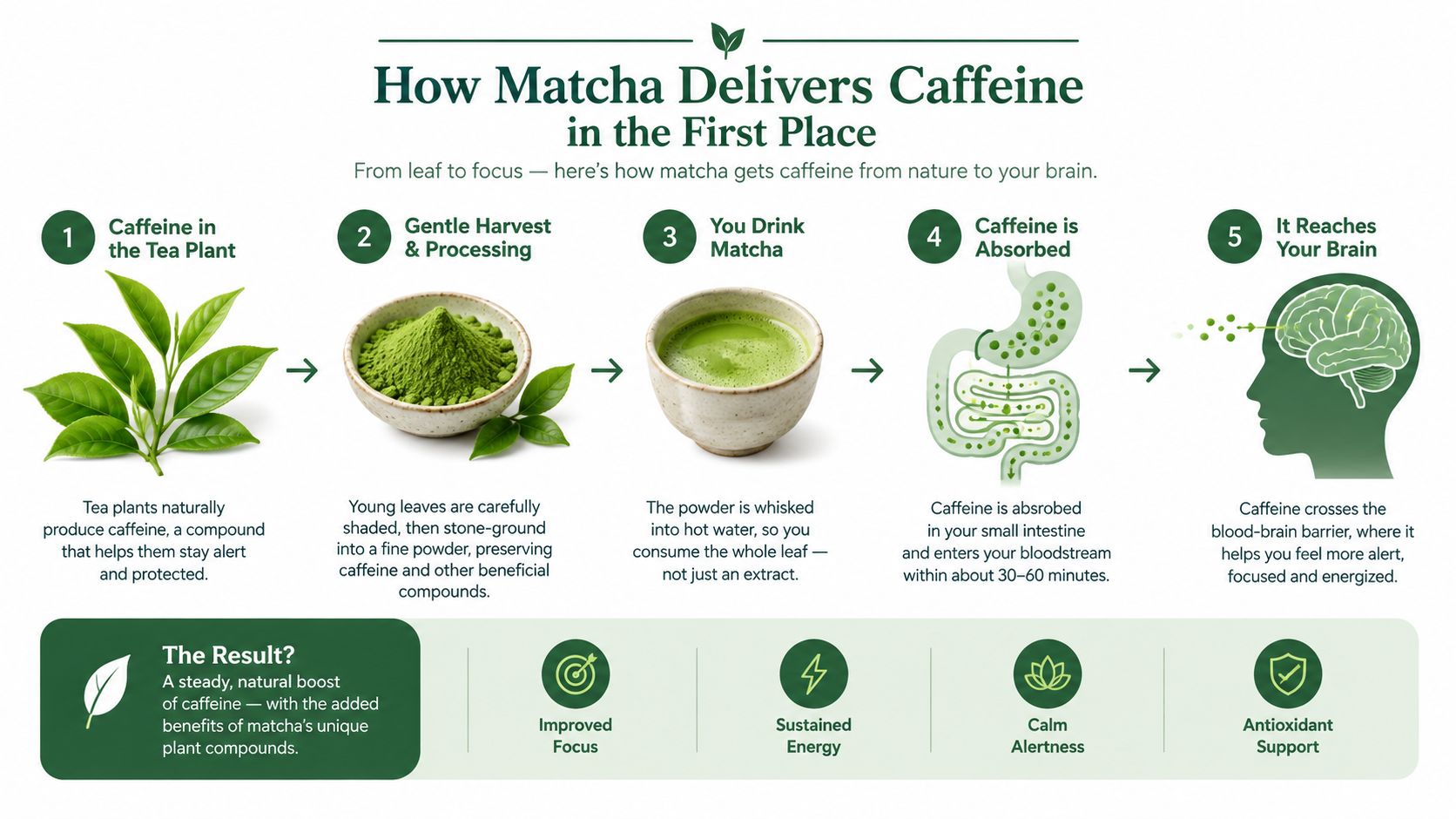
Matcha begins as a tea leaf, and caffeine occurs naturally in tea leaves. Australian health guidance identifies tea leaves as a natural caffeine source, while also explaining that the amount varies with tea type, serving size, preparation method, and brewing conditions (Food Standards Australia New Zealand guidance on caffeine).
Ordinary green tea is usually steeped in hot water. You drink the infusion, then discard the leaves. Matcha takes a different route:
- Tea plants are shade-grown before harvest, a process used to develop the leaf's flavour and composition.
- Harvested leaves are steamed to help preserve their green character.
- The leaves are dried and prepared as a tea material known as tencha.
- Stone mills grind the prepared leaves into a very fine powder.
- You whisk that powder into water or milk and consume the leaf itself.
That final step changes the caffeine equation. Drinking steeped tea is like drinking water that has drawn flavour from fruit and leaving the fruit behind. Drinking matcha is closer to blending the whole fruit into a smoothie. The liquid carries the leaf solids with it, including compounds that would remain in discarded tea leaves.
The control variable is powder mass
This is why grams of matcha matter more than cup volume. Adding milk, water, or ice changes the drink's concentration and texture, but it doesn't remove the caffeine already present in the powder. A diluted iced matcha can contain the same caffeine as a concentrated bowl if both use the same amount of powder.
Preparation still affects the experience. Powder quantity, cultivar, shading, particle size, water temperature, whisking, and dilution can all vary. An exact product-level label claim requires laboratory testing or a supplier certificate of analysis, rather than a generic figure for all matcha.
For someone learning the difference between tea types, Ceremonial Grade Matcha 60g is a Shizuoka-sourced, shade-grown, stone-ground powder intended for a smooth, whisked cup. Its product description identifies it as vegan, gluten free, dairy free, and additive free, but those qualities don't establish a universal caffeine dose. The amount in your bowl still depends on how much powder you use.
How Much Caffeine Matcha Has by Grade and Preparation
A café menu may call two drinks the same latte even when one uses a small scoop and the other uses a generous one. The cup size does not reveal the caffeine dose. Weighing the powder gives you a repeatable starting point.
An Australian benchmark places a typical 250 mL matcha serving at approximately 60–75 mg of caffeine. The same comparison lists brewed green tea at approximately 24–45 mg per 250 mL and coffee at approximately 100 mg per 250 mL. These figures describe typical prepared servings, not every matcha recipe or product.
Use that range as a reference point rather than a laboratory specification. A recipe with less powder may fall below it, while a larger or more concentrated recipe may exceed it.
Think in grams, not labels
Grade names describe intended use and flavour. They do not guarantee a particular caffeine amount. Ceremonial matcha is commonly whisked and sipped for its texture and flavour. Culinary matcha is selected for blending, baking, and lattes. Sweet matcha includes added sweetness or a sweetened blend, so both the formulation and scoop size affect what you consume.
Hojicha is roasted green tea powder. It is often chosen for a gentler tea style, but its caffeine level still depends on the product and serving size.
| Drink | Typical serve | Caffeine range (mg) |
|---|---|---|
| Matcha, typical Australian benchmark | 250 mL | Approximately 60–75 |
| Brewed green tea | 250 mL | Approximately 24–45 |
| Coffee | 250 mL | Approximately 100 |
| Black tea | 220 mL | Approximately 50 |
The black tea comparison comes from Healthdirect Australia, which lists approximately 50 mg in a 220 mL cup (Healthdirect caffeine guidance). It is a useful reference, not a direct measurement of matcha.
A worked estimate for your own drink
Start with the powder. Suppose your recipe contains two grams. If the supplier provides a tested caffeine concentration, multiply that concentration by the powder mass. Without product testing, compare the recipe with the typical Australian serving range and describe the result as an estimate.
A two-gram recipe prepared as a 250 mL drink can be compared with the broad 60–75 mg per serve benchmark. If you increase the recipe to three grams while keeping the drink at 250 mL, the caffeine exposure will generally increase. The cup has not changed, but the amount of powdered leaf has.
Your preparation method also affects how you experience the drink. Water, milk, ice, and dilution change strength and texture, but they do not remove the caffeine already present in the powder. Record the product, powder weight, drink volume, and preparation method. That recipe gives you a more useful personal reference than a label such as ceremonial or iced.
Matcha vs Coffee, Black Tea, Green Tea, and Hojicha
A café order can look large without containing a large caffeine dose. A small whisked bowl may use less powder than a tall iced matcha, while milk and ice mainly change volume, texture, and dilution. The amount of powdered leaf is the more useful starting point.
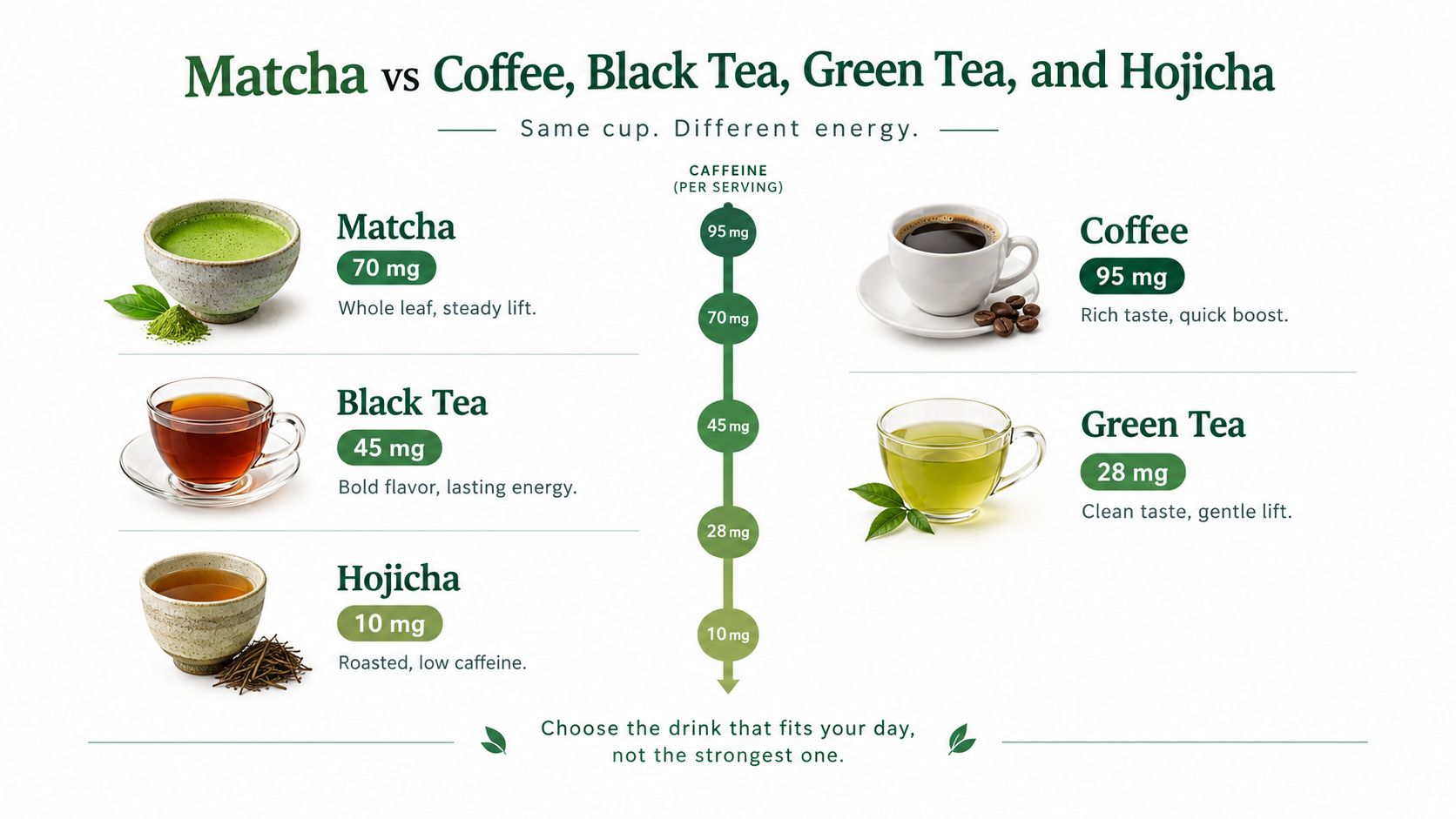
Australian comparison points place a typical 250 mL matcha serving at approximately 60–75 mg. Brewed green tea is approximately 24–45 mg per 250 mL, coffee approximately 100 mg per 250 mL, and black tea approximately 50 mg in a 220 mL cup. These figures help with orientation, but they are not a fixed matcha rule. Your recipe determines the dose.
Matcha also differs from steeped tea in how it is prepared. Green and black tea release compounds into water, while matcha suspends powdered leaf in the drink, so you consume the leaf itself. The explanation of Japanese green tea and caffeine provides useful context for that distinction.
Compare the powder, not just the cup
Suppose a recipe uses two grams of matcha and makes a 250 mL drink. You can compare it with the broad 60–75 mg per serve Australian benchmark. Add more powder while keeping the same drink size, and the likely caffeine exposure rises. A three-gram recipe is therefore not equivalent to a two-gram recipe just because both fill one cup.
Coffee may provide a stronger lift in a similar volume, while brewed green tea often provides less. Hojicha is roasted Japanese green tea and is commonly chosen for a gentler routine. The verified Australian figures here do not establish a precise hojicha amount, so treat it as a lower-caffeine alternative in many practical routines, not a guaranteed fixed dose.
For a pre-sweetened format, Premium Sweet Matcha 200g is described as a blend containing 30% authentic Japanese green tea leaves, prepared with a scoop and whisk. That ingredient detail does not specify caffeine. Weighing the powder and following the intended serving method gives you a clearer personal reference than labels such as ceremonial, latte, or iced.
L-Theanine, Caffeine, and the Myth of Crash-Free Energy
You drink matcha before a busy morning and feel alert without the sharp rush you sometimes associate with coffee. That experience may relate to matcha's combination of caffeine and L-theanine, an amino acid naturally present in tea leaves. Caffeine drives alertness, while L-theanine may moderate how that stimulation feels. The result can seem steadier, though individual responses still vary.
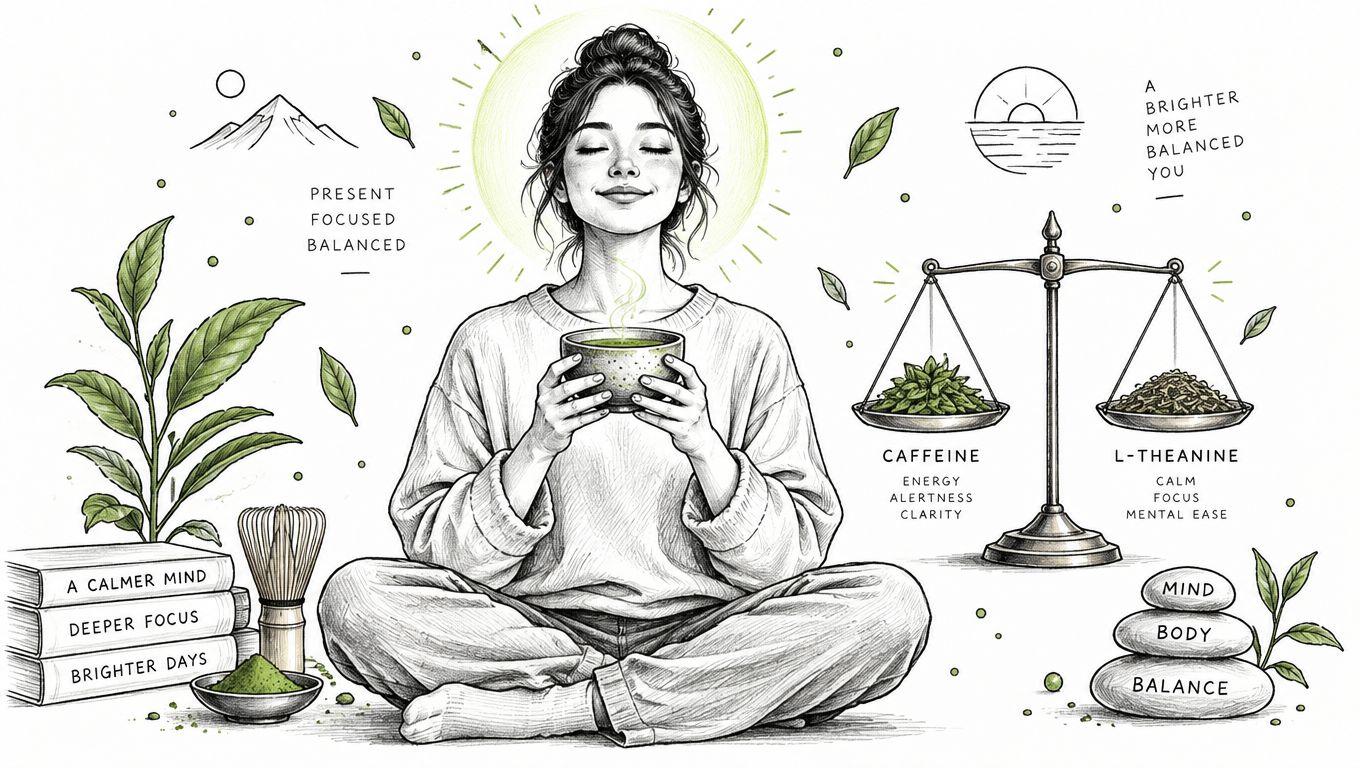
The combination changes the experience for some people, but caffeine remains active. Sleep quality, food intake, personal sensitivity, timing, and the total amount consumed all influence the result. Matcha late in the day can still interfere with sleep, even when it feels gentler than coffee. Coffee, chocolate, energy drinks, and caffeine-containing medicines can raise your overall intake further.
What L-theanine can and can't explain
Tea compounds may shape the way caffeine feels. They cannot promise crash-free energy, guaranteed calm, or unlimited tolerance for matcha. Australian health guidance links caffeine effects in adults with possible sleep-pattern disruption, anxiety, dependence, and withdrawal symptoms. Dose, timing, and individual sensitivity all influence those effects (Australian caffeine guidance).
Your preparation still sets the caffeine dose. A stronger ceremonial serving or a large café recipe can feel stimulating, even with L-theanine present. L-theanine does not reduce the powder you consumed or override the way your body processes caffeine.
The relationship between these compounds is explored further in this guide to matcha and L-theanine. Matcha may feel different from coffee, while still containing caffeine and producing familiar effects for some drinkers.
A short visual pause can reinforce that distinction:
How to Manage Your Matcha Caffeine Intake
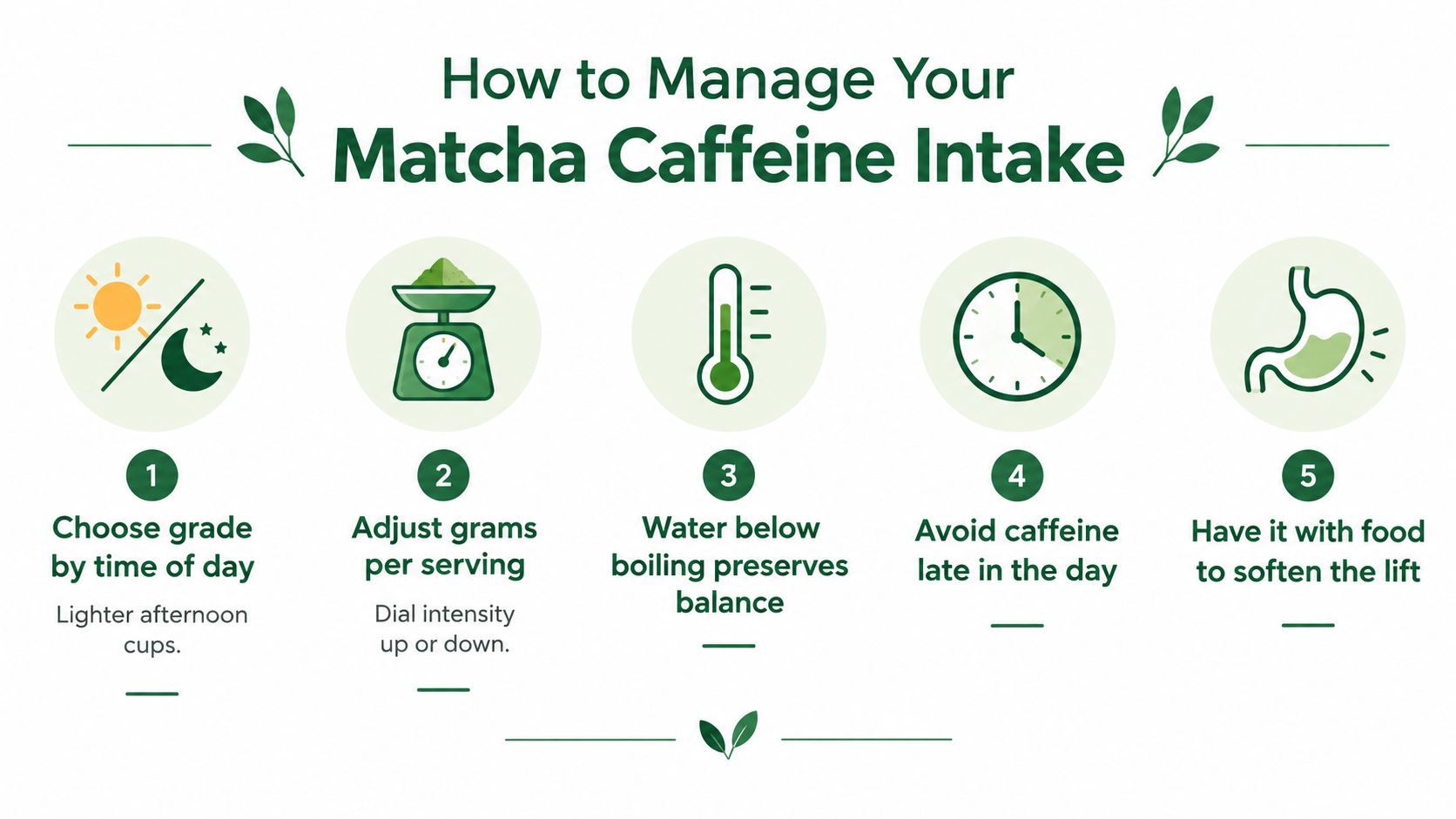
Matcha caffeine is a preparation-driven dose, not a fixed number attached to every cup. The amount you drink depends largely on the grams of powder in the bowl or café recipe. A kitchen scale makes that dose repeatable, especially when you are comparing a homemade drink with a café order.
If a serving feels too stimulating, reduce the powder first. Adding milk, water, or ice changes the flavour, temperature, and texture, but it does not remove the caffeine already present in the powder.
Build a routine you can repeat
Choose the recipe to suit the moment. A stronger whisked serving may fit the start of a demanding day. A smaller or lighter preparation may work better when you are already alert. Hojicha offers a roasted tea option for days when you want to rotate away from matcha.
Water temperature mainly changes flavour and texture. The more dependable caffeine controls are powder mass, serving frequency, and timing.
Track your routine for a few days:
- Record the recipe: Note the powder mass, drink volume, and whether you used water, milk, or ice.
- Add other sources: Include coffee, black tea, green tea, chocolate, energy drinks, and medicines that contain caffeine.
- Observe your sleep: If falling asleep becomes harder, move matcha earlier or reduce the serving.
- Use consistency: A pre-sweetened product may make preparation and flavour more repeatable, but follow its serving guidance.
- Rotate deliberately: Choose a lower-caffeine tea style when you want a different evening drink.
A useful experiment: change one variable at a time. Reduce the powder first, then observe your alertness and sleep before changing the recipe again.
Australian guidance places around 400 mg of caffeine per day as a general benchmark for healthy adults. That amount covers the entire day's intake, not matcha alone, as noted in the earlier FSANZ dietary intake assessment. Use the benchmark for context, then account for your own response. A serving can fit within a population-level reference point and still be too strong, too late, or too frequent for your sleep.
Matcha Caffeine for Sensitive Groups and Special Situations
Pregnancy or breastfeeding can turn a routine matcha into a question about the whole day's caffeine. Australian guidance uses a lower daily reference for these situations than for healthy adults, so matcha needs to be counted alongside coffee, tea, chocolate, energy drinks, and caffeine-containing medicines. A general estimate cannot replace advice from a qualified health professional.
Children and adolescents also need a cautious approach. Australian guidance reports evidence of increased anxiety in children at approximately 3 mg per kilogram of body weight per day. Parents should not assume matcha is automatically a harmless replacement for a soft drink. Because the powder is consumed rather than steeped and discarded, a small-looking cup can still contain a concentrated tea serving.
Adults may respond differently depending on anxiety, sleep, changing caffeine sensitivity, or an existing medical condition. Possible effects include disrupted sleep patterns, anxiety, dependence, and withdrawal. Dose and timing can shape the experience, so a preparation that feels manageable in the morning may be unsuitable later in the day.
Medicines can interact with caffeine as well. If you take medication, are pregnant or breastfeeding, or are choosing a drink for a child, ask a qualified health professional for personalised guidance instead of relying on a standard matcha estimate. Reduced-caffeine products are another option. This guide to decaffeinated matcha tea explains available approaches, although product details still require careful checking.
A Simple Framework and Common Matcha Caffeine Questions
A matcha drink does not have one fixed caffeine dose. The amount changes with the grams of powder, so your preparation matters as much as the tea itself.
Keep four points in view:
- Matcha contains caffeine because it uses tea leaves.
- The dose depends on preparation, especially the powder you measure.
- L-theanine may shape the experience, but it cannot promise crash-free energy.
- Australian daily benchmarks offer context, while sensitivity, timing, and other caffeine sources still matter.
Does matcha have more caffeine than coffee?
A typical 250 mL matcha serving contains approximately 60–75 mg, compared with approximately 100 mg for the same volume of coffee in the Australian matcha comparison. More powder or a stronger preparation can shift the balance.
Is matcha safe every day?
Many healthy adults use the 400 mg daily benchmark as a reference, counting caffeine from coffee, tea, chocolate, energy drinks, and medicines. The FSANZ daily caffeine guidance provides context, not a personal target. Your sleep and response still matter.
How late is too late?
There is no universal cut-off. If matcha disrupts sleep, drink it earlier, use less powder, or choose a lower-caffeine option.
Consistent measuring makes intake easier to estimate. A 200 g pre-sweetened format or 60 g pouch can simplify routines, but the serving size and product information determine the dose.
TOO MATCHA. offers Japanese matcha and hojicha powders in ceremonial, culinary, sweetened, and wholesale formats. Visit TOO MATCHA. and weigh your serving for a more predictable routine.