Matcha Green Tea Grades: The Complete Guide for 2026

In Australia, matcha is commonly described in at least three practical grades, ceremonial, premium, and culinary. Ceremonial matcha is intended for straight whisking, while culinary matcha is designed to hold its flavour through milk, sugar, cooking, and baking, because the categories reflect harvest timing and use rather than a formal government standard.
You may be standing in the kitchen with a bright green pouch in one hand and a latte recipe in the other, wondering whether the more expensive powder is automatically the better choice. The answer depends on what you're making. A silky ceremonial matcha can be wasted in a heavily sweetened smoothie, while a hearty culinary powder may taste harsh when whisked with water alone.
The useful question isn't only, “Which matcha grade is highest?” It's “Which grade gives the right colour, bitterness, texture, and flavour strength for this preparation?” That decision map matters in Australia, where buyers choose between Japanese powders for traditional drinking, café lattes, iced drinks, desserts, and commercial foodservice.
Table of Contents
- Understanding Matcha Grading Conventions
- The Science Behind Matcha Quality
- Ceremonial Versus Culinary Grade Matcha
- Preparing Matcha for Different Uses
- Choosing the Right Matcha for Your Needs
- Storing and Maximising Freshness
Understanding Matcha Grading Conventions
You are choosing between a bright green pouch and a latte recipe. The powder labelled ceremonial may be excellent whisked with water yet disappear under milk, while a stronger culinary matcha can taste too bitter when served plain. The useful question is not which label ranks highest. It is which powder suits the preparation method, ingredients, and heat involved.
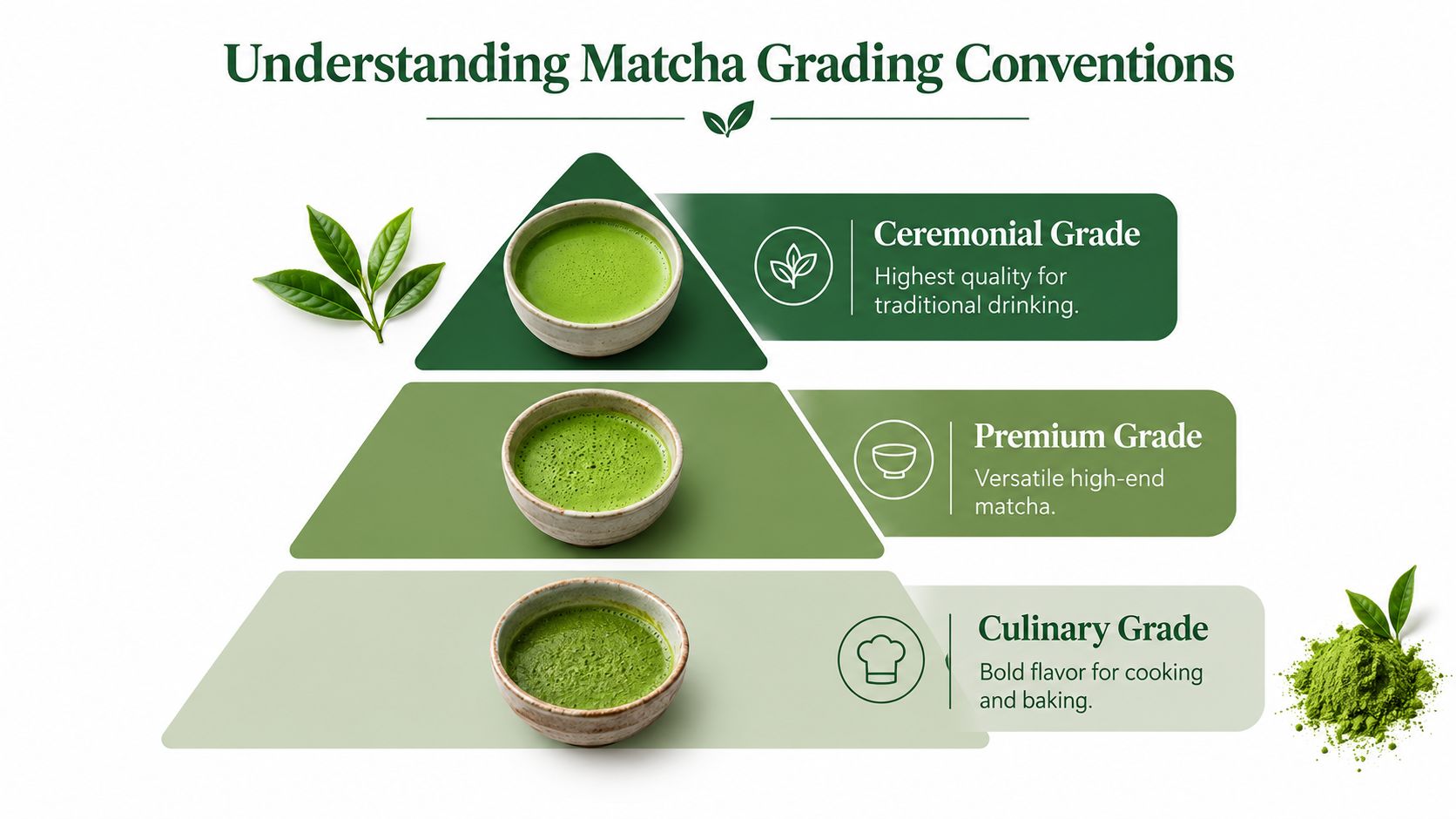
Terms such as ceremonial, premium, classic, latte, and culinary are industry conventions in Australia, not formal government classifications. Australian tea guidance groups matcha by leaf selection, shading, processing, flavour, and intended use rather than one legally enforced scale (Australian Tea Masters' guide to matcha).
Ceremonial matcha is commonly associated with the first flush and young spring leaves. Its smoother texture and balanced flavour make it suitable for drinking with water. Premium matcha generally offers a more flexible middle ground for everyday bowls, iced drinks, and lattes. Culinary matcha is chosen for baking, cooking, smoothies, and recipes where milk, sugar, fruit, chocolate, or flour will shape the final flavour.
Some suppliers also describe nibancha, the second harvest, as a practical latte option. Its more assertive character can remain noticeable after milk is added, making it useful when a delicate first-harvest powder would be muted.
Read the label as a use guide
Read the packaging in three steps:
- Check the stated use. “Ceremonial” usually points to water-only preparation, “premium” to flexible drinking and latte use, and “culinary” to mixed drinks or food.
- Check the harvest description. Earlier-harvest leaves are generally linked with smoother, sweeter flavours. Later-harvest or blended leaves often provide stronger bitterness and better performance in recipes.
- Use colour and origin as clues, not proof. Vivid green powder and Japanese origin are helpful signals, but a grade name cannot guarantee the result in your cup.
For a plain-language comparison, read this guide to the difference between matcha and green tea.
The label starts the assessment. Taste and application finish it. Buyers in Australia should match the powder to water whisking, milk drinks, cold blends, or heated recipes, then check whether the supplier clearly states origin, harvest, processing, and recommended use.
The Science Behind Matcha Quality
The sensory gap between matcha grades begins in the tea field. Shading before harvest changes the leaf's development and is associated with higher amino-acid levels, a fuller umami character, and less astringency. Leaf age also matters. Younger top leaves are typically selected for smoother drinking powders, while older or blended leaves create a stronger, more assertive profile that can work better when combined with milk, sugar, flour, or chocolate.
Processing then determines how those qualities arrive in the bowl. Matcha is a finely milled powder, so particle refinement affects both mouthfeel and whisking. A very fine powder disperses more evenly and creates a smoother suspension. A coarser powder can feel gritty, settle quickly, and leave a rough finish even when the underlying tea has useful flavour intensity.
What to inspect before tasting
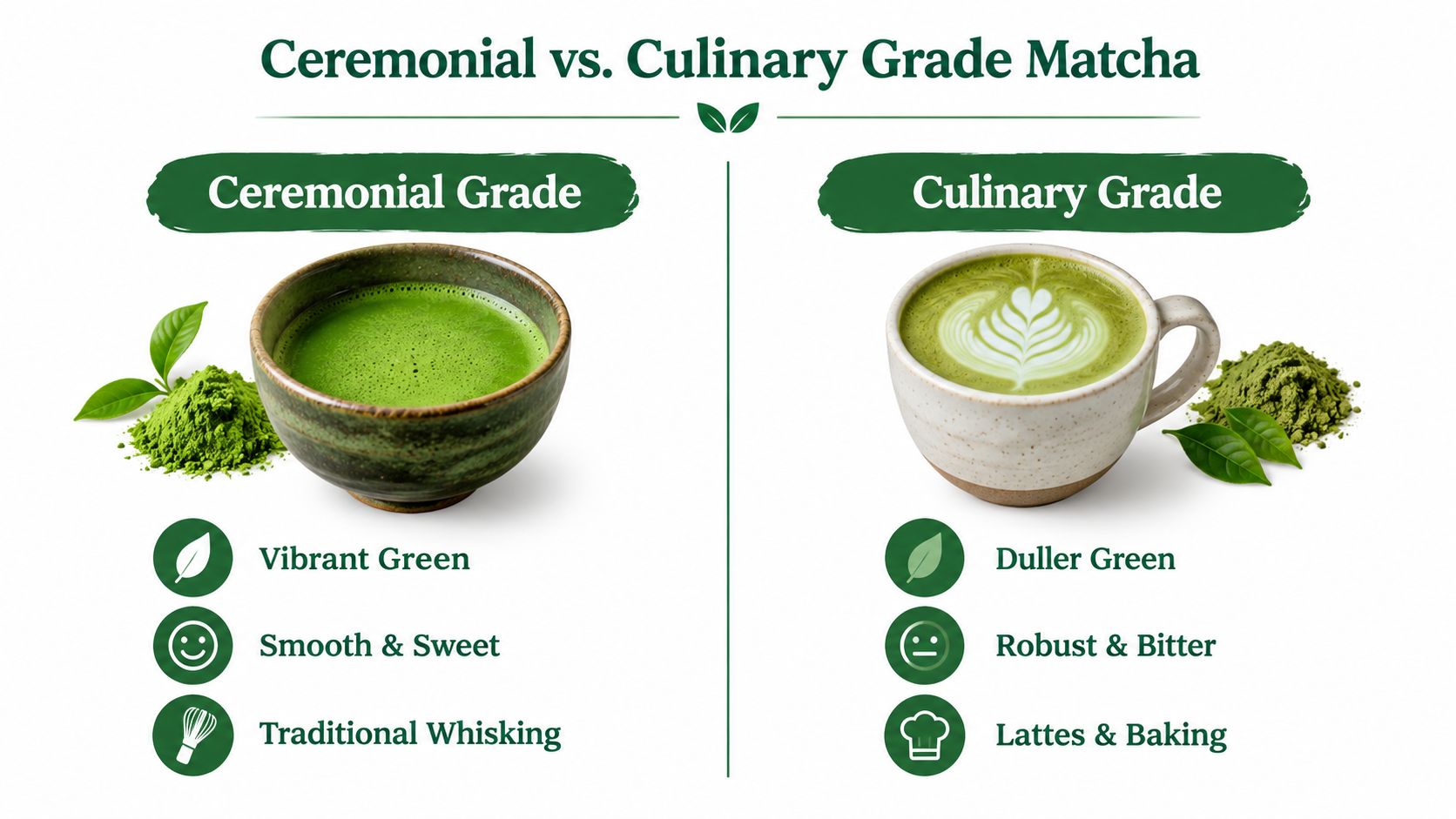
Colour is the first practical signal. Australian buyer guidance describes premium ceremonial matcha as bright or vivid green, while culinary powder is often duller and more astringent (Australian matcha quality guide). Colour alone can mislead, but a fresh vegetal aroma and naturally sweet umami are useful signs when they appear together.
Texture tells you how the powder was refined. Silky, fine particles should sift readily and whisk into a relatively even mixture. Coarse particles won't disappear just because you use more effort. For lattes and baking, that roughness may be less noticeable, but it still affects the finished drink or dessert.
Aroma gives an early warning. Fresh matcha should smell vegetal and lively rather than stale, flat, or dusty. A dull aroma paired with yellowish colour and strong harshness suggests a powder better suited to recipes than to drinking straight.
Practical rule: Judge the powder in the format where you'll use it. A culinary matcha that tastes powerful in a sweetened latte may be doing its job, not failing a ceremonial test.
A product such as Ceremonial Grade Matcha 60g is positioned for this direct comparison: it is sourced from Shizuoka, Japan, shade-grown, and stone-ground into an ultra-fine powder described as naturally sweet, smooth, vibrant green, and rich in umami. Its stated attributes include vegan, gluten-free, dairy-free, and additive-free composition.
The most reliable buying habit is to consider colour, aroma, particle fineness, bitterness, and preparation method together. No single label replaces sensory information.
Ceremonial Versus Culinary Grade Matcha
Choosing between matcha grades starts with the way you will prepare the powder. A bowl whisked with water exposes flavour, aroma, bitterness, and texture. Milk, sugar, fruit, chocolate, blending, and heat soften or cover some of those qualities, so the powder needs enough character to remain present.
Ceremonial matcha is intended for whisking with water and drinking with few additions. Its value lies in balance: vivid colour, fine texture, sweet umami, and controlled bitterness. Finely refined powder should whisk into a light froth and give a smooth, velvety mouthfeel. Choose it when the tea itself is the focus, whether served straight or in a lightly prepared drink.
Culinary matcha is selected for recipes and drinks where other ingredients compete with the tea. Its flavour needs to remain noticeable after dilution, sweetening, blending, or heating. Australian guidance commonly places culinary matcha in baking and foodservice, where its stronger, sometimes more bitter profile can cut through flour, dairy-free milk, sugar, fruit, or chocolate (Australian grading guidance).
A practical sensory comparison
| Grade | Colour and texture | Flavour | Best fit |
|---|---|---|---|
| Ceremonial | Bright green and fine, often silky | Sweet umami, smooth, low bitterness | Straight whisking and lightly prepared drinks |
| Premium or classic | Green and refined, with a more assertive profile | Balanced enough for drinking, strong enough for milk | Hot or iced lattes and mixed drinks |
| Culinary | Often duller and coarser | Bold, full-bodied, more astringent | Baking, cooking, smoothies, and strongly flavoured drinks |
| Sweet matcha | Depends on the tea blend and added sweetener | Consistent, approachable, ready to mix | Convenient lattes and iced drinks |
Premium often provides the most practical middle ground. In a latte, it can deliver visible colour and a clear tea flavour without paying for qualities that milk will soften. It also suits home drinkers who alternate between water-based drinks and milk-based recipes.
Sweet matcha is a pre-sweetened blend, not a traditional grade in the same sense as ceremonial or culinary. It offers convenience and a repeatable flavour. The trade-off is reduced control, because the tea and sweetener cannot be adjusted separately. It suits consistent lattes and iced drinks rather than careful adjustment of bitterness or sweetness.
The price hierarchy in Australian wholesale listings reflects this segmentation. One catalogue lists matcha from A$390 per kilogram for Kagoshima Standard through to A$1,050 per kilogram for Izumo Reserve, with the listed cost per cup-equivalent moving from A$1.17 to A$3.15 (Australian wholesale matcha catalogue). The higher-priced powder is not automatically the better choice. Match the grade to water, milk, or heat first, then compare flavour and cost.
Preparing Matcha for Different Uses
Preparation should follow the powder, not fight it. Ceremonial matcha rewards a careful whisking method because water exposes every part of its flavour and texture. Culinary matcha is more forgiving when dispersed into a larger recipe, but it still benefits from being mixed smoothly before you add it to milk, batter, or a smoothie.
For ceremonial matcha
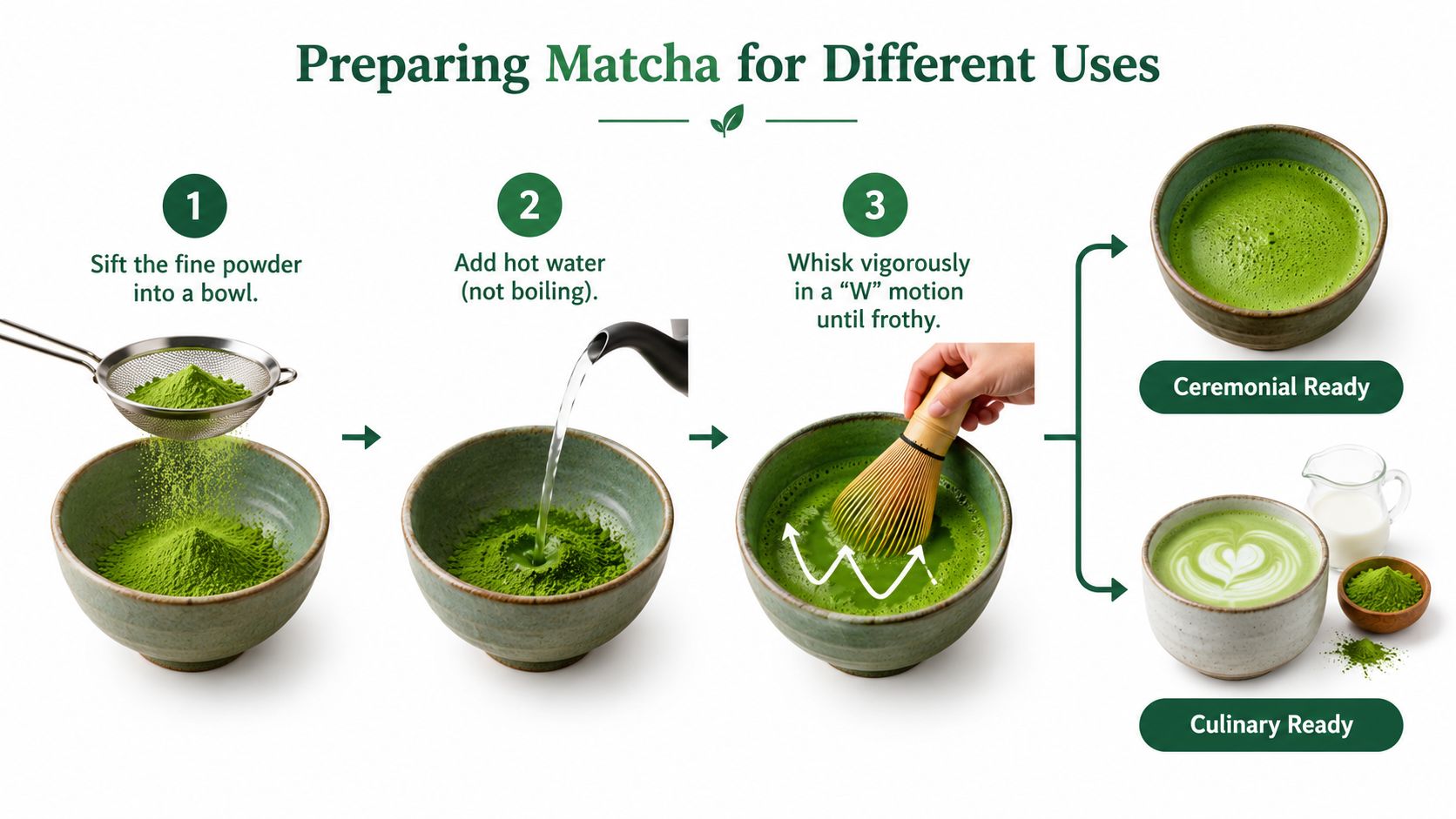
Start with a clean bowl and sift the powder. This breaks up compacted particles before water arrives and makes whisking more efficient. Add hot water that isn't boiling, then use a bamboo whisk to work the powder briskly in a W-shaped motion. Keep the whisk near the surface at the end to build a fine froth rather than just stirring from the bottom.
The objective is a smooth, suspended drink with a light, even foam. If the result tastes sharply bitter, check the water temperature, powder freshness, and quantity before blaming the grade. Very hot water can draw out harsher notes, while stale matcha loses the bright aroma that makes direct drinking appealing.
For a broader set of serving ideas, use this practical guide on how to use matcha powder.
For a latte, whisk the powder first with a small amount of water to make a smooth concentrate. Add warm or iced milk afterwards. This prevents dry pockets from floating through the drink and lets you control the final strength.
For culinary and sweet matcha
Culinary matcha works well when you create a slurry before adding it to the main mixture. In a smoothie, blend it with liquid before adding ice and fruit. In baking, whisk it into the dry ingredients or dissolve it into a small wet component first, depending on the recipe. This distributes colour and flavour more evenly than tipping the powder straight into a thick batter.
A pre-sweetened product such as Premium Sweet Matcha 200g is described as containing 30% authentic Japanese green tea leaves and a naturally sweet, silky-smooth powder. It's intended for quick, consistent preparation, including lattes and iced drinks, and is described as vegan, gluten-free, dairy-free, and additive-free. With a sweet blend, start with less additional syrup than you'd use for unsweetened matcha, then adjust the milk and ice rather than adding sweetness automatically.
Choosing the Right Matcha for Your Needs
The best grade is the one that survives your preparation method while giving you the flavour you want. Start with the final format, then consider how much of the tea will remain exposed.
For plain whisked matcha, choose ceremonial when you want smooth texture, vivid colour, and a more layered umami profile. Paying for finer leaf selection and refined processing makes the clearest sensory difference here. If you're new to matcha, a smaller format lets you learn what sweetness, vegetal aroma, and bitterness feel like before committing to a larger supply.
For a hot or iced latte, premium or classic matcha is often the practical choice. Milk softens bitterness and changes texture, so the subtle qualities that justify a top ceremonial powder may become less distinct. Choose culinary instead when the drink includes strong syrups, chocolate, fruit, or a large amount of milk and you need the tea flavour to remain present.
For smoothies, culinary matcha usually makes more sense. Fruit, yoghurt, plant-based milk, and ice all compete with the tea. A bolder powder can keep its identity without requiring you to use a delicate drinking grade in a heavily flavoured mixture.
For baking and cooking, select culinary by default. Heat and other ingredients alter the final result, and culinary matcha is built around persistence rather than delicate sweetness. It can be the superior choice for a cake, cookie, sauce, or dessert even when ceremonial is more expensive.
What cafés should assess
Café buyers need consistency more than label prestige. Ask whether the powder:
- Keeps its colour: A latte should still look recognisably matcha after milk is added.
- Maintains flavour: The tea shouldn't disappear beneath sweetener or ice.
- Whisks or blends efficiently: Staff need a repeatable method during service.
- Fits the menu economics: A premium powder may suit a whisked signature drink, while culinary or premium grade may be more rational for high-volume mixed beverages.
Australian market reporting places matcha revenue at $53.75 million in 2024 and projects $82 million by 2030, so the local category is expanding while consumers become more interested in how grades perform in real drinks (Australian matcha market coverage). Supply conditions also matter. Reporting on the Australian market says Japan's green tea exports to Australia reached 195,319 kilograms between January and August 2025, while a tencha auction price reached 8,235 yen per kilogram, up 170% from a year earlier (SBS reporting on Australia's matcha boom).
That pressure makes value a performance question. If ceremonial supply is tight or expensive, premium may be the smarter café choice for milk-based drinks, and culinary may be the more dependable option for recipes.
Storing and Maximising Freshness
Matcha changes quickly once air, light, heat, and moisture reach the powder. The first sign may be a loss of vivid colour, followed by a flatter aroma and a harsher finish. That's why a small pouch can make sense for an occasional drinker, while a café should organise stock so opened powder gets used before it sits exposed for too long.
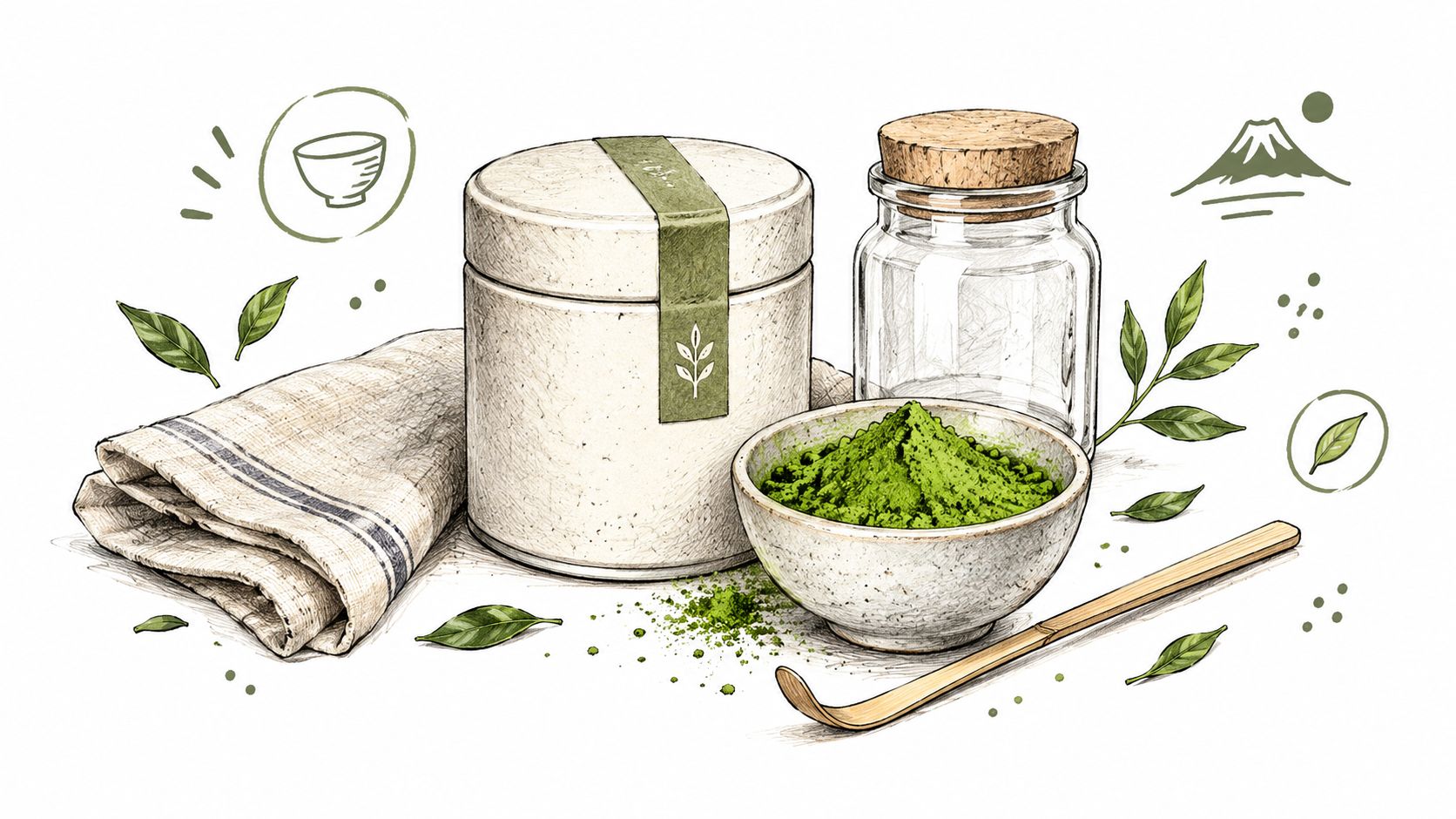
A simple storage routine
Keep the package tightly sealed and away from direct sunlight, steam, and warm benchtops. Close the pouch or tin immediately after scooping, and use a clean, dry utensil so moisture doesn't enter the powder. A refrigerator can help protect unopened matcha from heat, but condensation is a risk, so allow a cold container to return to room temperature before opening it.
For the full process, follow this guide on how to store matcha powder.
Fresh shipment models also matter because matcha's quality depends on the time between milling, packing, opening, and drinking. Sourcing from Japan gives buyers clearer visibility into origin and production, but the final storage routine still sits with the household, café, or retailer. Australian green tea supply is heavily import-dependent, with one industry report estimating that imports cover 95–98% of domestic organic green tea consumption by volume, and Japan supplying 15–20% of imports, particularly through matcha and high-grade sencha (Australian organic green tea import analysis).
For buyers comparing costs, another Australian market report estimates that the country imports more than 99% of its raw green tea leaves, identifying high-quality Japanese matcha and sencha as a major cost driver at about AUD 30–80 per kilogram wholesale (Australian unsweetened green tea market analysis). Those supply realities reinforce the value of buying the grade that matches the job and storing it carefully once it arrives.
Start with a direct-drinking ceremonial powder if you want to understand matcha's smoothest side. Add premium for flexible lattes, culinary for baking and bold blended drinks, and sweet matcha when speed and consistency matter most. The right matcha green tea grade isn't the one with the grandest label. It's the one that still tastes right when it reaches your bowl, glass, or recipe.
TOO MATCHA. offers Japanese-sourced ceremonial, culinary, and pre-sweetened matcha formats for whisking, lattes, iced drinks, baking, and foodservice. Visit TOO MATCHA. to compare grades and choose a powder that suits the way you prepare matcha.