What Is Matcha Green Tea Powder? a Complete Guide
You're standing at an Australian café, scanning the menu for your usual flat white, when a bright green matcha latte catches your eye. You've seen the powder online, perhaps whisked into a glossy drink or folded into a vivid cake, but the basic question remains: what is matcha green tea powder, and why does it taste so different from ordinary green tea?
Matcha is finely milled powder made from specially grown leaves of Camellia sinensis. Instead of steeping the leaves and discarding them, you mix the powder into water, milk, or food and consume the whole leaf. That difference affects matcha's flavour, texture, preparation, caffeine experience, and the way Australian buyers should judge quality.
Table of Contents
- Understanding Matcha Green Tea Powder
- How Matcha Is Produced
- Matcha Grades Explained
- Health Benefits of Matcha
- Brewing and Culinary Uses
- Storage and Buying Guide
- Finding the Right Matcha for You
Understanding Matcha Green Tea Powder
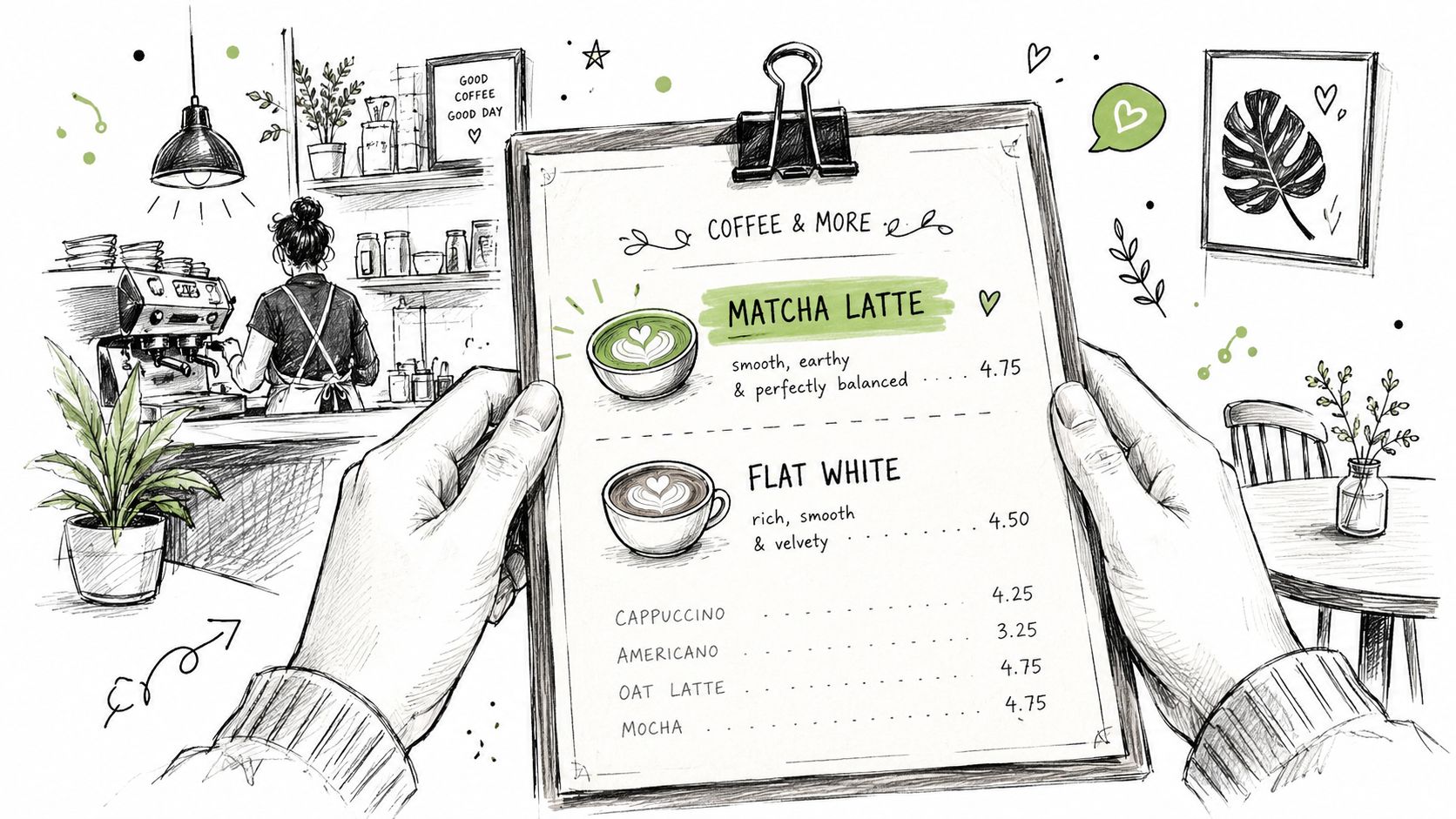
A café customer ordering matcha for the first time may expect something like green tea with milk. The first sip usually gives a clearer answer. Matcha has a creamy body, a fresh vegetal character, and an umami depth that ordinary brewed tea rarely delivers. In a latte, milk softens those flavours, while a traditionally whisked cup lets the powder's sweetness, aroma, and texture remain fully visible.
The leaves used for matcha are shade-grown before harvest, then steamed, dried, stripped of stems and veins, and ground into an ultra-fine powder. This is not the same as grinding finished tea leaves from a standard tea bag. The shading changes the leaf's chemistry, supporting matcha's vivid colour and savoury-sweet flavour, while the careful processing preserves the material that becomes the final powder.
Matcha and ordinary green tea
With standard green tea, hot water draws flavour and soluble compounds from the leaves. You drink the infusion and leave most of the leaf behind. With matcha, the powder remains suspended in the drink, so particle size, dispersion, and mouthfeel become part of the drinking experience.
The whole-leaf format also explains why matcha is often discussed in relation to catechins, amino acids, chlorophyll, and caffeine. These compounds are present in the powder rather than being limited to what water extracts during a short steep. That doesn't make every health claim about matcha reliable, but it does make matcha a distinct food format rather than a stronger cup of green tea.
A short history
Powdered tea customs developed in China during the Tang Dynasty. The practice was later refined in Japan, where the Zen monk Eisai helped establish tea cultivation and whisking traditions after bringing tea seeds and the method of preparing powdered tea. Over time, whisked matcha became closely connected with chanoyu, the Japanese tea ceremony.
Today, matcha appears in Australian cafés, home kitchens, smoothies, desserts, and foodservice menus. Australia's category is structurally import-dependent, with more than 90% of domestic demand met by imports, while Japan supplies an estimated 65–75% of import value because of its concentration in premium grades, as summarised by Australia matcha market analysis. Understanding where matcha comes from helps explain why origin, grade, freshness, and supply consistency matter so much when you buy it.
How Matcha Is Produced
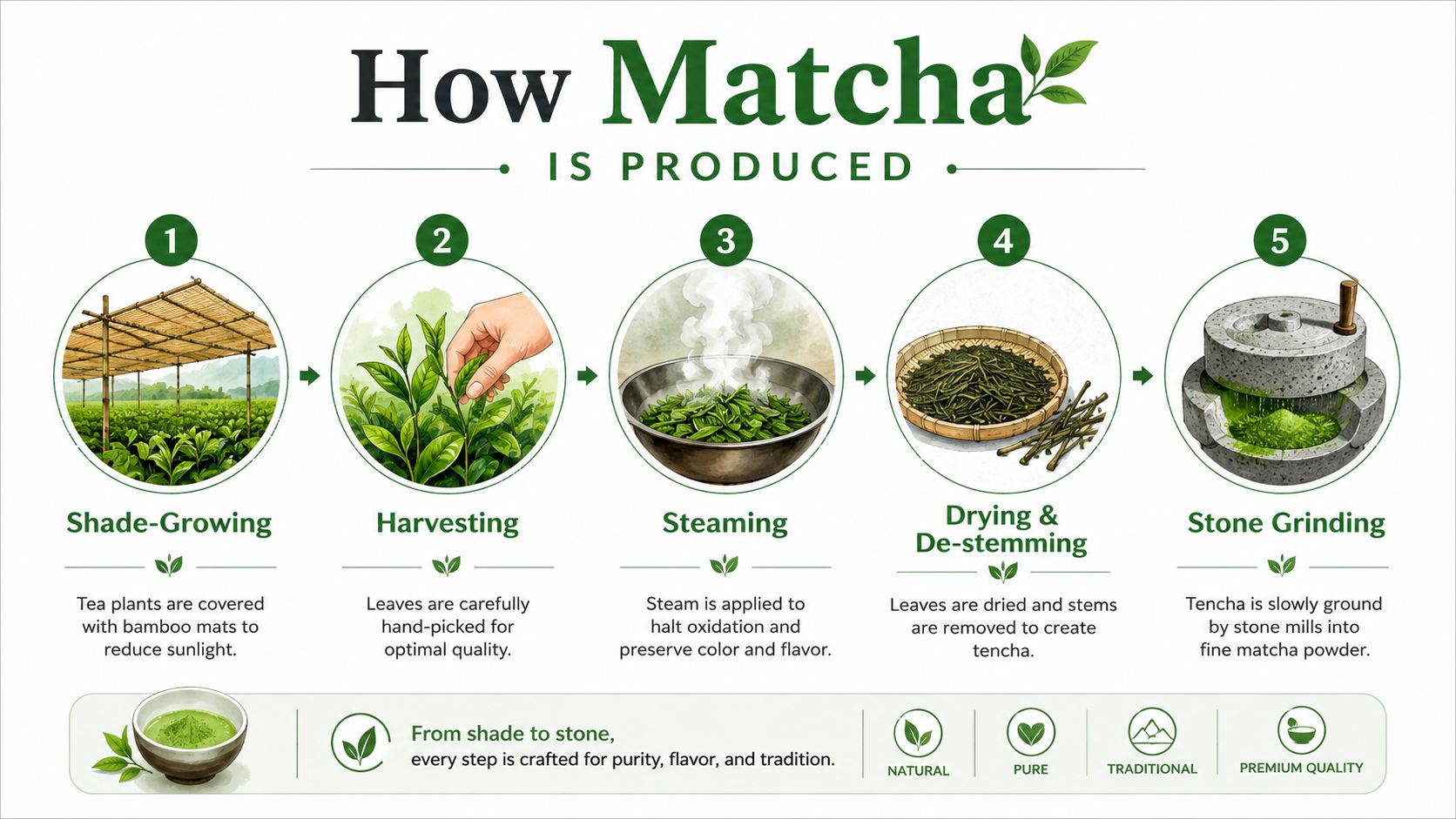
Matcha's colour and flavour begin in the tea field, not in the café. Producers shade the tea plants before harvest, reducing direct sunlight and encouraging the leaves to develop the characteristics associated with matcha. The shade-growing stage shifts leaf chemistry towards higher levels of amino acids such as theanine while preserving catechins and caffeine in the finished powder, as described in the science of matcha.
From leaf to tencha
- Shade-growing: Producers cover the plants before harvest. Less sunlight encourages deeper green colour and helps create matcha's rounded, umami-led taste.
- Selective harvesting: The youngest and most tender leaves are chosen for higher-grade matcha. Leaf maturity affects flavour, colour, and texture, so harvest selection is one of the important differences between grades.
- Steaming: Fresh leaves are steamed soon after picking to halt oxidation. This preserves the green character instead of allowing the leaves to darken in the way they would during more oxidising tea production.
- Drying and de-stemming: The leaves are dried without the rolling process used for many other teas. The resulting crude material is called aracha. Producers then remove stems and veins, leaving the pure leaf material known as tencha.
- Stone grinding: Tencha is slowly ground between stone surfaces into an ultra-fine powder. Fine milling supports better suspension and a smoother latte, while poor granulation can leave sediment and an uneven texture.
Why processing affects your cup
Matcha is a whole-leaf ingestion format, not an extract. A well-made powder should disperse evenly when sifted and whisked, producing a velvety drink rather than gritty sediment. Moisture control matters too, because damp powder can cake, lose its freshness, and become harder to dose consistently.
For a beginner who wants to taste matcha without committing to a large quantity, Ceremonial Grade Matcha 60g is sourced from Shizuoka, Japan, and described as a shade-grown, stone-ground powder intended for a smooth, whisked cup. Its listed product attributes include premium, vegan, gluten free, dairy free, and additive free.
The production method also creates practical quality checkpoints. Independent Australian specification data includes benchmarks such as 95% passing 200 mesh, loss on drying of ≤8.0%, total heavy metals below 10 ppm, and defined microbial limits, including the absence of Salmonella and Staphylococcus aureus in specified test amounts, as outlined in Australian matcha quality specifications. Buyers supplying cafés or retailers should ask for documentation rather than relying only on colour or marketing language.
Matcha Grades Explained
The word “grade” sounds precise, but matcha labels aren't always standardised across sellers. Treat the label as a starting point, then check the powder's origin, harvest information, ingredient list, colour, texture, and intended use. A powder that performs beautifully in a cake may not make an enjoyable cup with water, and an excellent whisking matcha may be unnecessarily costly for baking.
Ceremonial grade
Ceremonial matcha is designed for drinking with water. It's typically made from carefully selected early-harvest tencha and should have a bright jade colour, fine texture, fresh aroma, and naturally sweet umami flavour. A good example produces a smooth, rounded cup with little bitterness when prepared with appropriately warm water.
Choose this grade when the powder itself is the focus. It suits traditional whisking and minimalist lattes where milk doesn't need to hide a harsh or flat flavour. You can also use it in an iced latte, but baking with it may waste the qualities you paid for.
Culinary grade
Culinary matcha is made for recipes and stronger-flavoured drinks. Its flavour can be more intense or astringent, which helps it remain noticeable after mixing with milk, fruit, sugar, fats, or other ingredients. It's the practical choice for regular lattes, smoothies, ice cream, cakes, cookies, and sauces.
A latte made with culinary matcha can taste excellent, especially when you prefer a stronger tea flavour. It won't necessarily deliver the same delicate sweetness or creamy finish as a powder selected for drinking straight, but that isn't its job.
Sweet or ingredient grade
Sweet matcha is formulated for convenience and consistency. It may be pre-sweetened or designed for confectionery and other applications where the powder must work alongside sugar, flour, dairy, or plant-based ingredients. Always check the ingredient panel, because sweetened matcha isn't interchangeable with pure matcha powder.
| Grade | Colour | Flavour profile | Texture | Best uses | Price range |
|---|---|---|---|---|---|
| Ceremonial | Vibrant green | Sweet, smooth, umami-led | Ultra-fine and creamy | Whisked tea, minimalist lattes | Varies by origin and processing |
| Culinary | Strong green | More robust, sometimes more astringent | Fine, designed to mix | Lattes, smoothies, baking, ice cream | Varies by formulation and sourcing |
| Sweet or ingredient | Green, formulated for the recipe | Sweetened or recipe-focused | Designed for easy incorporation | Quick lattes, confectionery, desserts | Varies by ingredients and format |
Practical rule: Buy ceremonial for straight drinking, culinary for everyday mixed drinks and food, and sweet or ingredient grade when convenience and recipe consistency matter most.
Health Benefits of Matcha
Matcha contains caffeine, the amino acid L-theanine, catechins, and other compounds naturally present in tea leaves. Because you consume the powder rather than discarding steeped leaves, matcha is a concentrated food matrix. That doesn't mean it should be treated as a cure-all, and broad promises about weight loss, detoxification, or disease prevention go beyond the information available here.
The most useful Australian comparison is practical: how might matcha feel compared with coffee? Recent Australian reporting places a typical 250 ml coffee at about 100 mg of caffeine, while matcha is usually around 60–75 mg per cup, with the combination of caffeine and L-theanine often associated with a smoother alertness experience, as discussed by ABC News Australia's matcha and coffee comparison.
Caffeine and L-theanine
Caffeine can increase alertness, but individual responses vary. Some people find coffee feels abrupt or produces unwanted jitters, while matcha feels gentler. L-theanine may contribute to that difference, although your result depends on the powder amount, drink size, food consumed alongside it, personal caffeine sensitivity, and sleep habits.
Australian product panels demonstrate why serving assumptions can mislead. One locally sold organic matcha lists a 5 g serving with 150 mg of caffeine, while another listing reports 180 mg of L-theanine per 100 g. Café formulations vary as well. Starbucks Australia lists 75 mg of caffeine per serve for an iced matcha latte, while other Australian menu items using matcha list 62 mg to 150 mg, showing that the final drink depends heavily on recipe and serving size.
| Compound or factor | Matcha, 1 tsp or 2 g | Coffee, 1 cup or 240 ml |
|---|---|---|
| Caffeine | Commonly about 60–75 mg per cup, depending on preparation | A typical 250 ml coffee is reported at about 100 mg |
| L-theanine | Naturally present in tea leaves | Not naturally present in coffee |
| Antioxidant compounds | Contains catechins, including EGCG | Contains its own coffee compounds, but not tea catechins |
| Alertness experience | Often described as steadier by some drinkers | Can feel more immediate or stimulating for some people |
| Energy crash likelihood | Individual response varies | Individual response varies |
Catechins, including EGCG, are antioxidant compounds found in green tea. Matcha also contains vitamins and minerals, but the amount you receive depends on the powder, serving size, and nutrition panel. For a more detailed discussion of the compounds associated with matcha, see Japanese green tea powder benefits.
Start with a modest serving if you're sensitive to caffeine, avoid treating matcha as automatically caffeine-free or risk-free, and consider drinking it earlier in the day if it affects your sleep. If you're pregnant, managing a medical condition, or taking medication affected by caffeine, ask a qualified health professional about a suitable intake.
Brewing and Culinary Uses
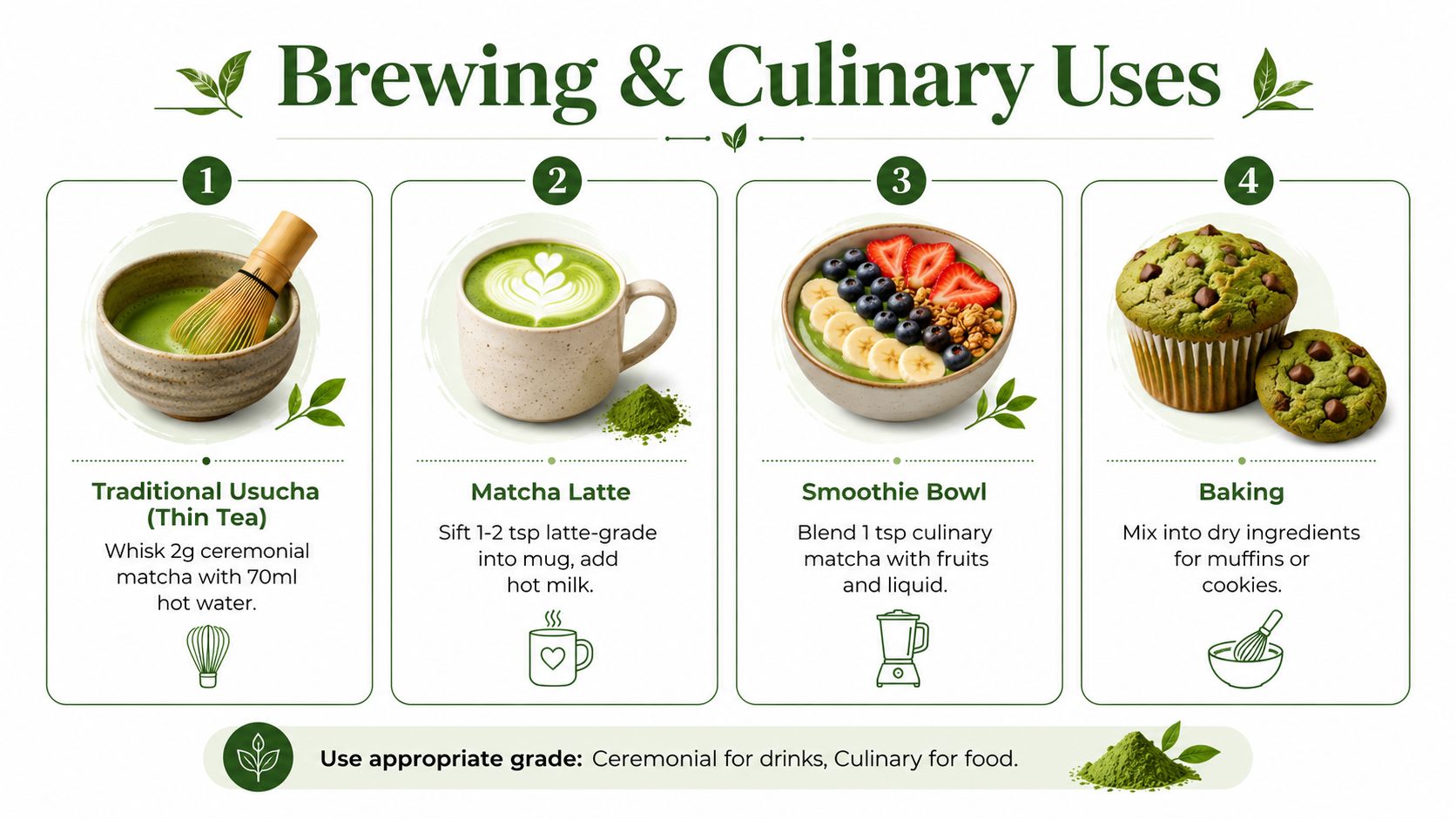
Matcha behaves differently depending on how you use it. Ceremonial powder rewards simple preparation, while culinary powder is built to stand alongside milk, sugar, fruit, fat, and flour. Sifting matters for both, because dry clumps resist hydration and leave an uneven drink.
Traditional usucha
For thin tea, use ceremonial matcha and a bamboo chasen whisk.
- Warm your bowl and add the powder through a fine sieve.
- Add water at 70–80°C. This temperature helps reduce harsh bitterness.
- Use the whisk in quick W-shaped movements, keeping the whisk close to the surface.
- Stop when the powder is evenly dispersed and a fine foam appears.
Don't press the whisk into the bowl, as that can damage the bamboo tines and make it harder to create a smooth surface. The aim is a fine suspension, not a stiff, spoonable paste.
Lattes and cold drinks
For a hot latte, sift ceremonial or premium culinary matcha into a cup, add a small amount of warm water, and whisk until smooth. Add steamed dairy milk or a plant-based alternative, then adjust with a sweetener that suits the tea's flavour, such as maple syrup or a small amount of honey.
Culinary matcha is often the sensible daily option because milk and sweeteners soften its sharper edges. For an iced latte, dissolve the sifted powder with warm water first, then add cold milk and ice. Shaking in a sealed jar can work, but a whisk or handheld frother usually gives more even dispersion.
Cooking with matcha
Use culinary grade for baking and desserts. Sift it into dry ingredients before combining the wet and dry mixtures, and balance its bitterness with sugar or fat. It works well in cakes, cookies, panna cotta, smoothies, overnight oats, and ice cream.
A small amount can add colour and tea flavour to a smoothie bowl without making the drink heavy. For a practical preparation guide covering drinks and recipes, visit how to use matcha powder. Save ceremonial powder for applications where you'll notice its texture and flavour, rather than burying it in a strongly flavoured cake.
Storage and Buying Guide
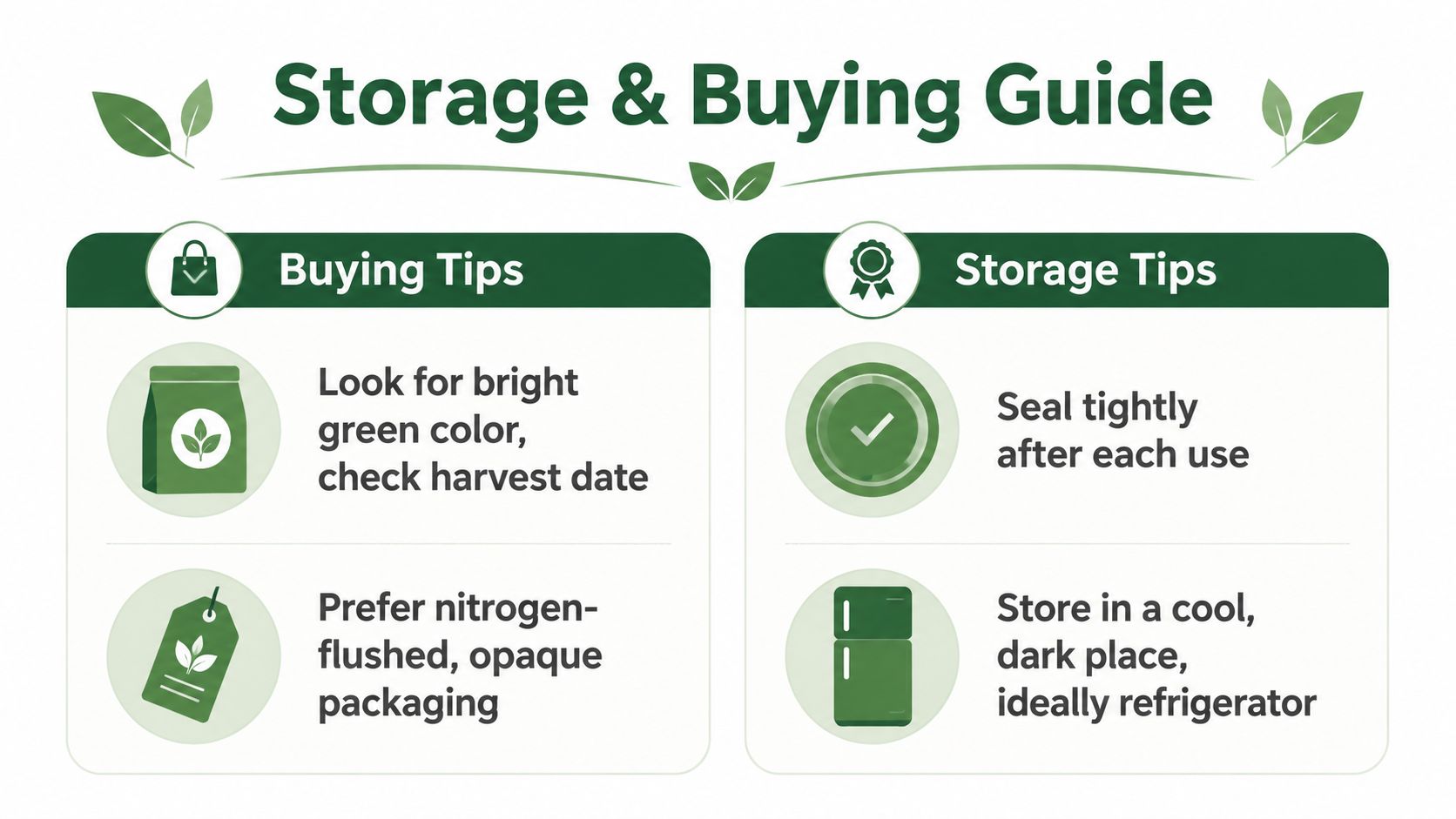
A freshly opened pouch can lose its lively aroma quickly on a warm Australian kitchen bench. Matcha is finely milled, so oxygen, light, heat, and moisture reach a large amount of leaf surface. Over time, the colour becomes duller and the flavour can turn flat or hay-like. An opaque tin holding a tightly sealed pouch offers better protection than transparent packaging in direct sunlight.
Keep oxygen and moisture out
Keep unopened matcha in a cool, dark place and follow the supplier's directions. Once opened, press out excess air and seal the pouch firmly. Refrigeration can help if the packaging and supplier guidance allow it. Let the container warm towards room temperature before opening, because opening chilled matcha can introduce condensation to the powder.
Use a clean, dry spoon. Steam from a kettle, wet utensils, or water droplets can cause clumps and shorten freshness. For a more detailed routine, see how to store matcha powder.
Assess the powder before buying
Check for vibrant green colour, a fine, talc-like texture, clear Japanese origin information, and a harvest or packing date where available. Fresh matcha should smell lively and vegetal. A dusty, flat, or hay-like aroma suggests that storage age or handling deserves closer attention. A yellow-green appearance alone does not prove poor quality, but it is a useful prompt to check the product details.
Matcha is an imported specialist category for Australian buyers, with supply available in formats suited to whisking, lattes, and baking. Market research indicates that Australia's green tea powder imports grew at an estimated 13–17% compound annual growth rate from 2020 to 2025, while customs-cleared matcha shipments grew by about 12–18% year-on-year over the past five years, according to Australia matcha market research. Compare sourcing and freshness information rather than choosing by colour or price alone.
Buying checkpoint: A price significantly below comparable Japanese matcha often indicates later-harvest leaves or reduced freshness controls. Check the label for origin, format, harvest or packing information, and storage guidance before buying.
Finding the Right Matcha for You
The right matcha depends on what you'll do with it after opening the package.
If you want to whisk tea with water and taste the powder directly, choose ceremonial grade with a bright colour, fine texture, and smooth umami profile. If your routine is a café-style latte, smoothie, or iced drink, culinary grade may offer the stronger flavour and practical value you need. If you want a fast, consistent sweet drink, a sweet or ingredient format can reduce preparation steps, but check whether sugar or other ingredients have been added.
Your quality checklist is straightforward:
- Colour: Look for a lively green rather than a dull, yellowish tone.
- Texture: The powder should be fine and siftable, not gritty or heavily clumped.
- Origin: Prefer clear Japanese sourcing and useful information about the product.
- Documentation: For foodservice or retail use, request compositional and per-lot testing information.
- Storage: Buy an amount you can use while it still smells fresh and tastes expressive.
Australian demand now supports several matcha channels rather than one uniform product. A report valued Australia's green tea powder imports at US$27.05 million and 2,249.28 tonnes in the twelve months from November 2024 to October 2025, with value up 41.01% year-on-year, as reported in Australian green tea import data. Another market report estimated Australia's matcha market at more than A$54 million in 2024, while Japanese green tea exports to Australia reached 195,319 kilograms between January and August 2025, up 131% year-on-year, according to Australia matcha tea market coverage. Those figures point to a market with room for ceremonial sipping, daily lattes, culinary use, and bulk supply.
TOO MATCHA. offers ceremonial matcha in 60g, 500g, and 1kg formats, premium culinary matcha in the same sizes, and premium sweet matcha in 200g, 500g, and 1kg formats. Its range also includes hojicha powder, multipacks, bundles, starter sets, and wholesale pathways, so a home drinker, baker, or café can select a format that matches actual usage rather than buying one powder for every purpose.
Choose a grade based on your routine, then start with a manageable format and learn how the powder tastes in your preferred drink or recipe. Visit TOO MATCHA. to explore Japanese-sourced ceremonial, culinary, and sweet matcha formats for whisking, lattes, baking, and foodservice use.