Vegan Matcha Powder Guide: Grades, Benefits, and Buying Tips
You're standing in the kitchen with a bright green pouch in one hand and a carton of oat milk in the other, wondering whether “vegan matcha” is a special kind of tea or just a label on the front of the packet. The answer matters because pure matcha is naturally plant-based, while latte blends, sweetened powders, and café mixes can contain extra ingredients that change what you're buying.
Australia's category is growing beyond a specialist niche. The Australian matcha market was estimated at USD 35.4 million in 2024 and is projected to reach USD 52.7 million by 2030, with a forecast 7.1% CAGR from 2025 to 2030. Powder was the largest product segment in 2024, while instant premixes were identified as the fastest-growing segment, a useful distinction for anyone choosing between traditional powder and a convenient dairy-free drink mix. (Australian matcha market outlook)
Table of Contents
- What Vegan Matcha Powder Really Means
- Choosing Between Ceremonial, Culinary, and Sweet Grades
- Caffeine, L-Theanine, and What Matcha Does to You
- Buying Fresh Matcha and Storing It Properly
- Three Easy Vegan Matcha Recipes to Try at Home
- Troubleshooting Bitter, Clumpy, or Dull Matcha
- Wholesale and Cafe Buying Considerations in Australia
- Quick Answers for Vegan Matcha Buyers
What Vegan Matcha Powder Really Means
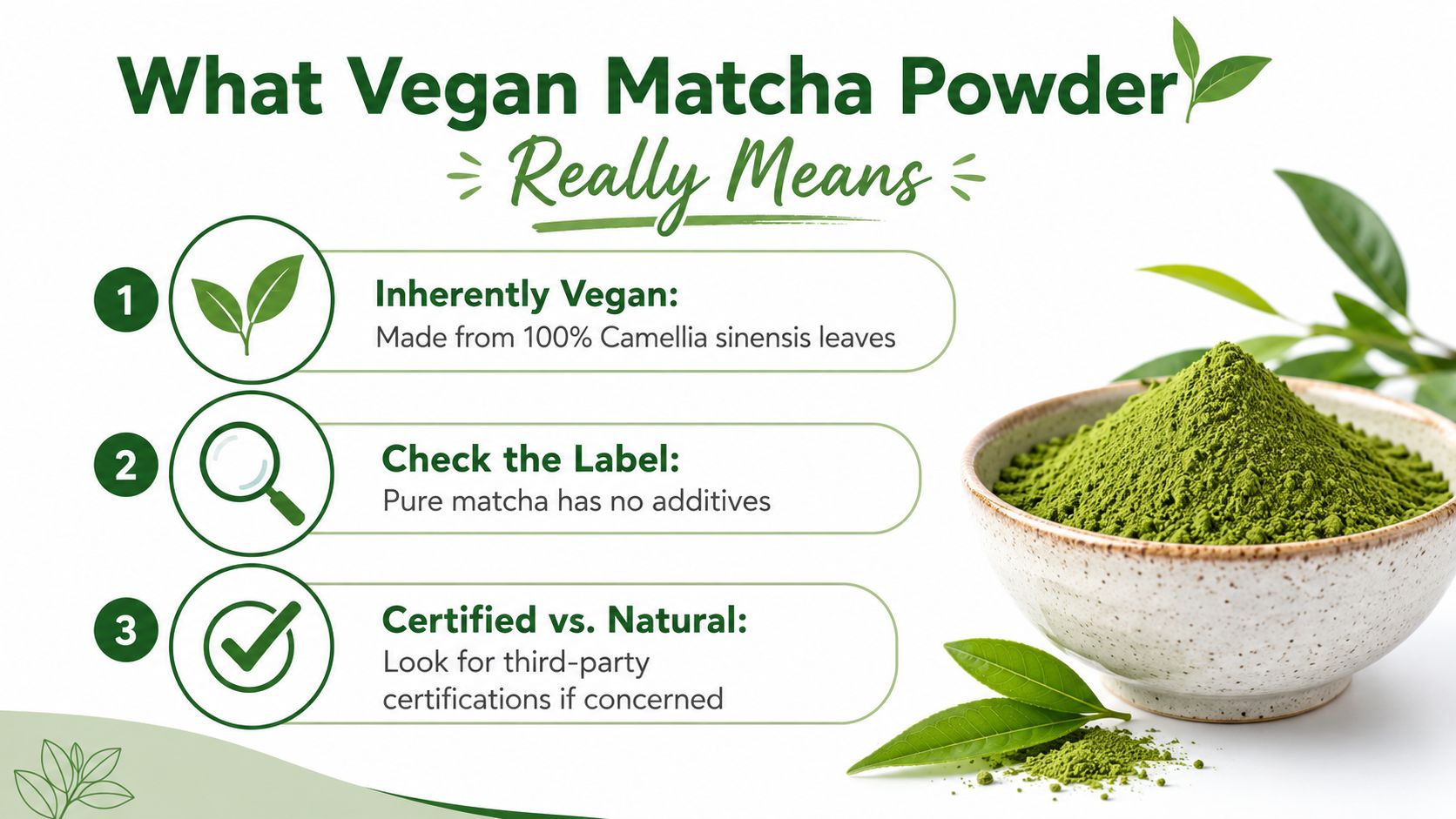
Pure matcha is finely milled green tea made from the leaves of Camellia sinensis. If the ingredient panel says only matcha, the powder is vegan. The tea leaf is plant-based, and milling doesn't require milk, honey, eggs, gelatin, or another animal-derived ingredient.
The confusion starts when manufacturers add ingredients for convenience, sweetness, texture, or flavour. A pre-sweetened matcha powder may still be vegan, but you need to confirm the recipe rather than assume the front label tells the whole story.
Read the ingredient panel first
Use this quick check before buying:
- Look for a single ingredient. “Green tea powder” or “matcha” with no additions is the simplest formulation.
- Separate matcha from the milk. A pure powder can be vegan even if the suggested recipe uses dairy. The final drink depends on what you add.
- Check blended products carefully. Coconut sugar, monk fruit, stevia, and plant-based flavourings can fit a vegan diet, but the label should identify every ingredient.
- Watch for dairy derivatives. Sodium caseinate, milk powder, whey, lactose, and milk solids can appear in latte-style mixes.
- Look beyond the powder. Commercial drinks can sometimes include honey, gelatin, or shellac glazing, particularly when matcha is part of a larger confectionery or ready-to-drink formulation.
A single-origin pure matcha doesn't need a vegan certification to qualify as vegan by ingredients. Certification may still reassure shoppers who want third-party verification, especially when a factory handles dairy products or the powder contains several additives.
Australian product pages often treat “vegan”, “dairy-free”, and “gluten-free” as straightforward label claims, but the more useful question is whether the powder is single-ingredient, sweetened, or designed as a latte blend. Vegan matcha powder isn't a separate botanical category. It's a buying and formulation decision.
Choosing Between Ceremonial, Culinary, and Sweet Grades
The grade should follow the way you'll use the powder. Ceremonial matcha is generally made for drinking with water, culinary matcha has enough body to stand up to food and plant milk, and pre-sweetened matcha is built for speed and consistency.
| Grade | Best Vegan Use | Flavour Profile | Typical Price Tier |
|---|---|---|---|
| Ceremonial | Whisked tea and minimal-ingredient lattes | Smooth, fresh, nuanced, often umami-led | Premium |
| Culinary | Oat or soy lattes, smoothies, baking, café recipes | More robust, grassy, sometimes more bitter | Moderate |
| Pre-sweetened or sweet | Quick iced drinks and consistent latte service | Sweetness is built in, with less control over the final cup | Varies by formulation |
Ceremonial for clarity
Choose ceremonial grade when matcha itself is the main flavour. It suits a morning bowl whisked with water, an iced matcha with minimal additions, or a dairy-free latte where you still want the tea to remain noticeable. Its brighter colour and finer texture can make the drinking experience more polished, but “ceremonial” isn't a regulated term, so the word alone doesn't verify quality.
Check the country and region of origin, the freshness information, the colour, and the aroma. A powder described as ceremonial can still vary in sweetness, bitterness, and texture.
Culinary for mixing and cooking
Culinary grade is the practical choice for a banana smoothie, matcha chia pudding, baked goods, or a café latte with a strongly flavoured plant milk. Its deeper flavour is less likely to disappear behind oats, fruit, cocoa, or sweetener.
For a small trial pack, Premium Culinary Grade Matcha 60g is described as Japanese-sourced, silky-smooth, vegan, gluten-free, dairy-free, and additive-free. It's positioned for cooking, lattes, baking, and smaller-scale home use.
For a detailed comparison of the terminology and preparation differences, see ceremonial grade matcha versus culinary grade.
Sweet formats for convenience
Pre-sweetened products may contain coconut sugar, monk fruit, or stevia. They can simplify a busy café workflow or an iced drink at home, but they remove some control. You can't reduce the sweetness without changing the powder-to-liquid balance, and you should never assume a sweetened blend is vegan until its ingredients confirm it.
A simple rule works well: ceremonial for tasting, culinary for building, sweet for speed.
Caffeine, L-Theanine, and What Matcha Does to You
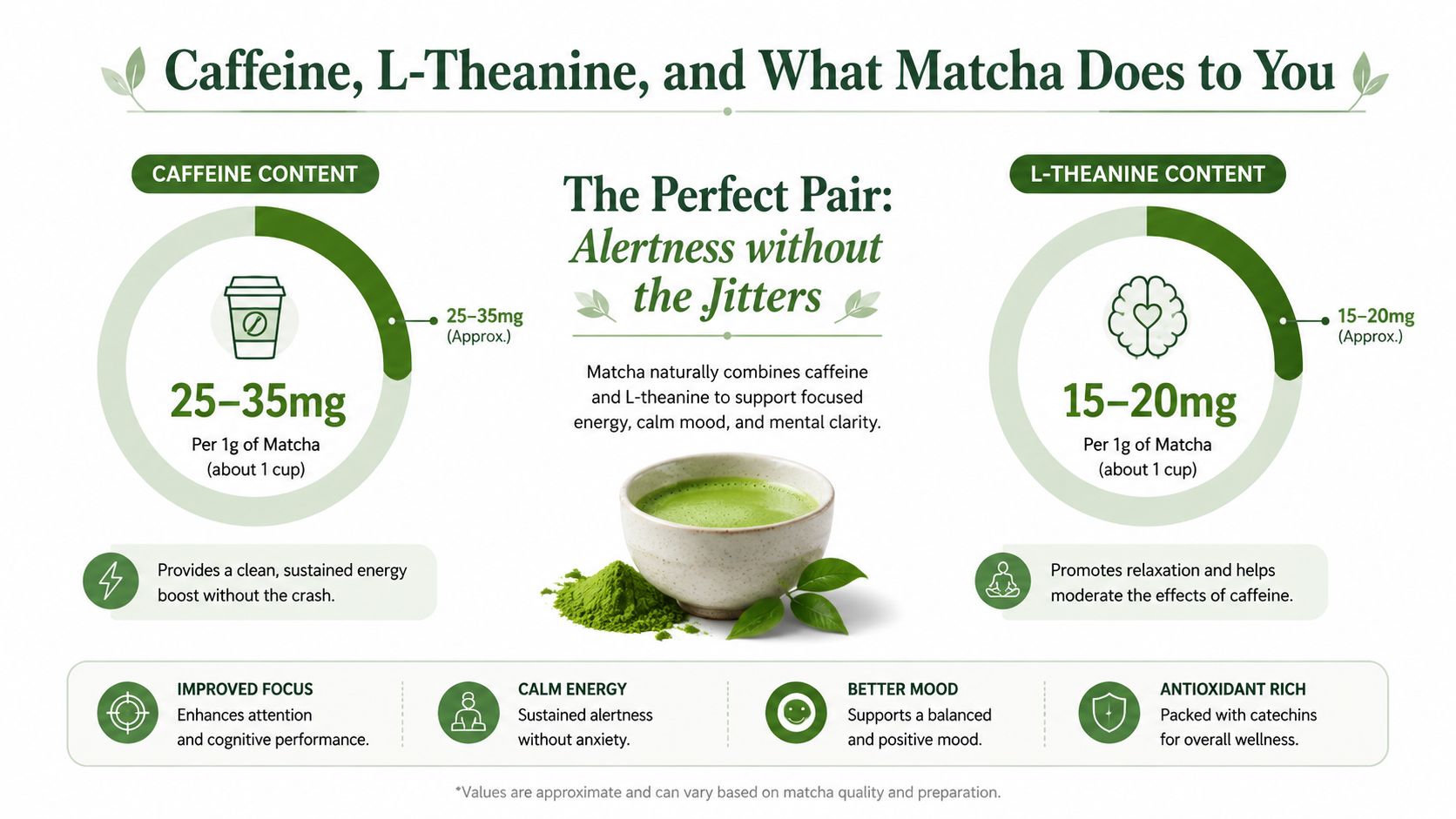
Matcha is a whole-leaf tea powder, not an infusion that leaves the leaf behind. That means you consume the powdered leaf, so caffeine and L-theanine can be more concentrated than in steeped green tea.
One Australian lab-tested matcha sample measured 33.3 mg of caffeine per gram and 21.3 mg of theanine per gram. A comparison of 36 commercial teas reported average green-tea values of 16.28 mg/g caffeine and 6.46 mg/g theanine. (Matcha potency lab results)
Turn the laboratory result into a serving
A 1 g serve of the tested matcha would provide roughly 33.3 mg caffeine and 21.3 mg theanine. A 2 g serve would provide roughly 66.6 mg caffeine and 42.6 mg theanine. These are practical estimates based on that tested sample, not a guarantee for every brand or grade.
That distinction is important. A small whisked bowl can be a low-to-moderate caffeine drink, while a café latte made with a larger scoop can feel substantially stronger. A 2 g serve isn't automatically excessive, but it shouldn't be treated as interchangeable with a very lightly dosed cup.
The combination is why matcha is often described as supporting calm focus. Caffeine contributes to alertness, while L-theanine is associated with a less sharp-feeling experience for some drinkers. The exact effect varies with tolerance, food, sleep, preparation, and the individual powder.
A sensible dosing routine
Start with 1 g if you're caffeine-sensitive or new to matcha. Move towards 2 g only if the smaller serving feels too light, and avoid adding multiple servings close together until you know how your body responds.
Shade-growing is commonly used to encourage a richer, sweeter leaf profile before milling, but it doesn't make matcha caffeine-free. Oat, soy, almond, or coconut milk changes flavour and texture, not the amount of caffeine in the powder.
People who are pregnant, breastfeeding, taking medication, or managing caffeine sensitivity should follow advice from a qualified health professional and consider their total daily caffeine intake. The useful habit is simple: measure the powder rather than guessing by spoon size. For more detail on the relationship between these compounds, read matcha and L-theanine benefits.
Buying Fresh Matcha and Storing It Properly
Freshness is easier to judge when you treat matcha like a delicate food rather than a shelf-stable pantry powder. Before opening the packet, inspect the colour, date information, origin details, and packaging. Once opened, the main enemies are heat, light, and oxygen.
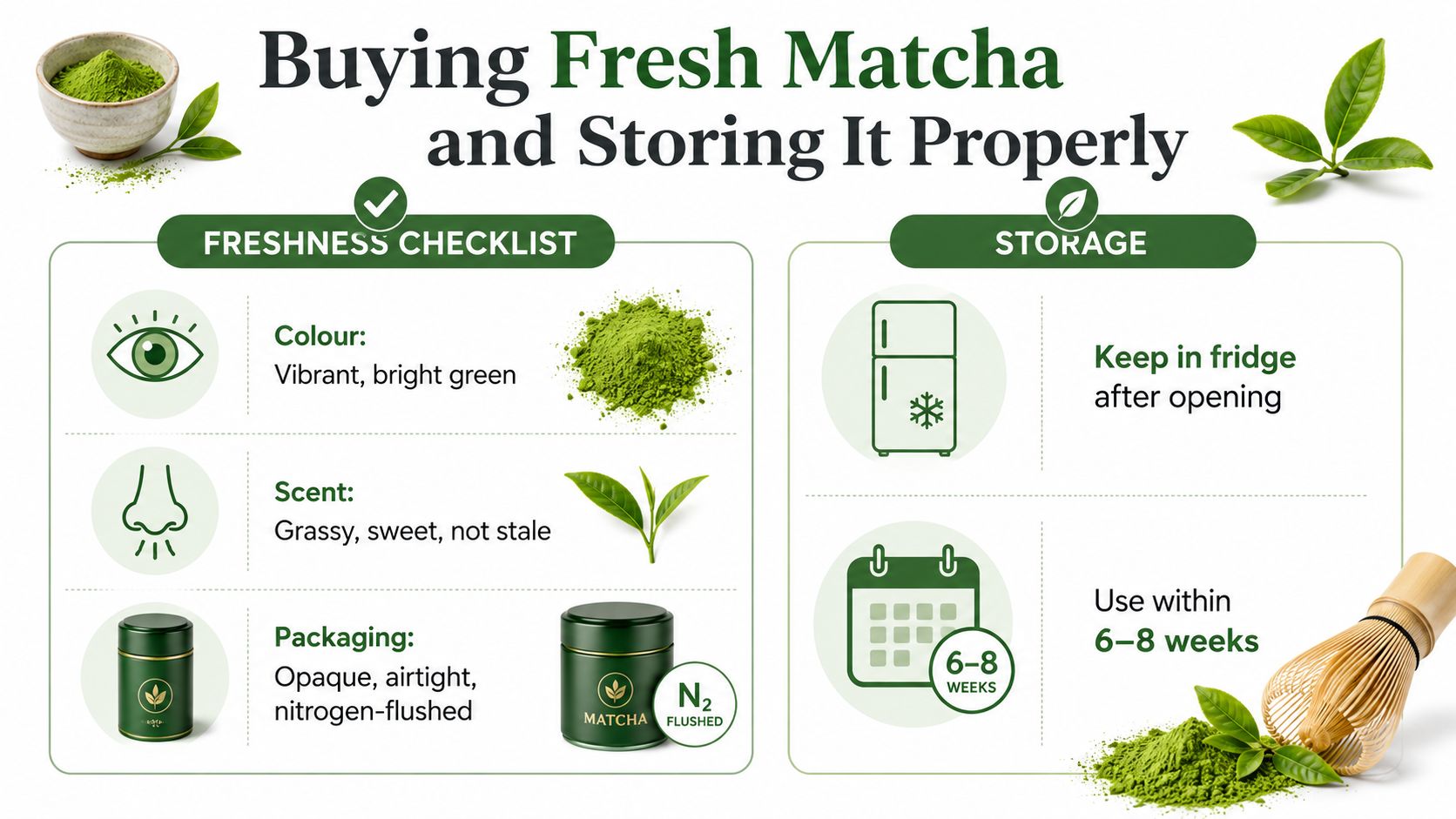
Fresh matcha usually looks vibrant green rather than grey, olive, or brown. The aroma should suggest freshly cut grass, sweetness, or soft vegetal notes. A stale, musty, papery smell is a warning sign, particularly if the powder has been exposed to air.
A practical freshness checklist
- Colour: Look for a lively green appearance. Dull colour can indicate oxidation or old stock.
- Aroma: Smell for grassy freshness and gentle sweetness, not damp cardboard or mustiness.
- Date information: Check the harvest or packing details when provided, as well as the best-before date.
- Packaging: Prefer an opaque, airtight container or inner pouch that limits light and air exposure.
- Origin: Japanese origin and useful regional information can make sourcing easier to assess.
After opening, keep matcha in its original sealed pouch or tin, and place that inside an airtight container or resealable bag. Refrigeration can help protect flavour, but moisture is a serious risk, so let the container come to room temperature before opening it. That reduces condensation inside the pack.
A freezer can work for a sealed pouch that won't be opened regularly. It's less suitable for a container you access every morning because repeated temperature changes invite moisture.
Ceremonial matcha generally rewards quicker use after opening because subtle aroma and sweetness fade first. Culinary matcha is more forgiving in smoothies and baking, where other ingredients carry the flavour, but it still loses colour and freshness over time. If you buy a larger pack, decant a small working portion and keep the main supply sealed.
Storage rule: Keep the bulk of the powder dark, cold, dry, and tightly sealed. Open it as little as possible.
For a visual demonstration of the storage routine, watch this preparation guide.
The guide to storing matcha powder is useful if a pouch has been sitting in a warm cupboard or beside a kettle.
Three Easy Vegan Matcha Recipes to Try at Home
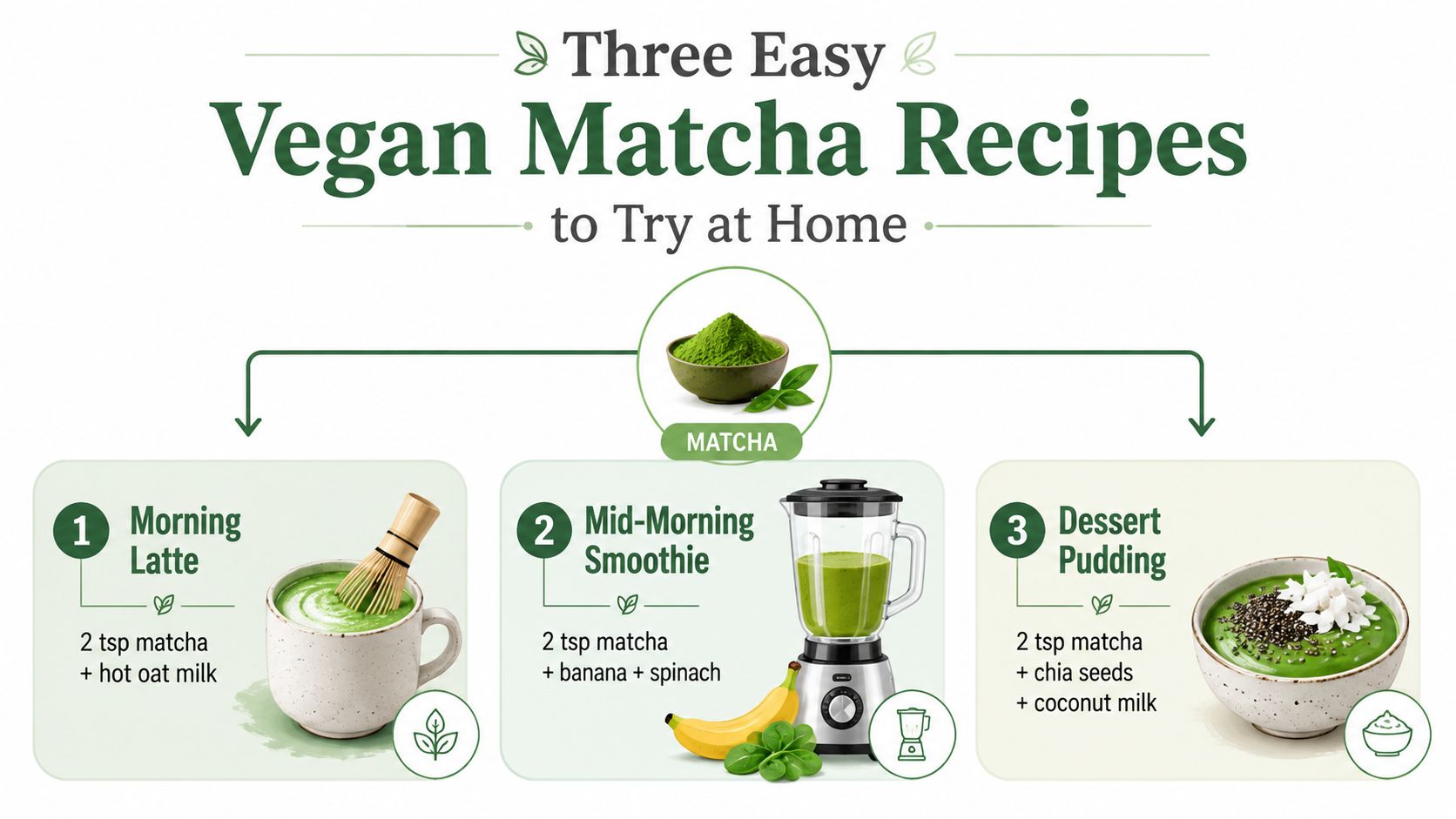
One powder can behave very differently across a morning drink, a cold smoothie, and a dessert. Use the same measured quantity across the three recipes, then notice how temperature, fat, sweetness, and texture change the result.
Morning oat-milk latte
Sift 2 teaspoons of vegan matcha powder into a bowl. Add a small splash of warm water, then whisk until smooth before pouring in warm oat milk. The water should be hot enough to dissolve the powder but not boiling, and the milk should be warm rather than scalding.
Add maple syrup to taste. Ceremonial grade suits this recipe when you want a clean, recognisable matcha flavour, while culinary grade works well if the oat milk and sweetener are prominent.
Kitchen cue: Always sift first. It takes less effort than trying to break up dry clumps after the milk has been added.
Mid-morning banana and spinach smoothie
Add 2 teaspoons of matcha, a banana, a handful of spinach, frozen fruit, plant protein, and a splash of coconut milk to a blender. Blend until completely smooth, adding more liquid only if needed.
Cold blending makes culinary grade a sensible choice because fruit, greens, and protein can cover delicate notes. Coconut milk contributes body, while the banana supplies sweetness without requiring a pre-sweetened powder.
Matcha chia pudding
Whisk 2 teaspoons of matcha with coconut milk before adding chia seeds. Let the mixture thicken in the refrigerator, stirring again after the seeds begin to hydrate so the matcha distributes evenly.
Culinary grade is usually the practical option here. If you're making a dessert where matcha remains on the surface or is only lightly mixed, a finer powder can give a cleaner finish.
You can also use the same culinary powder in vegan energy bites made from dates, nuts, cocoa, and matcha. Keep the method gentle and taste before adding extra sweetener. A pre-sweetened product may work in a fast pudding, but reduce or omit additional maple syrup until you know how sweet the blend is.
Troubleshooting Bitter, Clumpy, or Dull Matcha
Most matcha problems have a preparation cause that you can correct. A bitter cup doesn't always mean the powder is poor, and clumps usually reflect how the powder met the water.
| Symptom | Likely Cause | Quick Fix |
|---|---|---|
| Bitter or harsh taste | Water is too hot or the powder is over-dosed | Use cooler water and begin with a smaller serve |
| Dry clumps | Powder wasn't sifted or water was poured directly onto it | Sift first, add a little water, then whisk into a paste |
| Weak foam | Whisking technique, bowl shape, or water quality | Use a bamboo whisk and a brisk W-shaped motion |
| Dull grey-green colour | Oxidised stock, prolonged sitting, or poor storage | Use fresher powder and prepare each serve just before drinking |
| Thin latte | Low-fat plant milk or too much liquid | Try oat or soy milk and adjust the liquid gradually |
Water above roughly 80 degrees Celsius can produce a harsher, more astringent cup by extracting unpleasant bitter notes from the leaf. If you don't have a temperature-controlled kettle, boil the water and let it cool briefly before mixing.
Tap-water minerals can mute flavour and foam. Filtered water often gives a cleaner result, especially when your whisk creates little texture despite good powder.
Use a bamboo chasen and whisk in a quick W or M motion, keeping the whisk near the surface once the powder has dispersed. Metal tools can be useful for measuring, but a bamboo whisk is gentler on the bowl and better suited to creating fine foam.
Prepare only what you'll drink promptly. Matcha left sitting can lose brightness, and a thin almond milk may make a latte look pale compared with oat or soy milk. If your powder is old but still smells acceptable, move it into baking or smoothies rather than using it for a plain bowl.
Wholesale and Cafe Buying Considerations in Australia
A café buying vegan matcha powder isn't choosing only a flavour. It's selecting an ingredient, a service format, a storage system, and a label position that staff can repeat consistently.
Japan remains a major source for the Australian packaged green-tea category. Australia imported 96,630 kg of green tea in immediate packings from Japan in 2023, valued at US$2.32891 million, and Japan was the top partner by quantity for that category. (Australian green-tea import data)
More recent trade reporting recorded 195,319 kilograms of Japanese green tea shipments into Australia between January and August 2025, a 131% year-on-year increase, making Australia the eighth-largest export destination for Japanese green tea globally. (Australian matcha boom and Japanese tea shipments)
Choose the format around service
A large tin can suit a café with steady turnover, while a smaller pouch may protect freshness when matcha is ordered less often. Single-serve sachets can simplify portion control and travel service, but they may create more packaging waste and less flexibility for recipe adjustments.
For each supplier, ask for:
- Ingredient documentation: Confirm whether the powder is pure, sweetened, or blended.
- A certificate of analysis: Request relevant testing documentation for pesticide residues and heavy metals.
- Origin and batch details: Record the Japanese growing or packing information supplied with each lot.
- Storage instructions: Keep stock away from sunlight, steam, heat, and the busy café bench.
- Menu wording: “Vegan matcha latte” should describe the ingredients served, including the selected plant milk.
Australian food businesses also need to follow applicable food labelling rules. Food Standards Australia New Zealand maintains requirements covering general food labels and mandatory allergen declarations, even when a product is vegan, dairy-free, and gluten-free. (Food Standards Australia New Zealand labelling guidance)
The regulatory boundary becomes more important when a business moves from ordinary matcha powder into concentrated green-tea extract. The 2026 Poisons Standard states that oral Camellia sinensis extract products can fall under Schedule 5 when they provide more than 300 mg EGCG per maximum recommended daily dose, while noting that foods as such aren't affected. (Australian Poisons Standard decision)
| Use Case | Recommended Grade | Serve Size (g) | Typical Weekly Serves |
|---|---|---|---|
| Traditional whisked drink | Ceremonial | 1 to 2 | Occasional to steady |
| Dairy-free latte | Culinary or ceremonial | 1 to 2 | Steady to high |
| Smoothie or dessert | Culinary | Adjust to recipe | Occasional to steady |
| Fast iced service | Pre-sweetened | Follow product directions | Steady to high |
These are operational categories, not promises about exact demand. Track actual powder use, waste, and customer feedback before committing to a larger pack.
Quick Answers for Vegan Matcha Buyers
Is pure matcha vegan?
Yes, when the ingredient is powdered Camellia sinensis leaves. The final drink only remains vegan if the milk, sweetener, flavourings, and toppings are also plant-based.
Can blended matcha contain dairy?
It can. Read for milk powder, whey, lactose, milk solids, and sodium caseinate. Honey isn't vegan, and confectionery-style products may use shellac glazing, so inspect the full ingredient list rather than relying only on “green” or “natural” branding.
Which vegan sweetener should you use?
Maple syrup adds a rounded flavour and dissolves easily in warm drinks. Coconut sugar brings a deeper caramel note but may need more stirring. Stevia and monk fruit can work well in cold drinks when already dissolved or blended, though their sweetness profiles can be more noticeable.
A pre-sweetened powder is convenient, but it removes control over the final sweetness. Pure powder is the better choice if different customers want different levels.
Which plant milk works best?
Oat milk usually gives the fullest, creamiest latte latte texture and tends to support matcha's colour. Soy milk offers good body and a neutral-to-beany character that can work with intense culinary powder. Almond milk is lighter and may produce a thinner drink, while coconut milk adds richness and a distinctive flavour that can complement smoothies and desserts.
The best pairing depends on the matcha. A delicate ceremonial powder can disappear beneath a strongly flavoured milk, while culinary powder has more strength for oat, soy, or coconut recipes.
Does matcha expire?
It has a best-before date, and quality declines after opening. Oxidised matcha often looks dull and smells stale rather than fresh. If it no longer makes an enjoyable whisked drink but remains free from moisture and off smells, use it in baking, smoothies, or chia pudding.
Store unopened and opened powder according to the packaging directions, protect it from moisture, and avoid repeatedly opening a cold container.
Is matcha suitable for caffeine-sensitive drinkers?
Matcha contains caffeine, so sensitivity matters. Start with a measured 1 g serve, drink it earlier in the day, and assess your response before increasing the amount. Anyone who is pregnant, breastfeeding, taking medication, or managing caffeine restrictions should discuss caffeine intake with a qualified health professional.
A lower-dose pure powder gives you more control than a pre-sweetened blend with a fixed serving. Culinary grade can be a practical everyday option because it works in food and drinks, but grade doesn't remove caffeine. The amount you use remains the key variable.
TOO MATCHA. offers Japanese-sourced ceremonial, culinary, and pre-sweetened matcha formats for home preparation, recipes, cafés, and wholesale supply. Visit TOO MATCHA. to compare the format that fits your vegan latte, smoothie, baking routine, or foodservice menu, and choose a powder you can store and measure with confidence.