Japanese Green Tea Matcha Guide for Better Brewing

You're standing at an Australian café counter, watching a bright green matcha latte being whisked behind the bar. The menu offers ceremonial, culinary and sweet matcha, yet the labels don't explain which one belongs in a bowl, which one works in a latte, or why one cup tastes grassy while another tastes creamy and sweet.
That confusion is understandable. Japanese green tea matcha is made from the whole tea leaf, finely ground into powder, so preparation, freshness and format matter more than they do with an ordinary tea bag. Choose the right grade for your habit and you'll spend less, avoid unnecessary bitterness and get far more flavour from each serve.

This guide follows matcha from shaded tea leaf to powder, bowl, latte and dessert. It's written for the curious beginner, the home barista, the baker testing a new ingredient and anyone who wants to understand why matcha has become such a visible part of Australian café culture.
Table of Contents
- Introduction to Japanese Green Tea Matcha Today
- What Makes Japanese Green Tea Matcha Unique
- Understanding Matcha Grades and Flavour Profiles
- How to Prepare Matcha at Home
- Creative Culinary Uses Beyond the Bowl
- Health Benefits and Mindful Energy Explained
- Smart Buying and Storage for Lasting Freshness
Introduction to Japanese Green Tea Matcha Today
You are at an Australian café counter, choosing between ceremonial, culinary and sweet matcha. One powder is intended for a bowl whisked with water, another is made to hold its flavour in a latte or cake, and a third already includes sweetness for a quicker drink. The labels make more sense once you match the format to the job.
Australia's interest in matcha is growing. Market coverage from SBS News reports revenue of more than US$54 million in 2024, with forecasts of 7.1% annual growth through 2030 and revenue above US$81 million by then. Growth explains why matcha appears across cafés and supermarkets, but it does not decide which powder belongs in your kitchen.
Why the powder matters
A bowl of matcha suits someone seeking a vivid, savoury-sweet tea to sip slowly. An iced latte needs a powder that can remain noticeable beside milk, vanilla or fruit. Cookies, white chocolate and overnight oats need enough flavour to carry through other ingredients. These are separate uses, like choosing a saucepan for soup rather than a teacup.
Matcha stays in the drink. Unlike steeped sencha or a green tea bag, it is finely ground leaf suspended in water, so you consume the leaf instead of removing it after infusion. This creates dense colour, creamy body and concentrated flavour. It also leaves stale, poorly prepared or unsuitable powder with nowhere to hide.
Australian imports of green tea in packages under three kilograms reached US$27.05 million in the twelve months from November 2024 to October 2025, a 41.01% year-on-year increase, according to the Australian HS 090210 trade report.
The useful question isn't “Which matcha is highest quality?” It's “Which matcha suits what I'm about to make?”
Ceremonial matcha earns its place when you taste it directly. Culinary matcha brings enough character for milk, sugar and baking. Sweet matcha reduces preparation when convenience and consistent flavour matter most. The right choice depends on your usual Australian café-style habit, from calm focus in a bowl to an iced latte or dessert.
What Makes Japanese Green Tea Matcha Unique
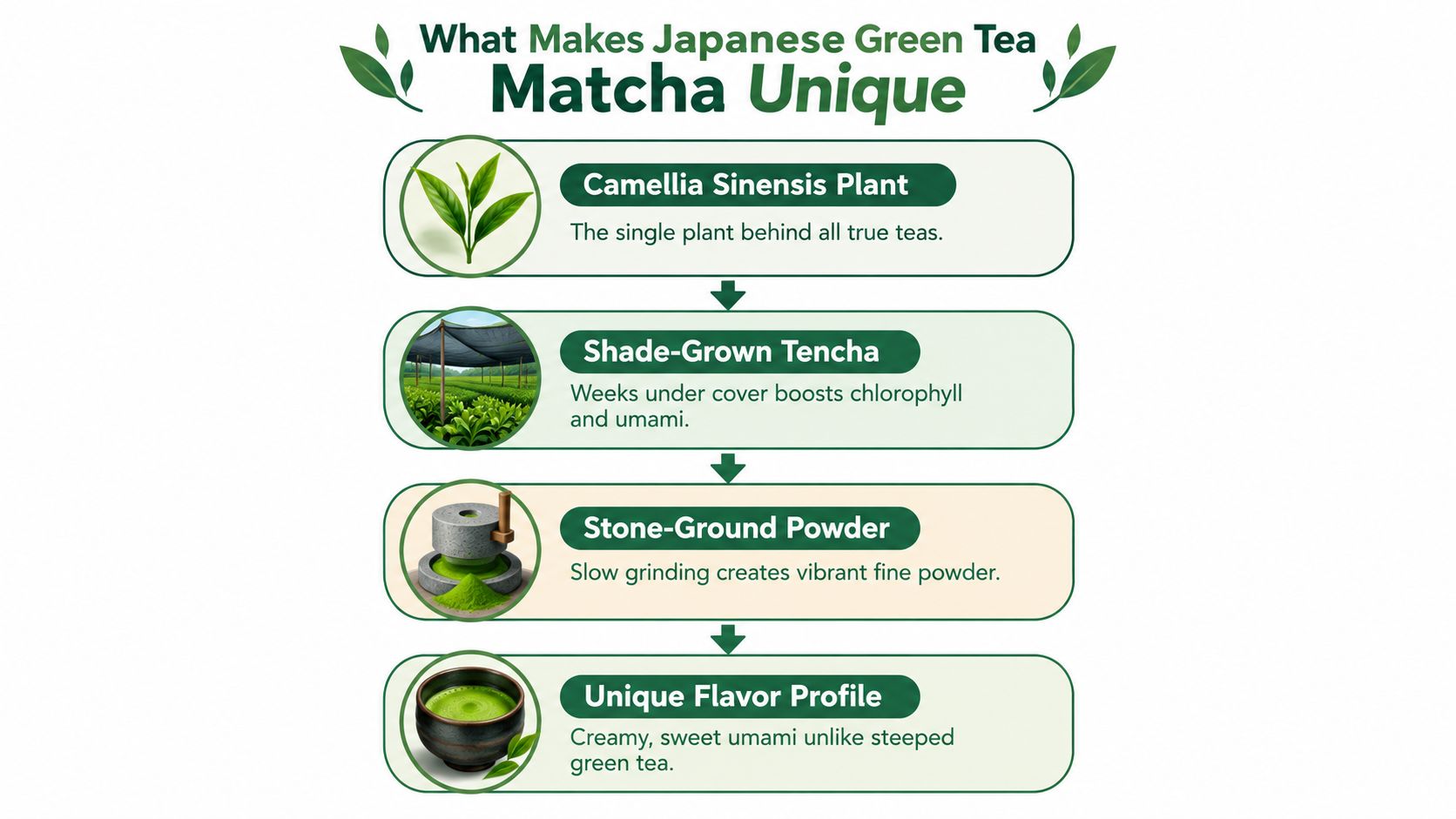
Every true tea begins with the Camellia sinensis plant. What changes is how growers cultivate and process the leaves. Matcha's distinctive character starts before harvest, with the plants covered from direct light for a period of growth.
From shaded leaf to tencha
Think of shading as a flavour incubator. When tea plants grow under cover, the leaves develop a deeper green appearance and a fuller savoury character. Growers harvest these leaves for tencha, the material used to make matcha.
The leaves are steamed soon after picking. Steaming helps preserve the fresh green character, then the leaves are dried and sorted. Stems and tougher parts are removed, leaving the delicate leaf material ready for grinding. This is one reason matcha tastes different from ordinary loose-leaf green tea. A steeped tea gives you an infusion, while matcha gives you the leaf itself in suspended powder.
Traditional stone grinding creates an exceptionally fine texture. The aim isn't to make green tea smaller. It's to produce a powder that disperses smoothly through water, creating the familiar velvety body when whisked properly. Fast grinding or poor storage can affect the texture, aroma and colour you notice in the bowl.
How to recognise the real experience
Origin helps, but it isn't the whole decision. Japanese growing regions such as Shizuoka are associated with distinctive local tea styles, while freshness and the grinding process can influence what reaches your cup. Look for clear information about Japanese origin, a vivid green colour and a fine powder that doesn't feel coarse between your fingers.
For a first pure tasting, Ceremonial Grade Matcha 60g is described as sourced from Shizuoka, Japan, shade-grown and stone-ground into an ultra-fine powder. The product information also identifies it as vegan, gluten free, dairy free and additive free.
Whole-leaf matcha powder shouldn't be confused with green tea extract. Powder is tea used as a beverage ingredient. Extracts are concentrated ingredients designed differently, often with much stronger functional positioning. That distinction becomes important when Australian sellers write labels or wellness messaging.
Understanding Matcha Grades and Flavour Profiles
Matcha grades make sense once you stop treating them as a simple ladder from “good” to “bad”. They're better understood as tools for different preparations. Ceremonial matcha is made to be tasted with water, culinary matcha is designed to remain present in recipes and milk drinks, and sweet matcha is built for speed and repeatability.
| Grade | Flavour Profile | Best For | Texture and Colour |
|---|---|---|---|
| Ceremonial | Smooth, rounded, umami-rich and naturally sweet | Whisked usucha, pure sipping and careful tastings | Very fine texture with a vivid green colour |
| Culinary | Bolder and more assertive, able to cut through other ingredients | Lattes, smoothies, baking and desserts | Silky powder with strong green colour |
| Sweet | Smooth and sweetened, designed for an easy drink | Iced lattes, quick café-style drinks and beginners | Easy to whisk, with a consistent green appearance |
Ceremonial for the bowl
Ceremonial matcha is the choice when water is the main partner. A good example should have enough smoothness and umami to make a small bowl satisfying without milk or syrup. If you dilute it heavily or bury it under strong flavours, you may miss the qualities you paid for.
That doesn't make ceremonial matcha unsuitable for lattes. It means the preparation gives its delicate flavour less room to speak. A useful comparison of the two main unsweetened formats appears in this guide to ceremonial and culinary matcha.
Culinary for mixing and cooking
Culinary matcha needs a stronger voice. Milk, yoghurt, fruit, flour, chocolate and sugar can soften tea flavour, so a bold powder works better in a recipe than a subtle sipping matcha. It also makes more practical sense for a baker who wants to use matcha regularly rather than reserve it for a quiet tea ritual.
The Premium Culinary Grade Matcha 60g is described as sourced from Japanese tea-growing regions, ground to a silky-smooth powder and suited to lattes and baking. Its listed attributes include vegan, gluten free, dairy free and additive free.
Sweet for convenience
Sweet matcha is a different proposition again. It's a pre-sweetened blend for people who want a quick, repeatable drink without measuring a separate sweetener. That makes it especially practical for iced lattes, where cold milk and ice can mute flavour and make hand-balancing sweetness less predictable.
The right choice depends on the drink you'll make. Buying ceremonial matcha for every recipe can waste its subtlety, while choosing culinary matcha for a plain bowl may leave you wanting a softer finish.
How to Prepare Matcha at Home
Smooth matcha doesn't require a ceremonial room or a cupboard full of equipment. It needs sifted powder, warm water and enough movement to break up clumps. A bamboo chasen gives the most traditional result, but a small electric frother can help if you're building the habit.
A dependable bowl method
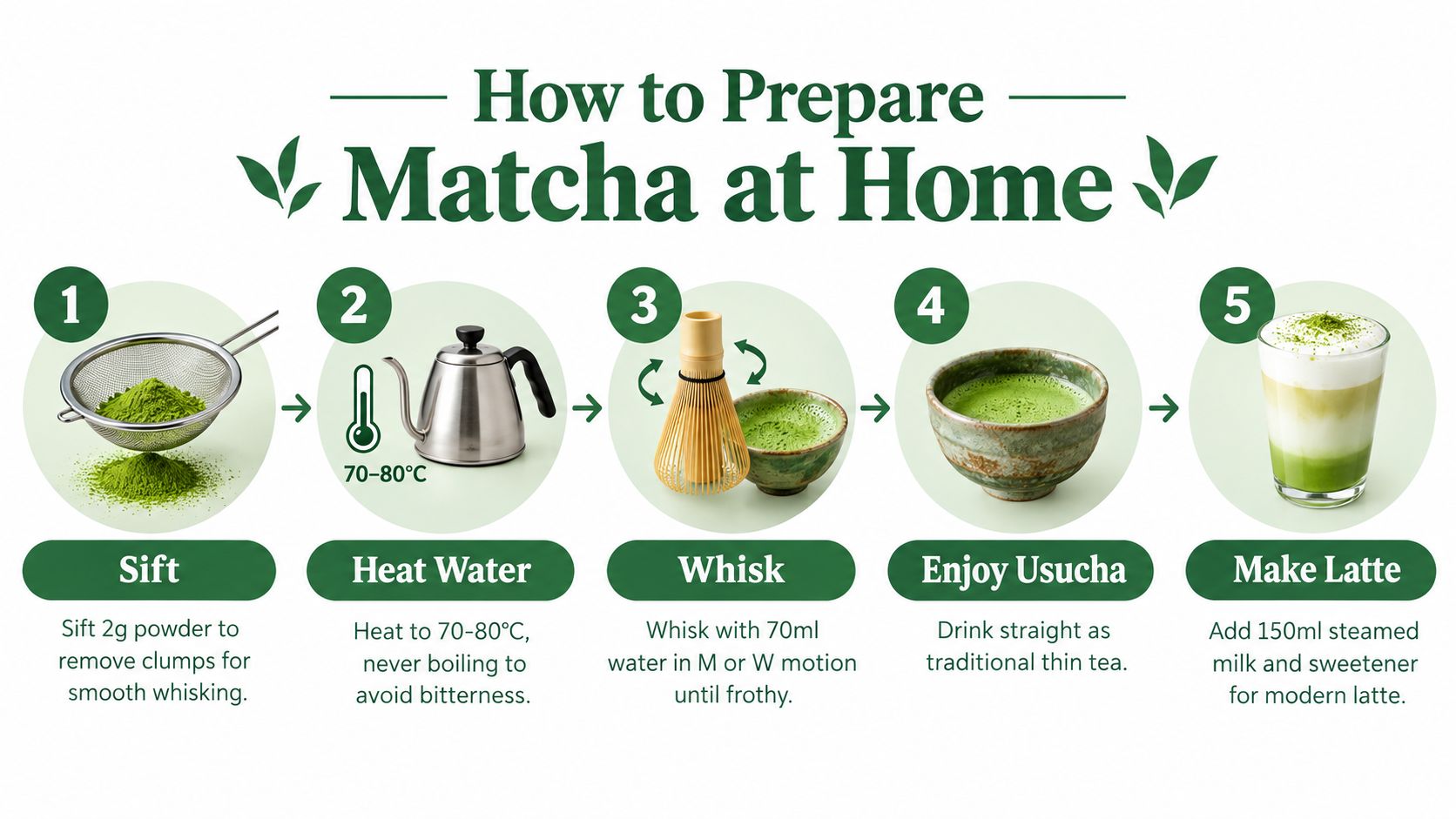
- Sift the powder. Pass 2 g of matcha through a fine sieve into a bowl. This removes compacted pieces before water arrives, so you won't need to fight dry lumps with the whisk.
- Add warm water. Use 70 ml of water at 70 to 80°C. Boiling water can make the drink taste sharper and more bitter, especially when you're drinking the matcha without milk or sweetener.
- Whisk lightly but quickly. Hold the bowl steady and move the chasen in an M or W pattern. Keep the whisk near the surface rather than grinding it into the base of the bowl. Stop when a fine layer of froth appears.
- Drink it fresh. Traditional thin tea, or usucha, is intended to be enjoyed soon after whisking. The powder will settle over time, so a gentle final swirl keeps the texture even.
- Build a latte. For a hot drink, add steamed milk. For an iced version, whisk the matcha first, then pour it over ice and milk. Starting with a concentrated tea paste can help the powder distribute more evenly.
Golden ratio: Begin with 2 g matcha and 70 ml warm water, then adjust strength after tasting rather than adding powder blindly.
A bowl with a wide base gives the whisk room to move. If you don't have a chasen, an electric frother works best when you first dissolve the powder with a small amount of water. More detailed hand technique is available in this matcha whisking guide.
The caffeine content is measurable rather than negligible. A standard 2 g serve is reported to contain roughly 57 to 64 mg of caffeine, while another Australian estimate places it at about 60 to 70 mg per 2 g serve, as described by Zen Green Tea. That range is comparable to a strong black tea, so choose your serving size with your own caffeine sensitivity in mind.
For a shortcut, Premium Sweet Matcha 200g is described as a pre-sweetened blend containing 30% authentic Japanese green tea leaves. The product information positions it for quick preparation, with no separate sweetener needed, and lists it as vegan, gluten free, dairy free and additive free.
Creative Culinary Uses Beyond the Bowl
Matcha changes character when it meets fat, sugar and heat. In water, you notice freshness, umami and texture directly. In milk, yoghurt or white chocolate, those flavours become rounder and softer, while a stronger culinary powder can preserve the tea's presence.
Start with familiar drinks
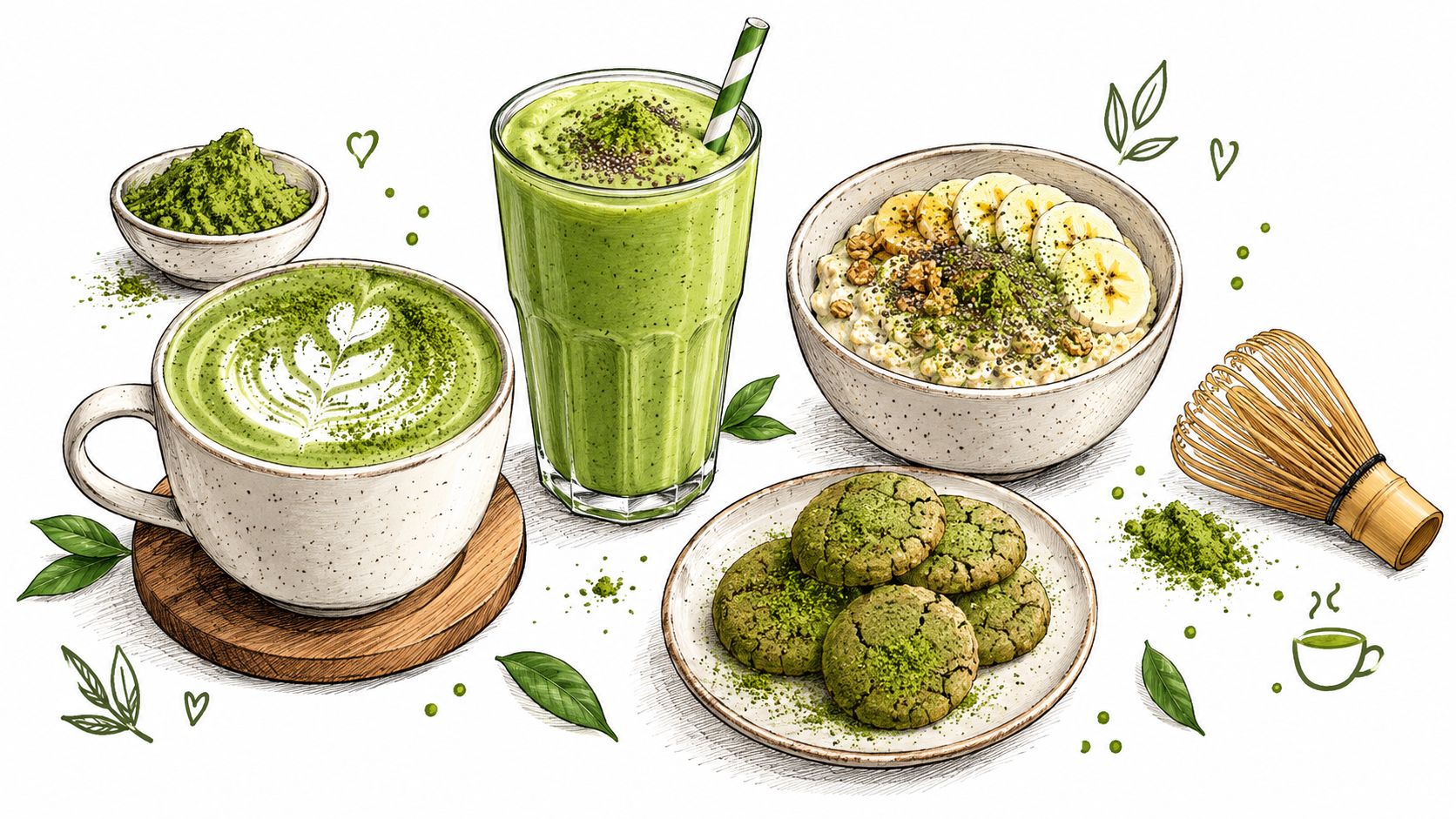
A matcha latte is the simplest bridge from bowl to kitchen. Whisk the powder with warm water first, then add dairy or plant-based milk. Oat milk gives a naturally rounded result, while dairy milk can make the drink taste especially creamy. For an iced latte, dissolve the matcha before adding cold liquid, because dry powder tends to float or form stubborn pockets.
Smoothies are more forgiving. Matcha can sit alongside banana, yoghurt, mango or berries, although strongly flavoured fruit may cover delicate tea notes. Overnight oats offer a gentler canvas. Stir sifted matcha into the wet ingredients before adding oats, then taste for balance once the mixture has softened.
Bake for colour and structure
Matcha works naturally in biscuits, cakes, muffins, madeleines and shortbread. A culinary grade is usually the practical choice because flour, butter, sugar and heat all compete with the tea. Add the powder to the dry ingredients and sift it with the flour so the colour distributes evenly.
Heat can dull matcha's fresh green appearance. Keep baked goods away from unnecessary overbaking, and expect the flavour to become more toasted and subdued than it is in a bowl. That isn't a flaw. It's the result of using the ingredient in a different environment.
Pair it with gentle sweetness
White chocolate and matcha are natural partners because cocoa butter softens the powder's vegetal edge. The combination works in bark, ganache, truffles, cheesecake and chilled desserts. Sweet matcha can simplify iced drinks and dessert sauces, but remember that it already contains sweetness, so reduce other sweeteners until you've tasted the mixture.
Kitchen rule: Use ceremonial matcha when the tea itself is the feature. Use culinary matcha when other ingredients need to share the stage.
For savoury cooking, matcha needs restraint. A small amount can add colour and a green, vegetal note to dressings, noodles or salt blends, but strong heat and salty ingredients can quickly overwhelm it. Start with a little, mix thoroughly and taste before adding more.
Health Benefits and Mindful Energy Explained
Matcha appeals to people who want caffeine without making coffee the only option. The experience comes from more than caffeine alone, because matcha also contains naturally occurring theanine. Australian product testing reported 21.3 mg/g of theanine and 33.3 mg/g of caffeine in one matcha, compared with green tea averages of 6.46 mg/g theanine and 16.28 mg/g caffeine in a cited study of commercial teas, as presented by Pure Matcha Australia.
At 1 g of that tested matcha, those reported values would represent approximately 33.3 mg caffeine and 21.3 mg theanine. At 2 g, they would approximate 66.6 mg caffeine and 42.6 mg theanine, based on the same testing disclosure. These are product-specific figures, not a universal matcha guarantee, so the label and serving size still matter.
Calm focus needs realistic language
People often describe matcha as providing smoother alertness than coffee. The reasonable explanation is that caffeine supports stimulation while theanine may contribute to a more even-feeling experience for some drinkers. That doesn't make matcha caffeine-free, and it doesn't guarantee that everyone will feel the same way.
Start with a smaller serve if you're sensitive to caffeine, drinking matcha later in the day or already consuming coffee and tea. Since the whole powder stays in the cup, portion control is straightforward. You can use less powder without changing the brewing method.
Whole leaf isn't the same as extract
Australian compliance becomes stricter for concentrated green tea extracts. A 2025 Australian compliance summary states that natural caffeine in tea can remain in food, while green tea extract containing more than 300 mg of catechins in a one-day amount is restricted, and preparations above 300 mg of EGCG per maximum daily dose are tightly regulated under the Poisons Standard, according to the Australian matcha ingredient compliance guide.
For a matcha drink, that distinction matters. Whole-leaf powder used as a tea ingredient should be discussed as a beverage, not presented like a concentrated supplement. Responsible product choices also include checking whether a blend is vegan, dairy free or gluten free when those requirements affect your diet.
Smart Buying and Storage for Lasting Freshness
A good buying decision starts with use, not packaging. If you'll whisk matcha with water, prioritise a Japanese ceremonial-style powder with a smooth finish. If your routine centres on lattes, smoothies or baking, choose a culinary format with enough flavour to remain noticeable. If you need fast iced drinks, a pre-sweetened blend can remove several preparation steps.
Australia's green tea category remains structurally dependent on imports. One Australian market report estimates that organic green tea imports account for 95 to 98% of domestic consumption by volume, with Japan supplying 15 to 20% of import volume, mainly premium matcha and high-grade sencha, according to IndexBox's Australian organic green tea market analysis. That makes origin, shipment timing and stock planning relevant for both households and cafés.
A practical label checklist
- Check Japanese origin: Look for clear information about where the tea was grown and processed.
- Assess the colour: A lively green appearance is more encouraging than a dull olive tone, although colour alone can't prove quality.
- Look at the texture: Fine, smooth powder should sift and whisk more easily than coarse material.
- Match the size to your habit: A small pouch suits first tastings and occasional home use, while larger formats make more sense for regular preparation, recipe work or hospitality.
- Separate powder from extract: Choose a tea ingredient for drinks and avoid supplement-style claims unless the product is specifically regulated and labelled for that purpose.
Freshness depends on protection from light, heat, air and moisture. Store opened matcha in a sealed container in a cool, dry cupboard, and always use a clean, dry spoon. Refrigeration may help in some homes, but condensation can damage powder when a cold container is opened in warm, humid air. For a fuller routine, follow this matcha storage guide.
Tools matter less than consistency. A sieve, bowl and whisk can make traditional preparation approachable, while starter sets, multipacks and larger formats may suit gifting, recipe testing or café service. Choose the format you'll finish while the flavour is still lively, then buy the grade that matches the drink you make most often.
TOO MATCHA. offers Japanese ceremonial, culinary and premium sweet matcha powders for whisked tea, lattes, iced drinks and baking, along with preparation tools, starter sets and larger formats for hospitality use. Visit TOO MATCHA. to choose a matcha format that fits your routine and start brewing with a clearer idea of what belongs in your bowl, glass or kitchen.