Jade Leaf Matcha Powder Compared for Australian Buyers
You open an overseas review of Jade Leaf matcha powder, then check an Australian checkout and the story changes. The tin looks the same, the grade name looks familiar, and the delivery note says the pouch still has to cross the water. By the time it reaches your kitchen, the question is no longer which brand won a ranking. It is whether this powder suits the drink you will make, the caffeine that drink adds to your day, and how fresh the powder will be when you open it.
Table of Contents
- Why Jade Leaf Matcha Powder Is Hard to Judge from Australia
- Jade Leaf and Too Matcha Side by Side
- How Grade, Flavour and Freshness Differ
- Which Powder Suits Lattes Baking or a Whisked Cup
- How Much Caffeine a Matcha Serve Adds
- How to Substitute One Matcha for the Other
- Choose the Pouch and Order for Your Habit
Why Jade Leaf Matcha Powder Is Hard to Judge from Australia
An overseas review may describe a daily whisked cup, while an Australian buyer has to account for shipping, stock and the time the tin spends in transit. Those details affect how well the powder fits your routine, alongside its grade and flavour.
Industry reporting estimates that Australia's matcha market generated more than AUD 54 million in 2024 and could exceed AUD 81 million by 2030, with about 7.1 per cent annual growth, according to Peptea's coverage of the market. The same coverage reports that Australia imported 195,319 kilograms of Japanese green tea between January and August 2025, a 131 per cent increase on the year before, ranking Australia as the eighth-largest destination for that tea. These figures describe the wider market, not Jade Leaf: they do not establish the brand's Australian sales, customer numbers, market share or history.
For a buyer, the practical checks are more specific: confirm the grade and origin, check whether the product is available locally or ships from overseas, and choose a pack size you can use while the powder is fresh. A ceremonial powder for a whisked bowl serves a different purpose from a culinary powder for banana bread. Judge each by the drink or recipe you plan to make.
Jade Leaf and Too Matcha Side by Side
For a whisked cup, a baked recipe or a quick latte, the useful comparison is how each powder fits the job and reaches your kitchen. Jade Leaf is an imported Japanese brand with ceremonial and culinary formats. An Australian marketplace listing says one organic premium culinary product was not locally available and required express shipping, as noted on the U-Buy Australia listing.
The listing also estimates that more than 90 per cent of matcha volume consumed in Australia comes from overseas, with Japan supplying an estimated 65 to 75 per cent of import value. Those figures give context to how matcha reaches Australian buyers. For a particular purchase, the practical questions are the grade, the intended use and the shipping path.
Too Matcha sells Japanese matcha and hojicha powders in an Australian store, freshly shipped from Japan. Its range includes ceremonial, premium culinary and premium sweet matcha, as well as hojicha, in home and bulk sizes.
| Criterion | Jade Leaf | Too Matcha |
|---|---|---|
| Provenance | Japanese matcha; ingredient grade cites Uji, Kagoshima, Shizuoka and Miyazaki | Matcha and hojicha powders sourced directly from Japan |
| Grades | Ceremonial, culinary and commercial ingredient grade | Ceremonial, premium culinary and premium sweet matcha, plus hojicha |
| Flavour role | Ingredient grade positioned for baking, food production, supplements and skincare | Ceremonial for a whisked cup; culinary for baking and recipes; sweet for lattes, iced matcha and smoothies |
| Australian access | Online retail; one culinary listing required express shipping | Sold from an Australian store, with matcha freshly shipped from Japan |
| Known formats | A 100g limited ceremonial tin is noted; other sizes are not confirmed here | 60g, 200g, 500g and 1kg, depending on grade |
| Best first job | Check the grade and delivery details for the drink or recipe you have in mind | Choose a grade for sipping, recipes or a sweetened drink |
Cells shoppers misread
For Australian access, check the delivery details alongside the product name. A listing that requires express shipping may suit a planned purchase, while a local store can be more convenient when you need to order for a regular routine.
Formats matter too. The documented 100g limited ceremonial tin does not establish which other Jade Leaf sizes are available in Australia. Too Matcha lists sizes by grade, from 60g packs to 500g and 1kg bulk pouches.
Buying screen: Before comparing value, name the drink or recipe, the amount of powder it needs and how the pack will reach your kitchen.
How Grade, Flavour and Freshness Differ
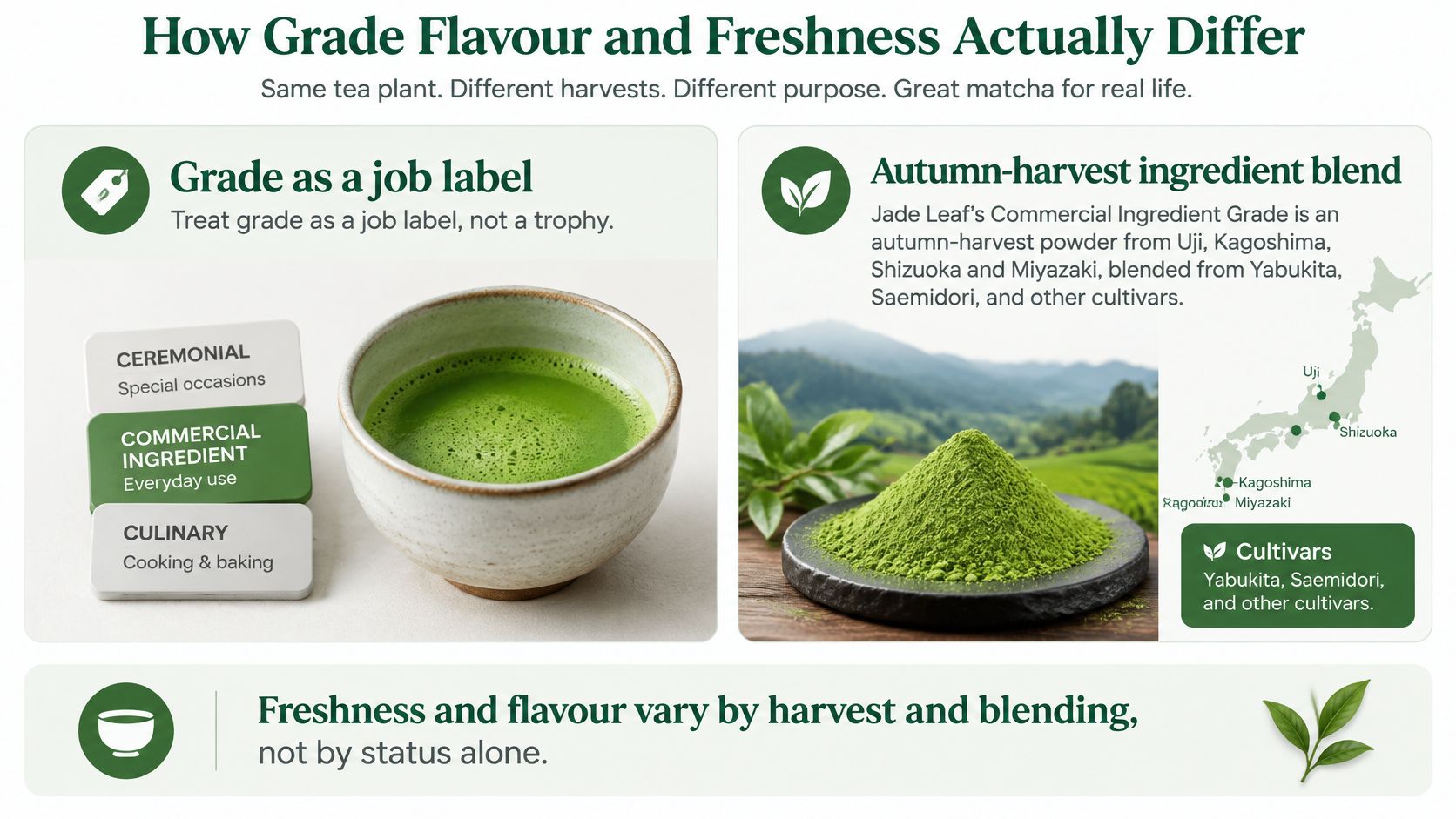
A powder chosen for a whisked cup can behave very differently in a cake batter. Grade helps indicate a powder's intended job, while flavour and freshness shape how it performs in the cup or recipe.
Jade Leaf ingredient grade
Jade Leaf's Commercial Ingredient Grade is described as an autumn-harvest powder from Uji, Kagoshima, Shizuoka and Miyazaki. The maker lists a blend of Yabukita, Saemidori, Yutakamidori, Asanoka and Okumidori, and positions it for commercial baked goods, food production, supplements and skincare. Its intended role is outlined on the Jade Leaf ingredient matcha page.
The listed format is 100 per cent matcha, with USDA Organic, vegan, gluten-free and dairy-free claims. Those US claims do not establish Australian certification. The page also gives caffeine as 15 to 25 mg per serving; check the serving's gram weight before using that figure to log a drink or recipe. For foodservice, ask for a current certificate of analysis covering caffeine, microbiology, pesticide residues and heavy metals.
Ingredient grade suits batter, blends and manufacturing. Its flavour and intended use make it a different choice from a powder selected for a simple cup of water and matcha.
Three kitchen jobs on our side
Choose by the drink or recipe, then consider grade. A delicate whisked cup and a strongly flavoured bake place different demands on the powder.
Ceremonial grade has a clean, vegetal flavour with natural sweetness and no bitterness. TOO MATCHA's ceremonial matcha is sourced from Japan, milled by a partner business using an advanced method to produce an ultra-fine, clump-free powder, and ground in small quantities to maintain freshness.
Premium Culinary Grade has a bold, earthy flavour with medium intensity. It is suited to baking, blending and recipes where a clear matcha flavour needs to hold its own.
Premium Sweet Matcha is sweet, smooth and mild, with no bitterness. Its balanced touch of sweetness suits lattes, iced matcha and smoothies.
Matcha powder begins with leaves that are picked, steamed, dried and ground. TOO MATCHA's powders are freshly shipped from Japan; bulk matcha and hojicha are packaged in air-tight, resealable pouches.
What fading looks like
A dull or yellow appearance, or a flat smell, can signal that powder has lost freshness. Once ground, matcha does not improve with age. Keep the pack sealed, cool and away from light, and finish one open pack before starting another.
For practical storage guidance, follow these matcha powder storage tips. A grey-looking whisked cup or flat aroma can affect the experience, whatever grade appears on the label.
Which Powder Suits Lattes Baking or a Whisked Cup
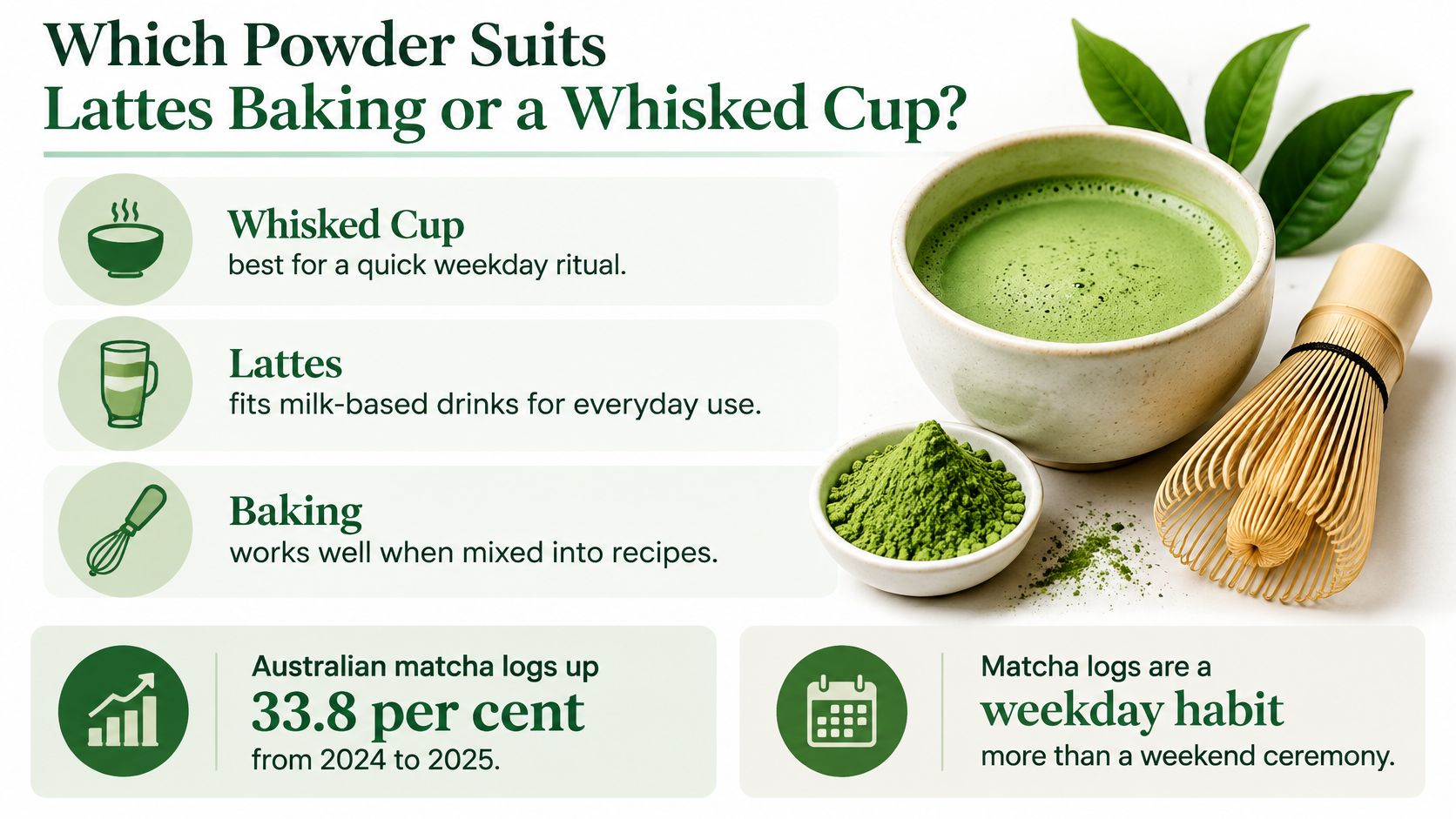
The right powder depends on what ends up in your cup or recipe. A whisked matcha lets the tea's flavour stand on its own; milk, sweetener and baking ingredients soften or cover it. Australian matcha logs rose 33.8 per cent from 2024 to 2025, compared with an 8 per cent rise for coffee, while matcha appeared once for every 60 coffees, according to Medianet Newshub's report on Australian matcha trends.
Match the occasion
Plain whisked cup. With just water and matcha, the powder's own flavour is easy to notice. A Jade Leaf ceremonial tin may suit a drinker who already likes it and can get it with a short transit. For a smaller pack, TOO MATCHA's Ceremonial Grade Matcha 60g is a 60g matcha from Shizuoka.
Weekday iced latte. If you want a quick drink without measuring out syrup, a sweetened powder keeps the routine simple. TOO MATCHA Premium Sweet Matcha is sweet, smooth and mild, with no bitterness, and is suited to iced matcha, lattes and smoothies.
Baking, oats and milky lattes. For banana bread, brownies, overnight oats or a latte where matcha needs to come through milk, choose a bolder powder. TOO MATCHA Premium Culinary Grade Matcha has a bold, earthy flavour with medium intensity and is used for baking, blending and recipes. A ceremonial powder can colour a cake too, but its more delicate cup qualities may be lost among the other ingredients.
Cafe or event volume. For repeated serves, TOO MATCHA matcha and hojicha powders come in 500g and 1kg bulk pouches. Choose 500g if that amount fits your expected use; 1kg suits a larger or more frequent routine.
The colour check
Look at the cup after whisking or at the crumb after baking. One customer described the matcha's colour as vivid green, unlike pale supermarket matcha. Colour gives you a visible comparison, but judge the powder by its flavour in the drink or recipe you make.
How Much Caffeine a Matcha Serve Adds
The caffeine in a matcha drink depends partly on how much powder goes into it. Weigh the serve rather than relying on a loosely filled scoop, and remember that harvest, blend and testing method can also affect the figure. A number from another tin may not describe yours.
The Australian Institute of Sport's caffeine guidance puts average adult intake at about 175 mg a day, with at least a quarter of adults above 230 mg. For healthy adults, its general guidance is no more than 400 mg a day and 200 mg in a single serving. Peptea's summary of FSANZ guidance says naturally occurring caffeine in tea is typically no more than 100 mg in a standard serving, and that acute intake up to 200 mg is not generally associated with safety concerns for healthy adults.
Matcha powder is swallowed with the drink, unlike brewed tea leaves that are removed before drinking. So the amount you use matters when comparing matcha with a cup of brewed green tea. For more context, read this guide to matcha tea and caffeine.
A check you can run tonight
- Add other sources. Include coffee, cola, chocolate and energy drinks.
- Estimate the matcha contribution. Use the caffeine figure for that batch, if available, or note the measured powder amount.
- Compare the total with adult guidance. For a healthy adult, the guidance cited above is up to 400 mg a day and 200 mg in a single serving.
FSANZ guidance identifies increased anxiety at about 3 mg per kilogram a day for children (FSANZ caffeine guidance). This is a different context from adult latte guidance.
Labels, not marketing
Naturally occurring caffeine in tea is treated differently from added caffeine, which must be declared on food labels, as FSANZ explains in its caffeine guidance. FSANZ also explains that solid or semi-solid foods containing 5 per cent or more caffeine are banned from retail sale, a rule aimed at concentrated powders rather than an ordinary matcha serve (caffeine powders and high-caffeine foods). Keep track of the powder weight and batch information, since one product's caffeine result may not apply to another.
How to Substitute One Matcha for the Other
Start with the drink or recipe you want to make. Match the powder to that job, then adjust sweetness and texture in small steps.
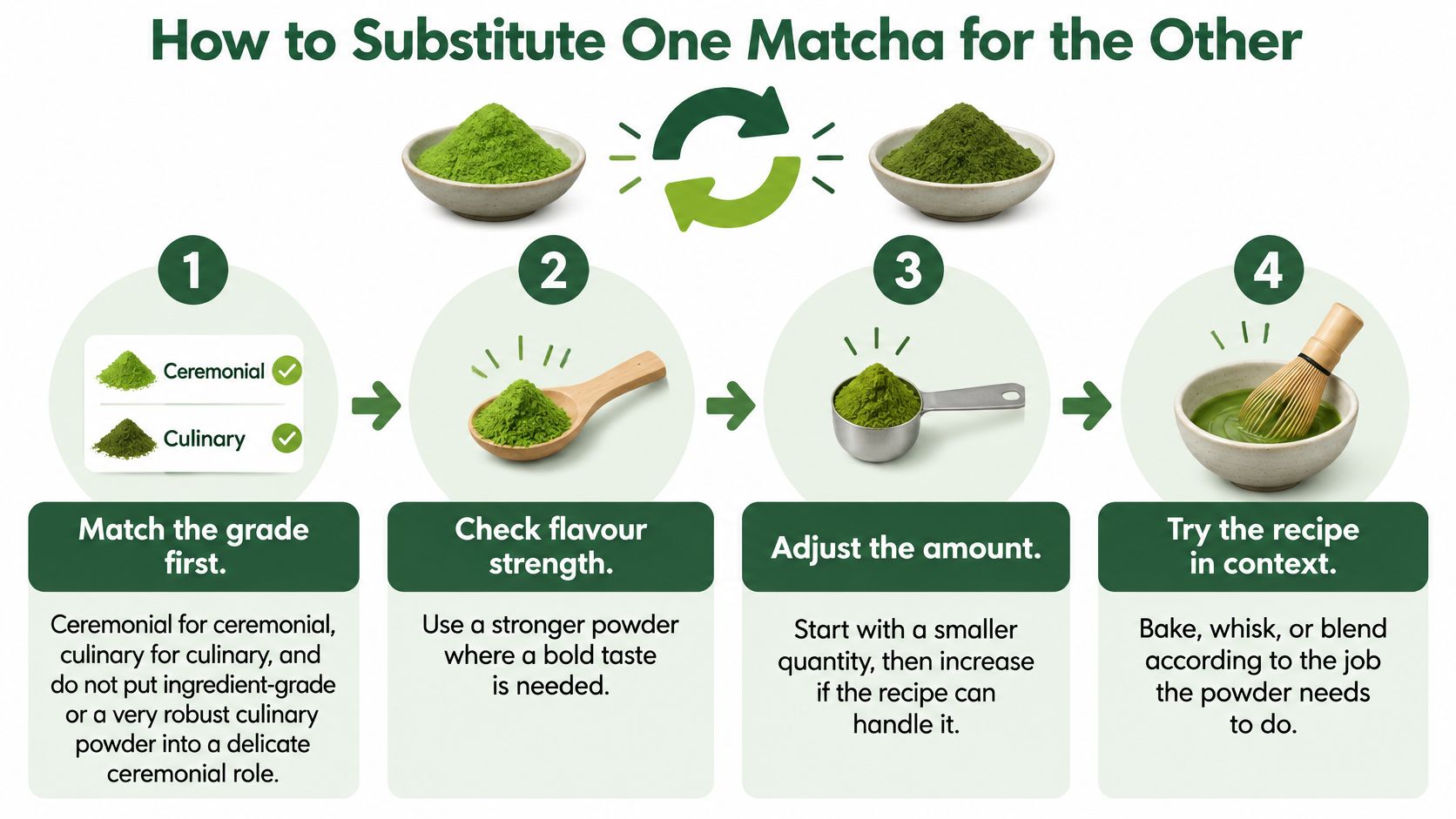
- Match the grade to the drink. For a whisked cup, choose a powder suited to drinking on its own. For baking, blending or recipes, culinary matcha's bolder flavour can hold its place among other ingredients.
- Keep the gram dose steady for your first test. Weigh the powder rather than relying on a scoop, then use a guide to matcha amounts per cup as your starting point. Holding the dose steady makes it easier to judge changes in flavour, colour and caffeine.
- Reduce added sugar when switching to sweet matcha. Too Matcha Premium Sweet Matcha is blended with 30% authentic Japanese green tea leaves and a balanced touch of sweetness. Leave out syrup at first, taste the drink, then decide whether it needs more.
- Add sweetener gradually when switching to plain matcha. If the original drink relied on a sweetened mix, plain matcha will taste sharper at first. Stir in a little sweetener, taste, and repeat only if needed.
- Use culinary matcha for recipes that call for matcha. Keep the recipe's stated amount for the first batch. A whisked cup and a baked recipe are different tests: the other ingredients can soften or change how the matcha tastes.
- Test a small serving before scaling up. Whisk or blend one drink and check the colour, flavour and texture. For a larger batch, this small trial helps you adjust the powder before making a full jug.
If you are pregnant, sensitive to caffeine, taking medicines that interact with it, or serving matcha to children, account for the caffeine in each drink. Matcha contains the tea leaf itself, so weighing the powder helps keep the amount consistent.
Choose the Pouch and Order for Your Habit
The right pack size depends on how often you make matcha and how quickly you will use it. A smaller pouch suits an occasional whisked cup; a larger one makes sense when the powder goes into drinks or recipes regularly.
Ceremonial Grade Matcha 60g costs $74.99. It gives a first-time whisker a manageable amount to work through while learning the flavour and preparation. For occasional cups, this size is a practical alternative to buying a kilo that may stay open too long.
Premium Sweet Matcha 200g costs $54.99. It suits regular weekday lattes. Try it without extra syrup first, since the powder already has balanced sweetness.
Premium Culinary Grade Matcha 60g costs $64.99. Choose it for baking, smoothies or lattes, then consider a larger pouch once you know it works in your recipes.
When bulk is the right call
A 500g or 1kg pouch can suit a steady matcha or hojicha routine. TOO MATCHA. sources its bulk powders directly from Japan and grinds matcha in small quantities to maintain freshness. Free shipping applies to orders over $80 AUD at checkout. Three-packs can suit shoppers who already know which grade they want.
| Pack | Who it suits | Freshness watchpoint |
|---|---|---|
| Ceremonial 60g | Occasional or first-time whisk drinkers | Manageable to finish before colour and aroma fade |
| Sweet 200g | Regular weekday lattes | A mid-size option for a regular habit |
| Culinary 500g | Weekly baking or a small menu test | Best suited to kitchens that use it often |
| 500g or 1kg bulk | Steady matcha or hojicha use | Choose a size that matches your turnover |
| Jade Leaf tins seen locally | Shoppers set on that brand | Confirm size and transit before comparing value |
A lower price per gram does not help if a large pouch sits unused. For a few cups a week, a 60g or 200g pack may be easier to finish. If you prefer Jade Leaf, check that the tin is available in Australia and compare its weight and shipping before deciding. Local retail listings can differ in size; confirm the tin details before comparing value per gram.
For Australian homes and small venues, match the grade to the drink or recipe, then choose a pack you expect to finish. Start with a manageable size and scale up once it suits your routine.
TOO MATCHA. offers Japanese matcha and hojicha in ceremonial, culinary and sweet grades, in home sizes and bulk formats. If you are comparing Jade Leaf matcha powder with a local option, begin with the grade that fits your intended drink and choose a size that suits your use. Visit TOO MATCHA. to choose a pouch and order in Australian dollars.