
Green Tea with Milk: How to Make It Taste Right

Your kettle is boiling, the mug is ready, and you're deciding whether to whisk matcha, reach for hojicha, or steep a green tea bag before adding milk. The result won't be decided by the milk alone. Tea form, milk type, temperature, tea strength, and sweetener all change the balance of the drink.
Treat green tea with milk as a formulation problem, not a fixed recipe. Matcha dissolves into the drink, while sencha is brewed and strained. Hojicha brings roasted depth, whereas a delicate green tea can disappear behind a creamy pour. The right method depends on the cup you want, whether that's grassy and light, rich and umami-led, toasted, hot, or iced.
Table of Contents
- What Green Tea with Milk Actually Means
- Choosing the Right Green Tea for Milk Drinks
- Building a Hot Matcha Latte Step by Step
- Iced Matcha and Hojicha Lattes That Hold Their Flavour
- Dairy versus Plant Milk and Why It Changes the Cup
- Sweeteners and Pre-Sweetened Matcha for Busy Mornings
- Fixing Common Green Tea with Milk Problems
What Green Tea with Milk Actually Means
Green tea with milk can describe several different drinks. A matcha latte uses powdered tea whisked into water, so the leaf remains in the cup. A green tea latte may use brewed sencha, jasmine green tea, or another infused leaf, with the liquid strained before milk is added. Those methods aren't interchangeable because the tea reaches the milk at a different strength and texture.
The tea itself also changes the result. Hojicha, a roasted green tea, has toasted, caramel-like notes that usually tolerate milk well. Genmaicha brings roasted rice and savoury warmth, while sencha tends to be grassy, fresh, and more vulnerable to being masked by a large amount of milk. Matcha has a dense texture and umami character, so it generally carries further in a latte than a lightly brewed green tea.
Milk is a structural ingredient, not an afterthought. Its fat affects roundness, its protein affects foam and tea binding, and its natural sweetness changes how bitterness registers. Temperature controls whether those flavours taste smooth or scorched. Sweetener can either soften astringency or cover the tea completely.
The four controls at the bench
- Tea form: Powdered matcha gives intensity and body. Hojicha gives roast. Steeped tea gives a lighter profile.
- Milk choice: Dairy, oat, soy, and almond each bring different levels of sweetness, protein, fat, and foam stability.
- Temperature: Hotter isn't automatically stronger. Excess heat can push green tea towards bitterness and cooked vegetal notes.
- Sweetener: Sugar, honey, maple, agave, or syrup changes both flavour and how easily the drink combines.
Practical rule: Taste the tea concentrate before adding milk. If it's weak or harsh at that stage, milk won't repair it.
Australian tea habits make this combination more relevant than it may first appear. An independent forecast estimates Australia's green tea market at USD 319.0 million in 2025, rising to USD 521.6 million by 2034, with a projected CAGR of 5.41%. The Australian market commentary and forecast also sits alongside ABS recognition of “tea regular prepared with milk” as a prepared-food item, while milk products were consumed at 269.4 grams per person per day in 2023–24, including 175.9 grams of dairy milk per person per day. Milk-based tea therefore fits an established Australian drinking pattern, even though the formulation still needs care.
Choosing the Right Green Tea for Milk Drinks
The simplest choice is matcha, especially if you want a drink that tastes like tea after milk has been added. Because matcha is finely powdered leaf, its chlorophyll, caffeine, amino acids, and umami remain in the cup. Shade-grown matcha can offer a naturally sweet, rounded profile, while culinary matcha usually has a bolder flavour that's useful when milk and sweetener are prominent.
A guide to using matcha powder is useful if you're still learning how to sift, whisk, and build the concentrate. For a small home pouch, the Ceremonial Grade Matcha 60g is sourced from Shizuoka, Japan, shade-grown, and stone-ground into a fine powder. It's described as vegan, gluten free, dairy free, and additive free.
Hojicha is more forgiving when milk is involved. Its roasted flavour reads as nutty, toasted, and gently sweet, so it can stand up to dairy or barista oat milk without requiring a heavily sweetened recipe. Steeped sencha or a strong green tea bag is the lightest option, but you'll need enough tea strength for the milk not to erase the grassy character.
| Format | Flavour profile with milk | Best use | Typical dose per 250 ml drink |
|---|---|---|---|
| Matcha | Umami, grassy, creamy, concentrated | Hot or iced lattes | 2 to 3 g |
| Hojicha powder | Toasted, nutty, roasted | Milk-forward hot or iced drinks | 2 tbsp powder with a small water concentrate |
| Steeped green tea | Light, fresh, grassy | Lighter dairy or plant-milk drinks | Use a stronger-than-usual infusion |
Ceremonial matcha makes sense when the tea itself is the focus. Culinary matcha works better when you're adding more milk, sweetener, ice, or other flavours. Pre-sweetened matcha is a practical option when you want repeatability and don't want to dissolve sugar separately.
Building a Hot Matcha Latte Step by Step
A dependable hot matcha latte starts with the concentrate, not the milk. You'll get better results with a chasen, small whisk, fine sieve, thermometer, and warmed mug, although a small kitchen whisk and a wide bowl can work if that's what you have.
Make the concentrate
- Measure the matcha. Use 2 to 3 g for a balanced latte, or 4 g if you want a café-strength drink. Sift it into a bowl so the powder doesn't form dry pockets.
- Control the water. Use 75 to 80 °C water, not boiling water. Excess heat can make matcha taste scorched, bitter, or aggressively vegetal.
- Add a small amount of water. Pour in enough to form a smooth paste, then add the remaining water gradually.
- Whisk properly. Move the chasen in a fast W or M pattern for 15 to 20 seconds, rather than stirring in circles. Stop when the surface has fine bubbles and the concentrate looks evenly dispersed.
The matcha whisking method matters because the whisk's rapid side-to-side movement breaks up clumps and introduces a fine layer of foam. A spoon may combine the ingredients, but it won't create the same texture.
Add milk without flattening the tea
Warm 150 to 200 ml milk separately, then pour it into the matcha concentrate. Keep the milk warm and silky rather than aggressively boiling. If you're using a steam wand, hold it close to the surface briefly to add air, then lower it slightly to create a finer, denser texture.
Dissolve sugar or honey in the warm water before whisking in the matcha. Alternatively, add syrup to the warmed milk, where it will distribute more evenly than it would in a finished drink. Taste before adding more. Matcha's bitterness can be softened by sweetness, but too much sweetener turns the latte into a flavoured milk drink with tea in the background.
The tea should arrive first, then the milk should round it out. If the milk arrives first, you'll often compensate for a weak concentrate by adding too much powder.
Iced Matcha and Hojicha Lattes That Hold Their Flavour
Ice exposes weak formulation quickly. As it melts, it dilutes the tea, so an iced latte needs a concentrated base rather than the same hot recipe poured over cubes.
For a shaken iced matcha, combine 2 tsp matcha with 60 ml hot water and whisk until smooth. Add simple syrup to taste, then shake the mixture with ice for a few seconds. Strain it over fresh ice and add 180 ml cold milk. Fresh ice matters because the original shaking ice has already started diluting the concentrate.
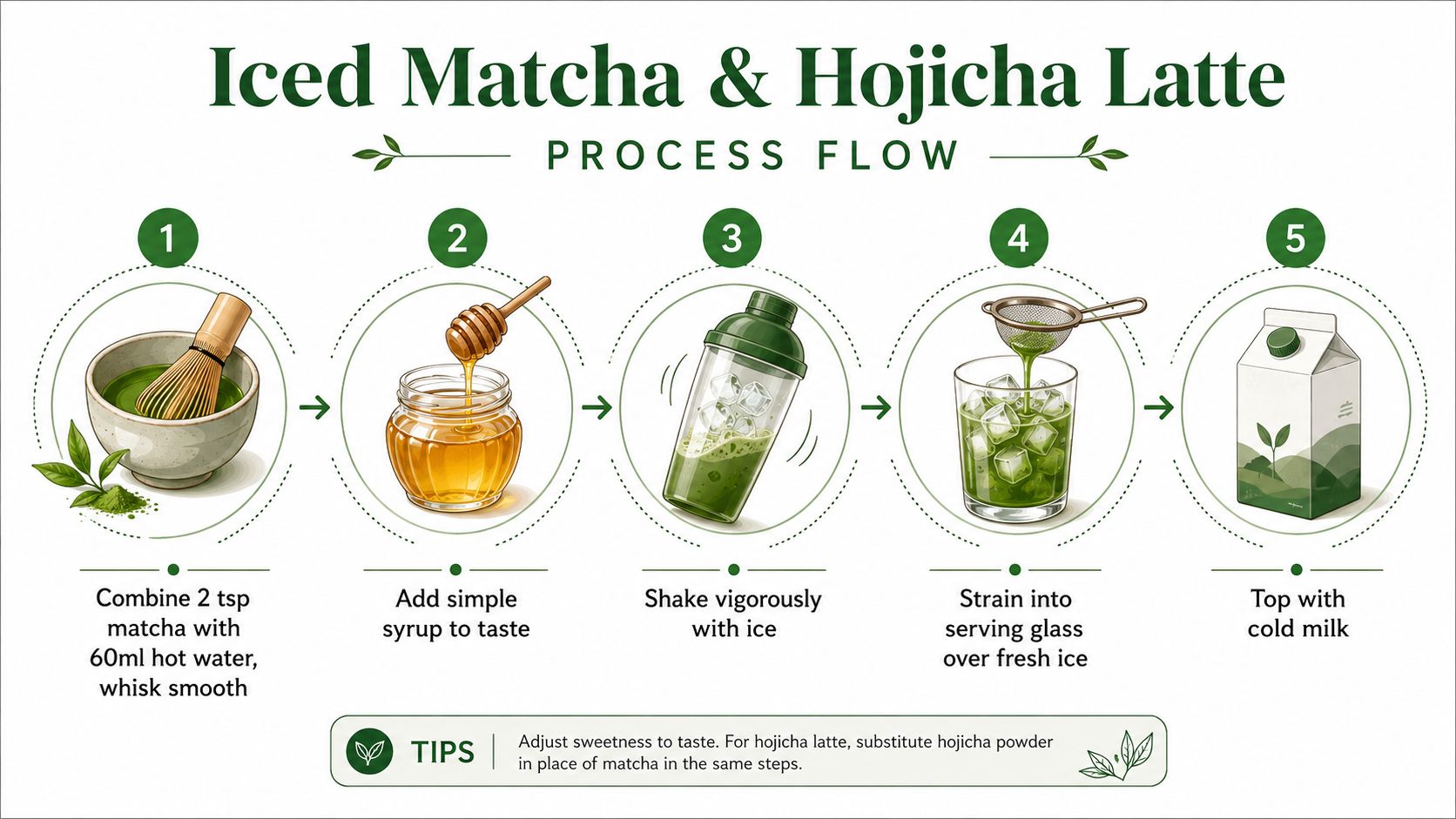
For a stronger drink, use the same matcha dose in an 80 ml cold-water concentrate, then pour it over ice and milk. The smaller water volume keeps the tea forward as the ice melts. The matcha approach for iced lattes also helps you decide whether to shake, whisk, or layer the drink.
Hojicha needs a separate build because its roasted powder behaves differently in flavour. Steep 2 tbsp roasted hojicha powder in 80 ml hot water, chill the concentrate, then layer it over ice with 200 ml milk and a touch of honey. Barista oat milk brings out the roasted grain notes, while dairy makes the drink rounder.
Pre-sweetened matcha can skip the syrup step. A product such as TOO MATCHA Premium Sweet Matcha is designed for a quicker milk-forward drink, so you can combine it with cold milk over ice without leaving a layer of undissolved sweetener at the bottom.
Blended versions need the same principle. Add the liquid first, then matcha or hojicha concentrate, sweetener, and finally crushed ice. This helps the powder disperse before the blender has to handle the ice.
A short visual demonstration can help you judge the texture and order of ingredients:
Dairy versus Plant Milk and Why It Changes the Cup
Milk changes green tea through more than flavour. Fat adds roundness, protein influences foam and can bind tea compounds, and natural or added sugars affect perceived bitterness. In an in-vitro digestion model, skim milk and casein-rich matrices reduced green-tea flavan-3-ol bioaccessibility from 32% in buffer to 10% with milk protein, a relative reduction of about 69%. That study on milk protein and green-tea flavan-3-ol bioaccessibility supports treating milk as a formulation variable, particularly when the aim is to preserve tea compounds rather than maximise creaminess.
Whole dairy milk gives the most familiar latte texture. Its fat creates a fuller mouthfeel and its casein supports stable microfoam, but lactose adds sweetness that can soften or obscure grassy matcha. Oat milk is often the closest plant-based alternative for a café-style latte. Its body and gentle sweetness work with matcha and roasted hojicha, although darker hojicha can become distinctly nutty.
Soy milk carries tea flavour well and tends to work with stronger brewed green tea, but its beany character can compete with delicate sencha. Almond milk keeps the drink lighter and lets the tea lead, though it can split in very hot pours and its foam tends to collapse quickly.
| Milk type | Mouthfeel | Froth stability | Flavour interaction with tea |
|---|---|---|---|
| Whole dairy | Rich and rounded | Strong microfoam when steamed well | Softens bitterness and adds lactose sweetness |
| Barista oat | Full, smooth, lightly sweet | Usually reliable | Supports matcha and roasted hojicha |
| Soy | Medium-bodied | Often good | Carries stronger tea, but can add beany notes |
| Almond | Light and clean | Less stable | Lets delicate tea lead, but can split with excess heat |
A human crossover trial found that green tea combined with 15 g milk protein increased diet-induced thermogenesis versus water alone, but the green tea and milk-protein condition didn't outperform milk protein alone. In whole milk, catechins were recovered in the subnatant with a non-linear response when concentration doubled, which is consistent with binding and saturation effects. The human and food-system evidence on milk, protein, and green tea points to a practical conclusion: standardise both milk fat and tea dose if you want repeatable drinks.
Sweeteners and Pre-Sweetened Matcha for Busy Mornings
Sweetener should support the tea's profile, not hide a poorly brewed base. White sugar is the cleanest choice for matcha because it adds neutral sweetness and dissolves readily in hot water. In a cold drink, dissolve it into the concentrate first, since dry crystals settle at the bottom of an iced latte.
Honey brings floral depth to sencha and works particularly well with hojicha. It's slower to dissolve in cold liquid, so stir it into warm tea or warm milk before chilling. Maple syrup adds a darker, caramel-like note, while agave stays relatively neutral and combines easily in both hot and cold drinks.
Flavoured syrups are useful when the tea is being used as a base for a broader café profile. Vanilla can soften grassy notes, hazelnut suits roasted hojicha, and brown-sugar syrup adds depth without requiring a new tea. Add syrup to the milk or concentrate before combining, rather than pouring it into the finished glass and hoping it disperses.
Pre-sweetened matcha isn't automatically a lazy substitute. It's the better tool when you need a consistent cold drink, don't want to measure syrup, or regularly find that sweetener settles under the ice. TOO MATCHA Premium Sweet Matcha combines matcha powder with sugar already balanced for milk-forward ratios, so it can shorten preparation while keeping sweetness distributed through the drink.
The choice depends on your workflow. Use plain ceremonial or culinary matcha when you want control over sweetness and tea intensity. Use a pre-sweetened format when repeatability and speed matter more than adjusting every serving.
Green tea can provide both caffeine and L-theanine, although levels vary by tea type and brewing method. One analysis of commercially available teas reported mean green-tea L-theanine of 6.56 mg/g and mean caffeine of 16.28 mg/g, with a caffeine-to-theanine ratio of 2.79. A peer-reviewed analysis of tea caffeine and L-theanine gives useful context, but it shouldn't be treated as a fixed value for every latte.
Fixing Common Green Tea with Milk Problems
Most failed milk tea drinks don't need more ingredients. They need one variable corrected.
A bitter matcha usually starts with water that's too hot or a powder that's been whisked aggressively for too long. Use the thermometer rule of 175 °F, sift the powder for about 15 seconds, and keep the water below boiling. A chalky drink is usually under-sifted matcha or insufficient whisking, not a sign that you need more milk.
An iced latte that splits often has a temperature problem. Cold milk hitting a very hot, acidic concentrate can produce cloudy separation, especially with some plant milks. Chill the concentrate first, add milk to the tea rather than pouring hot tea into cold milk, and avoid overheating the milk before the drink goes over ice.
Foam that collapses within minutes can come from over-steamed dairy, an unsuitable plant milk, or a dirty steam wand. Clean and dry the wand, introduce air near the surface, then lower it to create texture rather than large bubbles. Protein and fat percentages affect foam stability, so two cartons labelled with the same milk type can still behave differently at the bench.
Tea that disappears behind milk needs more tea, not more milk. For iced drinks, a 2:1 tea-to-milk concentrate gives the brewed base enough intensity to survive dilution. A brewing study found that at 80 °C for 5 minutes, green-tea bags produced 28 ± 5.6 mg caffeine per 200 ml, compared with 17 ± 8.9 mg per 200 ml for loose leaf. The same study found L-theanine at 13 ± 2.5 mg per 200 ml after green tea was brewed at 80 °C for 2 minutes. These results from the Australian brewing comparison show why bag style, leaf format, time, and temperature can materially change the finished drink.
| Symptom | Likely cause | Fix |
|---|---|---|
| Bitter, puckering matcha | Water too hot | Use about 175 °F, or 80 °C |
| Chalky grit | Powder wasn't sifted or whisked enough | Sift for about 15 seconds and whisk in a W pattern |
| Split iced latte | Hot concentrate met cold milk too quickly | Chill the concentrate and add milk to the tea |
| Foam collapses fast | Over-steaming or dirty wand | Clean the wand and steam for finer microfoam |
| Tea tastes weak | Too little tea or too much milk | Increase tea dose and use a 2:1 concentrate for iced drinks |
Bitter means hot water. Weak means more tea, not more milk. Flat foam means clean and dry the steam wand. Split means add milk to tea, never the reverse.
For Australian readers choosing green tea for wellness, the trade-off isn't whether milk is “good” or “bad”. The available literature is mixed and compound-specific, while an Australian-focused review notes that tea intake remains meaningful but is projected to decline to about 7 thousand metric tons by 2026, suggesting interest in more functional, health-led formats. The review of green tea, milk, and health-related questions supports checking the tea dose, milk type, and intended outcome rather than making a blanket judgement.
Caffeine also remains relevant during breastfeeding. Australian guidance says caffeine passes into breast milk, that large amounts of tea are best avoided, and that small amounts of caffeinated drinks are generally considered acceptable. Milk doesn't remove the caffeine exposure, so people comparing plain tea with matcha lattes should consider the serving's tea dose and preparation method. The Australian breastfeeding caffeine guidance is the appropriate reference for personal decisions.
A standard Australian food-service source places a cup of green tea at about 25 to 40 mg of caffeine, compared with 95 to 200 mg commonly found in coffee, while noting the presence of L-theanine. The Australian green tea caffeine comparison is a useful starting point, but matcha powder, tea bags, steeping time, and serving size can all change the final cup.
Visit TOO MATCHA. to compare ceremonial, culinary, sweetened matcha, and hojicha formats for the milk drink you're trying to build, then choose the tea powder, whisking tools, or bulk option that fits your home or café workflow. Start with one controlled recipe, change one variable at a time, and use the first sip to decide whether you need more tea, less milk, lower heat, or a different sweetener.