Uji Matcha Latte: The Ultimate 2026 Recipe Guide

You're at the kitchen bench with a bowl of bright green powder, warm milk, and a whisk that seems determined to spray matcha everywhere. The first sip is often a surprise. Instead of tasting like a sweet green drink, a well-made uji matcha latte can have savoury umami, fresh grass, gentle sweetness, and a lingering tea finish.
The challenge is knowing which powder belongs under milk, how hot the water should be, and why one latte tastes smooth while another turns bitter or sinks into green sediment. Uji matcha gives you a useful starting point because its origin tells you something about how the tea was grown and processed, but the right grade still depends on how you plan to drink it.
Table of Contents
- What Uji Matcha Actually Is and Why the Region Matters
- Choosing the Right Grade for Your Uji Matcha Latte
- How to Build a Hot Uji Matcha Latte at Home
- How to Build an Iced Uji Matcha Latte at Home
- Milk Options and Sweeteners That Fit Each Build
- Common Mistakes That Ruin an Uji Matcha Latte
- Putting It All Together for a Reliable Daily Latte
What Uji Matcha Actually Is and Why the Region Matters
Uji is a historic tea-producing region near Kyoto, Japan, where growers have refined shade-growing, cultivar selection, and tea processing over generations. The name points to provenance, not merely a colour or flavour style. A powder labelled only "Japanese matcha" may contain tea from several regions or be a blend, while Uji matcha should give you clearer information about origin.
Matcha is made from tencha, tea leaves that are shaded before harvest, steamed, dried, and stripped of stems and veins. The prepared leaf is then ground into a fine powder. Because you drink the leaf rather than infusing it and discarding it, the powder's texture and growing conditions have a direct effect on the cup.
Why the region changes the cup
Shade reduces the plant's exposure to direct sunlight and supports the development of the savoury, rounded character people associate with quality matcha. Soil, mist, local weather, cultivar choice, harvest timing, and grower technique all influence the final result. Uji matcha can show notes ranging from sweet and creamy to fresh, vegetal, lightly roasted, or intensely umami.
The label alone still isn't enough. Look for:
- Clear provenance: A named Japanese region gives you more useful information than a label that says only “green tea powder”.
- Cultivar or blend detail: Single-cultivar matcha can offer a more defined flavour, while blends are often designed for balance and consistency.
- Fine grinding: A silky powder should suspend smoothly when whisked. Coarse particles tend to settle, streak, or feel gritty.
- Intended use: A tea designed for drinking with water may be wasted in a strongly flavoured latte, while a culinary powder may taste too assertive on its own.
Practical rule: Origin helps you understand the flavour, but the preparation method decides which qualities matter most.
A flat, harsh powder can make milk taste dull, while a vivid, sweet and umami-rich matcha can remain recognisable after dilution. This guide to Uji matcha powder is useful when you want to explore the relationship between origin, powder texture, and preparation before choosing a latte grade.
Choosing the Right Grade for Your Uji Matcha Latte
A latte doesn't automatically need the most expensive matcha. Milk changes the balance by softening bitterness, diluting aroma, and adding its own sweetness or fat. The best choice is the grade that remains expressive in your preferred milk without charging you for delicate notes you won't taste.
Ceremonial grade is generally made for whisking with water alone. It uses younger leaf material, has a brighter colour and smoother mouthfeel, and can show gentle sweetness and refined umami. Those qualities are excellent in a thin tea, but milk can cover them. Premium culinary grade is usually the more practical daily option because its bolder, slightly more astringent profile holds its shape in a latte.
Classic culinary grade has more body again. It can work well with heavier milk, syrups, baking, and recipes where matcha needs to compete with other flavours. Bargain blends may look green in the packet but produce a dull, bitter or weak drink once mixed.
A side-by-side comparison
| Grade | Leaf Source | Flavor Profile | Best Latte Use | Suggested Milk Ratio | Typical Price Tier |
|---|---|---|---|---|---|
| Ceremonial | Younger leaf tips | Bright, sweet, smooth, umami-rich | Light milk latte or water-only preparation | 1 part matcha concentrate to 2 to 3 parts milk | Highest |
| Premium culinary | Selected leaves suited to blending | Bold, rounded, lightly astringent | Everyday hot or iced latte | 1 part matcha concentrate to 3 to 4 parts milk | Mid to high |
| Classic culinary | More robust tea material or blends | Stronger, more roasted, sometimes sharper | Sweetened drinks, baking, and heavier milk | 1 part matcha concentrate to 4 parts milk | Lower to mid |
The ratio is a simple buying rule. The more milk you use, the more assertive the matcha needs to be. If you want a small amount of milk and a tea-led finish, ceremonial can make sense. For a full mug or tall iced drink, premium culinary usually gives better value per serving.
Grind quality matters alongside grade. Ultra-fine powder disperses more evenly, while coarse powder sinks even when the flavour itself is good. A small format such as Ceremonial Grade Matcha 60g suits someone who wants to taste ceremonial matcha in a water-led preparation before deciding whether to use it in lattes.
For a practical comparison of latte-oriented options, this guide to the best matcha powder for lattes can help you judge grade, strength, texture, and intended use together rather than treating the word “ceremonial” as an automatic answer.
How to Build a Hot Uji Matcha Latte at Home
A hot latte rewards control. You don't need elaborate ceremony, but you do need measured powder, controlled water, and milk that is warm rather than scalding.
Gather and measure
Use 2 to 3 grams of premium culinary Uji matcha, a fine bamboo scoop, a small sifter, a chasen or handheld frother, a kyusu or kettle, a thermometer, and 180 to 200 millilitres of warmed milk. Measuring powder by weight gives you a repeatable cup, especially because different powders pack differently in a spoon.
Sift the matcha into a dry bowl. Powdered leaf forms clumps easily, and liquid won't always break them apart once they have formed. Add 60 to 70 millilitres of water at 75 to 80°C, then whisk in a brisk W-motion until the concentrate develops a fine microfoam.
Warm the milk separately to 60 to 65°C. Steam it if you have the equipment, or heat it gently in a saucepan or microwave-safe jug. Milk that's too hot can taste cooked and can make the matcha seem harsher, so use the thermometer instead of relying on bubbles.
Combine without flattening the flavour
Pour the warm milk into the matcha concentrate from a low height. This keeps splashing under control and helps the two liquids combine without destroying the foam. Finish with a thin layer of milk foam rather than a stiff cap that separates from the tea.
Your first sip should show sweet umami, fresh grass, and a clean tea finish. If bitterness dominates, check the water temperature first. If the drink tastes like warm milk, increase the powder slightly within the stated range or reduce the milk rather than adding more sweetener.
The matcha whisking method shows why sifting, water control, and a proper whisking motion matter. If speed matters more than custom dosing, Premium Sweet Matcha 200g is a pre-sweetened blend intended for quick, consistent preparation, so it follows a different workflow from unsweetened culinary matcha.
How to Build an Iced Uji Matcha Latte at Home
An iced latte needs a stronger concentrate because cold milk and ice soften the flavour. The method also changes: use cool water, shake rather than whisk, and assemble the drink over ice.
- Sift 2 grams of culinary Uji matcha into a small jar or shaker.
- Add 60 millilitres of cool water, seal the container, and shake hard for 15 seconds.
- Fill a tall glass completely with ice.
- Pour the shaken matcha over the ice, then add 200 millilitres of chilled milk.
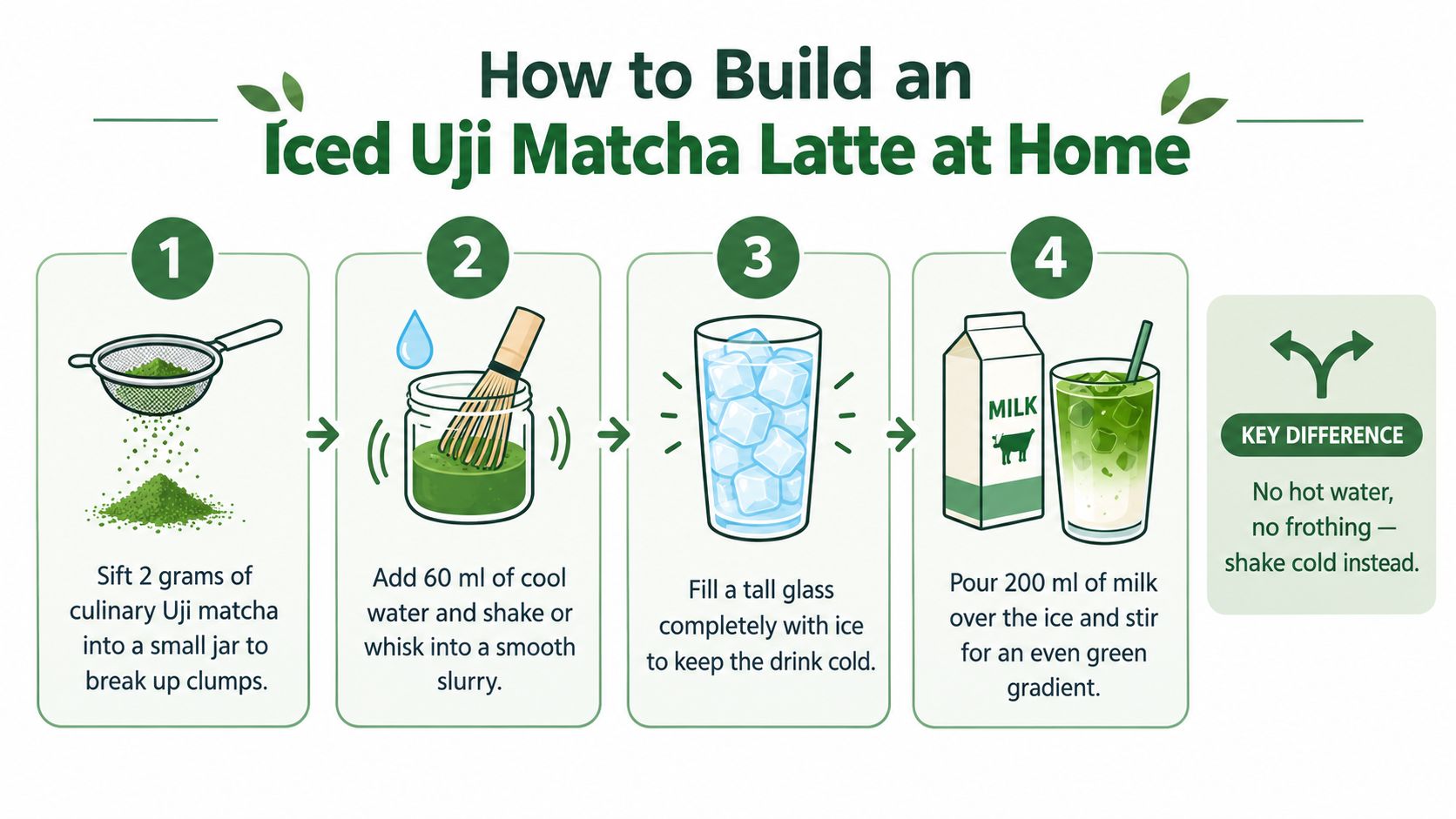
The choices are deliberate. Cool water prevents the concentrate from developing early bitterness, shaking dissolves the powder quickly while creating a glossy surface, and pouring over ice keeps the drink cold without chilling the matcha concentrate for too long. Granulated sugar often sits at the bottom of an iced drink, so a small amount of pre-made simple syrup blends more cleanly.
Skipping the shake leaves clumps and creates a flat, pale drink. If you don't have a jar, whisk the matcha and cool water in a bowl until smooth, then pour it over the ice. Stir after adding the milk so the green gradient becomes an even latte.
The iced method is especially forgiving when the milk is already cold. Warm milk melts the ice before you've had the first sip and leaves the drink thin. Keep the concentrate separate until the glass is ready, then build it in one deliberate sequence.
Watch the preparation here:
Milk Options and Sweeteners That Fit Each Build
Milk isn't a neutral background. It changes the body, sweetness, aroma, and perceived bitterness of your uji matcha latte, so choose it alongside the sweetener rather than afterwards.
Full-fat dairy milk carries umami and rounds off sharper edges. It suits honey or maple syrup when you want the tea to remain clear. Oat milk brings natural sweetness and a soft body, making it the easiest plant-based partner for a straightforward latte. Almond and soy can feel lighter or introduce their own nutty or bean-like notes, so a deeper sweetener can restore balance.
Coconut milk creates a different drink altogether. Its tropical aroma can be enjoyable with a bolder sweet grade, but it can hide the quieter floral and savoury details of a refined matcha.
A practical pairing matrix
| Milk Type | Best Sweetener Style | Resulting Balance |
|---|---|---|
| Full-fat dairy | Honey or maple syrup | Round, creamy, tea-led |
| Oat milk | Light sugar, honey, or simple syrup | Naturally sweet, soft, and balanced |
| Almond milk | Maple syrup or brown sugar | Nutty, gently rich, less grassy |
| Soy milk | Brown sugar or simple syrup | Fuller and more pronounced, with a stronger finish |
| Coconut milk | Rich syrup or a sweetened blend | Tropical, bold, and dessert-like |
If your matcha tastes bitter, sweetener shouldn't be the first repair. Check the water temperature, grade, and dose before adding more sugar. A well-balanced latte needs enough sweetness to support the tea, not enough to disguise an over-extracted or low-quality powder.
For an unsweetened powder, add the sweetener to the matcha concentrate while it is still fluid. This distributes the flavour more evenly than pouring syrup into the finished glass. With an iced drink, shake or stir the syrup into the concentrate before it meets the ice.
The most useful choice depends on your target. Use dairy for richness, oat for an easy daily cup, almond for a nuttier profile, soy for more structure, and coconut when you actively want the matcha to move towards dessert.
Common Mistakes That Ruin an Uji Matcha Latte
Most disappointing lattes point to one controllable variable. A clumpy drink doesn't mean you lack whisking skill, and bitterness doesn't mean matcha is supposed to taste harsh. The cup is giving you information.
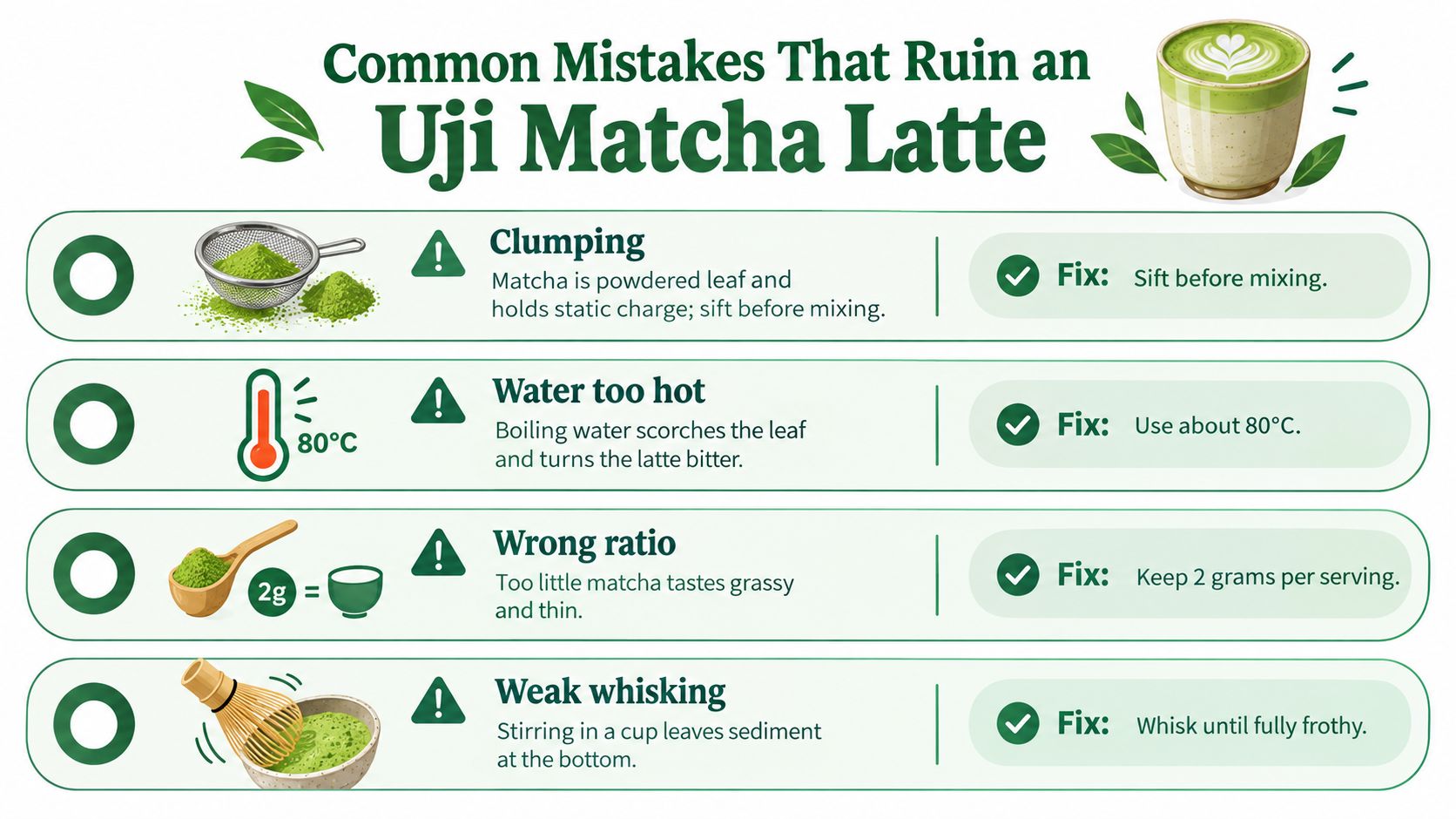
Four failures and their fixes
- Clumping: Matcha is powdered leaf and can hold static charge. Sift it into a dry bowl or jar before adding water, then whisk the powder into a small concentrate.
- Bitterness: Water above the useful range can pull out harsh astringency, and low-grade matcha can become unpleasant when prepared like a delicate tea. Hold the water around 70 to 80°C.
- Pale, thin flavour: Too much water for the amount of powder produces a weak concentrate. Weigh the matcha and keep the serving near 2 grams before adjusting the milk.
- Weak whisking: Stirring in a cup often leaves sediment at the bottom. Use a chasen or handheld frother and continue until the surface is properly foamy.
Watery iced lattes have a separate cause. If the milk isn't chilled, it melts the ice as soon as it enters the glass. Prepare the matcha concentrate first, chill the milk, fill the glass with ice, and assemble only when everything is ready.
A bitter latte is usually a measurement or temperature problem before it's a personal taste problem.
Keep one variable fixed while you troubleshoot. If you change the powder, milk, sweetener, and water temperature at once, you won't know what improved the drink. Start with sifted powder and controlled water, then adjust milk volume or sweetness after the tea tastes clean.
Putting It All Together for a Reliable Daily Latte
A dependable morning build needs a default rather than endless choices. Start with 2 grams of culinary-grade Uji matcha, sifted into a bowl, and whisk it with 60 millilitres of water at 75 to 80°C. Top it with 180 millilitres of steamed oat milk and about half a teaspoon of honey or simple syrup, then adjust the sweetness only after tasting.
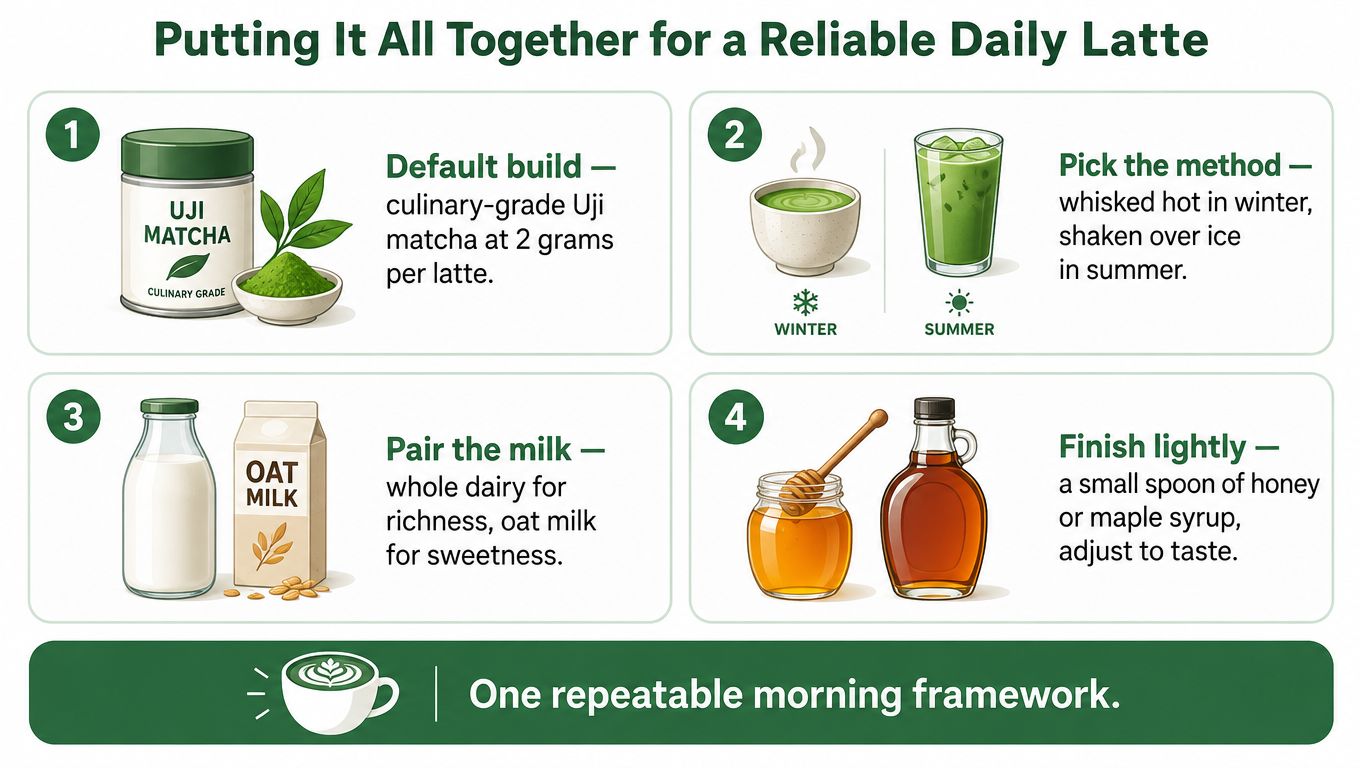
Treat that recipe as an anchor, not a rule. If you're drinking the matcha with very little milk or nearly straight, move up to ceremonial grade. If you want a rounder, richer cup, use barista-style whole milk. For a nuttier and less sweet profile, try almond milk with maple syrup.
Two checks tell you whether the balance is right. The surface should have a smooth crema rather than dry clumps, and the finish should taste like clean green tea without lingering grassy bitterness. If the tea disappears, reduce the milk or choose a stronger grade. If the drink feels sharp, lower the water temperature or add a little more body through the milk.
A short kettle-to-cup routine
- Measure: Weigh the matcha and warm or chill the milk.
- Sift: Break up clumps before any liquid touches the powder.
- Concentrate: Whisk hot or shake cold, depending on the build.
- Assemble: Add milk, taste, and make one small adjustment.
With the ingredients ready, this routine can take you from kettle to first sip in under four minutes. The point isn't to chase a ceremonial performance every morning. It's to create a cup where grade, temperature, ratio, and milk all support the same flavour.
TOO MATCHA. offers Japanese matcha and hojicha powders across ceremonial, culinary, and pre-sweetened formats, along with preparation tools and options for home, café, and wholesale use. Visit TOO MATCHA. to choose a powder that matches your preferred hot or iced uji matcha latte build.