
Cold Brew Bottle Guide: How to Pick, Brew, and Clean One

You've opened the fridge for an iced drink, found a half-used tea pouch on the bench, and realised the kettle is the last thing you want to switch on. A cold brew bottle solves that small daily problem neatly. Fill it, chill it, and you've got a ready-to-pour drink waiting when you need it.
Cold brew bottles meet people through coffee, but tea is where their flexibility becomes obvious. Matcha can taste grassy and clean rather than harsh, while hojicha develops a rounded roasted character without the sharpness that can appear when hot water sits on the leaves too long. The right bottle also makes batch preparation easier for a work commute, a small kitchen, or a fridge that needs one reliable drink instead of another complicated gadget.
Table of Contents
- What a Cold Brew Bottle Does and Why It Works for Tea
- Key Features to Look for When Choosing One
- How to Brew Matcha and Hojicha in a Cold Brew Bottle
- Adjusting Strength, Flavour, and Steep Time
- Cleaning and Maintenance Without Losing Flavour
- Final Tips for Better Home Brewing Results
What a Cold Brew Bottle Does and Why It Works for Tea
A cold brew bottle lets tea steep gradually in cool water, usually with a filter that keeps leaves or powder away from the finished drink. The slower extraction changes the balance of flavour. Instead of forcing a large amount of bitterness and astringency out quickly, cool water gives the drink time to develop softer aromas and a gentler finish.
That difference matters with green tea. Matcha is already finely milled, so it doesn't need a long leaf steep to release flavour. A brief cold preparation can preserve its fresh, grassy character while reducing the cooked or burnt edge that sometimes appears when the powder is mixed with water that's too hot. The result won't have the same foam or intensity as whisked matcha, but it can be smoother and easier to drink over ice.
Hojicha behaves differently. Its roasted leaves bring notes of toast, nuts and caramel, and a longer chill gives those flavours room to round out. The cold brew bottle becomes a simple way to keep a batch in the fridge without constantly pouring hot tea over ice and diluting it.
Why tea drinkers get more from the bottle
Coffee drinkers often value these bottles for a smooth, concentrated brew. Tea drinkers can use the same design for several purposes:
- Matcha drinks: Cold water, a gentle swirl and a final shake create a quick iced drink with a fresh flavour.
- Hojicha: A filter basket keeps roasted leaves contained while the tea slowly infuses.
- Herbal blends: Larger leaves and dried botanicals can steep without a separate strainer.
- Batch preparation: A sealed bottle gives you a prepared drink for the fridge, desk or commute.
Australia's packaged coffee category shows why portable chilled drinks appeal to consumers. One independent market analysis estimates that cold-brew variants are the fastest-growing bottled coffee segment in Australia, expanding at 18–22% annually, while the overall bottled coffee market is projected to sustain a 6–9% value CAGR from 2026 to 2035. The same analysis estimates current per-capita bottled coffee consumption at 4.5–6.0 litres per year, rising to 7–9 litres by 2035, a projected volume increase of about 40–50% (Australia bottled coffee market analysis).
Practical insight: The bottle doesn't make tea better by itself. It gives you control over contact time, temperature, filtration and storage, which is what makes repeatable flavour possible.
Key Features to Look for When Choosing One
The best cold brew bottle for tea isn't necessarily the one with the most elaborate lid. Start with the filter, because matcha and hojicha need different handling.
Matcha powder is extremely fine. A very fine mesh can catch undissolved clumps, but some filters still let a small amount of powder through, which is normal for a drink made from suspended tea. Perforated metal works better for loose hojicha leaves, while a removable basket makes emptying and rinsing much less frustrating. If you'll switch between powders and leaves, choose a bottle with a filter that comes out completely rather than one fixed inside the neck.
Double-wall insulation is useful when a roasted tea sits in the fridge for hours and then travels to work. It slows temperature change and protects the drink from warming quickly, although it can make it harder to see sediment. Clear glass or Tritan lets you inspect colour, particles and remaining liquid at a glance. Glass feels neutral and is easy to assess visually, while Tritan is lighter for commuting.
The details that prevent daily annoyance
A 500 ml personal bottle suits one drink and takes up little fridge space. A 1 to 1.5 litre pitcher makes more sense when several people are drinking the same batch. Don't choose a large vessel just because it sounds efficient. A half-full pitcher can occupy more space than two personal bottles and may encourage you to keep a drink longer than its best flavour.
Look closely at the lid seal. A self-closing pour mechanism can be convenient at home, but a screw-top lid with a strong silicone gasket is usually easier to trust inside a bag. A wide neck matters more than it first appears. Your brush should reach the bottom, and your fingers should be able to remove the filter without scraping the glass.
| Feature | Option A | Option B | Best For |
|---|---|---|---|
| Filter | Fine mesh | Perforated metal basket | Matcha powder, or loose-leaf hojicha |
| Body | Glass | Tritan | Clear flavour inspection, or lighter commuting |
| Capacity | 500 ml | 1 to 1.5 litres | Personal servings, or shared batches |
| Lid | Screw-top gasket | Automatic pour design | Leak-conscious travel, or easy home serving |
| Neck | Wide opening | Narrow opening | Simple cleaning, or compact proportions |
If you're already comparing insulated drinkware, this guide to an insulated tumbler with a straw is useful for deciding whether you need a brewing vessel or a serving cup. For a sweetened powder option, Premium Sweet Matcha 200g is described as a blend made with 30% authentic Japanese green tea leaves, with a naturally sweet, silky-smooth profile and vegan, gluten-free, dairy-free and additive-free positioning.
How to Brew Matcha and Hojicha in a Cold Brew Bottle
Use filtered water and a clean bottle for both recipes, but don't treat matcha and hojicha as interchangeable. Matcha is powder, so it needs dispersion. Hojicha is leaf tea, so it needs controlled contact with the water.
Cold brew matcha
- Sift the powder. Add one to two teaspoons of matcha to the bottle. Sifting prevents compact clumps from sticking to the base.
- Add cold water. Pour in a modest amount of filtered water first, then swirl gently until the powder is dispersed. Don't shake aggressively at this point, because dry powder can form stubborn paste-like lumps around the lid.
- Top up and add ice. Add the remaining water, then a few ice cubes if the bottle has enough room for movement.
- Seal and chill. Refrigerate for 20–40 minutes. The shorter rest keeps the flavour lively and avoids the heavy bitterness that can develop when powder is left undisturbed for too long.
- Shake once more. Give the sealed bottle a final shake immediately before pouring. Matcha settles, so a brief re-mix is part of the method.
The filter choice depends on your preference. A fine mesh can catch larger clumps, but you'll still get the characteristic body of suspended matcha. If you want a cleaner, lighter drink, pour through a separate fine strainer when serving.
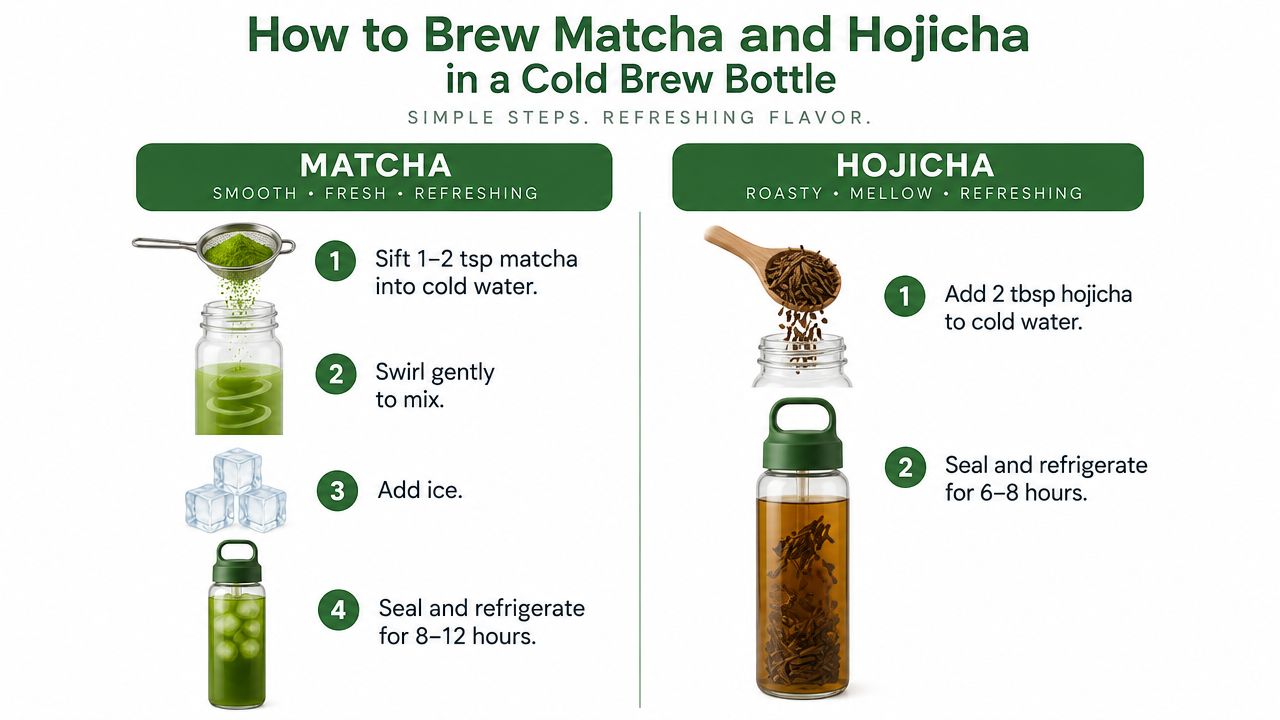
Cold brew hojicha
- Measure the leaves. Use three to four grams of roasted hojicha leaves.
- Load the filter. Place the leaves into the removable basket. Leave room for the leaves to expand, otherwise the water won't circulate evenly.
- Fill with cool water. Add filtered water slowly, making sure the leaves are wetted rather than floating in a dry pocket.
- Seal and refrigerate. Steep for six to eight hours. Overnight is convenient, but taste the batch before extending the time.
- Pour without shaking. Hojicha doesn't need agitation after brewing. Shaking can break up leaf particles and make the drink cloudy.
For a deeper explanation of preparation choices, this hojicha tea recipe offers another useful reference point. Matcha will look vivid green, feel fuller and smell grassy. Hojicha will pour amber to brown, with a roasted aroma and a softer, toasted finish.
A cold brew bottle isn't automatically a shelf-stable container. Keep the finished drink refrigerated. Food Standards Australia New Zealand advises keeping potentially hazardous food out of the 5°C to 60°C danger zone, so chill and hold the finished bottle at or below 5°C as quickly as possible (Food Standards Australia New Zealand food safety guidance). Healthdirect advises storing perishable food at or below 5°C, using it within 2 to 3 days, and discarding it if it has been out for more than 4 hours (Healthdirect food storage guidance). Better Health Channel gives the same four-hour discard rule for high-risk foods (Better Health Channel food safety advice).
Adjusting Strength, Flavour, and Steep Time
Change the tea-to-water ratio before changing the steep time. More tea gives you a stronger drink without leaving the leaves or powder in contact with water for unnecessarily long periods. Longer steeping is the second lever, and it can deepen flavour while also pulling out more bitterness.
For matcha, a shorter preparation keeps the drink bright and fresh. For hojicha, a shorter 4–6 hour steep can preserve toasted and caramel-like notes, while a longer 8–12 hour steep produces deeper colour and a more pronounced, caffeine-driven bitterness. These are starting points, not rules. Tea age, particle size, water quality and the bottle's filter all affect the result.
Adjust the variables one at a time
- More tea: Use this when the drink tastes thin but otherwise balanced.
- Less tea: Reduce the amount when the finish is heavy, drying or bitter.
- Shorter contact: Stop the brew earlier to protect delicate grassy notes or lighter roasted aromas.
- Longer contact: Extend the chill when you want a deeper, more concentrated flavour.
- Dilution: Add cold water or milk to a concentrate-style brew for a softer cup.
- Extra chilling: After straining, leave the drink cold for longer to let sharp astringency settle.
Grind size matters mainly for coffee, but it still has a practical parallel in tea. Fine matcha disperses through water, while larger hojicha leaves need space to open. Don't crush roasted leaves to force a faster extraction. You'll usually get more sediment and a muddier finish rather than a cleaner drink.
Starting temperature also changes the pace. Fridge-cold water extracts slowly and gives you a gentle profile. Room-temperature water starts faster, but it should be chilled promptly once the brew reaches the flavour you want. Shake matcha at the start and end. Avoid repeated shaking with hojicha.
| Adjustment | Matcha Effect | Hojicha Effect |
|---|---|---|
| Increase tea ratio | Fuller body and stronger green flavour | More roasted depth and colour |
| Reduce tea ratio | Lighter, cleaner texture | Softer toast and less intensity |
| Shorten steep | Fresher, less bitter profile | Sweeter toasted notes |
| Extend steep | Deeper flavour with more bitterness risk | Stronger roast and darker finish |
| Dilute with water or milk | Smoother iced drink | Milder, rounder serving |
| Use room-temperature water initially | Faster dispersion | Faster leaf extraction |
Taste at a consistent point rather than waiting for a vague sense that the bottle is ready. Try one sample at the shorter end, then another later, and record what changed. A simple note such as “more powder, less chill” is enough to build a reliable personal recipe.
Cleaning and Maintenance Without Losing Flavour
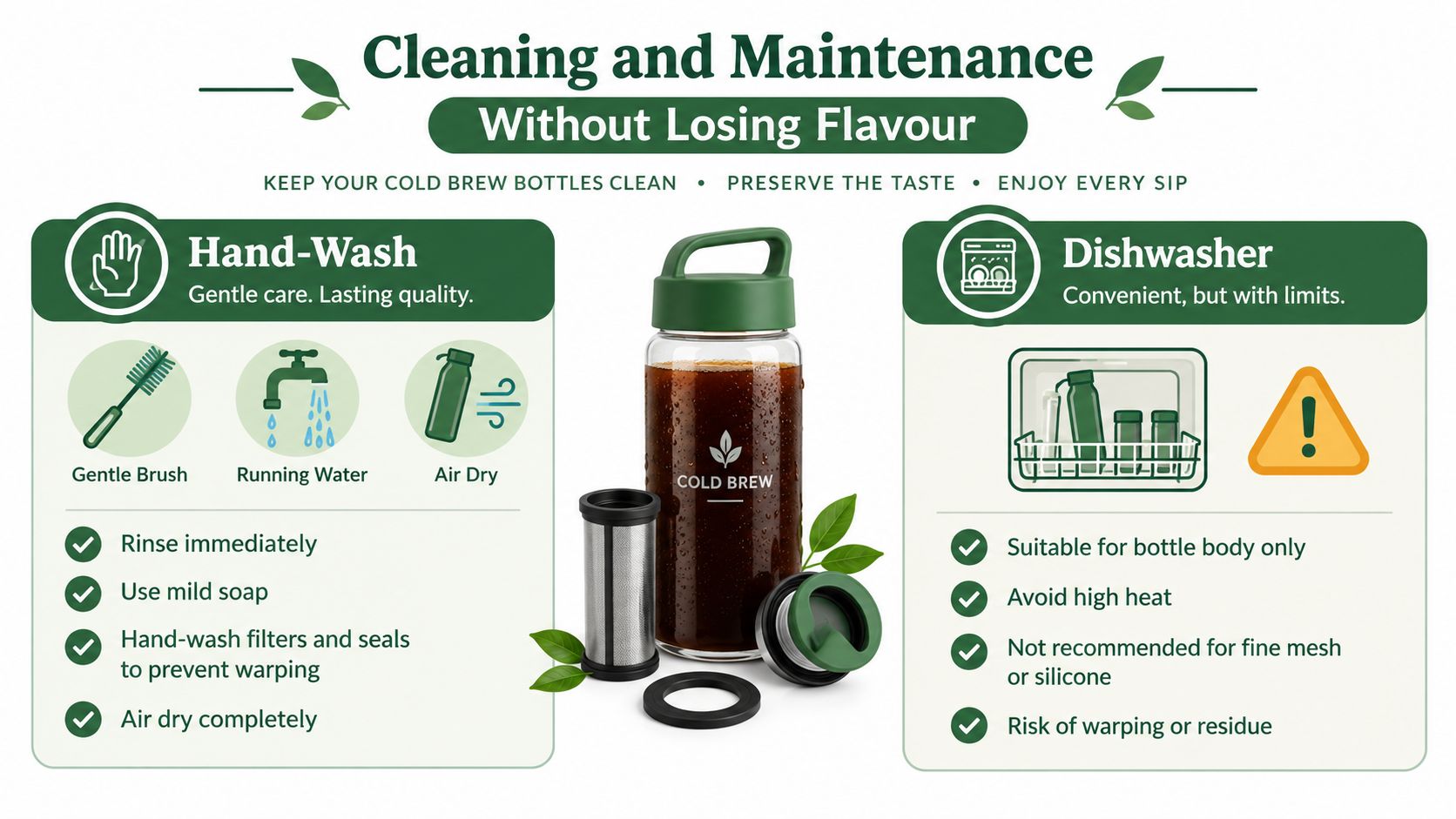
A cold brew bottle can be easy to clean or surprisingly awkward, depending on its filter and neck. Hand-washing takes more attention but gives you control over the mesh, gasket and lid grooves. A dishwasher can save time for a compatible bottle body, but high heat and strong spray can warp delicate parts or leave residue in places you can't see.
Rinse the bottle as soon as you pour the last drink. Remove the filter, wash each component with warm water and mild unscented soap, then use a bottle brush on the base and neck. Fine mesh filters and silicone seals usually deserve gentle hand care. Scrubbing them aggressively can distort the mesh or stretch the seal.
Hand-washing versus the dishwasher
Hand-washing is the safer default for a reusable tea bottle. It lets you rinse out fine matcha particles before they dry into a paste and gives you a chance to inspect the filter. Pay special attention to the underside of the lid, where tea oils and powder can collect.
Dishwasher cleaning works selectively. Use it for the bottle body only when the manufacturer says it's suitable, and avoid high heat for parts made from silicone or fine mesh. A dishwasher cycle won't replace disassembly. If you leave the gasket in place, hidden residue can remain behind it.
If a bottle develops lingering bitterness or a stale taste, residue is a likely cause. A periodic soak with baking soda can loosen tea film. A diluted white vinegar soak can help with mineral deposits, but rinse thoroughly afterwards and don't combine cleaning agents.
Cleaning rule: If you can smell the previous brew before adding fresh water, the bottle isn't ready for another batch.
Inspect the lid and gasket regularly. Replace a seal once it becomes cracked, loose or permanently flattened, because a small leak can turn a desk or bag into a clean-up job. Store the bottle open until every component is fully dry. Closing a damp bottle traps moisture and creates conditions for mould.
For powder-based drinks, the same attention to small crevices applies to a whisk. The guide to cleaning a matcha whisk is relevant in spirit, even though a bottle needs its own brush and filter routine. Clean immediately, dry completely and avoid letting tea residue become part of the next recipe.
Final Tips for Better Home Brewing Results
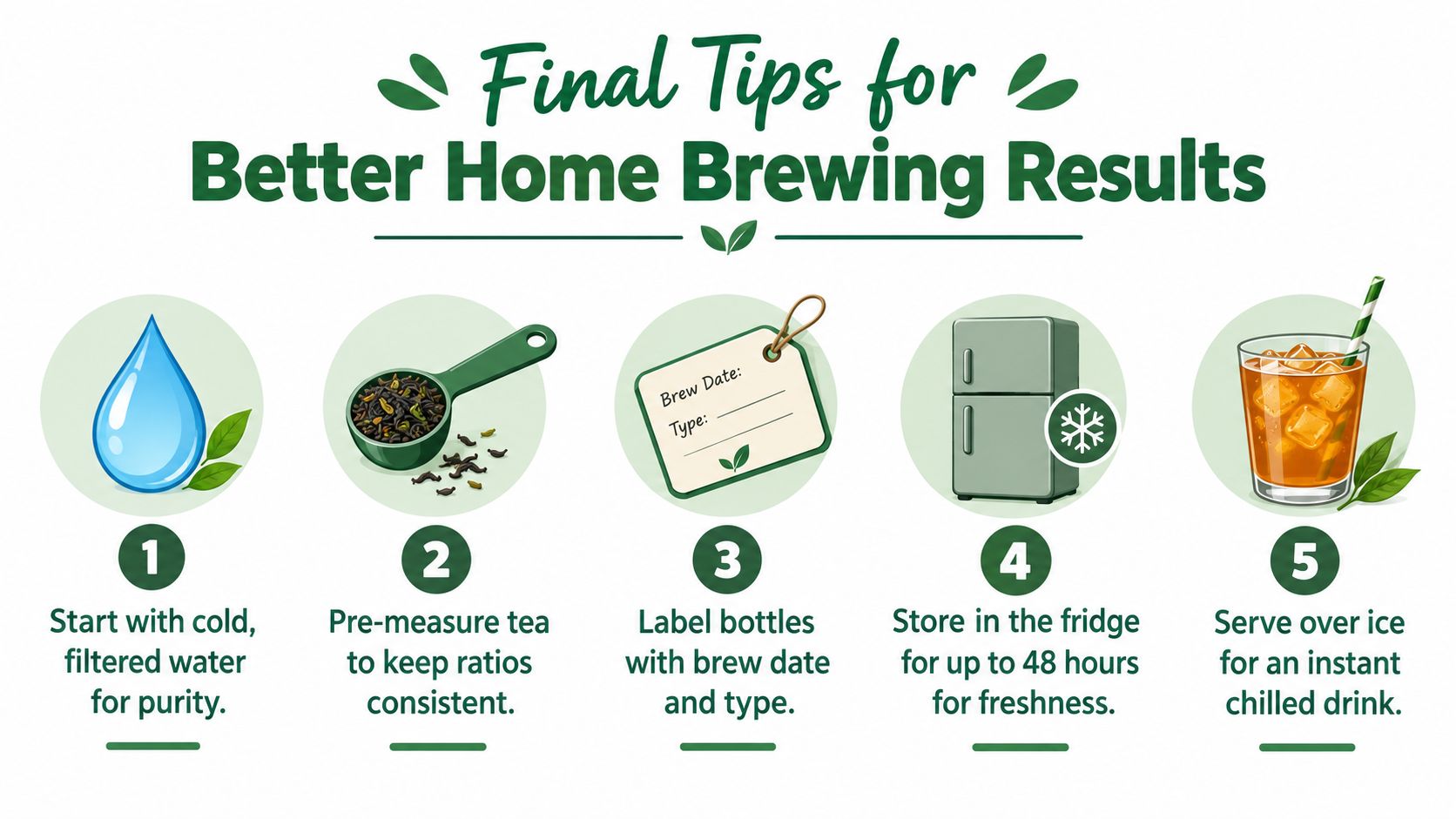
The bottle matters less than the habits around it. Start with cold, filtered water, measure the tea before you pour, and keep the same bottle fill level when you compare recipes. Consistent inputs make flavour changes easier to understand.
A label on the bottle is surprisingly useful when several drinks share the fridge. Write the brew date and leaf type, especially if one bottle contains hojicha and another contains a herbal blend. Store finished drinks in the fridge and use them while they still taste fresh. The final serving is simple, pour over ice or dilute a stronger batch with cold water or milk.
A repeatable home routine
- Pre-measure the tea: Use the same spoon or scale each time so the ratio doesn't drift.
- Label the batch: Record the brew date and tea type before the bottle goes into the fridge.
- Keep a short log: Note the steep time, water temperature and whether the drink tasted thin, sharp or balanced.
- Change one variable: Adjust time, ratio or temperature, not everything at once.
- Try different formats: Use leaf tea, matcha, herbal blends or a concentrate-style preparation when the bottle suits it.
Australian cold brew bundle data also highlights the operational side of chilled drinks. One Australia-focused analysis estimates that multi-pack and bundle offerings represent 25–35% of total cold-brew volume sold through grocery and convenience channels, while cold-brew bundle volume in December–February can exceed winter volume by 40–60%. It also estimates that 40–55% of packaged cold-brew volume is sourced from overseas producers, with peak-month out-of-stock rates at major grocery retailers estimated at 8–12% (Australian cold brew bundle analysis). At home, the lesson is simpler. Prepare around your actual routine, not an imagined one, and don't brew more than you can store and drink safely.
For online drinkware purchases, shipping can affect the value of a small bottle. Australia Post reports that 35% of businesses always offer free shipping, 30% offer it after a spending threshold, and the most common threshold is $51–$100 AUD (Australia Post eCommerce report). The report also says one in four shoppers are willing to spend up to $10 more, and one in five up to $20 more, to qualify for free shipping (Australia Post free-shipping guidance). That makes a tea bundle or useful accessory a practical way to build a sensible order, rather than adding random items.
Keep experimenting with small adjustments. A cold brew bottle is a flexible brewing tool, not a one-purpose coffee gadget, and your best recipe will come from repeated tasting. Try a few ratios, note what works for matcha and hojicha, and share your discoveries with other home brewers as your routine takes shape.
TOO MATCHA. offers Japanese-sourced matcha and hojicha powders, accessories, recipe content, and formats for home preparation, foodservice and wholesale supply. Browse TOO MATCHA. to choose a tea powder for your cold brew bottle experiments and build a more consistent iced-drink routine.