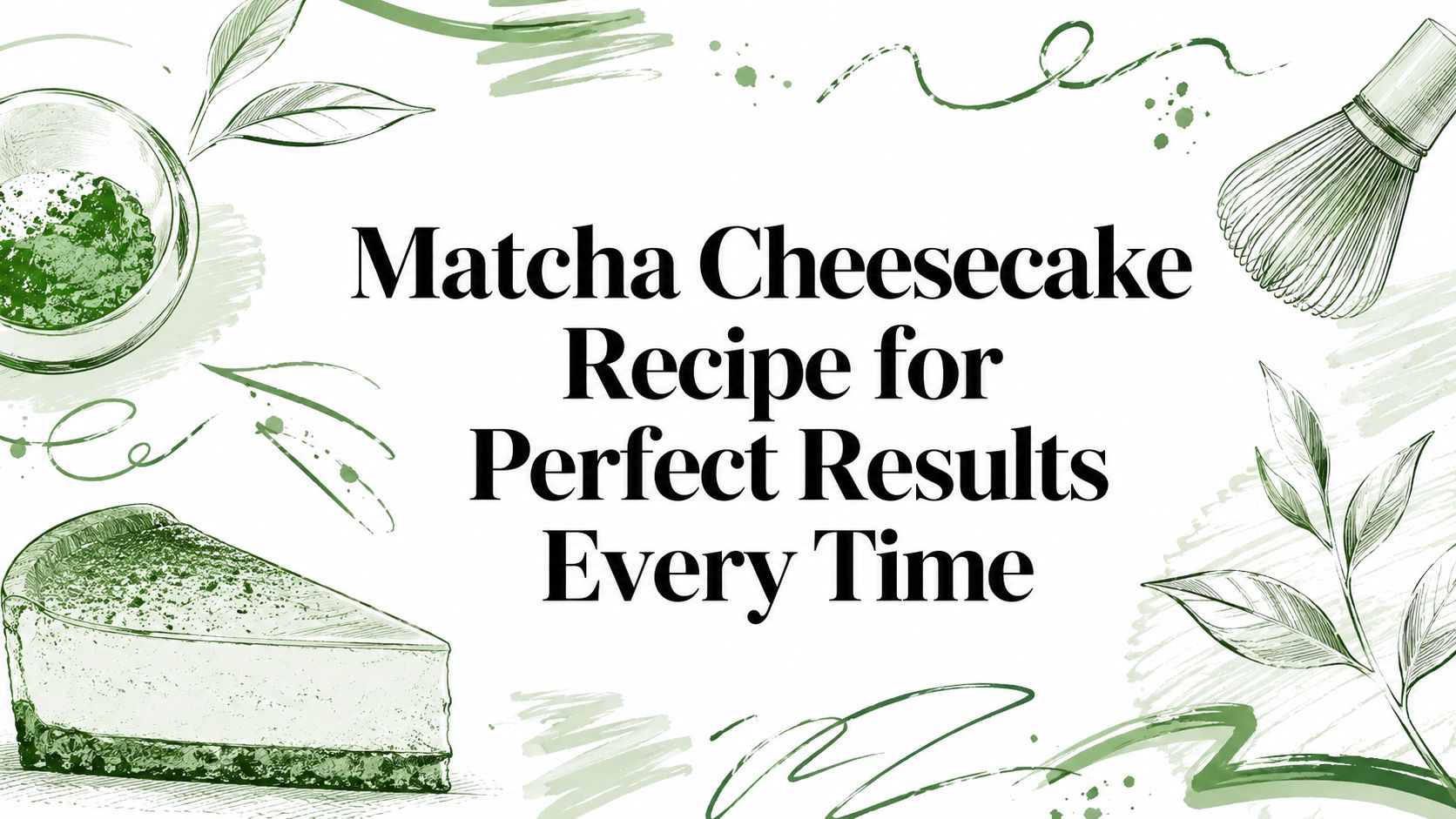
Matcha Cheesecake Recipe for Perfect Results Every Time
You've probably seen it happen. A gorgeous slice of matcha cheesecake arrives at a café table with that soft jade colour, a clean edge, and a flavour that's earthy, creamy, and balanced. Then you try to make one at home and end up with a pale filling, gritty specks, or a top that splits before it even cools.
That gap between café-quality and home-baked usually comes down to technique, not ambition. Matcha is unforgiving when it's handled casually, and cheesecake is the same. Put them together and every shortcut shows. The good news is that a reliable matcha cheesecake recipe doesn't need to be complicated if you understand what each step is doing.
Table of Contents
- The Ultimate Guide to Flawless Matcha Cheesecake
- Choosing Your Matcha and Essential Ingredients
- The Classic Baked Matcha Cheesecake Recipe
- The Effortless No-Bake Matcha Cheesecake Recipe
- Mastering Matcha Cheesecake Technique and Troubleshooting
- Serving Storing and Customising Your Cheesecake
The Ultimate Guide to Flawless Matcha Cheesecake
The best matcha cheesecake recipe should give you two things at once. First, it should taste unmistakably like matcha, not just sweet cream cheese with a green tint. Second, it should slice cleanly and look deliberate, with smooth texture and clear colour rather than patchy streaks.
That's where many home versions fall apart. Bakers often use whatever matcha is already in the pantry, mix it straight into the batter, and hope the oven does the rest. It won't. Matcha behaves more like a precision ingredient than a casual flavouring, especially in cheesecake where every flaw sits in plain view.

In Australia, the café standard is high. Tastewise notes that specialty cafés treat matcha with the same care as specialty coffee, and that mindset matters when you want a cheesecake with proper umami depth instead of flat sweetness. It also explains why high-grade matcha has become central to premium desserts, not just drinks.
Practical rule: If you want a cheesecake that looks and tastes café-made, treat the matcha as a primary ingredient, not a garnish.
There are two strong ways to make this dessert at home, and each solves a different problem. The baked version gives you a richer, denser centre and a more classic cheesecake finish. The no-bake version is quicker, cooler, and softer, with a mousse-like texture that works beautifully in warm weather or when oven space is limited.
Both methods can produce a striking result. They just require different expectations. If you want the depth and structure of a Japanese café dessert, bake it. If you want a simpler make-ahead option that still delivers colour and flavour, go no-bake.
Choosing Your Matcha and Essential Ingredients
The ingredient list for a strong matcha cheesecake recipe is short enough to seem simple. That's exactly why ingredient quality shows up so clearly. You don't have much to hide behind. If the cream cheese is too loose, the filling won't hold. If the matcha is dull or harsh, the whole dessert tastes muddy.

The grade question matters
There's always confusion around ceremonial and culinary matcha, especially in baking. The simplest way to decide is this. Use a strong culinary-grade matcha for the batter, and reserve finer ceremonial matcha for finishing or applications where the tea isn't competing with dairy, sugar, and fat.
Ceremonial grade is prized for drinking because it can be softer, sweeter, and more delicate. In cheesecake, those subtle notes can disappear. A premium culinary grade has enough backbone to stay present after baking or chilling. That stronger profile is what keeps the dessert tasting like matcha instead of tinted vanilla cheesecake.
If you want a practical breakdown of grade use, whisking, and kitchen applications, this guide on how to use matcha powder is worth reading before you start.
The ingredient list that actually works
For either style of cheesecake, these ingredients consistently give the best texture and flavour:
- Cream cheese: Use full-fat block cream cheese, not spreadable tub-style cream cheese. The block version has better body and a cleaner set.
- Sugar: Caster sugar dissolves more easily than coarse granulated sugar, which helps keep the filling smooth.
- Cream: Thickened cream or pure cream gives body. In no-bake versions, whipped cream lightens the texture.
- Eggs: Needed only for the baked cheesecake. Bring them to room temperature so the batter emulsifies evenly.
- Biscuits for the base: Digestives or plain sweet biscuits work well because they stay neutral and buttery.
- Butter: Melted butter binds the crumb. Use enough to hold the base together, but not so much that it turns greasy.
- A small amount of liquid for the matcha: Warm water or lemon juice helps disperse the powder before it goes into the filling.
Good cheesecake starts before mixing. Room-temperature dairy, sifted matcha, and a lined tin remove half the usual problems.
A final note on flavour balance. Matcha has bitterness, sweetness, grassiness, and umami in the same spoonful. The cream cheese should soften that profile, not erase it. That's why bold matcha is usually the better baking choice.
The Classic Baked Matcha Cheesecake Recipe
A baked matcha cheesecake is the version I'd make when I want a more polished dessert. It has a deeper flavour, a firmer slice, and that luxurious centre that sits somewhere between custard and classic cheesecake. It also rewards patience. Rushing any stage, especially mixing and cooling, tends to show.
For the biscuit base
Use:
- 200 g plain sweet biscuits or digestives
- 90 g unsalted butter, melted
Crush the biscuits into fine crumbs, then stir through the melted butter until the texture resembles wet sand. Press the mixture firmly into the base of a lined springform tin. Use the bottom of a glass or measuring cup so the layer is even, particularly around the edges where crumb bases often thin out.
Chill the base while you make the filling. A cold base holds its shape better when the filling goes in and is less likely to blend into the cream cheese mixture.
For the filling
Use:
- 500 g full-fat cream cheese, room temperature
- 150 g caster sugar
- 200 ml thickened cream
- 3 eggs, room temperature
- 2 tablespoons matcha powder
- 1 tablespoon warm water or lemon juice
- 1 teaspoon vanilla extract
- 1 tablespoon plain flour
Start by whisking the matcha with the warm water or lemon juice to make a completely smooth paste. Set that aside. In a separate bowl, beat the cream cheese until there are no visible lumps, then add the sugar and mix until smooth. Add the cream, vanilla, and matcha paste, then mix just until the colour is even.
Add the eggs one at a time, mixing gently after each addition. Finish with the flour. The goal isn't volume. The goal is a silky batter with no pockets of dry ingredient and no trapped air bubbles that can rise and burst in the oven.
A good baked cheesecake batter looks glossy and heavy. If it looks foamy, it's been mixed too aggressively.
Pour the filling over the chilled base and tap the tin lightly on the bench to release larger air pockets.
Baking and cooling
Place the springform tin inside a larger roasting pan and bake it in a water bath. That gentle, humid environment protects the surface and helps the cheesecake cook evenly from edge to centre. Bake until the outer edge is set but the middle still has a soft wobble.
Once baked, resist the temptation to open the oven repeatedly or move the cake straight to the bench. Cheesecake hates abrupt temperature changes. Letting it finish gently is part of the bake, not an optional extra.
For serving, chill the cheesecake fully before slicing. A warm baked cheesecake can be delicious, but if you want a neat café-style cut, cold is better. Use a sharp knife, wipe it between slices, and dust lightly with matcha just before serving so the surface stays vivid.
A few flavour notes help here:
- For more earthiness: Increase the matcha slightly, but keep sweetness balanced.
- For a softer citrus edge: Use lemon juice in the matcha paste rather than water.
- For a cleaner finish: Don't overload the top with fruit or sauces. Matcha gets lost easily.
This baked method is the one to choose when presentation matters and you want a dessert with more structure and depth.
The Effortless No-Bake Matcha Cheesecake Recipe
No-bake matcha cheesecake solves a different problem. It gives you the same core flavour in a softer, lighter format, and it doesn't ask you to manage oven temperature, water baths, or careful baking windows. The texture is less dense than the baked version and more creamy than custardy, which many people prefer.
When no-bake is the better choice
Choose no-bake when you want a dessert that's easy to prepare ahead, especially for a dinner party or warm weekend. It's also the better choice if you like a mousse-like centre and a colder finish on the plate.
Compared with the baked version, the flavour often feels a little brighter because the matcha isn't exposed to oven heat. The trade-off is structure. A no-bake cheesecake won't have the same deep, set body as a baked one, so it relies more on good chilling and a properly balanced filling.
The full no-bake recipe
Use for the base:
- 200 g plain sweet biscuits or digestives
- 90 g unsalted butter, melted
Use for the filling:
- 500 g full-fat cream cheese, room temperature
- 100 g caster sugar
- 300 ml thickened cream
- 2 tablespoons matcha powder
- 1 tablespoon warm water or lemon juice
- 2 teaspoons gelatine powder
- 2 tablespoons hot water
- 1 teaspoon vanilla extract
Make the crumb base exactly as you would for the baked version, then chill it until firm.
For the filling, whisk the matcha with the warm water or lemon juice until smooth. In a small cup, bloom the gelatine in hot water and stir until fully dissolved. Beat the cream cheese with the sugar until smooth, mix in the vanilla and matcha paste, then fold in softly whipped cream. Add the dissolved gelatine last and mix quickly but gently so it disperses evenly.
Pour the filling onto the chilled base, smooth the top, cover, and refrigerate until firm enough to slice cleanly. If you want a neater finish, line the sides of the tin with acetate or baking paper before filling.
The no-bake version should feel light on the spoon but stable on the plate. If it slumps badly, it needed more time in the fridge or better mixing.
Baked vs. No-Bake Matcha Cheesecake at a Glance
| Attribute | Baked Cheesecake | No-Bake Cheesecake |
|---|---|---|
| Texture | Dense, velvety, custard-like | Light, creamy, mousse-like |
| Flavour profile | Deeper, rounder, more dessert-like | Fresher, brighter, cooler |
| Method | Oven-baked with water bath | Chilled to set |
| Skill focus | Batter control, bake timing, cooling | Whipping, folding, setting |
| Best for | Celebrations, plated dessert, neat slices | Make-ahead entertaining, warm days |
| Main risk | Cracking or overbaking | Soft set or weak structure |
If you're undecided, think about the eating experience you want. The baked version feels more formal. The no-bake one feels more relaxed.
Mastering Matcha Cheesecake Technique and Troubleshooting
One cheesecake comes out with a glossy pale-green centre and clean slices. The next has specks, a dull surface, or a crack straight across the top. The difference is rarely luck. It comes from a few repeatable choices, and matcha makes each one visible.

Start with the matcha paste
If the powder goes straight into cream cheese, lumps are hard to remove. Fat coats the dry particles, and once that happens, whisking harder only spreads the problem through the batter. Make a smooth paste first with warm water, lemon juice, or a little warm cream, then add it to the dairy base.
For the brightest finish and the cleanest tea flavour, use a good culinary or premium matcha rather than an old, flat powder from the back of the cupboard. TOO MATCHA Everyday Grade works well in baked cheesecake, where the richer dairy base softens bitterness. For a no-bake filling, where the tea stays fresher and more exposed, TOO MATCHA Premium Grade gives better colour and a clearer finish.
If you want a quick refresher on consistency, this guide on how to whisk matcha for a smooth paste is useful before you mix the filling.
A common mistake is overcorrecting with extra liquid. The paste should be thick but fluid, closer to double cream than a drink. Too thin, and the batter loosens. Too thick, and it leaves streaks.
Preventing cracks in baked matcha cheesecake
Cracks come from heat and stress. A baked cheesecake rises, contracts, and settles, so the goal is controlled movement rather than a dramatic bake. Keep the oven moderate, avoid whipping in excess air, and take the cake out while the centre still has a slight wobble.
Cooling matters as much as baking. Sudden temperature changes pull the top apart, especially around the edges where the custard sets first. Once baked, turn the oven off, crack the door slightly if your recipe allows, or cool the cake gradually according to your method instead of moving it straight onto a cold bench.
As noted earlier, one matcha cheesecake reference highlights two useful points in the same guidance: pre-mixing the matcha into a paste helps prevent grainy texture, and gradual cooling with the oven door closed helps reduce cracking. Those two habits fix many home-baked failures.
Keeping the colour bright
Matcha loses its vivid green when it is exposed to too much heat, too much light, or a powder that started dull in the first place. This is why grade matters. Better matcha does not just taste cleaner. It also holds a more attractive colour through mixing and setting.
Baked cheesecake will always mute matcha slightly because of oven heat. That is normal. The target is a soft, fresh green, not a harsh neon shade. No-bake cheesecake keeps a brighter colour, which is another reason I prefer TOO MATCHA Premium Grade there. Its colour stays cleaner against the white dairy base.
Texture fixes for both methods
For baked cheesecake, a grainy texture usually points to cold cream cheese, overmixed eggs, or matcha added dry. Room-temperature ingredients blend faster and need less beating, which keeps the filling smoother.
For no-bake cheesecake, poor structure usually comes from under-whipped cream, weak gelatine dispersion, or not enough chill time. Craft Passion notes that matcha cheesecake benefits from a long chill, ideally overnight at 4°C, for a cleaner set and easier slicing. That advice applies even if you are making a denser café-style cheesecake rather than a fluffy Japanese version.
Quick troubleshooting guide
- Visible green specks: Matcha was added dry or the paste was not whisked smooth enough.
- Olive or brownish tone: The cheesecake baked too long, or the matcha grade was too dull to begin with.
- Cracked top: The cake baked too hot, took on too much air, or cooled too quickly.
- Loose no-bake filling: The cream was under-whipped, the setting agent was unevenly mixed, or the cheesecake was sliced before it had fully set.
- Rubbery texture: Too much gelatine in the no-bake version, or overbaking in the baked version.
- Weak tea flavour: The matcha quantity was too low for the amount of dairy, or the powder quality was too flat.
Cafe-quality results at home come from choosing the right method, then respecting the small technical details that method needs. Baked matcha cheesecake rewards careful heat control. No-bake rewards clean mixing and patient chilling.
Serving Storing and Customising Your Cheesecake
A well-made matcha cheesecake doesn't need much dressing up. The cleanest finish is often the best one. A light dusting of matcha on top, a spoonful of unsweetened whipped cream, or a few raspberries on the side add contrast without covering the tea flavour.
How to serve it well
Serve the cheesecake cold, with a sharp knife wiped between slices. That gives you the neat edge people associate with café desserts. If you're dusting with matcha, do it just before serving so the powder stays bright and dry rather than absorbing moisture from the surface.
For a more refined plate, pair it with:
- Fresh berries: Their acidity sharpens the creamy filling.
- Whipped cream without much sugar: It softens bitterness without making the dessert heavy.
- A plain biscuit crumb or extra base crumble: Useful when you want more texture on the plate.
Storage and flavour variations
Store leftover cheesecake in an airtight container in the fridge. Keep it away from strong-smelling foods because dairy fillings absorb odours easily. For handling and freshness tips, this guide on how to store matcha powder is also useful if you bake with matcha regularly.
You can also adapt the flavour profile without changing the whole method. A roasted tea powder gives the same cheesecake base a deeper, nuttier character than matcha. Dairy-free cream cheese and plant-based cream can work for a vegan-style variation, though the final set will depend on the product used and may be softer.
Buying specialist tea powders online has made these variations easier for home bakers. One industry report cited by The Manila Times says online retail now accounts for over 41 per cent of global matcha revenue, which fits the way many Australian bakers now source niche ingredients for desserts like this.
If you want to make this matcha cheesecake recipe with authentic Japanese tea powders chosen for different uses, browse TOO MATCHA. for options suited to baking, whisking, and experimenting at home.